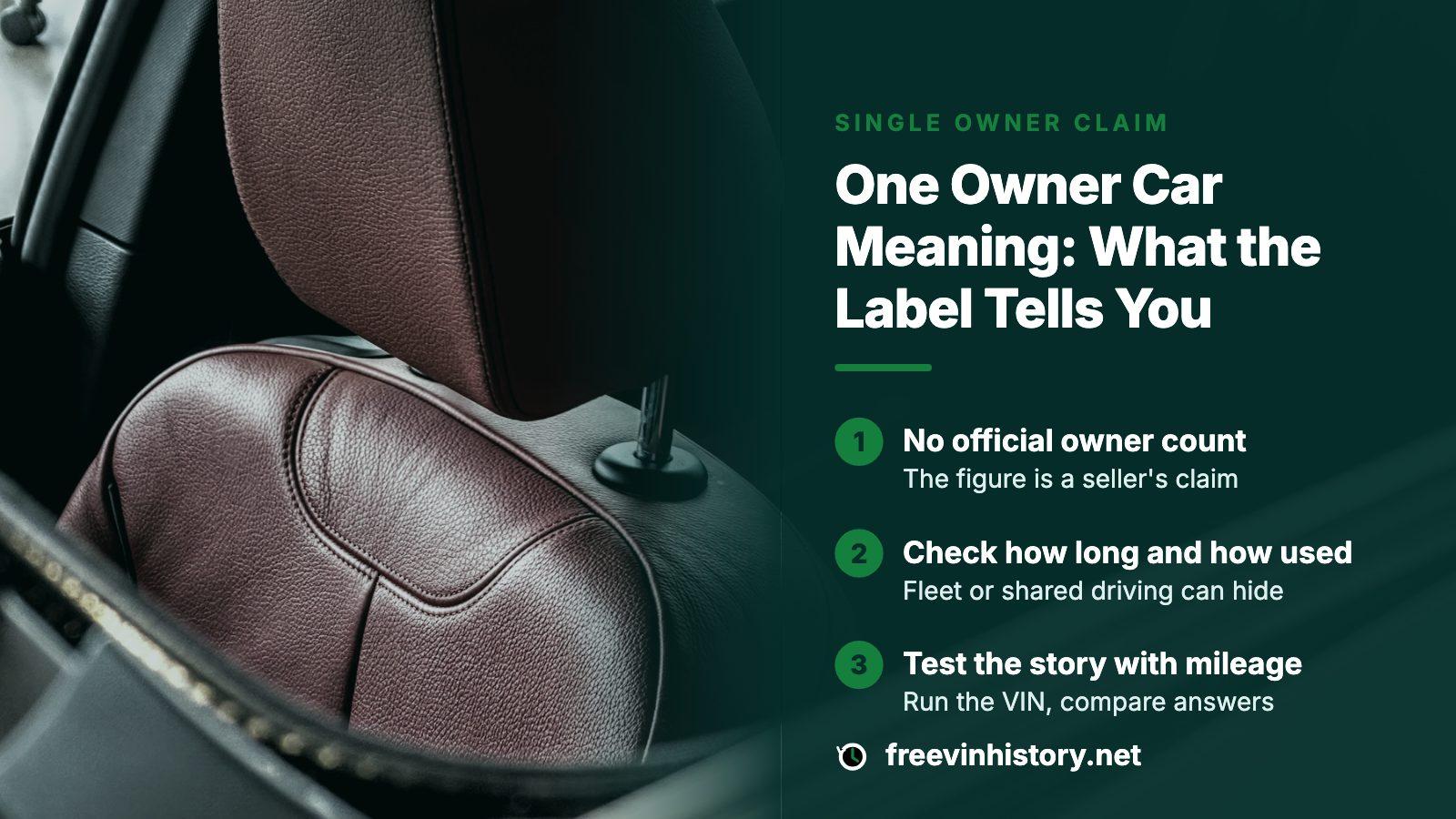
THE SHORT ANSWER
One owner means one person or business has held the title since the car was first sold. It usually suggests steady care, but it guarantees nothing. No federal record stores an owner total, so the figure comes from a seller's word or a vendor's reading of title events. Treat it as a claim to test with the VIN, the paperwork and an inspection.
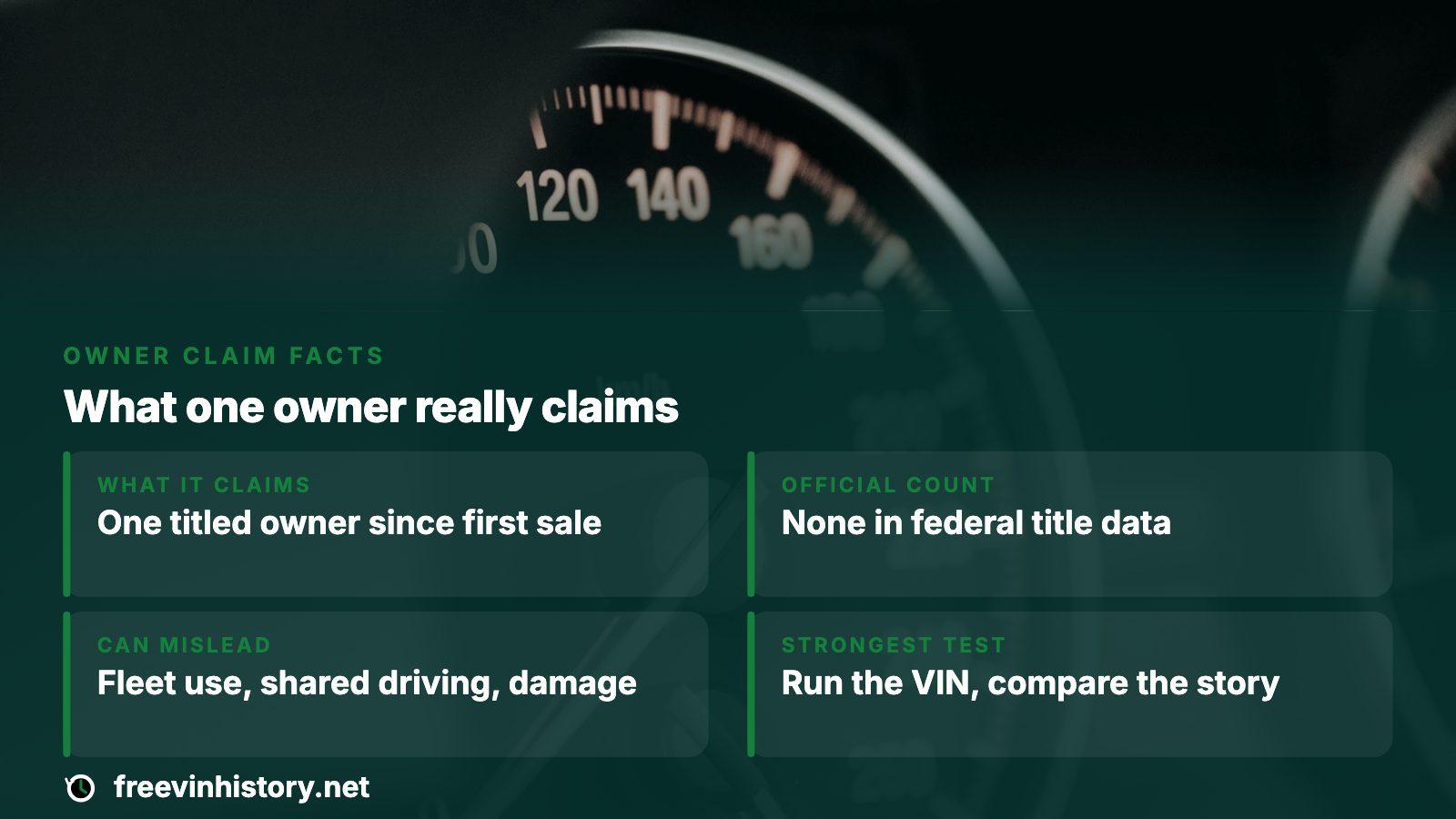
- What it claims
- A single titled owner since the first retail sale
- Official owner count
- None exists in the federal title data
- Where it can mislead
- Shared driving, fleet use and hidden damage fit inside one name
- Best test
- Run the VIN, then compare the answer with the seller's story
What a seller means by one owner
Walk onto any used lot and the label turns up on windshield stickers and online ads. It says the car left the showroom with one buyer and never changed hands afterward. That buyer might be a retired teacher, a married couple on one title, or a company.
Notice what the phrase leaves out. It does not say how long that owner kept the car, how many miles they drove, or who else sat behind the wheel. It also leaves open whether the car was a lease return or a rental that happened to be titled once.
So read it as a headline, not a verdict. The claim is worth checking because the answer, when it holds up, really does tell you something about how the car was treated.
Why no record counts owners
The federal rule that governs state title reporting spells out what each state sends to the national title system. Every state forwards its title data daily. Five kinds of information go in: the car's identifier, whatever the certificate says about the vehicle (brands included), one recipient's name per certificate, salvage-yard and insurer acquisition data when collected, and the mileage declared at issuance.
Look for a total in that list and you will not find one. What exists is a series of certificates, each with a name attached. Any owner number you see is somebody's tally of that series.
What this means for the claim
When an ad says one owner, it is either the seller's memory or a vendor's reading of title events. Neither is an official count, so the claim deserves a second look.
How the one owner claim gets built
A report vendor sees title events and has to decide which ones represent a new owner. Different vendors draw the line in different places, and a seller's own count may come from yet another source.
- A lease buyout puts the finance company on the title first, then the driver, so one person can show as two.
- A move to another state produces a fresh certificate with the same name on it.
- A replacement title after a loss, or a name change, is paperwork rather than a sale.
- A dealer that titles the car to itself adds a line that never had a driver.
Because of this, the same car can read as one owner in one place and two in another. The gap tells you about the counting rules, not about the car.
When one owner is a good sign
A long, single-person history often means someone knew the car's noises and kept receipts. Fewer handoffs also mean fewer chances for a title wash, an odometer rollback or a quiet salvage purchase to slip in.
The signal gets stronger when the story lines up on its own. Look for service records from one shop, a mileage curve that rises evenly and a title that was issued in the state where the owner lives. A thick folder of receipts says more than the label ever will.
When one owner hides the real story
One name on a title can cover many hands. A company car, a family vehicle with several drivers, or a rideshare vehicle all appear as a single owner. Heavy use under one name is still heavy use.
The count also says nothing about damage. A single owner can total a car and have it rebuilt without ever selling it. Federal guidance on title data points out that brands such as junk, salvage and flood are what warn a buyer about a damaged car that is offered without disclosure.
The takeaway
A one owner label tells you about paperwork, not condition. Brands, total loss history and odometer data answer the questions that actually affect your money.
What to check instead of trusting the count
The government's consumer title report limits itself to five things. Title status with the latest title date comes first, then brands, mileage, total loss and salvage events. A tally of owners never makes the cut, which shows where dependable evidence sits.
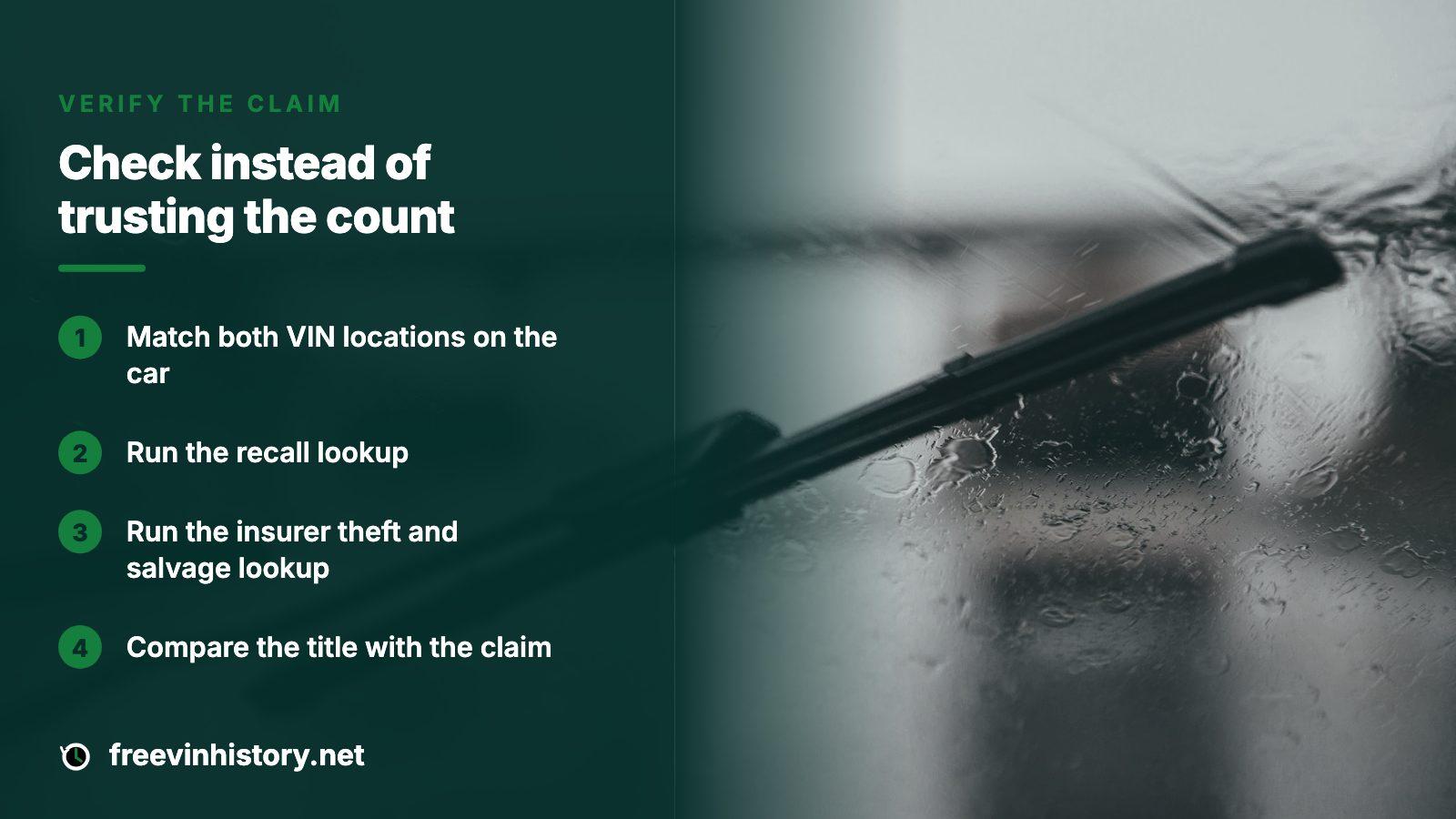
- Two VIN locations should read identically: look through the glass at the dashboard corner, then at the driver-side pillar.
- Use the free government recall lookup, then the insurer-funded theft and salvage lookup.
- Check that the seller's own name is the one shown on the title.
- Line up the ad's mileage against the dash and older readings.
- Get an independent mechanic to look it over.
Those free lookups are useful, but they do not answer the ownership question, so move to a fuller report if the car passes this first round.
Using mileage to test the story
Odometer disclosure is one of the items states report with the title, so readings accumulate over the car's life. Federal guidance notes that checking those readings helps a buyer notice discrepancies, and that odometer fraud can leave a buyer overpaying for an unsafe car.
Apply that to a one owner pitch. A car claimed to be garage-kept by one person should show readings that climb at a believable pace. Mileage that falls, or sits still for years and then leaps, calls for questions before you leave a deposit.
Where a full report fits
Start with the free preview on this site: type in the VIN and it returns the vehicle's identity, any photos on file, how many recalls are open, and tallies of title and auction entries. No owner list appears there.
If the car still looks promising, the paid report adds an ownership and use-type entry along with brands, damage and odometer readings. You pay once and nothing renews; see the pricing page for the amounts. That entry describes use, and names no individuals.
Where this information comes from
- eCFR: 28 CFR 25.54, responsibilities of the States — Lists what states must send to the national title system and shows no owner count among the items.
- BJA VehicleHistory.gov: understanding an NMVTIS report — Explains the five indicators, brands, odometer data and total loss history.
- 18 U.S.C. 2721: permitted uses of motor vehicle records — Shows why personal details of past owners are not handed to ordinary buyers.
Sources and photos: Facts checked against the sources above in November 2026. Photos by Obi, Thibault Valjevac and CHUTTERSNAP on Unsplash; diagrams by FreeVINHistory.
Keep reading
- Free previous owners check by VIN: what you can see and what stays privateWhat free tools can and cannot say about earlier owners.
- Car title search by VIN free: what you can see before you payHow to look at title status and brands before you buy.
- Free odometer check by VIN: what you can verify before you payTest the mileage story that goes with a one owner pitch.
- Free vehicle history report: what the free sources showWhere free history lookups stop and a full report starts.
Frequently asked questions
Is a one owner car worth more?
Often buyers prefer it, and sellers advertise it for that reason, but the label is not a price rule. Condition, brands, mileage and records matter more. Compare the asking price with similar cars and let the VIN results and an inspection decide whether the premium is justified.
Can a one owner car still have been in a crash?
No. One titled owner can crash a car, repair it and keep it. Accident and damage show up in other records, such as brands, total loss entries and insurer reports, so a buyer should check those directly instead of reading the owner count as a clean bill of health.
Can I find out who the previous owner was?
Generally not. A federal statute restricts who can obtain personal details held in state vehicle files, and plain buyer curiosity is not among the allowed purposes. A history report describes events and use type, and it does not hand over names.
Why does one report say one owner and another say two?
Vendors read the same title events with different rules. A lease buyout, an out-of-state move or a dealer taking title can count as a new owner in one report and be ignored in another. The difference reflects counting choices, not a change in the car.
How do I verify a one owner claim?
Request the title and the service folder, check that the VIN on the car agrees with the paperwork, use the free recall and theft lookups, and weigh mileage against earlier readings. A fuller report can add an ownership and use-type entry as one more data point.
Now check the car itself
The guide explains what to look for. The report shows what this VIN has on record.