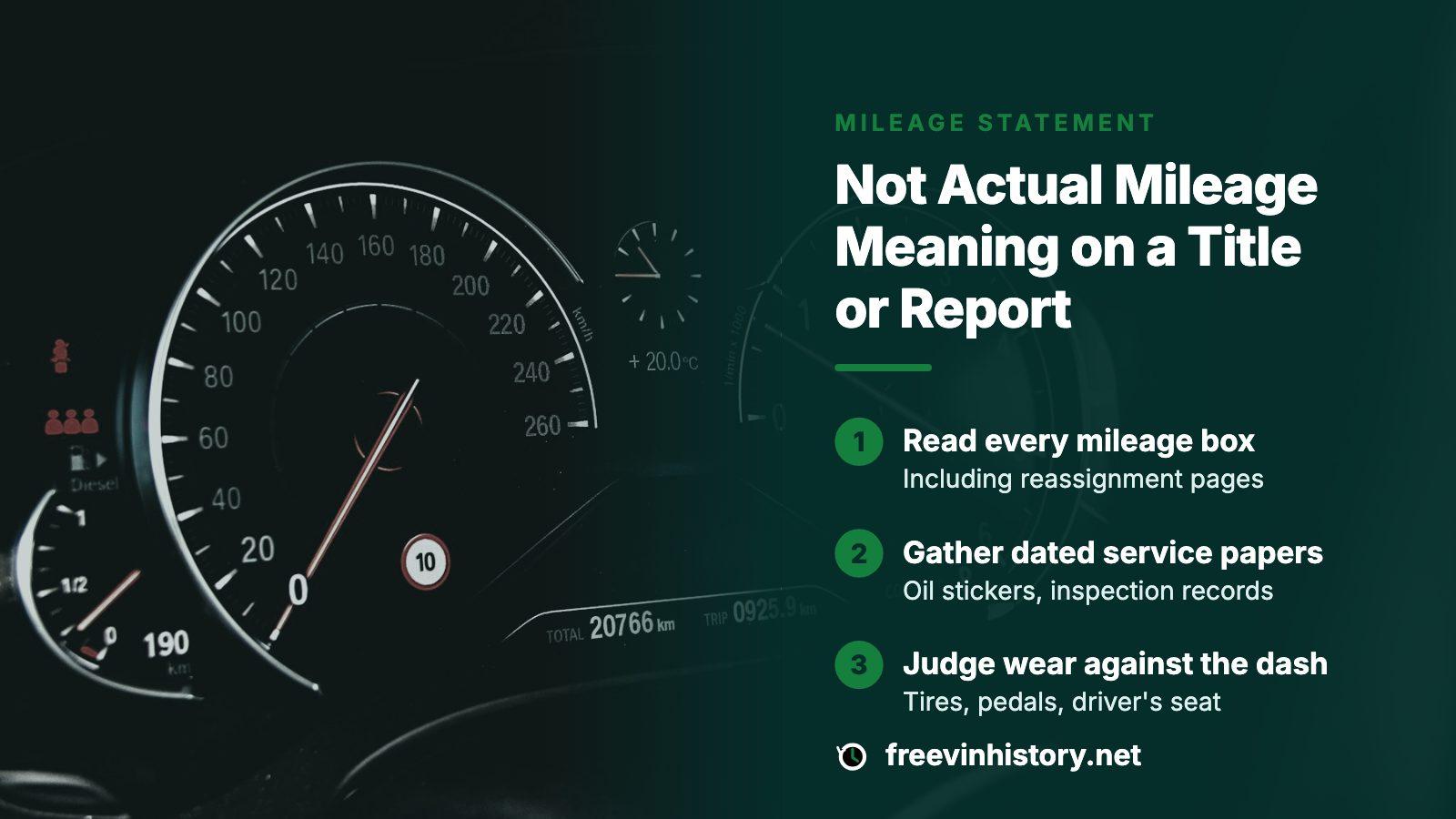
THE SHORT ANSWER
A not actual mileage notation means a seller declared in writing that the dash figure cannot be trusted as the car's real distance. It applies when the display is broken or the gap is bigger than normal calibration error. True mileage is unknown, so judge the car by condition and records, and price in wear you cannot read from the dash.
- Where it comes from
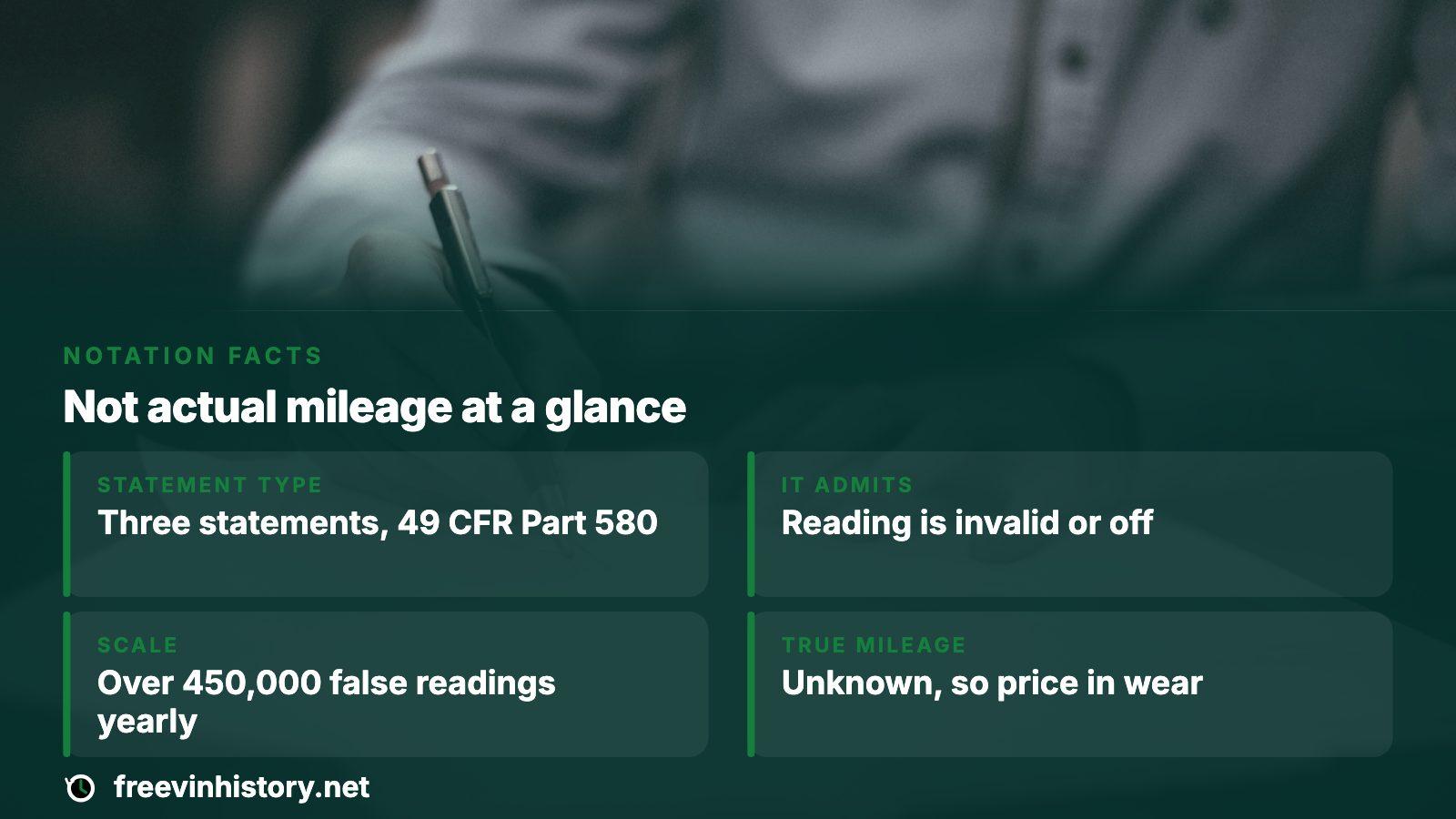
- One of three mileage statements a seller can sign under 49 CFR Part 580
- What it admits
- The reading is invalid or off by more than calibration error
- Scale of the problem
- NHTSA estimates over 450,000 false readings sold each year
- Free first step
- The preview here shows whether title records exist before you pay for the report
The wording a seller signs at transfer
When ownership changes hands, the seller completes a mileage disclosure on the title, or on a reassignment form if the seller does not hold the title. Federal regulation 49 CFR 580.5 offers the seller three statements to pick from. The first vouches for the figure, to the seller's knowledge. The second admits the car has gone past what the odometer can display. The third tells the buyer the figure is wrong and must not be leaned on.
That third statement is the one buyers search for. Titles and history reports shorten it to not actual mileage. It must come with a warning notice that a discrepancy exists, and the next title issued has to carry whatever the earlier owner disclosed, so the notation follows the vehicle.
- Statement one: the seller stands behind the figure.
- Statement two: the odometer has rolled past its limit.
- Statement three: the figure is untrustworthy, with a warning attached.
When a seller is required to write it
The regulation ties the third statement to what the seller knows. It applies when the display shows no valid figure, or when it departs from the real one by more than ordinary calibration error explains. A dead cluster, a swapped instrument panel with no record of the old reading, or a known rollback all qualify.
A seller who signs the first statement while knowing better is giving a false statement, which the statute separately prohibits, and a dealer buying to resell may not take a disclosure that is incomplete. So the notation can be honest paperwork. Pricing the consequences falls to the buyer.
What the notation does to a car's value
Mileage is shorthand for wear. Once a title calls the figure unreliable, nobody can say whether the engine has covered a modest distance or a punishing one. Expect to set the discount yourself, since no guidebook table does it for you.
| Situation | What the notation means | What to do |
|---|---|---|
| Broken display, honest seller | The seller could not read a valid figure | Ask for repair invoices; price on condition |
| Replaced cluster | The new unit started from a different number | Ask for paperwork showing the old reading |
| Known rollback | Someone altered the figure on purpose | Walk away or consult an attorney |
| Notation on an earlier title | A past owner declared it and it carried forward | Treat the true mileage as unknown today |
None of these restores the lost information, which is why the notation calls for a lower offer rather than a debate about the dash.
Not actual mileage versus odometer fraud
The two are easy to confuse. NHTSA describes fraud as tampering with an odometer, by disconnecting, resetting or altering it, to change what it shows. The notation is the opposite: an open admission on the title that the number is unreliable.
The civil remedy sits on the fraud side. Under federal law, a seller who deceived on purpose can owe the buyer $10,000 or triple the loss, whichever is bigger. Fees go to a winning plaintiff, and suits must start within 2 years. An honest notation, read before signing, gives little to sue over. A concealed one might.
Where the notation turns up before you buy
Start with the title, since the disclosure is written there. Then read any history report. The Justice Department's NMVTIS report includes an odometer entry as one of five indicators and keeps brands applied by any state. A mileage entry far above the dash is a warning sign too.
From an NHTSA owner complaint
One buyer's complaint about a 2016 Honda Civic says a retailer's own record for the car carried a rollback note, not actual miles and true mileage unknown. A credit bureau's report confirmed a mileage discrepancy, and an earlier Michigan title showed inconsistent mileage. The owner wanted federal investigators to look into it.
The label was findable in paperwork. Ask the seller for every title copy and read each mileage box.
When the title and the dash disagree
A formal notation is the clear case. The harder one is a title with no warning where the numbers still clash. Another NHTSA complaint describes a 2012 Toyota Camry bought from a dealer at 101,375 miles, whose title later showed 245,980. The owner traced it to an auction sale where the mileage afterward read 101,294, and two other cars from the same dealer showed similar gaps.
From an NHTSA owner complaint
That Camry's buyer found the gap only after the sale. The owner reported that engines in two of the three cars seized five months after purchase, and that the dealer's other sales showed the same pattern.
Compare every title figure and auction record with the dash before money moves.
Which vehicles can skip the disclosure
Not every sale needs a mileage statement. Under 49 CFR 580.17, vehicles rated above 16,000 pounds are exempt, as are older vehicles once enough years pass. Model year 2010 and older stay exempt. NHTSA's December 2020 alert says model year 2011 and newer vehicles are covered for 20 years, so 2011 models disclose through 2031.
On a classic or an older work truck, a missing notation proves little, because the seller may have owed no statement at all. Lean on physical evidence and VIN records.
How to test a car that carries the notation
Assume the dash tells you nothing and gather other evidence. NHTSA's buyer advice still applies, and a mechanic can add what a driveway look cannot.
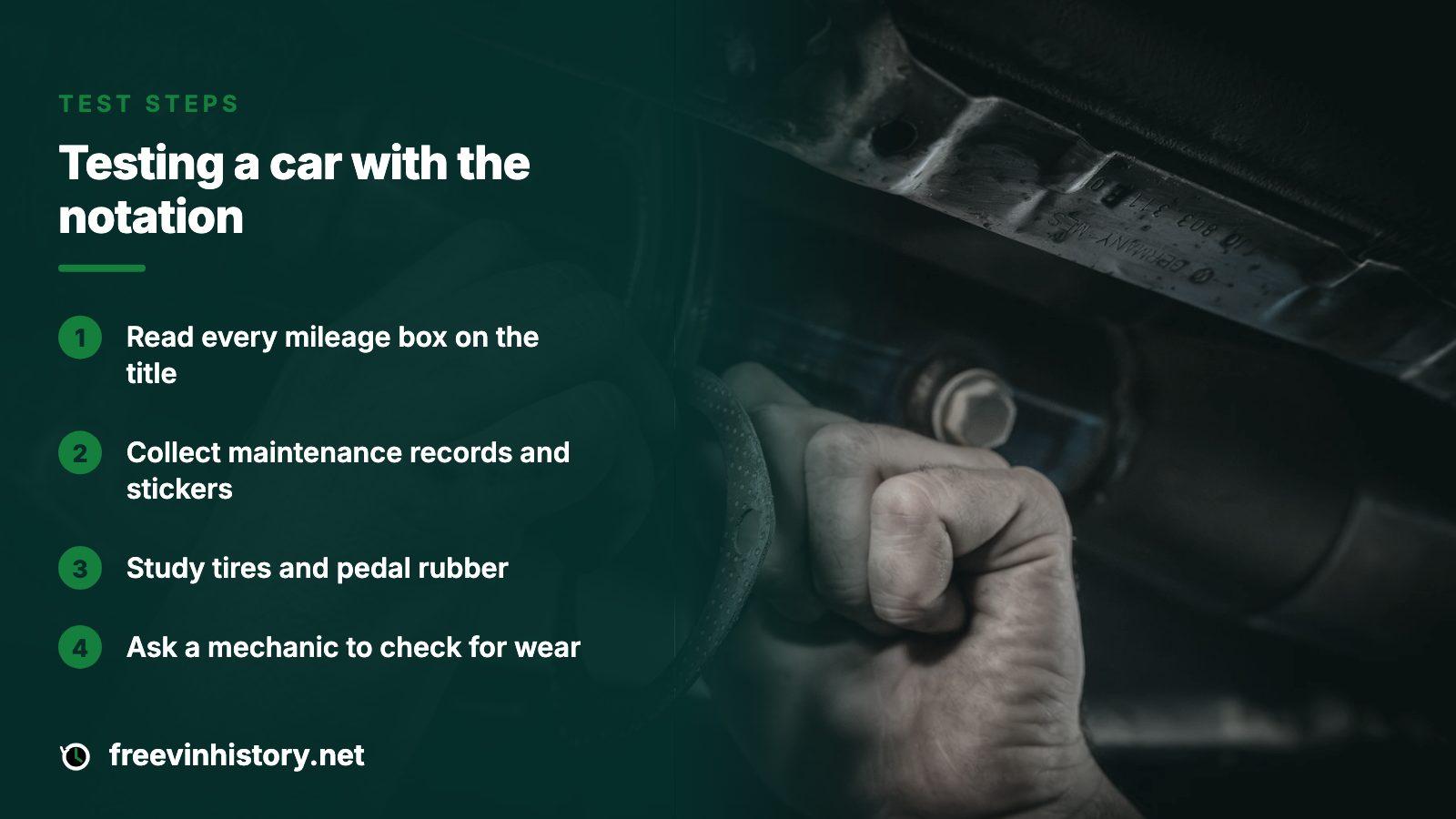
- Read every mileage box on the title and any reassignment pages.
- Collect maintenance records, inspection papers and oil-change stickers in the glove box, door frame or under the hood.
- Study the tires, pedal rubber and driver's seat bolster against the figure shown.
- Ask a mechanic to look for wear that fits a hard life, such as play in the steering and loose suspension joints.
- Put the VIN into the free preview and see what it surfaces.
NHTSA adds that a tampered digital odometer has no moving parts to inspect, so the car's condition and a dated record trail give the best clues.
The step up from the free preview
Here, the preview costs nothing. Enter the VIN to see the car's identity and counts of title and auction entries, a sign of whether records are worth opening. It does not print odometer readings.
The full report is bought once, separately, with nothing recurring. It lists odometer entries by date beside title brands and salvage records, so you can see whether earlier figures sit above today's dash. For a shortlist there are bundles of 3, 5 or 10, and amounts live on the pricing page only. If an entry beats the display, ask the seller to explain in writing.
Where this information comes from
- NHTSA: Odometer fraud — How NHTSA defines fraud, its buyer tips and who handles complaints.
- NHTSA: Odometer disclosure changes — Which model years must disclose mileage and until when.
- Federal odometer rule, 49 CFR 580 — The seller's choice of mileage statements, what the form holds, and who is exempt.
- Federal damages law, 49 U.S.C. 32710 — Damages, the filing deadline and attorney's fees.
- Justice Department: reading an NMVTIS report — Which data points a federal title report includes, and how it defines a brand.
- NHTSA owner complaint 11701027 — owner experience, paraphrased
- NHTSA owner complaint 11693831 — owner experience, paraphrased
Sources and photos: Facts checked against the sources above in November 2026. Photos by Viktor Theo, Martin Fennema and Scott Graham on Unsplash; diagrams by FreeVINHistory.
Keep reading
- Exceeds mechanical limits meaning: what the odometer box tells a buyerThe second mileage statement, for odometers that rolled past their display limit.
- Certificate of title meaning: what the document proves and what it hidesWhere the mileage box and any brands sit on the title.
- Free odometer check by VIN: what you can verify before you payThe checks that cost nothing and what free lookups cannot show.
- NMVTIS report: what the federal title record shows and missesThe federal title database behind the newest odometer entry on a report.
Frequently asked questions
What does not actual mileage mean on a car title?
The seller declared the dash figure untrustworthy. Federal rules call for that statement when the display is dead, or wrong by a wider margin than calibration drift, so the car's real distance is unknown and its wear has to be judged another way.
Is a not actual mileage title the same as a rollback?
No. A rollback is an alteration made to change the figure. The notation is an open warning written on the title. A rollback can sit behind it, but the notation itself only says the number is unreliable, so ask the seller what happened.
Can I still register a car marked not actual mileage?
Federal law bars licensing a transferred car without the seller's title and any mileage statement the title has space for. The notation is part of that statement. What a state does next varies, so ask your state title office before you buy.
Should I buy a car with this notation?
Only at a price that reflects unknown wear, after a mechanic's inspection and a read of all service paperwork. If you go ahead, get the seller's explanation in writing and keep copies of every title page.
Does a clean VIN check prove the mileage is real?
No. Free lookups for recalls, theft or salvage do not return odometer entries, and a history report can only repeat what was filed. Compare the dash with every dated entry and the car's physical wear, since a gap between them is the warning sign.
Now check the car itself
The guide explains what to look for. The report shows what this VIN has on record.