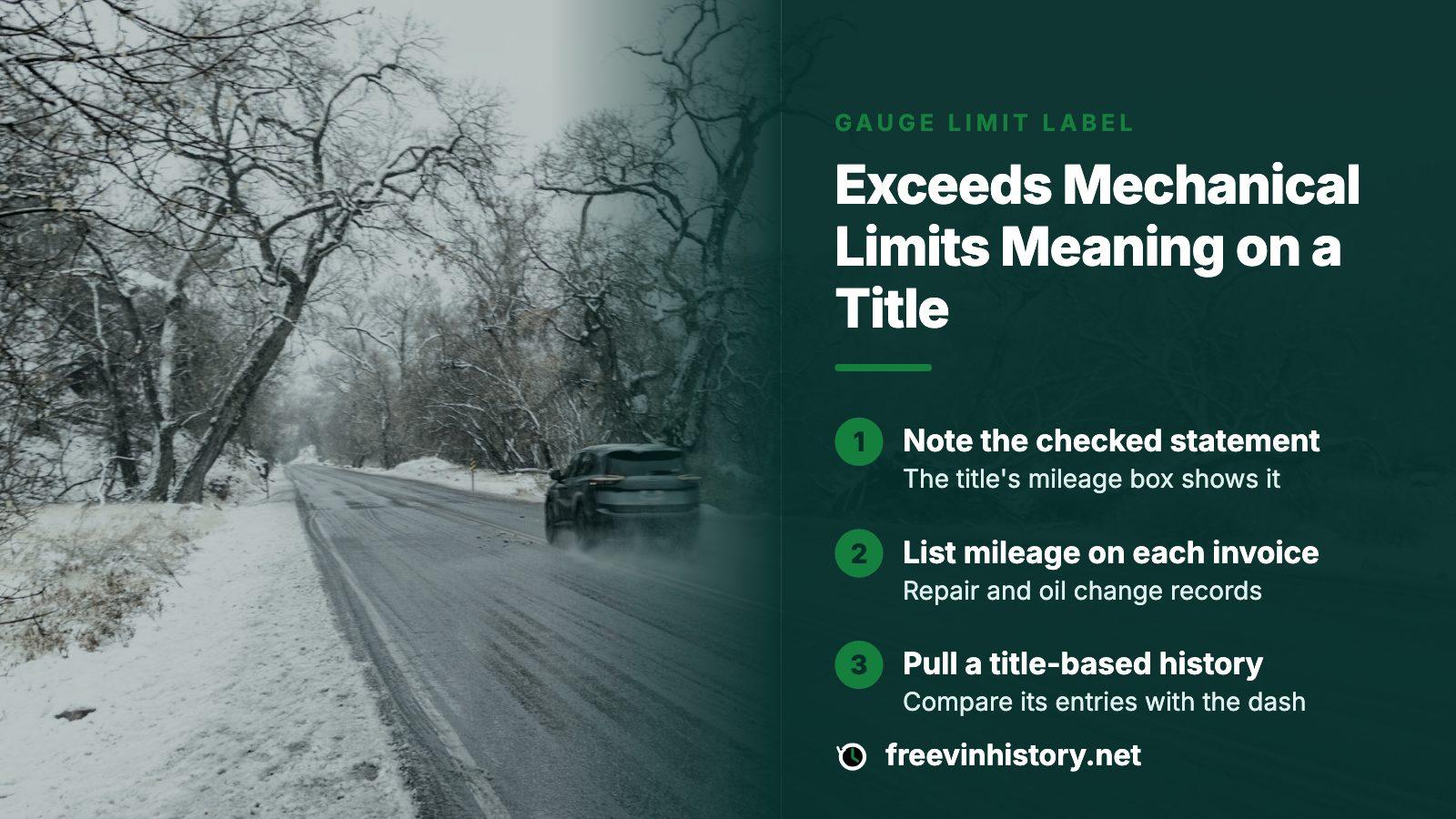
THE SHORT ANSWER
The phrase appears on a title or transfer form when the seller knows the odometer reading reflects more mileage than the instrument was designed to show. The shown figure is therefore too low, and the true total is higher but unknown. The label differs from not actual mileage, which covers a gauge that is broken or wrong. Treat the car as a high-mileage one and price it that way.
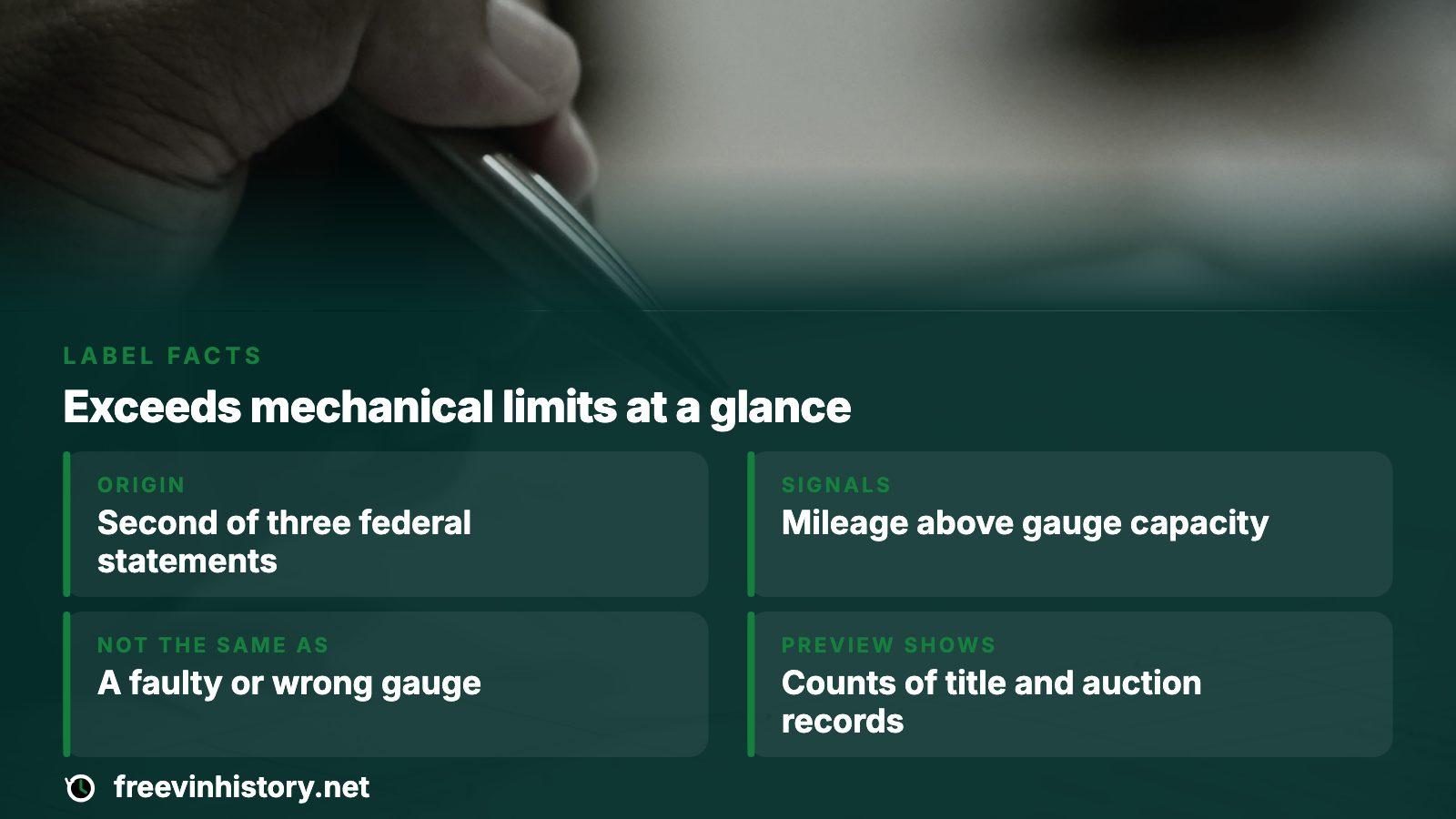
- Where it comes from
- The seller's second choice among three mileage statements in the federal odometer rule
- What it signals
- True mileage is above what the gauge could display
- Not the same as
- Not actual mileage, which flags a discrepancy or a faulty display
- Free preview here
- Shows counts of title and auction records, not odometer entries
What the phrase says in plain terms
Every mechanical odometer has a ceiling. When a car outlives it, the display can no longer hold the true total, so the figure on the dash stops matching the miles driven. Federal law deals with this by letting a seller who knows it is the case say so in writing at the moment of sale, instead of presenting a low reading as if it were accurate.
The rule's own wording speaks of mileage in excess of the designed mechanical odometer limit. A seller who signs that box is telling the next owner two things: the reading printed on the title is a floor, and nobody can say by how much. For a buyer, the practical translation is simple. Expect a car that has been driven a great deal, and budget for the wear that goes with it.
One of three boxes a seller can sign
Under 49 CFR 580.5, the seller writing the mileage on a title picks one certification. The three options sit side by side on the federal form, and each one tells you something different about how far to trust the number.
| Seller's statement | What the seller is saying | What it means for you |
|---|---|---|
| Actual mileage | Seller believes the dash number is correct | The default; still worth confirming against records |
| Mileage exceeds mechanical limits | The odometer has gone past its designed display range | Real mileage is higher than shown; true figure unknown |
| Not the actual mileage | The display is invalid, or the true total is known to be well off | Do not rely on the number; a warning travels with it |
Each form carries a printed warning about fines or prison. The box ticked is a signed statement of what the seller knows.
How it differs from not actual mileage
The two non-default boxes are easy to mix up, yet they describe different problems. Exceeds mechanical limits is about capacity: the gauge worked as designed, ran out of room, and the figure wrapped around. Not actual mileage is about reliability: the display cannot be trusted at all.
The second label is the more worrying one. It can sit on a car with a failed gauge or an altered odometer, while the first usually points to sheer use. Neither box proves why the number is wrong, and federal law bars a false statement in either direction.
When and where the notation shows up
The statement is made at transfer, on the title or on a reassignment form, and the next title issued must carry the mileage disclosed. That is how the label follows a car from owner to owner.
- On a paper title, as a checked box beside the mileage line.
- On an electronic title, as part of the recorded disclosure.
- On a lease return form, where the person returning the car makes the same three-way choice.
- On a power of attorney, where the box matters if the mileage written there is below the title's.
- In a history report, where a title-derived odometer entry may carry the notation forward.
An auction company also keeps the reading from the day it took possession of a car, for five years after the sale, which is one more place a mileage trail can be rebuilt.
Reading it as a buyer: price and risk
Treat the box as information about use, not as a defect. A well kept car can carry it. The trouble starts when a buyer skips the label and pays a price built for far fewer miles.
Ask what the seller knows. Invoices, inspection stickers and tire dates give a rough trail the gauge cannot. Judge the engine, suspension and transmission on age and condition, not on the displayed figure, and if the asking price assumes the printed mileage is real, that gap is your negotiating room.
What a hidden mileage gap looks like in practice
No owner complaint filed with NHTSA names this exact box. The nearest public record is a buyer who learned of a mileage gap too late, a different problem that still shows why a printed figure alone is never enough.
From an NHTSA owner complaint
A 2003 Honda Accord changed hands in a private sale showing 156,000 miles, according to its new owner. Registration paperwork later put the figure at 337,000. The complaint is labeled odometer fraud.
The buyer learned the true figure from paperwork, after paying. Read the title statement before money moves, and check the history behind it.
Which vehicles never carry a statement
A title with no mileage statement is not always a red flag. Heavy trucks rated above 16,000 pounds, trailers and other unpowered vehicles are excluded, and so is a brand-new car until its first retail sale.
Age matters too. For model year 2010 and older, the exemption starts once a sale falls 10 years past the first of January of the model year. Newer cars keep the duty longer, for 20 years, and the rule gives 2031 as its example: a sale that year no longer needs a statement for a 2011 car. Check the model year before reading anything into a missing box.
How to test a car that carries the label
Begin with the paperwork, then the car, and look for physical evidence that matches the story the gauge tells.
- Read the title's mileage box and note which statement is checked.
- Collect repair and oil change invoices and list the mileage on each.
- Inspect the brake pedal, driver seat edge and steering wheel for wear.
- Order a pre-purchase inspection from an independent shop.
- Pull a title-based history and compare its odometer entries with the dash.
If earlier entries sit above today's display, ask the seller to explain in writing.

Where the VIN check fits
Start with the preview, which costs nothing. A VIN entered here returns the car's identity plus counts of title and auction entries, a hint about whether records are worth opening. Odometer readings are not printed there, and a quiet preview does not settle the mileage question.
The full report is bought once, never as a subscription, and its price sits on the pricing page alone. Odometer entries appear by date next to title brands and salvage records, so an earlier figure higher than the dash stands out. A buyer who proves intent to defraud can recover triple the loss or a $10,000 minimum, but suit must start within 2 years of the claim arising, so keep the records.
Where this information comes from
- Federal odometer rule, 49 CFR Part 580 — The three seller statements, the title form wording, who is exempt and how auctions keep records.
- 49 U.S.C. 32705: disclosure on transfer — The statutory duty to disclose mileage and to say when actual mileage is unknown.
- 49 U.S.C. 32703: preventing tampering — Which odometer acts are barred, including resetting and driving with a disconnected gauge.
- 49 U.S.C. 32710: civil actions — Damages formula, filing deadline and attorney's fees for a buyer who wins.
- Justice Department: reading an NMVTIS report — What the federal title database includes and where its data comes from.
- NHTSA owner complaint 11690002 — owner experience, paraphrased
Sources and photos: Facts checked against the sources above in November 2026. Photos by Zoshua Colah, Nina Mercado and Masjid MABA on Unsplash; diagrams by FreeVINHistory.
Keep reading
- Not actual mileage meaning: what the title brand tells a buyerThe third statement, for a gauge that is wrong rather than full.
- Certificate of title meaning: what the document proves and what it hidesWhere the mileage box and brands sit on a title.
- Free odometer check by VIN: what you can verify before you payThe checks that cost nothing and what free lookups leave out.
- NMVTIS report: what the federal title record shows and missesThe federal title database behind a report's odometer entries.
Frequently asked questions
What does exceeds mechanical limits mean on a car title?
It means the seller certified that the odometer reading reflects more miles than the instrument was designed to display. The number printed on the title is therefore too low, and the true total is higher but unknown. Buyers should treat the car as high mileage and judge wear, not the printed figure.
Is exceeds mechanical limits the same as odometer fraud?
No. The statement discloses that a gauge ran past its range, which is a lawful disclosure when true. Fraud involves resetting or altering an odometer, or giving a false statement at transfer. A seller can still misuse the box, so the claim deserves checking against service records and a title history.
Can I still register a car marked exceeds mechanical limits?
Federal law requires the seller's signed mileage statement with the title application where the title has room for it, and the chosen box is part of that statement. Whether a state adds its own steps varies, so ask your motor vehicle office about a title carrying this notation before you buy.
Does the exceeds mechanical limits box lower a car's value?
It signals heavy use, so the car should be priced on condition and likely mileage rather than the printed number. Value falls when a buyer pays a price based on the dash figure. A documented service history can support a fair price even when the true total is unknown.
Will a free VIN preview show this notation?
No. The preview on this site shows the car's identity and counts of title and auction records, not odometer entries. Mileage readings appear in the paid report, which lists entries by date. Your own copy of the title is the place to look for the checked box.
Now check the car itself
The guide explains what to look for. The report shows what this VIN has on record.