THE SHORT ANSWER
Mostly, in four stops. NHTSA lists unrepaired recalls, NICB flags insurer-reported theft, salvage and flood losses, and the Bureau of Automotive Repair publishes past smog inspections by VIN. The title carries the DMV's brand box. For title history across states, the DMV's buyer pages point to NMVTIS, sold by approved providers for a small fee. The preview on this site shows which accident, mileage, lien and auction records exist before any payment.
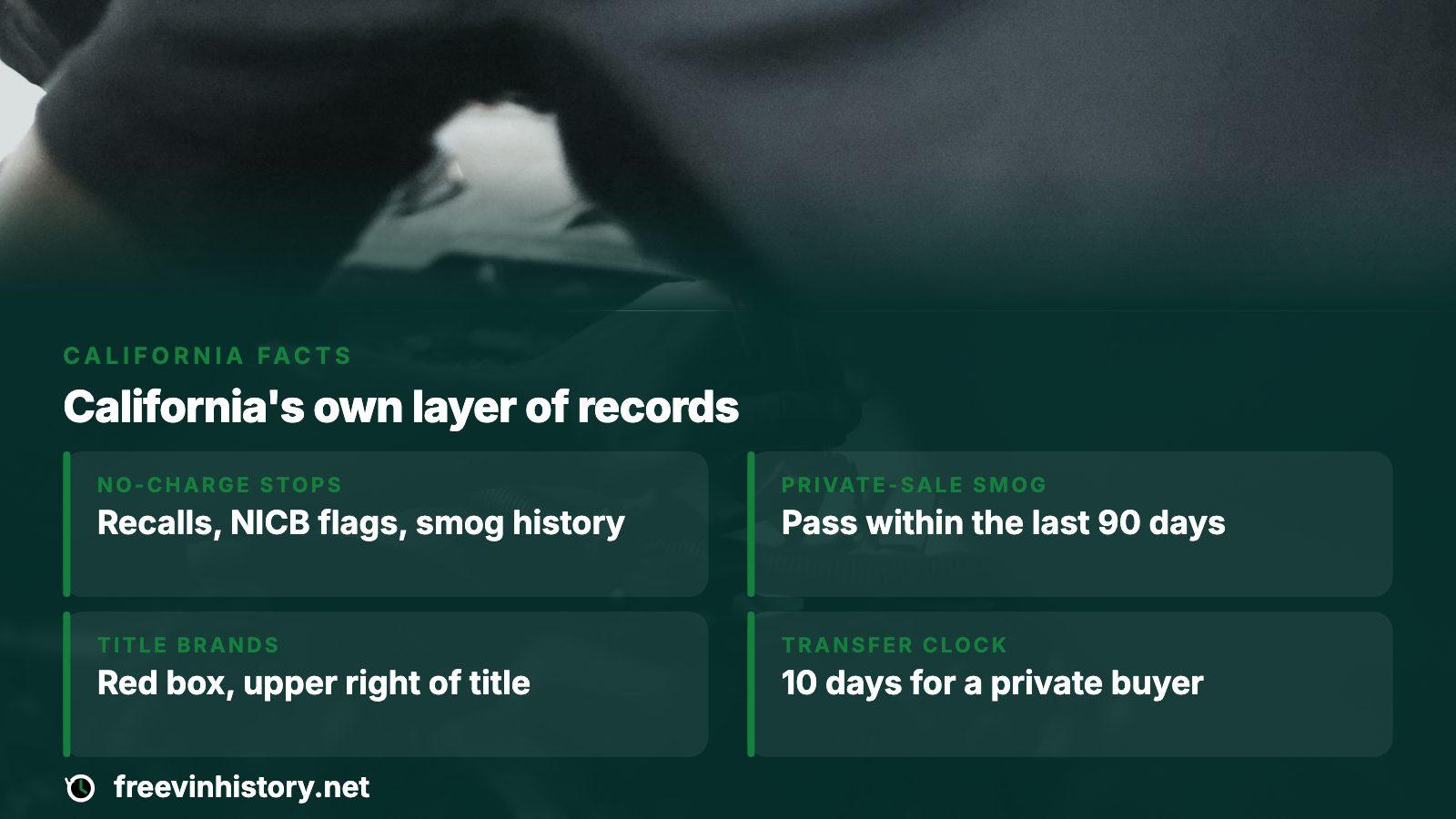
- No-charge stops
- NHTSA recalls, NICB insurer flags, BAR smog history
- Private-sale smog
- A pass within the last 90 days
- Title brands
- Red VEHICLE HISTORY box, upper right of the title
- Transfer clock
- 10 days for a private buyer
The run order for a California car
Work from cheapest to costliest. A car that stumbles early rarely deserves the paid stops, and one that clears the free ones still has blind spots.
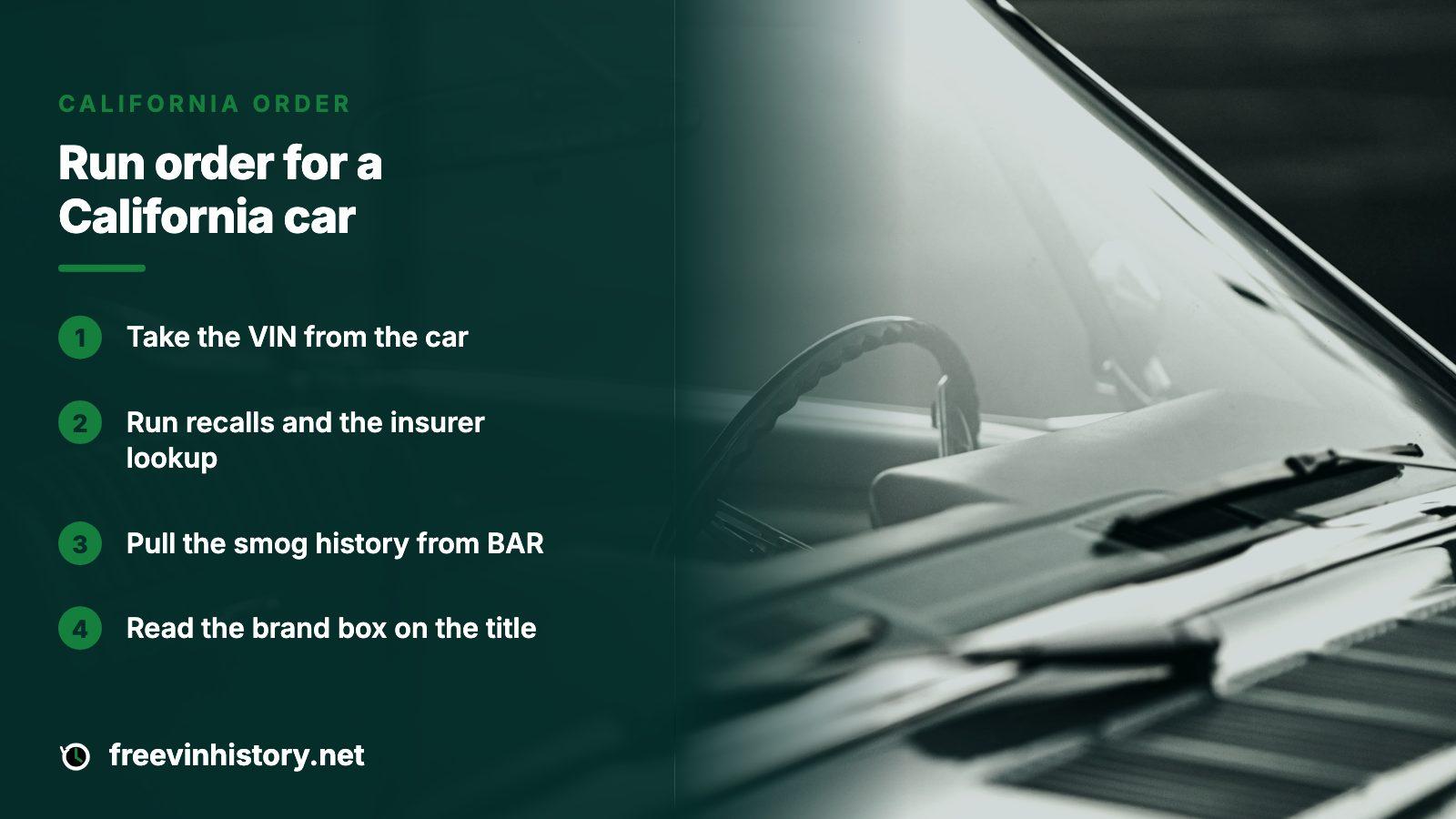
- Take the VIN from the car and check it against the paper title.
- Run the federal recall search.
- Run the insurers' theft, salvage and flood lookup.
- Pull the smog inspection history from the Bureau of Automotive Repair.
- Read the brand box on the California title.
- Order an NMVTIS title record for any car still on your shortlist.
- Open the preview of a full report for the records none of the above reach.
Step 1: get the number right before you search anything
Each lookup below rests on 17 characters, and NICB cautions that one wrong character can hide a match. Copy the number off the car yourself, from the windshield's lower driver-side corner, and set it beside the registration card and the paper title.
- A VIN plate attached by any means besides rivets is among the DMV's salvage warning signs.
- A title number off by one character means a typo or another car, so pause until the seller explains.
Step 2: the recall search answers one narrow question
NHTSA's search asks whether the VIN carries a safety recall nobody has repaired. A clean car returns the line 0 unrepaired recalls. Recalled parts are fixed free at a dealership, so an open recall is something to negotiate around, not a verdict on the car. Repaired recalls drop off the results, along with several other categories:
- recalls announced so recently that their VIN lists are incomplete
- safety recalls that are 15 years old or more, when the maker has not extended coverage
- recalls from small manufacturers, plus maker campaigns outside the safety category
Step 3: what the insurers' lookup can and cannot see
NICB's VINCheck compares the VIN with records from participating insurers and reports a theft never recovered, a salvage declaration or flood damage. It allows five searches in 24 hours from one IP address. Its data come from insurers that together write 92.49 percent of premium nationwide, so police files and insurers that opted out are absent.
A clean answer is not a clean history
NICB itself cautions that a spotless result guarantees nothing, and that VINCheck should not be the only thing relied on when buying. Damage that never became an insurance claim leaves nothing for it to find: a flood car dried out by its owner, or a collision paid for in cash.
Step 4: California's own no-charge layer, the smog history
The Bureau of Automotive Repair runs a public inspection-history lookup that accepts a VIN or a plate. The bureau prefers the VIN, since plates change, and refreshes its records nightly. Its page lists no result fields, so judge the lookup by what appears for your car. Four California rules make the record worth reading:
- In a private sale the passing test must be 90 days old at most; the seller arranges it before the sale and passes the report to you.
- A lit check engine light means no pass, whatever explanation comes with it.
- A gasoline or hybrid car in its first four model years skips the test at transfer, with a fee in its place, so a recent car may show no inspection at all.
- A car arriving from another state is tested before its first California registration, which also checks that aftermarket parts meet California requirements.
Step 5: read the brand box before you talk price
Look at the upper right corner of the title. On the current design, California records a car's brands in a red box labeled VEHICLE HISTORY, and the Salvage Certificate carries the same box. The DMV defines its brands this way:
| Brand on the title | What the DMV says it means |
|---|---|
| Salvaged | Serious damage from a crash or another cause, such as flood or vandalism; includes former junk cars |
| Original or Prior Taxi, or Police | Once used for hire or by police, so expect high mileage |
| Non-USA (grey market) | Made for another market, then modified to pass U.S. and California rules |
| Warranty Return or Lemon Law Buyback | Taken back by the maker under California's Lemon Law |
| Remanufactured | Put back together by a licensed remanufacturer, using parts that were reconditioned or already used |
Revived salvage cars call for a closer look. The DMV says some were repaired poorly or with stolen parts, and a car found carrying stolen parts cannot be registered. Sellers must disclose a salvage history, yet the DMV admits the rule is hard to police, especially on out-of-state cars.
Step 6: the title record the no-charge stops cannot reach
The DMV's buyer pages point to NMVTIS, the federal title database, as the place to check title history. California dealers must pull an NMVTIS report from an approved vendor before a used car goes on offer, and post a disclosure on any car whose report or title shows a junk or salvage brand. A private buyer can order one through vehiclehistory.gov for a small fee.
A report lists current brands, the latest odometer reading on file, insurer total-loss determinations and any hand-off to a salvage yard. By the Justice Department's count the system covers 87 percent of the nation's vehicles, yet some sources never report in, so a search that looks clean may still miss something. Brand rules differ by state, so one state's salvage car can be unbranded under another's rules.
Step 7: the preview, then the full report if the car earns it
The earlier stops leave four questions open: how the odometer moved between owners, whether the car passed through an auction, who holds a lien and whether an accident was ever recorded. The preview on this site shows which of those records exist for a VIN, at no charge. Beyond the preview, a lone report is available, as are 3, 5 or 10 together if you are comparing California listings, with a single transaction covering the purchase. No subscription follows, and rates sit on the pricing page. The preview is worth opening when:
- the title comes from another state, or the seller cannot say where the car lived
- the smog history has a gap, or the seller has no inspection report
- a brand sits in the red box and you want the story behind it
- the asking price sits well under similar listings
After the checks: the 10-day transfer clock
A private buyer has 10 days from purchase to move the title into their name, and the seller has 5 days to notify the DMV. The application needs:
- the title, with the seller's signature on Line 1
- mileage on record if the car is under 10 years old, using form REG 262 when the title has no mileage line
- a bill of sale signed by seller and titled owner, when they are different people
- a smog certification, plus fees and use tax
Where this information comes from
- California DMV: Branded titles — Supports the brand box, the brand meanings, the salvage warnings and the dealer's NMVTIS duty.
- California DMV: Registration for a vehicle purchased from a private party — Supports the transfer deadlines and the document list for a private purchase.
- California BAR: Smog Check — Supports the 90-day rule, the model-year exemptions and the first-registration test.
- California BAR: Check a vehicle's inspection history — Supports the VIN-or-plate lookup and the nightly refresh.
- NHTSA: Check for recalls — Supports what the recall search shows and omits.
- NICB: VINCheck lookup — Supports the insurer-only scope, the daily search cap and the clean-result caution.
- U.S. Department of Justice: NMVTIS for consumers — Supports what a consumer title report holds and where it can miss.
Sources and photos: Facts checked against the sources above in November 2026. Photos by Zoshua Colah, Dylan Michaud and Mustafa Sheikhmouss on Unsplash; diagrams by FreeVINHistory.
Keep reading
- Free VIN check through the DMV: what a state agency will and will not showHow state motor vehicle agencies in general answer a request for a free VIN check.
- Free salvage title check by VIN: what the free lookups showMore on spotting a salvage history the brand box may not show.
- Car title search by VIN free: what you can see before you payThe title lookups worth running on a car from any state.
- Free open recall check by VIN: GM, Polaris and every other makeWhat an open recall means and how the repair works.
Frequently asked questions
Is there a completely free VIN check for California cars?
Not one that covers everything. NHTSA's recall search and NICB's insurer lookup cost nothing, and the Bureau of Automotive Repair's inspection history lists no fee. A title record from an NMVTIS provider carries a small fee, and accident and auction detail sits in a full report. The preview on this site shows which exist.
Can I search a California car by license plate instead of the VIN?
The recall search and the smog history both accept a plate. The bureau still says the VIN gives the most accurate results because plates change, and NHTSA warns that a plate result can turn up the plate's former car instead of the one you are buying.
Does the seller have to supply a smog certificate in California?
In a private sale the car needs a passing Smog Check from the previous 90 days, the bureau says, and the seller gets the test done before selling and gives the buyer the report. A gasoline or hybrid car within four model years is excused at transfer, and a fee covers it.
What does an empty smog history result mean?
It is something to ask the seller about, not a verdict. The car may fall under the four-year exemption, may be an electric vehicle or motorcycle, which need no test, or the VIN may have been mistyped. Ask for the paper report and compare the VIN with the registration card.
If NICB and NMVTIS both find nothing, can the car still have been wrecked?
Yes. NICB searches only the records of insurers that take part, and the Justice Department says some sources never report to NMVTIS, so a database can stay silent about a real wreck. Privately paid repairs may show in neither, which is why a mechanic's inspection and a full-report preview belong on the list.
Now check the car itself
The guide explains what to look for. The report shows what this VIN has on record.