THE SHORT ANSWER
Mostly no, with a useful partial yes. NICB VINCheck costs nothing and flags cars a participating insurer reported as salvage, flood damaged or stolen. It does not read the junk brand a state may have put on the title. Use it to rule cars out, then run the full report on the one you want.
- Free insurer screen
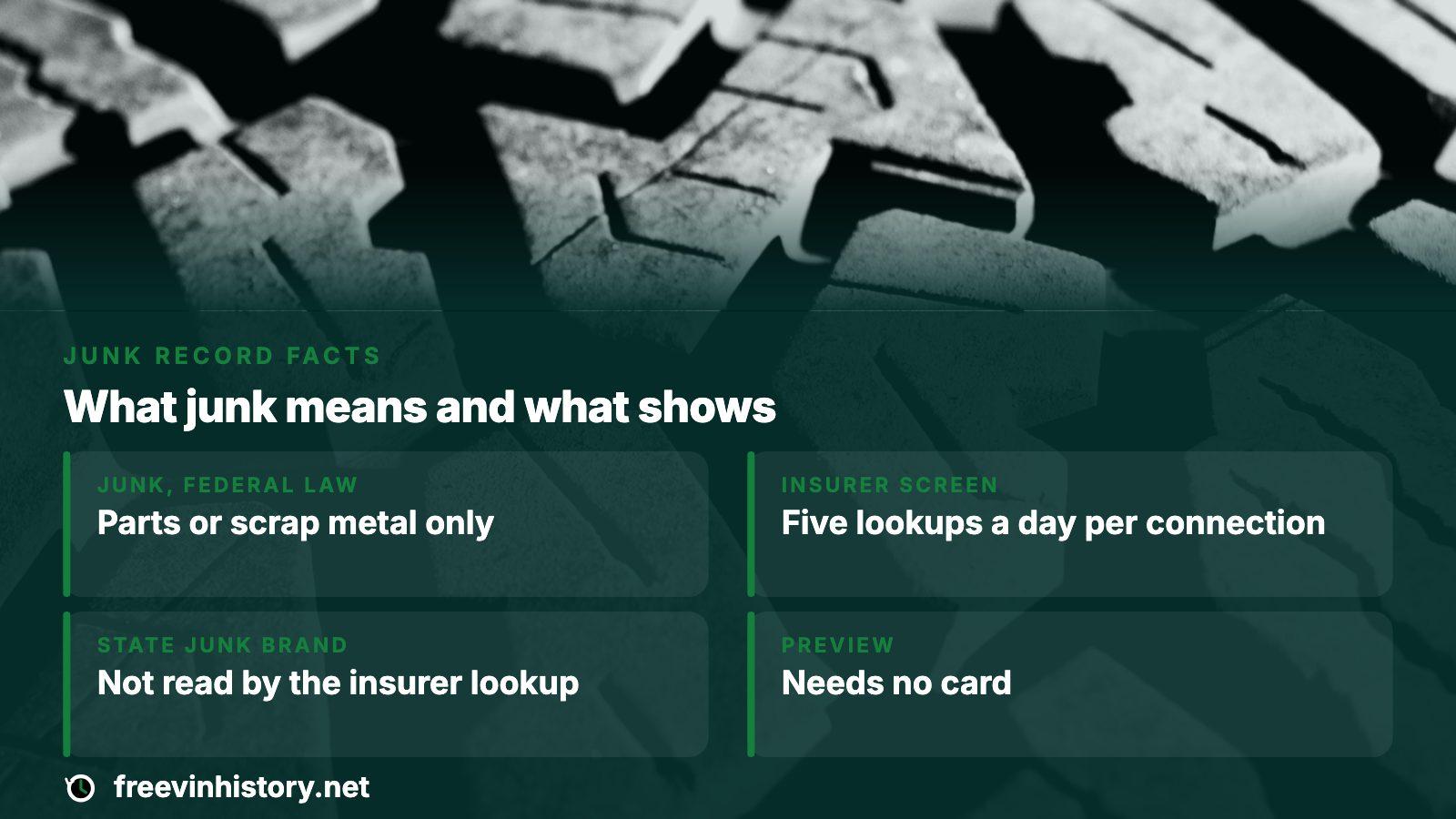
- NICB VINCheck, capped at five lookups a day per connection
- Junk, per federal law
- Undrivable on public roads and valued only as parts or scrap metal
- Free preview
- FreeVINHistory preview needs no card
- Full report
- One payment, no subscription; amounts on the pricing page
What a junk record actually claims about a car
Federal law gives the word a narrow meaning. A car qualifies as junk when it can no longer be driven on the public highway and is worth something only as spare parts or scrap metal. That is a far bleaker verdict than a car that looks rough or that a seller calls a junker.
States turn the idea into paperwork in their own ways. Massachusetts stamps JUNK on the record of a scrapped car, and that car is closed out of the state's title and registration system for good. California's equivalent is a non-repairable certificate, issued for a car an owner declared parts-only, one stripped bare or one burned to a shell. If the word surfaces on a car advertised for everyday use, raise it with the seller before anything else.
The three no-cost looks and what each one covers
Each free source answers a different slice of the junk question. None answers all of it.
| Free source | Shows | Misses |
|---|---|---|
| NICB VINCheck | Whether a participating insurer reported the car as salvage, flood damaged, or stolen and not recovered | State title brands, police records, insurers that opt out |
| NHTSA recall search | Whether the VIN has an unrepaired safety recall | Repaired recalls, title brands, damage of any kind |
| FreeVINHistory preview | Basic vehicle details and tallies of title and auction records | The content of those records |
The word junk does not appear in what NICB says VINCheck returns. Salvage is the nearest signal, so a salvage hit is your cue to dig, and a clean result only narrows the odds.
Running the screen in a sensible order
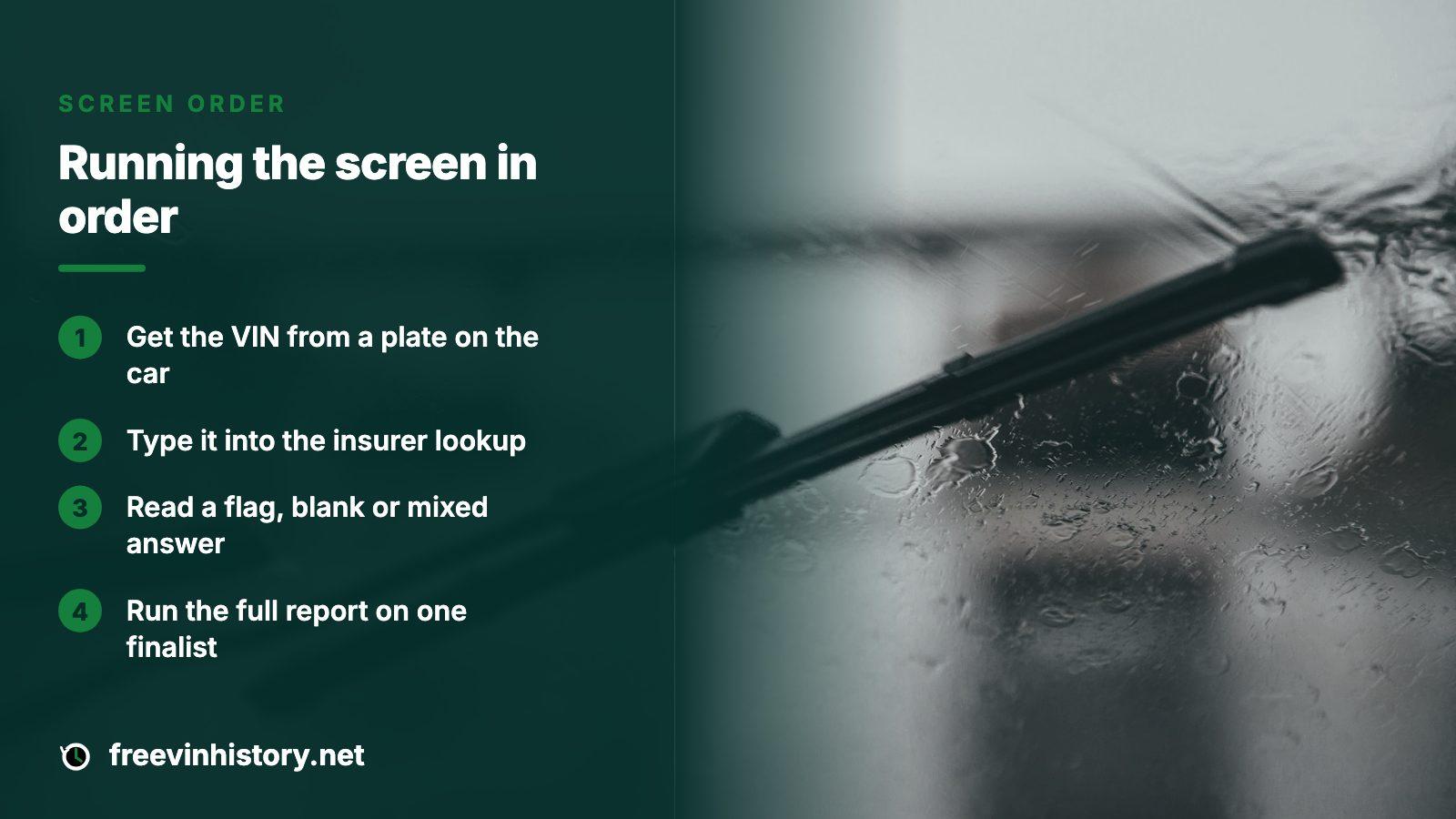
- Get the VIN from a plate on the car, not from what the ad says. NHTSA locates it low on the windshield's left edge, and your registration card repeats it.
- Type it into NICB VINCheck, going slowly. One wrong character can mean no match.
- Then give NHTSA's recall search the same VIN. A result of zero unrepaired recalls is the message you want to see.
- Put the VIN into the FreeVINHistory preview and note whether the title and auction tallies are above zero.
- If any step raised a flag, or the price looks too good, decide whether this car deserves the full report.
NICB caps lookups per connection at five a day, so a shortlist of a few cars fits in one sitting.
The yard trail a title can hide
The Justice Department's title system pulls in data from state title offices, insurers, recyclers and wrecking or salvage yards, so a search can show a car changing hands into that trade. The same page makes a point many buyers miss: a stay in a yard does not oblige a state to apply a brand, because state laws differ.
A car can have a yard past and a clean paper title
A brand is one record and a yard transfer is another. Look for both, since the paper the seller hands over may reflect only the last state that issued a title.
How to read a flag, a blank and a mixed answer
- A salvage result from NICB means an insurer judged repair costs too high against the car's value and paid the claim. The car may have been rebuilt and re-titled legally, so the question becomes the quality of the repair.
- A clean NICB result is not a guarantee. NICB says so itself, and its data covers only member insurers.
- A total-loss entry does not always mean a wreck. An unrecovered theft past the 30-day mark can pick up the label, and it remains if the car later surfaces in good shape.
- An empty federal report is good news only when the reporters did their part, and the department warns of false negatives such as no junk or salvage history.
Mixed answers deserve the most care. A clean insurer lookup beside a preview showing title records means someone filed something the lookup could not see.
Why the free tools miss a junked car that came back
Brand washing is the main gap. A car branded in one state can be retitled elsewhere by an office that never checks the earlier record, and the new paper title reads clean. The Justice Department points to Experian Automotive data from early 2008, covering more than 185,000 titles that held a brand in one state and emerged looking clean in another.
Coverage is the second gap. The federal database says it reaches 87 percent of the nation's vehicles, though reporting states are only a little over half of the total. NICB's members account for 92.49 percent of earned premium as of August 2026, so some insurers sit outside it. A car that never went through an insurance claim, or whose insurer is not a participant, will not show up at all.
What the full report adds once a car is a real candidate
Running a VIN through the FreeVINHistory preview costs nothing and takes no card. It confirms the basic details and tallies the title and auction records on file for that VIN. Buying the report opens them up: brands with their dates, salvage sale entries and any photos, accident and damage records, mileage readings and insurer files.
Those pieces map onto the junk question directly. A brand tells you what a state decided, an auction entry tells you where the car went next, and the odometer line tells you whether the mileage still makes sense. Sample output is on the sample report page, and the federal side is explained on the title database page.
Cost, then the next move
A preview needs no payment. After that, a report is paid for once: one report alone, or a bundle of 3, 5 or 10 when you are choosing among several cars. Nothing bills you again. Prices live on the pricing page only, so look there rather than at a figure from an old post.
- Flag from any free source: run the full report before you talk price.
- Every screen clean but the asking price well below market: run the report anyway, because the price itself is the warning.
- Report shows a brand: ask the seller for repair records and have an independent mechanic look at frame and wiring.
- Report shows junk or non-repairable: walk away unless the car is for parts.
Where this information comes from
- NICB: VINCheck lookup — what the insurer lookup returns, its daily cap, coverage share and own limits
- U.S. Department of Justice: NMVTIS for consumers — brands, yard transfers, brand washing and false negatives
- U.S. Department of Justice: Understanding an NMVTIS report — the five indicators a federal title report covers
- 49 U.S.C. 30501 definitions — the federal meaning of a junk automobile
- Massachusetts RMV: Junk vehicles — how one state records a junked car and bars it from the road
- NHTSA: Check for recalls — what the VIN recall search shows and omits, and where the VIN is
Sources and photos: Facts checked against the sources above in November 2026. Photos by Leo_Visions, Thibault Valjevac and Marvin Sagisi on Unsplash; diagrams by FreeVINHistory.
Keep reading
- Free salvage title check by VIN: what the free lookups showThe closest no-cost check, aimed at the salvage brand.
- Free total loss check by VIN: what you can see before payingHow an insurer's write-off decision shows up and what it means.
- NMVTIS report: what the federal title record shows and missesThe federal title record that keeps every brand a state applied.
- Sample reportA look at the full report before you buy one.
Frequently asked questions
Can I check if a car is junk for free?
Only in part. NICB's VINCheck is free and shows insurer salvage, flood and theft reports, but it does not read a state's junk brand. Combine it with the NHTSA recall search and the preview, then use the full report for the state title and yard records.
Do junk and salvage titles mean the same thing?
No, they differ. Salvage usually describes a car whose repair bill outran its value, and many get rebuilt. Junk or non-repairable is a stricter status: in Massachusetts a junked car is shut out of titling and registration, and California bars a car holding a non-repairable certificate from being titled again.
If NICB comes back clean, was the car never junked?
No. NICB itself says a clean result is no promise of a clean history. It searches only participating insurers, so a car that never generated a claim leaves nothing for it to find. A state's title brand is a separate record.
Can a junk brand be hidden by moving a car to another state?
On a paper title, yes, if the new state does not check earlier records. The Justice Department calls this brand washing. Its title database keeps every brand a state reported, which is why a report can reveal what the paper title no longer shows.
What does the FreeVINHistory preview show about junk history?
It returns basic vehicle details plus counts of title and auction records, and it asks for no card. Any count above zero is a reason to buy the full report, which holds the brands, sale entries and photos behind those numbers.
Now check the car itself
The guide explains what to look for. The report shows what this VIN has on record.