THE SHORT ANSWER
Type the plate and state into NHTSA's recall page for a free answer about open recalls on that car. Nothing free and official goes further. For title brands, theft and salvage, you need the VIN, which the seller can read off the title, registration or insurance card. Federal law keeps a stranger from pulling an owner's details from DMV files by plate.
- Free plate search
- NHTSA recall lookup by plate and state
- What it returns
- Unrepaired recalls only, no owner data
- NICB cap
- Daily cap of five per IP address
- After the free steps
- Preview first, report after
What a free plate lookup can honestly be
Search this phrase and most results promise more than a plate can deliver. Plates move between cars; the records a buyer cares about attach to the VIN instead. The free tools worth your time fall into two groups: one that accepts a plate, and several that wait for a VIN.
This page treats the free sources as steps in a sequence. Run the plate search, get the VIN, run the VIN searches, and only then decide whether a paid report earns its fee for this particular car.
Step one: the recall search that takes a plate
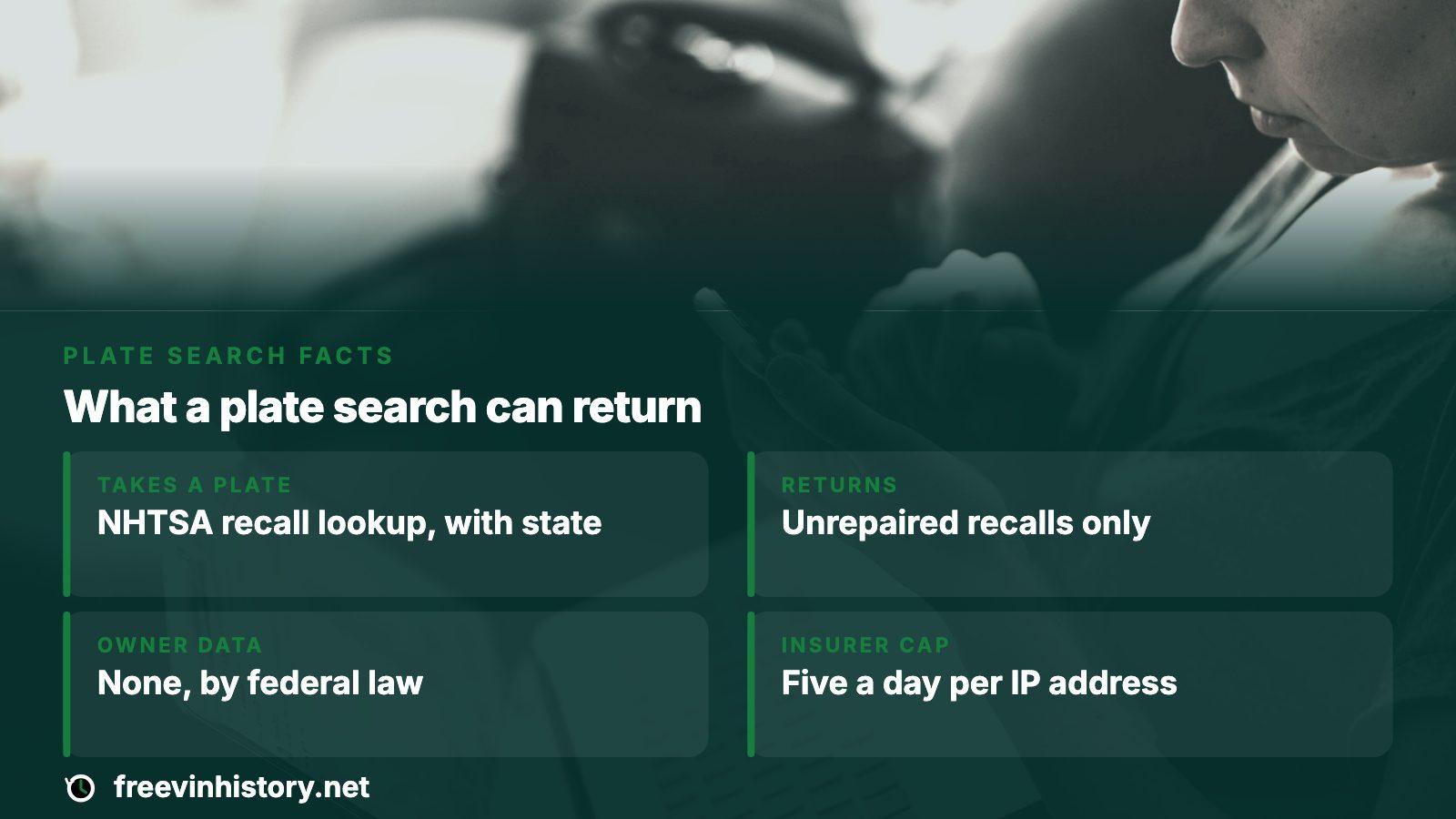
NHTSA's Check for Recalls page has a state dropdown and a plate box beside its other search fields. Entering a plate is voluntary, and the result is narrow: whether that specific vehicle needs a recall repair. If none is open, the page says so in a line that mentions zero unrepaired recalls.
NHTSA says the plate data comes from state motor vehicle departments. When the search returns the wrong car, usually because the plate moved from a previous owner's vehicle, the fix is a call to the state DMV, and the quick workaround is a search by VIN.
A wrong match is a clue, not a glitch
If the plate on the seller's car pulls up a different make or model, stop and ask why. It may be a stale record, a swapped plate or a story that does not hold together.
What that recall search leaves out
The government page lists its own blind spots. Knowing them stops you from reading a clean result as a clean car.
| Not shown by the plate or VIN search | Why it matters to you |
|---|---|
| Recalls already repaired | You cannot tell from here whether the fix was done properly or just paid for |
| Brand-new campaigns whose VIN lists are incomplete | A clean result today can change within weeks |
| Recalls older than 15 years | Matters on an older car, unless the maker extends coverage |
| Small-maker and specialty recalls | Low-volume brands may sit outside the data |
| Non-safety campaigns and international vehicles | Imports and goodwill repairs need a dealer call |
Step two: get the VIN without a lookup
Everything else in the free toolbox wants the 17 characters. You do not need a database to get them. Ask the seller to read or photograph the number, then compare it against the physical car.
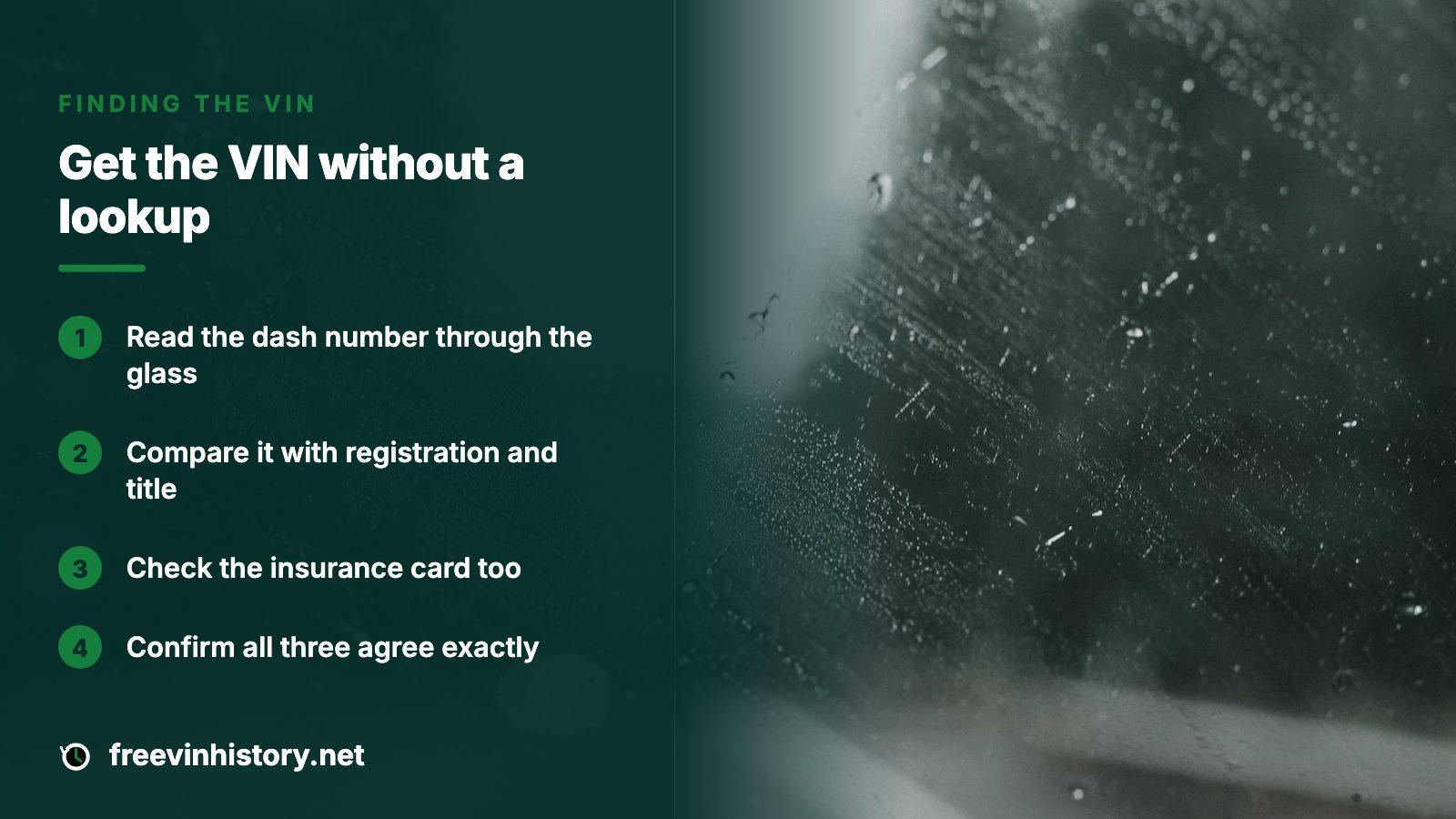
- From outside the driver's door, read the number on the dashboard corner through the glass.
- Compare it with the registration card and the title; all three should agree exactly.
- Check the insurance card, where a VIN is often printed as well.
- Hesitation over the VIN from a seller who freely recites the plate is itself information.
A mismatch between the windshield and the paperwork is worth walking away from before any report is run.
Step three: the free searches that need the VIN
NICB's VINCheck is the next stop. It reports whether member insurers flagged the car as stolen with no recovery, written off as salvage, or water damaged. The data comes from insurers covering 92.49% of U.S. earned premium, so a miss is possible. NICB allows five searches in a 24-hour window per IP address, though lookups stay unlimited over time.
NICB itself says this lookup cannot stand in for a complete history report. It does not query police files or insurers that opted out, and a mistyped VIN can hide a match.
- NHTSA by VIN: the same recall check, minus any plate mismatch risk, and up to 100 VINs in one batch.
- NICB VINCheck: insurer-reported theft, salvage and flood hits.
- The preview on this site: a tally of the record types found for that VIN, before any payment.
Why no free source names the owner
The federal law at 18 U.S.C. 2721 forbids a state DMV to knowingly hand out personal details held in its motor vehicle files, with exceptions listed in the same section. Those uses include government work, safety and theft matters, insurer claims and antifraud work, court proceedings, and notices to owners of towed cars. Curiosity about a stranger, or a seller you have not met, is not among them.
States follow that rule on their forms. Texas takes title and registration histories on Form VTR-275, sent by mail or handed in at a regional office, with identification attached. California tells the public that home address and Social Security number are not public record, and sends requests for someone else's vehicle record to form INF 70.
If you have a lawful reason
A crash, a legal dispute or an insurance claim goes to officers, your own insurance company or a lawyer, any of whom can request records when a permitted use applies. A site that promises a name for a plate is promising something the statute does not let a consumer have.
Reading what the free steps tell you together
Line up the answers. An open recall with a clean NICB result is a repair appointment, not a deal breaker. A salvage or flood hit from NICB means pausing the purchase until the seller shows repair paperwork and a clean title. No flags anywhere proves less than it feels like, because each free tool sees a single slice of the car's life.
Title brands, odometer readings and past owners sit in records none of these searches touch. The federal title database, NMVTIS, exists to stop stolen and dangerous cars from returning to the market. Its consumer reports come from approved providers at a price.
When the full report is worth paying for
Run the preview here first, since it costs nothing and tallies the title, damage and auction records it finds for that VIN. If the car survives that look and you are still serious, the report is a single purchase and never renews. Amounts sit on the pricing page, and only the preview costs nothing.
Skip the spend when a free step already ended the deal: a mismatched VIN, a total-loss flag, or a seller who refuses to give you the number.
Where this information comes from
- NHTSA: Check for Recalls — The plate and state search, what it returns and the list of recalls it leaves out.
- NICB: VINCheck lookup — Theft, salvage and flood flags from member insurers, its daily cap and its own caution.
- U.S. Code: 18 U.S.C. 2721 — The federal limit on releasing DMV personal information and the permitted uses.
- vehiclehistory.gov: NMVTIS — What the national title system is for and where its reports come from.
- TxDMV: Open records — How Texas takes vehicle record requests on Form VTR-275.
- California DMV: Records request — Which form covers someone else's vehicle record and what stays confidential.
Sources and photos: Facts checked against the sources above in November 2026. Photos by A n v e s h, Cole Keister and Michal Biernat on Unsplash; diagrams by FreeVINHistory.
Keep reading
- Free open recall check by VIN: GM, Polaris and every other makeThe recall search in more depth, including what to do about an open one.
- Free stolen car check online: what each lookup coversHow the theft side of the VIN check works and where it stops.
- Driver's Privacy Protection Act: why a VIN check never names the ownerThe federal privacy law behind every DMV refusal, explained plainly.
- Car title search by VIN free: what you can see before you payTitle questions once you hold the VIN in hand.
Frequently asked questions
Is there a truly free license plate lookup?
One official search takes a plate: NHTSA's recall page, which also asks for the state. It reports unrepaired recalls on that vehicle and nothing about owners, accidents or title brands. Other free tools, such as NICB VINCheck, need the VIN, not the plate.
Can I find the owner's name from a plate for free?
No lawful free source gives a stranger an owner's name. Under federal law a state DMV may share personal records only for a defined set of purposes, and idle curiosity is not one. Police, insurers and attorneys can request records when their reason qualifies.
How do I get a VIN from a license plate?
The reliable way is to ask the seller. Read it from the dashboard corner by the driver's door, the registration and title, or the insurance card. NHTSA's plate search can confirm recalls, but it is not meant to hand you a VIN.
Why did the recall search show a different car than the one I am buying?
NHTSA says plate information comes from state motor vehicle departments. A plate that moved from an old vehicle to a new one can keep pointing at the old record. Search by VIN instead and ask the seller about the plate history.
Is a free check enough before I buy?
It is enough to rule a car out, not to clear it. NICB warns that a clean result proves little, and the recall search omits repaired and older campaigns. If the car passes, the preview and then a paid report cover title, damage and odometer records.
Now check the car itself
The guide explains what to look for. The report shows what this VIN has on record.