THE SHORT ANSWER
The 1994 federal DPPA means a DMV cannot share identifying details held in title, registration and license files without a listed purpose or the person's signed consent. Vehicle facts such as recalls, brands and theft status are not personal information, so a VIN check can report them while owner names and addresses stay private.
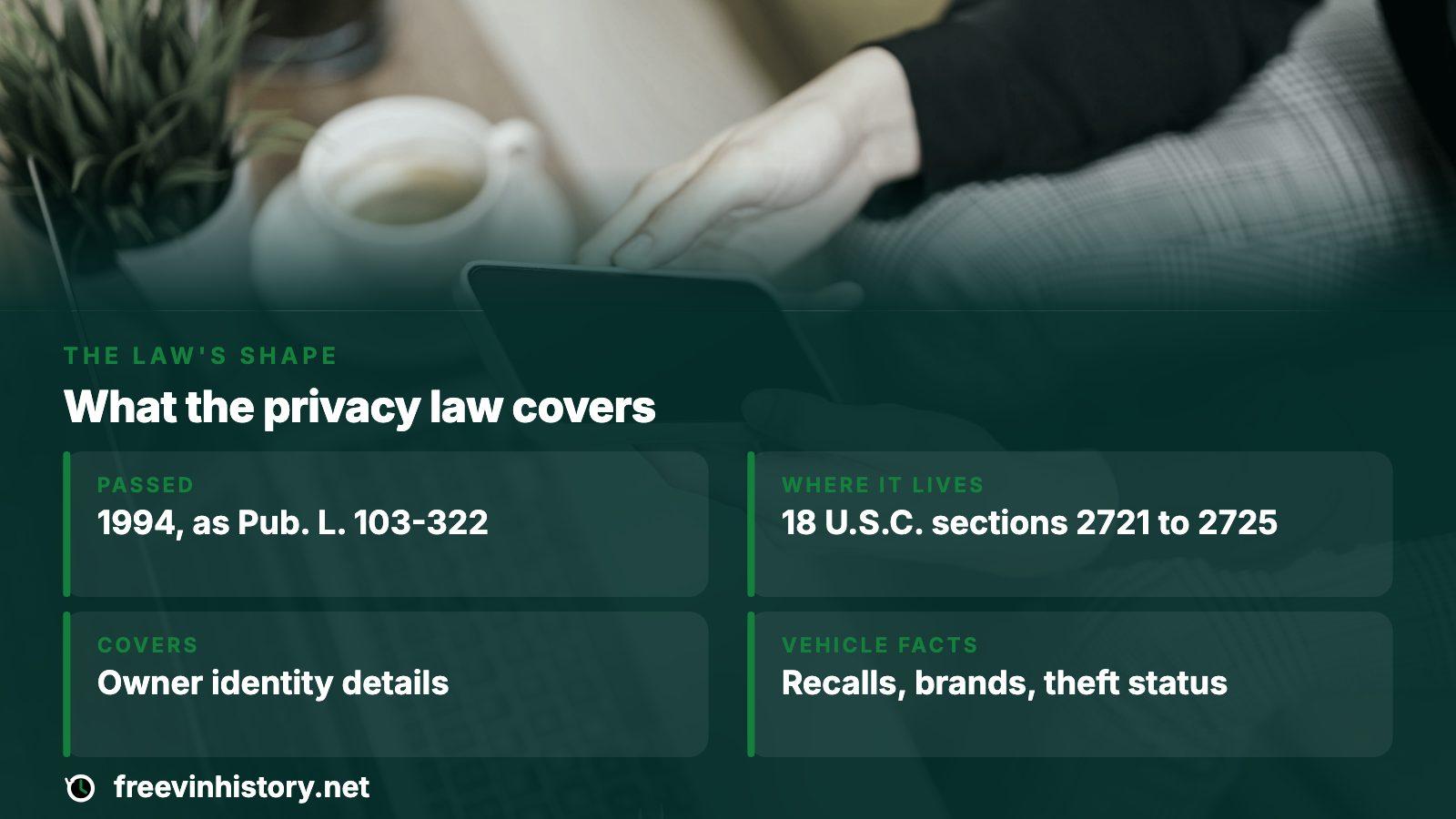
- Passed
- 1994, as Pub. L. 103-322
- Where it lives
- 18 U.S.C. sections 2721 to 2725
- Civil floor
- At least $2,500 in liquidated damages per successful suit
- Covers
- Owner identity details
What the law actually does
Congress wrote the act in 1994 and placed it in the criminal code. Its core rule sits in section 2721: no state DMV, nor anyone working for or under contract to it, may knowingly make identifying details from those files available, unless the situations the statute lists apply.
A motor vehicle record, in the law's definition, is anything tied to an operator's permit, a vehicle title, a registration or a state ID card. So the rule reaches the same files a used-car buyer would love to read: the title application, the registration history and the license behind them.
The law is aimed at the agency and at anyone who obtains the data. It does not stop a buyer from learning about the vehicle itself. That split between the person and the machine explains most of what a free check can and cannot show.
Personal details versus vehicle facts
The statute defines personal information as data that identifies an individual. Its examples run from photos and Social Security numbers to driver ID numbers, names, street addresses, phone numbers and health or disability data. The five-digit ZIP code is left out of the definition.
Information about vehicular accidents, driving violations and a driver's status is also carved out. A narrower tier, called highly restricted personal information, covers photos, Social Security numbers and medical details, and it needs the person's own written consent for nearly every use.
| Detail | Treated as | Reaches a buyer? |
|---|---|---|
| Owner name and street address | Personal information | Not through a VIN check |
| Driver ID number or photo | Personal or highly restricted | No |
| Open recall on the VIN | Vehicle data | Yes, from NHTSA |
| Title brand or theft flag | Vehicle data | Yes, from approved sources |
Who is allowed to obtain the records
Section 2721(b) lists the uses that allow personal information out. Several are routine and have nothing to do with a shopper. A few are close enough to car buying that readers often ask whether they apply to them.
- Agencies, courts and police carrying out official work.
- Insurers and insurance support groups handling claims, fraud checks, rating or underwriting.
- Safety, theft, emissions, recall and market-research work.
- Tell-the-owner notices after a tow or impound.
- Lawsuits and arbitration, including delivering court papers.
- Licensed private investigators, for a purpose the section allows.
- A requester who can show signed approval from the person in the file.
Curiosity about a seller, wanting to know the previous owner, or checking a stranger's car are not on that list. A buyer who simply wants a cleaner purchase has no permitted use of that kind.
Penalties for misuse
Section 2722 makes it unlawful to obtain or disclose the data for a use the law does not allow, and equally unlawful to lie in order to get it. Section 2723 sets a criminal fine for knowing violations. A state agency that routinely ignores the law risks a daily civil penalty, capped at $5,000, enforced by the Attorney General.
Section 2724 hands the individual a private claim. Someone whose record was obtained for a forbidden purpose can sue in federal district court, and the court may award actual damages, with a floor of $2,500 in liquidated damages, with punitive damages and attorneys' fees possible when the conduct was willful or reckless.
Why this matters to a buyer
Any site promising an owner name from a VIN or a plate is asking you to take part in a request the law restricts. The risk of a forbidden request falls on whoever obtains the data, not only on the seller of the lookup.
Why report sellers cannot simply resell the files
Section 2721(c) puts a leash on anyone who receives the data. Resale or redisclosure is allowed only for a purpose the act permits, and the reseller must keep a log for 5 years showing who got the data and why.
That is a heavy compliance duty, and it is one reason consumer vehicle history products are built around the vehicle. They report brands, odometer readings, salvage events and recalls tied to a VIN. The person who owned the car at each step is not part of the product.
Federal title data works the same way. The National Motor Vehicle Title Information System, run for the Justice Department, was built to guard consumers against title fraud and hazardous vehicles and to keep thefts from being resold. Its purpose is vehicle history, not a directory of owners.
What a free check can still tell you
Because the act protects people and not cars, the free tools remain useful. NHTSA's recall data is searched by make, model and year, returns campaign numbers and remedies, and costs nothing. It says nothing about who drove the car.
Free insurer-based theft and salvage searches and the state title or lien pages fill in other pieces. Expect to see status, not identity. When a DMV page returns only a lienholder or an issue date, the privacy law is a big part of the reason.
The free preview on this site follows the same line. It tallies what the VIN carries, such as title and auction records, which helps you weigh whether a full report is worth buying. The paid report then adds the detail about brands, odometer readings and damage, still without naming an owner.
Lawful ways to learn what you need
Most buyers do not need the owner's identity at all. They need to know whether the car is safe, whether the title is clean and whether the seller has the right to sell. Those questions have direct answers that do not touch the law's restricted data.
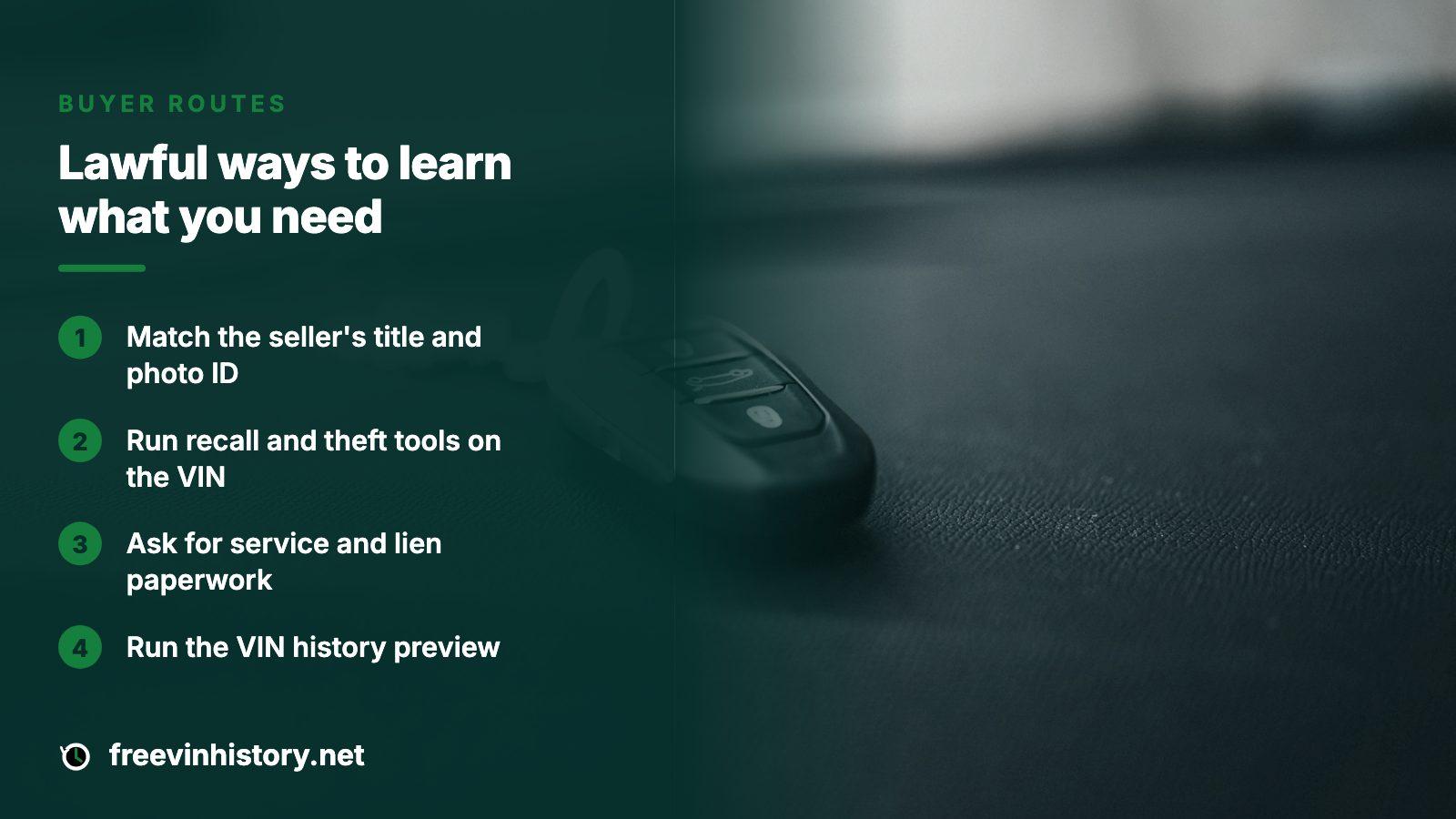
- Have the seller produce the title and a photo ID, then confirm the names agree.
- Run the VIN through the free recall and theft tools before you drive out.
- Ask the seller for service records and any lien paperwork.
- Run the full report once one car is a real candidate.
- Call the DMV about its own title procedures if the paperwork looks off.
If you truly have a permitted purpose, such as a lawsuit, the route runs through the DMV's formal records request, where you state the purpose and sign for it. Check the current form and fee with your state agency.
Red flags when a site promises owner data
Watch for lookups that say they reveal a previous owner's name, phone or address from a VIN or a plate. The statute does allow the data to flow for listed uses, but a consumer checkout page rarely proves any of them.
- A promise of the current owner's contact details for any buyer.
- No question about why you want the information.
- A preview that blurs a name and asks for payment to reveal it.
- No mention of the permitted-use rules anywhere on the page.
A reputable history product describes the car and says openly that it leaves out personal details.
Where this information comes from
- U.S. Code, 18 U.S.C. chapter 123 — The statute text: prohibition, permitted uses, penalties and definitions.
- National Motor Vehicle Title Information System — The federal purpose behind title data and where a report is sold.
- NHTSA recalls API — Shows recall data is organized around vehicles, not owners.
Sources and photos: Facts checked against the sources above in November 2026. Photos by Annika Wischnewsky, Bence Balla-Schottner and Jakub Żerdzicki on Unsplash; diagrams by FreeVINHistory.
Keep reading
- Free license plate lookup: the one official search, then the VIN stepsWhat a plate can and cannot lead to under the same law.
- Free previous owners check by VIN: what you can see and what stays privateHow to count past owners without learning who they were.
- Free VIN check through the DMV: what a state agency will and will not showWhat state agencies release for free.
- NMVTIS report: what the federal title record shows and missesThe federal title data a history report draws on.
Frequently asked questions
What is the Driver's Privacy Protection Act in simple terms?
It is a federal law from 1994 that limits what a state DMV may share about the people in its files, including names, addresses and photos. Exceptions need a listed purpose or the person's written agreement. Vehicle facts are outside that protection.
Can I find the previous owner of a car by VIN?
Not through a consumer VIN check. Owner identity is personal information, and the law restricts it to listed uses. A history report can show how many owners a car had and how it was used, which is usually what a buyer needs.
Does the act stop me from running a VIN check?
No. The act protects individuals, not vehicles. Recalls, brands, theft status and odometer readings are vehicle data, so checking them is fine. The restriction applies to personal details that identify the person on the record.
What happens if someone misuses motor vehicle records?
Knowing misuse can bring a criminal fine, and the person whose record was obtained can sue in federal court. Damages can include at least $2,500 in liquidated damages, punitive damages in willful cases and attorneys' fees.
Is a license plate lookup covered by the same rule?
Plate records at the DMV are motor vehicle records, so the same limits apply. A plate may help trace a VIN through a lawful request, but the owner's details stay protected unless a permitted use applies. Run the VIN once you have it.
Now check the car itself
The guide explains what to look for. The report shows what this VIN has on record.