THE SHORT ANSWER
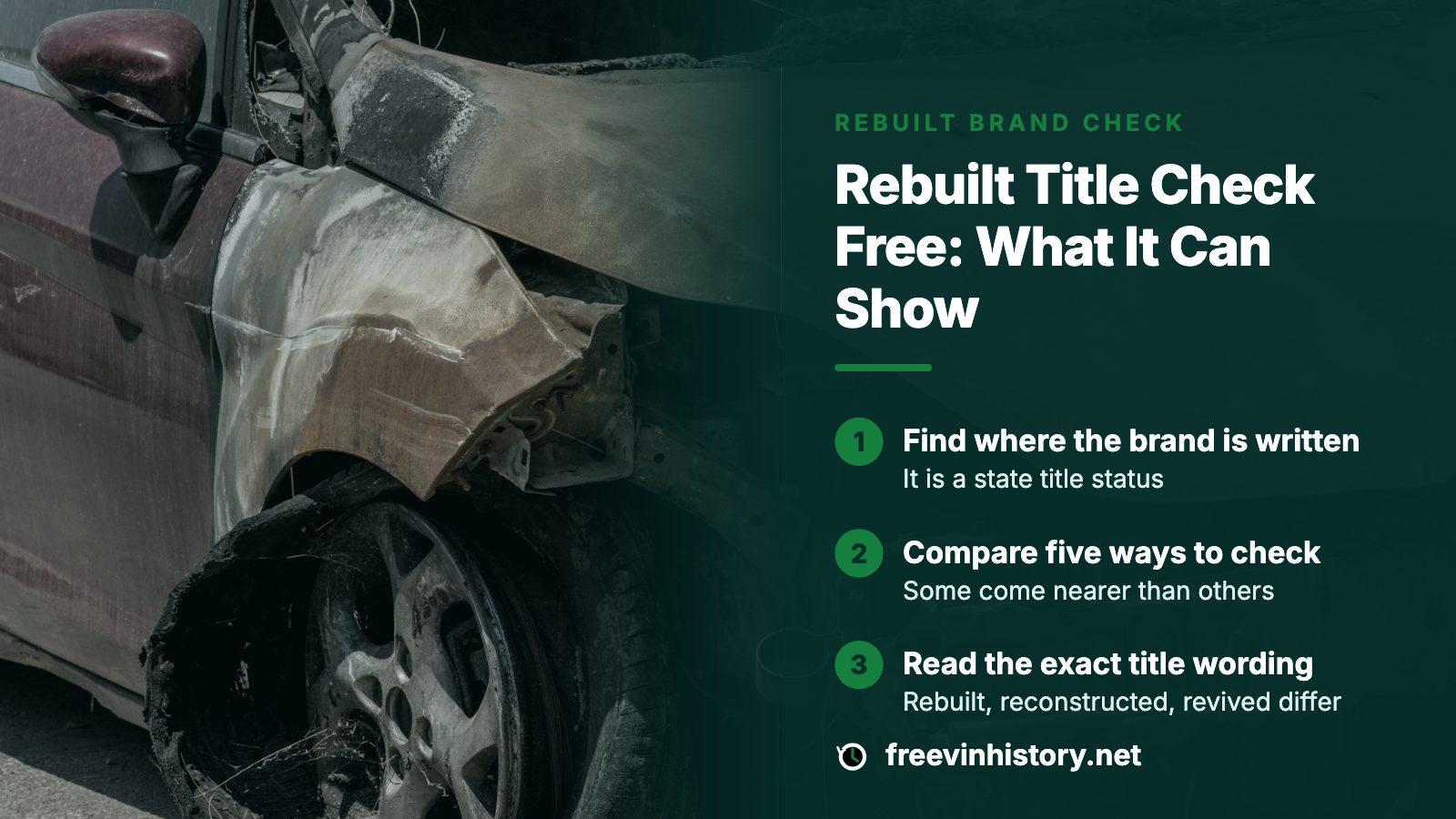
Partly. The rebuilt brand is a state title status, and the national title record that carries it is sold by approved providers rather than given away. At no cost you can read the title itself, search NICB's VIN database, and run the FreeVINHistory preview for title and auction record counts. Buy the full report once one car is worth pursuing.
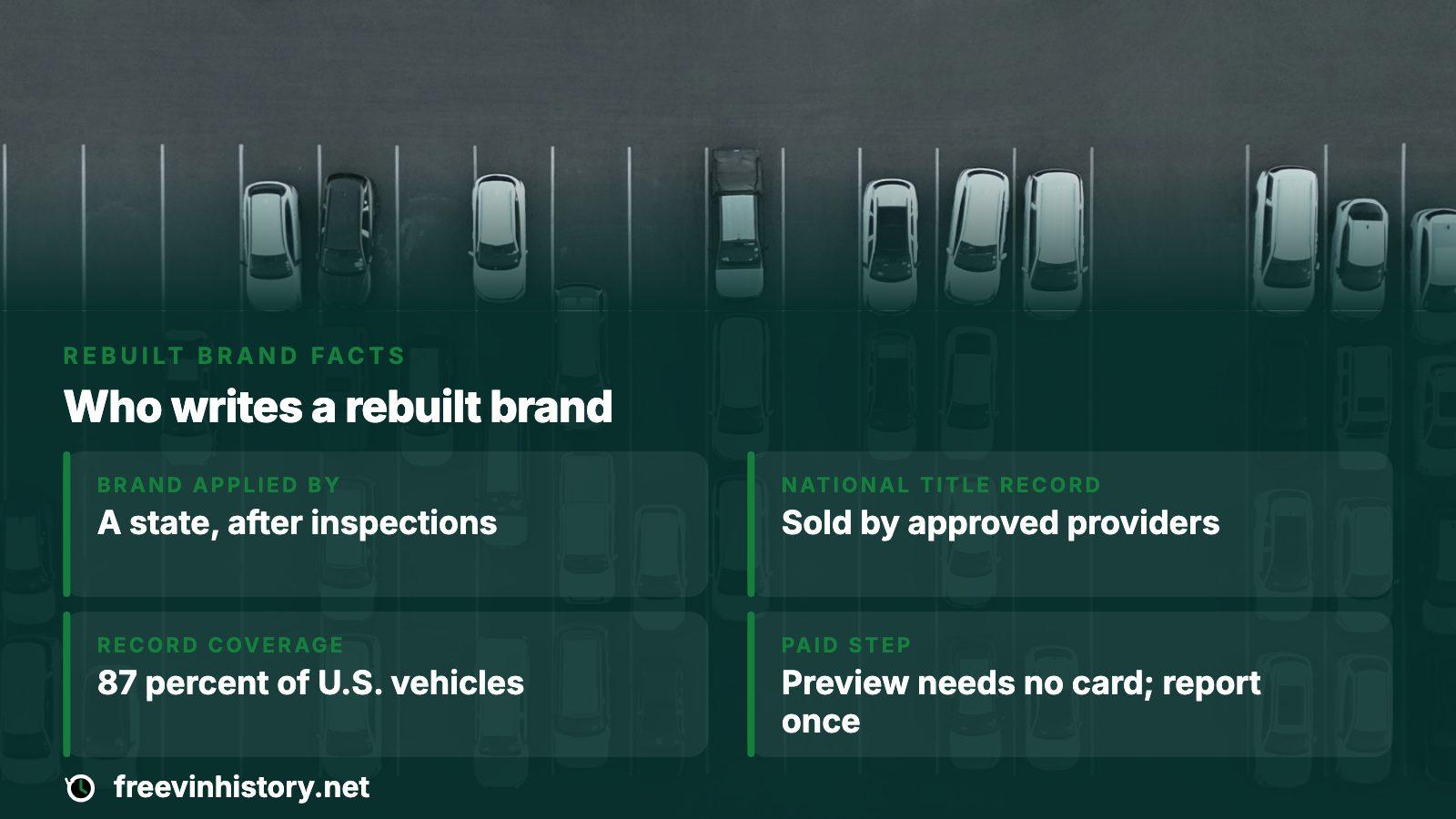
- Who applies the brand
- A state, after safety and anti-theft inspections
- National title record
- Sold by approved providers; DOJ puts coverage at 87 percent of U.S. vehicles
- No-cost pieces
- Paper title, NICB VIN search, FreeVINHistory preview
- Paid step
- Preview needs no card; the report is one payment
Where a rebuilt brand gets written down
Rebuilt is the second half of a two-step story. A car first earns a salvage brand, the stage where repair costs have passed a retail-value percentage that the jurisdiction sets. Someone then fixes it, the state's safety and anti-theft inspections pass, and the title is reissued with a new label. TxDMV also calls that stage prior salvage, and on a Texas title it reads Rebuilt Salvage.
That timeline explains why no-cost tools struggle with it. The label comes from a state, and the wording shifts a little from one state to the next. A brand does stay on a car's national NMVTIS record after a state applies it, DOJ explains, yet states differ on what earns one, so a damaged car may wear a brand in one state and arrive clean in the next.
Five ways to check, and how near each gets to the brand
| Route and cost | What it can tell you | What it misses |
|---|---|---|
| The title in the seller's hand: no cost | The wording the issuing state printed. California prints the brand in a red box headed VEHICLE HISTORY, at the top right of its newest title | Only that state's label, and nothing about how the car was repaired |
| Your state's own title check: cost varies | In Texas the official page hands you to approved NMVTIS providers, so the lookup is a paid one | Whatever the provider's report leaves out |
| NICB's VIN database: no charge | Per the Justice Department's tips page, it covers flood damage and other information and can be searched by VIN | It is not described as a source of state title brands |
| FreeVINHistory preview: no card | Tallies of title and auction records for the VIN | The records themselves, until the full report |
| NMVTIS report from an approved provider: the provider's fee | Brand history, the latest odometer reading, insurer total-loss decisions, salvage-yard transfers | States that have not reported yet, and any repair detail |
Only the paper title and the NMVTIS-style report speak to the brand directly.
Running the no-cost pass on one car
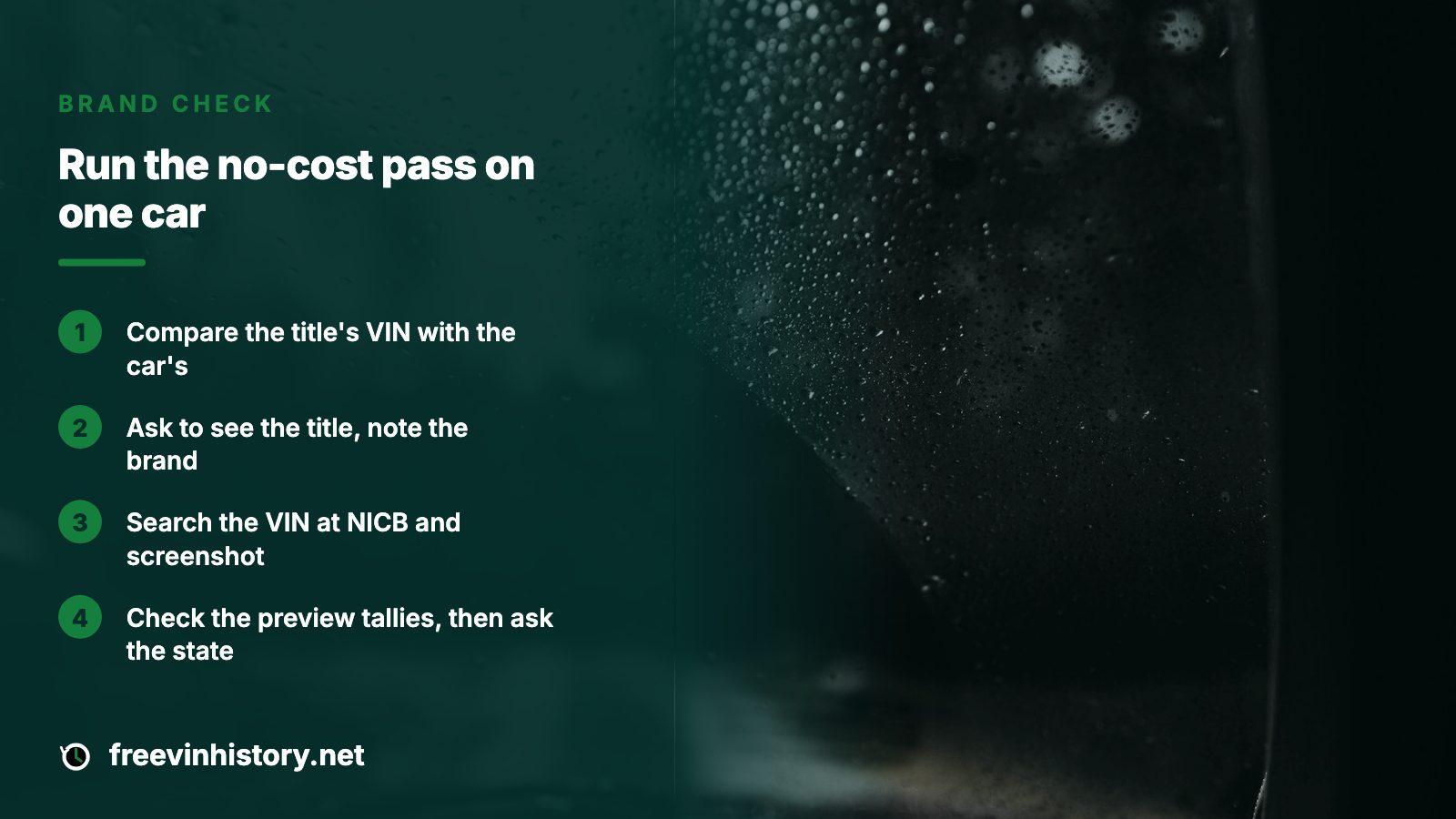
- Compare the title's 17 characters with the VIN stamped on the car itself; a VIN in a listing is only the seller's word.
- Ask to see the title before price comes up. Note the brand box and which state issued it, since wording differs by state.
- Search the VIN at NICB and save a screenshot with the date.
- Enter the VIN in the preview and see whether the title and auction tallies sit above zero.
- If a tally is above zero, or the seller's story and the paper disagree, get the state's title record or the full report before a deposit changes hands.
Stop after step four and you hold a screen, not a history.
What each answer means for a possible rebuilt car
| What you see | How to read it | Next move |
|---|---|---|
| The title says rebuilt and the seller never said so | A disclosure gap. California says sellers must disclose salvage history by law, but admits it is hard to enforce on cars from other states | Ask in writing what caused the original brand |
| Preview tallies are above zero and the seller says clean | Records exist that the seller has not described | Read the title entries and dates in the full report |
| Every source is quiet | Nothing reached these sources. The Justice Department warns a search can return a false negative | Request the state title record and book a mechanic |
Rebuilt, reconstructed, revived: read the exact wording
TxDMV's pages show how many neighbors the word has: Rebuilt for a former salvage car, Prior Owner Retained for a car once branded Owner Retained and then sold, and Prior Non-Repairable or Repaired for one built back from a car declared beyond repair. A separate TxDMV list files Reconstructed under custom vehicle and replica, and California lists Rebuilt and Reconditioned as common brands.
From an NHTSA owner complaint
A 2019 Ram 1500 owner told NHTSA the steering stopped turning at their driveway and a service message lit the dash. Earlier recalls had been done, the owner says, and the truck carries no warranty because a previous wreck left it with a reconstructed title. It was repaired at 1,492 miles and showed 4,347 when the complaint was filed.
The word on that title was reconstructed, not rebuilt, and by the owner's account it still shaped what the truck was covered for. Check the exact wording, then ask what coverage the maker gives cars carrying it.
What the brand can cost once you own the car
TxDMV says rebuilt cars are often denied insurance, and it puts their market value substantially below that of similar cars, every time, without naming a percentage. It also warns the bill for fixing a problem may exceed what the car is worth. Ring your insurance agent, VIN in hand, before talking money.
From an NHTSA owner complaint
A 2018 Hyundai Tucson owner described a highway climb on a 6 percent grade where the car stopped accelerating and the engine stalled, with no warning light first. The odometer stood near 65,000 and the owner kept up the servicing. The dealer said the engine needed replacing, the owner says, and warranty cover was refused because the title was rebuilt after hail damage, with "no crash or flood damage."
A brand that came from weather alone still counted, by this owner's account. Ask the seller what caused it, and ask the insurer and a dealer service desk how they treat that kind of title before you commit.
The repair is the part no lookup covers
A brand says a car was repaired and inspected, not how well. Texas lists three questions: how bad the damage was and who did the work, whether the frame came back aligned, and whether an independent, qualified mechanic examined the car. TxDMV warns that some repairers make replacement parts from damaged ones or welded pieces, and that a bent frame strains the drivetrain, tires and brakes.
California's DMV adds clues you can check on a walk-around:
- A VIN plate fixed with anything but rivets
- Airbag covers that were resealed or poorly fitted
- NHTSA labels missing from the doors, under the hood, or on the tailgate or hatch
- The restraint-system warning light glowing all the time
- Rust, mold or mud beneath the carpet in the trunk
- Heavy repair marks on the structure inside the fenders
Pick the mechanic yourself. The seller's shop has a stake in the answer.
When the preview ends and the full report starts
The FreeVINHistory preview needs no card. For a VIN it returns tallies of title and auction records, so a count above zero tells you records exist that deserve a read. The full report opens those records: brands with their dates, damage and accident entries, auction and salvage photos, mileage readings and insurance records.
That is the step that settles a rebuilt question for one car, so it belongs after the no-cost pass and before a deposit. Payment is a one-off, and no subscription exists. A buyer weighing several cars can order 3, 5 or 10 reports at once. The pricing page carries current amounts.
Where this information comes from
- TxDMV: Rebuilt vehicles — what rebuilt means, the questions to ask, insurance and value warnings
- TxDMV: Title check, look before you buy — the brand list, where Reconstructed sits, and the provider route to a paid NMVTIS report
- U.S. Department of Justice: NMVTIS for consumers — what brands are, what the report covers, coverage share and false negatives
- U.S. Department of Justice: NMVTIS used car buying tips — NICB's database as a VIN search that costs nothing
- California DMV: Branded titles — where the brand shows on a title, disclosure rules and physical clues
- NHTSA owner complaint 11315517 — owner experience, paraphrased
- NHTSA owner complaint 11544898 — owner experience, paraphrased
Sources and photos: Facts checked against the sources above in November 2026. Photos by engin akyurt, Justin Cron and Iain on Unsplash; diagrams by FreeVINHistory.
Keep reading
- Free salvage title check by VIN: what the free lookups showThe stage before rebuilt: how salvage flags show up and where they stop.
- NMVTIS report: what the federal title record shows and missesThe federal title record that carries state brands, and how to read it.
- Car title search by VIN free: what you can see before you payA wider title check by VIN, once the rebuilt question is settled.
- Sample reportWhat a full report looks like before you pay for one.
Frequently asked questions
Can I check a rebuilt title for free by VIN?
Only in part. Read the title the seller holds, search NICB, and run the preview for title and auction tallies, all without paying. The brand itself comes from state title data, which approved NMVTIS providers sell, so confirm it there or in a full report.
Does an NICB search show a rebuilt title?
The Justice Department describes NICB's database as searchable by VIN, free, and holding flood damage and other information. It does not describe it as a state title-brand lookup. A state applies the rebuilt brand after an inspection, so look for it on the title, in NMVTIS title data or in a full report.
Is a rebuilt title always a bad sign?
Not automatically. The car cleared the state's safety and anti-theft inspections, and TxDMV says the term generally means a salvage car was repaired or restored. Quality still varies, insurers often refuse rebuilt cars, and resale value drops. Judge the repair and the price, then confirm coverage before you buy.
Why would a seller say clean when a report says rebuilt?
Rules for branding differ between states, so a car one state brands may pass unbranded through another, and the Justice Department notes a search can return a false negative. California requires sellers to disclose salvage history but calls that hard to enforce on out-of-state cars. Ask for the state title record in writing.
What does the full report cost after the preview?
The preview needs no card. The report is paid once, as a single report or in packs of 3, 5 and 10, and nothing renews. Current amounts sit on the pricing page, so check there before you order.
Now check the car itself
The guide explains what to look for. The report shows what this VIN has on record.