THE SHORT ANSWER
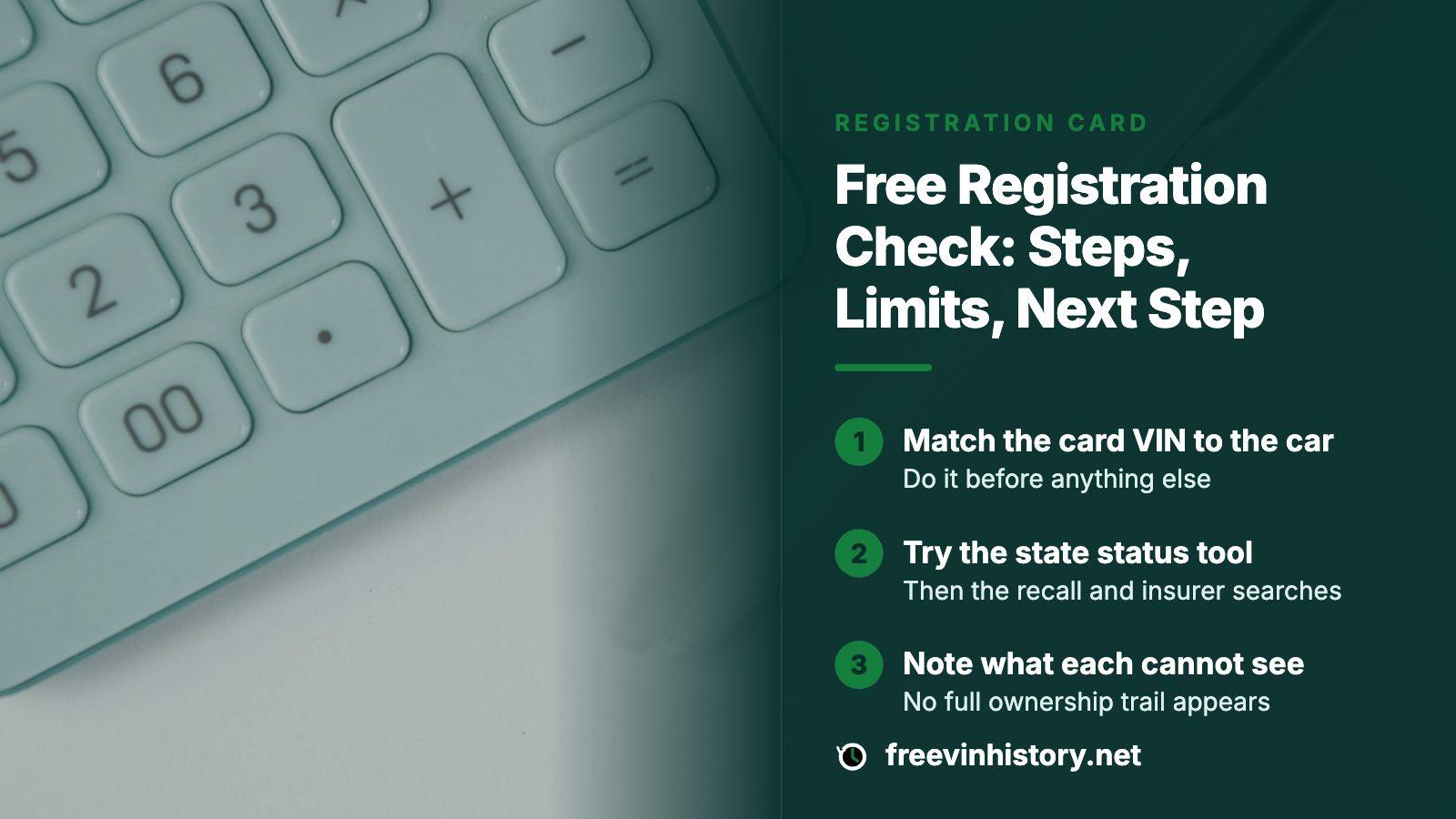
Start with the registration card and match its VIN to the car. Next, try your state's online vehicle-status tool if it has one, then put the VIN into NHTSA's recall search and the NICB VINCheck, writing down what each could not see. None of these free sources shows a full ownership trail. A report from this site, which starts with a free preview, covers the gaps in one place.
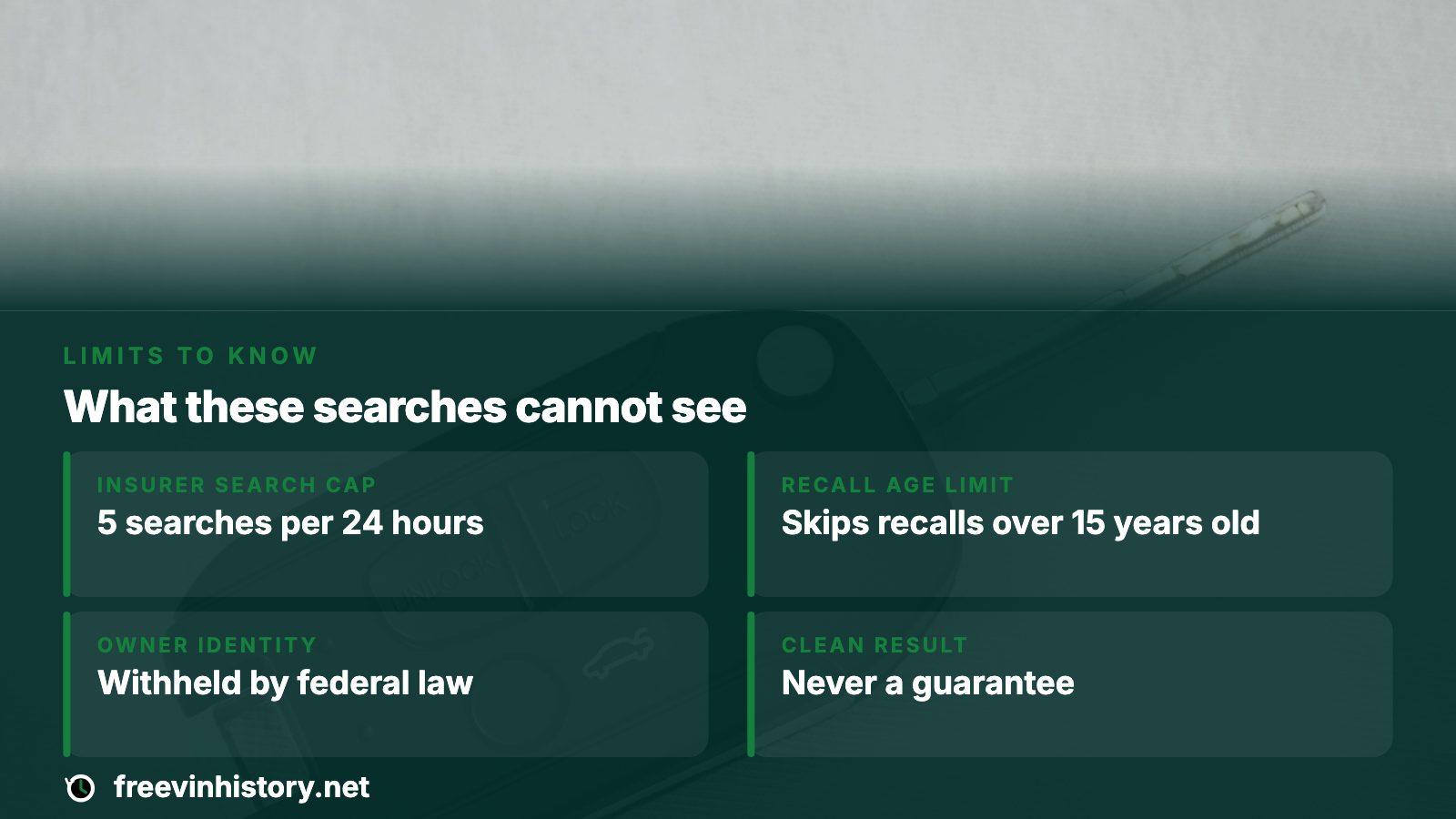
- Insurer search cap
- 5 searches per 24 hours per IP address
- Recall search age limit
- Skips recalls more than 15 years old
- Owner identity
- Withheld by federal law for ordinary buyers
- Clean result
- Never a guarantee
What people usually mean by a registration check
Most buyers who type this phrase want one of three things: proof the seller can legally put the car on the road, a way to confirm the car is the one described in the ad, or a look at who has owned it. The free tools handle the first two reasonably well. The third is mostly closed to the public, and that is by design.
Registration is the state's record that a particular vehicle is cleared for public roads. It is separate from the title, which records ownership and brands, and separate from the VIN decode, which describes the car itself. Mixing the three up is how a buyer ends up believing a single search covered everything.
Step 1: put the registration card next to the car
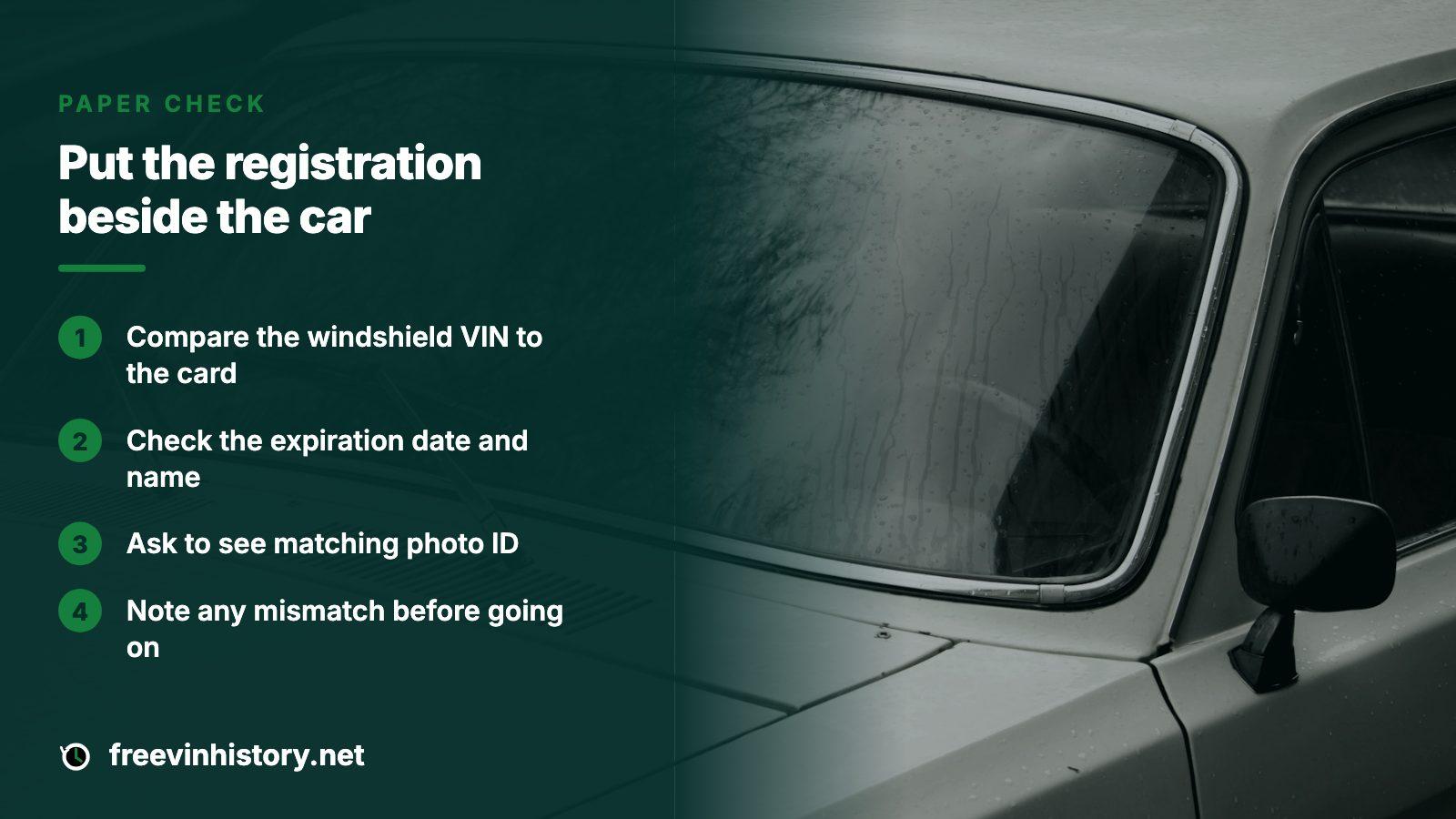
The cheapest check costs nothing and takes two minutes in the seller's driveway. NHTSA notes that the VIN appears on the registration card and may also be printed on an insurance card, so you can compare it with the number on the lower left of the windshield.
- Read all 17 characters on the windshield plate and on the card, one against the other.
- Look at the expiration date and the name on the card, then ask to see matching photo ID.
- Photograph both so you can enter the VIN later without typing errors.
A mismatch, a seller who has no card, or a card that lists a different vehicle should end the conversation until it is explained.
Step 2: try your state's own status tool
Some states publish an online lookup for vehicle status. Georgia's Department of Revenue, for example, lists a Lookup Vehicle Status service inside its DRIVES e-Services portal, next to tag renewal. Its page does not say which identifiers the lookup asks for or what the answer contains, so open the portal itself and read the screen before you rely on it.
Other states have nothing comparable, and some official pages refuse automated readers entirely, so we did not use them here. Search your state's DMV or motor vehicle agency site for terms like vehicle status, registration status or renewal. If nothing exists, the registration card in step 1 is your evidence.
Why the tool never names an owner
A federal statute bars state licensing offices from handing out the personal details in their files, with a list of exceptions: government work, safety and theft, recalls, insurers, towing notices and written consent from the person concerned. A shopper comparing used cars has no exception of their own.
Step 3: run the VIN through the federal recall search
Enter a VIN or a plate on NHTSA's recall page and it reports any repair still owed on that exact vehicle. If nothing is outstanding, the page says there are zero unrepaired recalls for the number. Weighing a stack of listings? One search takes as many as 100 VINs.
A plate search draws on state motor vehicle data, so it can show a previous vehicle that once carried the same plate. NHTSA's advice is to contact the state agency and use the VIN in the meantime. That is a good reason to give the VIN priority over the plate every time.
The search costs nothing, yet it leaves out recalls already fixed, and a brand-new campaign may not have all its VINs loaded, so an answer that looks clean today can change next month.
Step 4: run the insurer theft and salvage search
NICB's VINCheck is also free. Type in a VIN and it checks for a theft report with no recovery, or a salvage or flood label, filed by member insurers. It needs a correct 17-character VIN, so a typo can hide a match, and it limits each IP address to 5 searches in a 24-hour window.
Together, the member companies write 92.49% of U.S. earned premium, a big share but not everything. NICB is blunt about the boundaries: police files are not searched, insurers that stay out are invisible, and the tool is no full history report.
What the free stack still cannot tell you
| Free source | What it can show | What it leaves out |
|---|---|---|
| Registration card | VIN, dates, name on the paperwork | Anything the seller chooses not to hand over |
| State status portal | Varies by state, where it exists | Owner identity, and often the title record |
| NHTSA recall search | Unrepaired safety recalls for that VIN | Repaired recalls, very old campaigns, small makers |
| NICB VINCheck | Insurer theft, salvage and flood reports | Insurers that do not take part, police records |
Notice what is missing from every row: odometer history, a title brand that came from a state rather than an insurer, and any ownership timeline. Those gaps matter most on a car that has crossed state lines.
The federal title record fills part of the gap
On the Justice Department's vehicle history pages, NMVTIS is presented as a national database meant to curb title fraud and stop thieves reselling stolen cars. A consumer report from an approved provider shows the present title with any brands, the last odometer reading reported, an insurer's salvage or total-loss call, a handoff to a junkyard or recycler, and sometimes theft information.
The same government page calls these reports intentionally concise and cautions that some states and entities never report, which means a clean search may hide something. Every report points to the state's complete title file, and that is the one to open when real money is involved.
When the paid report is the sensible next step
If the free lookups come back clean and the car is cheap, you may be done. If you are sending a deposit, buying out of state, or the seller is vague about the car's past, put all of the records in one place. Start with our free preview, which hints at whether a full report has anything to find before any payment.
Our full report is a single payment with no recurring plan; see the pricing page for what is offered. Think of it as what comes after the free sources; it does not replace the registration card, the recall search or your own state's title file.
A fair sequence
Paperwork first, then the state tool, the recall page and the insurer search. Only when something is unclear, or the money at stake is large, move to the paid report.
Where this information comes from
- NICB: VINCheck lookup — member-insurer theft and salvage lookup, with its daily cap and own caveats
- NHTSA: Check for Recalls — scope of the recall search by VIN or plate, plus VIN locations
- Vehiclehistory.gov: NMVTIS for consumers — contents of a national title report and the gaps it admits
- Georgia Department of Revenue: motor vehicle services — example of a state vehicle-status lookup inside a DMV portal
- 18 U.S.C. 2721 (Cornell LII) — federal privacy statute and its exceptions
Sources and photos: Facts checked against the sources above in November 2026. Photos by Sasun Bughdaryan, Tigran Shishmanyan and Shadow Photography on Unsplash; diagrams by FreeVINHistory.
Keep reading
- Free VIN check through the DMV: what a state agency will and will not showwhat a state motor vehicle agency will and will not show from a VIN
- Car title search by VIN free: what you can see before you paythe title side of the story that registration never covers
- Free open recall check by VIN: GM, Polaris and every other makea longer walkthrough of the recall lookup from step 3
- Free stolen car check online: what each lookup coversmore on the theft records behind the insurer search
Frequently asked questions
Can I do a free registration check with only a license plate?
Only in narrow ways. NHTSA's recall search accepts a plate, but it pulls data from state records and can return a previous vehicle. Anything that promises an owner name from a plate runs into the federal privacy rule. Get the VIN from the seller or the car and search with that.
Does a registration check show who owns the car?
No, not for an ordinary buyer. Federal law limits a state agency's release of personal information to listed uses, and car shoppers are not among them. Ask to see the title and the seller's photo ID, and compare the names yourself.
Is an expired registration a red flag?
It can be. The cause might be as small as a forgotten renewal, or it might mean the car sat unused or has a problem the seller does not want to discuss. Ask why, and check the rules and renewal costs with your state agency before you agree on a price.
If NICB comes back clean, is the car fine?
No. NICB itself warns that clean does not mean guaranteed, since only member insurers supply records and police data is not searched. Use it as one signal alongside the recall search and the title record.
Is the report from this site free?
The preview costs nothing. After that, the report is a single payment, not a plan that renews; the pricing page lists the choices. Running the free sources first tells you whether the spend is warranted.
Now check the car itself
The guide explains what to look for. The report shows what this VIN has on record.