THE SHORT ANSWER
For a free travel trailer or motorhome VIN check, run three official lookups. Decode the VIN at NHTSA to confirm builder and model year, search NHTSA recalls for open repairs, then enter the VIN at NICB for insurer theft, salvage and flood entries. All three cost nothing. None reports title brands or sale history, and towables often have thin records. When one unit gets serious, FreeVINHistory's preview counts the records on file before any payment.
- Free decoder
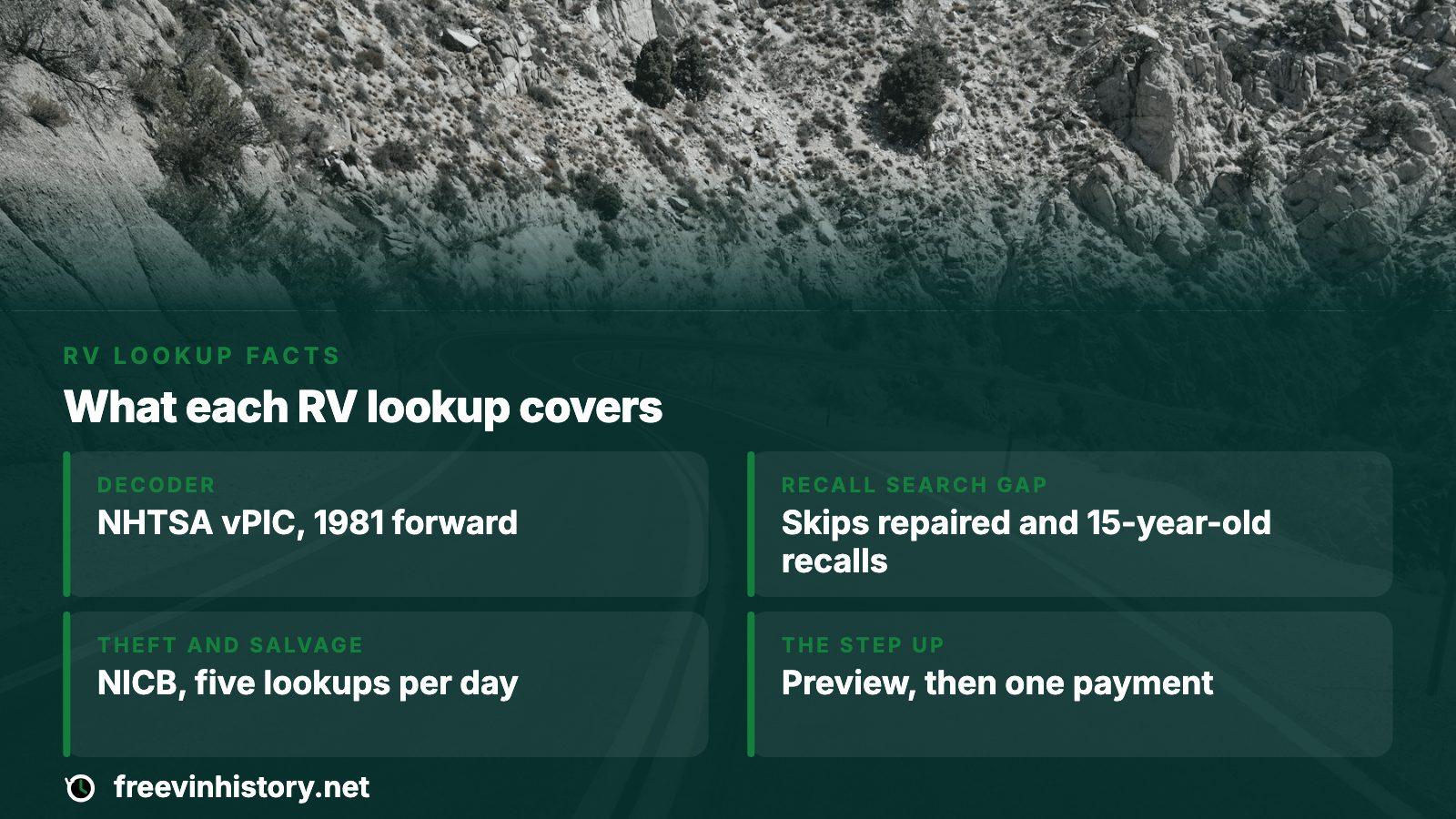
- NHTSA vPIC, model years from 1981 forward
- Recall search gap
- Skips repaired recalls and anything over 15 years old
- Theft and salvage
- NICB, five lookups per connection per day, insurer records only
- The step up
- A preview with no card, then one payment for the report
The free RV lookups and what each one answers
No single free site covers an RV end to end. Each official lookup answers one question, so the best check is the right tool for the doubt you have. Most buyers need them in the order below.
| Your question | Free tool | Catch on an RV |
|---|---|---|
| Who built it, and in what year? | NHTSA vPIC decoder | A motorhome can decode to its chassis maker instead of the coach brand |
| Is a safety repair still open? | NHTSA recall search | Leaves out repaired, brand-new and small-maker recalls |
| Was it stolen or written off? | NICB VINCheck | Insurer data only, with no partner named for trailers or motorhomes |
| What does the title say? | State record; federal title data through paid providers | Towable coverage varies, and the report itself is sold |
Read the VIN off the unit before typing anything
Listings and ad copy get VINs wrong, and one bad character sends every later lookup down the wrong road. Take the number from the rig itself.
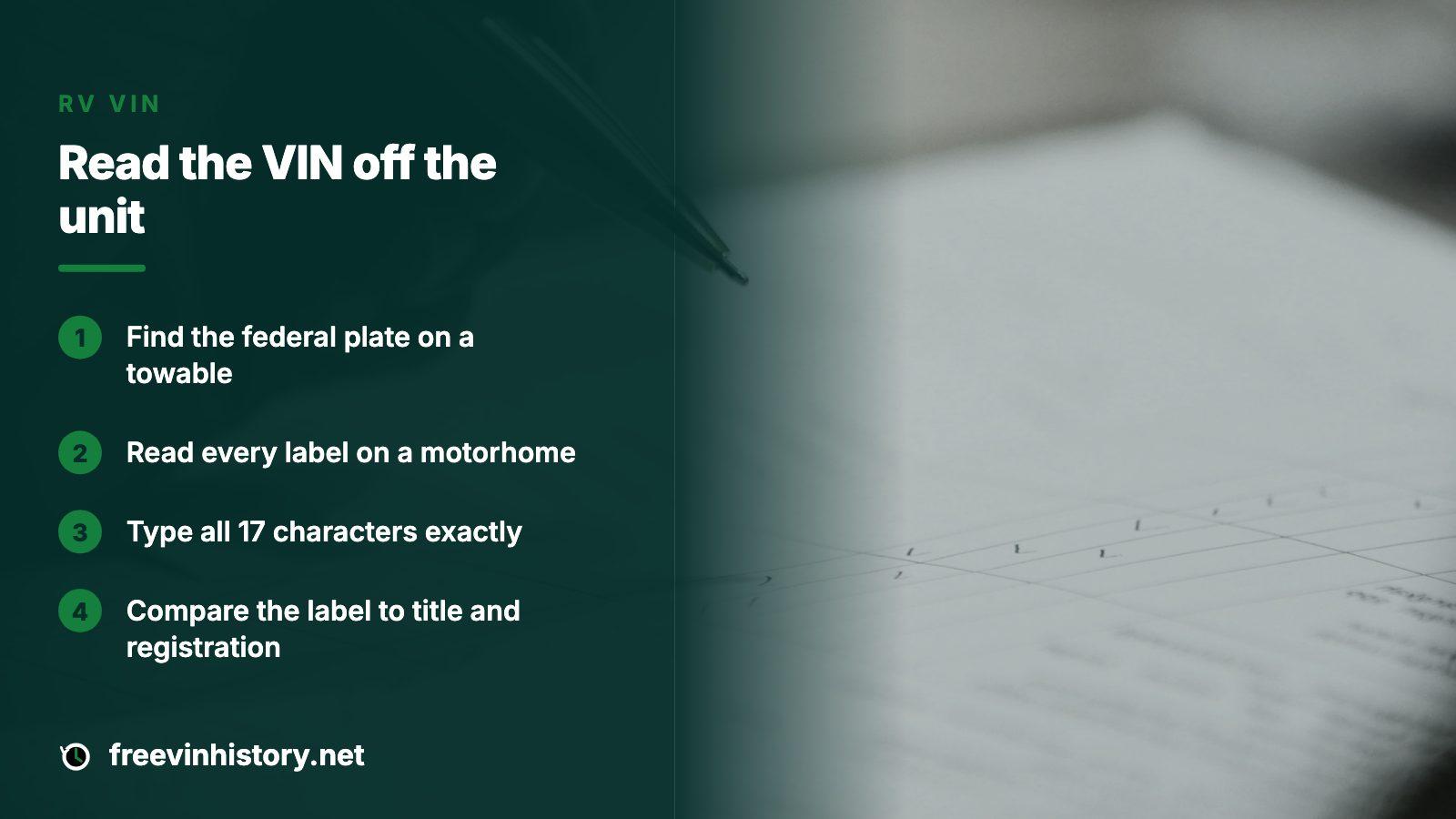
- Towable: look toward the front of the left side for the permanently fixed federal plate. The rule says it must be legible without moving anything, and pulling it off has to wreck it.
- Motorhome: a vehicle finished in stages carries several labels. The chassis maker, any intermediate builder and the final-stage builder each attach one, and each shows a VIN.
- Type all 17 characters exactly, since NICB says an incorrect VIN may fail to match a record that does exist.
- Hold the label against the title and registration. If they disagree, pause the deal and ask the seller why, in writing.
- Test the tenth character against the year the seller quotes: H stands for 2017 and N for 2022, for instance.
Decode first: the builder code says who stands behind it
NHTSA's vPIC decoder reads maker-reported data for model years from 1981 onward. In its builder register, trailer makers come back typed as Trailer, while a truck maker's code such as Ford's comes back as Incomplete Vehicle, meaning a chassis another company will finish. A motorhome VIN that starts with a code of the second kind is ordinary, because the chassis is the first stage of a two-stage build.
Two quirks help. One builder code can sit behind dozens of brand names, so a decode naming a parent builder rather than the brand on the awning is no fault. And a model year typed into the decoder that clashes with the tenth character triggers a warning, which makes the tool a quick test of the seller's story. Vehicles never meant for U.S. sale return only limited data.
The recall search is the strongest free tool, with fine print
Run by VIN, NHTSA's recall page says whether that one unit still needs a repair and prints a zero count when nothing is open. It omits repaired recalls, new ones whose VIN lists are still loading, anything over 15 years old unless the maker extends cover, and campaigns by small manufacturers.
RV recalls often hit equipment on the coach side. NHTSA lists four campaigns for one 2018 travel trailer line: an LP gas regulator, slide room screws, a power tongue jack and air conditioner wiring. Each fix was a no-cost dealer repair. If the VIN is unreadable, a lookup by vehicle year, make and model yields broader lists.
NICB VINCheck: theft, salvage and flood entries from insurers
NICB compares a VIN with theft, salvage and flood entries sent in by member insurers. It costs nothing and stops each connection at five lookups in any 24-hour stretch. Only insurance records come back, and only from insurers that take part. Police files are not searched.
Coverage is the catch for an RV. NICB describes the tool as covering insured vehicles in the U.S. plus some motorcycles and watercraft. Its page sends motorcycle, boat and commercial-truck shoppers to separate vendors and names none for motorhomes or trailers, and its latest theft analysis of recreational vehicles counts motorcycles, ATVs, snowmobiles and watercraft only. A towable that was never insured can come back clean because nothing was recorded. A salvage hit means an insurer paid a total-loss claim; the unit may since have been rebuilt and retitled.
Title records are where free checks run out
Brand history, odometer entries and total-loss records live in the federal title system, and consumers reach them through reports from approved providers, which are sold. The Justice Department's consumer page lists cautions that matter for RVs.
- The federal duty to report covers common automobiles only. Several states send more, but a towable's record may simply be absent.
- States title vehicles differently, and some exempt older ones from titling altogether.
- Some sources have not started reporting, so an empty result may be a false negative.
A thin title result on a trailer is weaker evidence than the same result on a car. Ask the state titling agency what it holds for the unit.
When the free sources disagree
On RVs, disagreement is common and informative. A decode naming a different builder than the label, or a year at odds with the tenth character, calls for a talk with the seller before anything else. Recall status can split too, as one owner told NHTSA.
From an NHTSA owner complaint
An owner of a 2022 Forest River Salem travel trailer, bought in July 2022, reported that a recall tied to fire and explosion risk was already open at the sale. By that account it went unnoticed until May 2025 and the repair is still unresolved. The maker's owner portal keeps listing the recall as open, while NHTSA's VIN search shows nothing unrepaired, and the trailer sits unusable.
Save a dated screenshot of every lookup. When NHTSA and the maker disagree, call the maker's customer line before paying; NHTSA says new recalls load VIN by VIN over time.
Where the full report picks up
FreeVINHistory's preview decodes the VIN and tallies how many title and auction records exist, with no card. If the tally shows activity, one payment buys the full report: brands with dates, salvage and auction photos, odometer readings, theft and lien entries. Sets of 3, 5 or 10 are available when several rigs are on the list. Nothing renews, and rates sit on the pricing page. On a towable, a thin preview may mean thin records rather than a clean past.
No report replaces an inspection. The FTC points out that history reports tend to catch crashes and flooding, not worn parts or mechanical faults, and that dealers need not post a Buyers Guide on most recreational vehicles, so nobody hands you the prompt to ask for one.
- Pay an RV inspector for a written report that includes make, model and VIN, and use the repair estimate to negotiate.
- Ask a motorhome seller for the chassis maker's paperwork and compare the VIN on it with the labels.
- With a dealer, treat a refused independent inspection as a reason to shop elsewhere.
Where this information comes from
- NHTSA: Check for recalls — What the VIN recall search shows, what it leaves out, and how search by make, model and year differs.
- NHTSA: vPIC VIN decoder — Model-year coverage, limits for vehicles not sold in the U.S., and the trailer VIN option.
- NICB: VINCheck lookup — Free insurer theft, salvage and flood lookup, its daily cap and the coverage NICB states.
- U.S. Department of Justice: NMVTIS for consumers — Federal title data, state differences, and why a search can come back falsely clean.
- eCFR: 49 CFR 567.4, certification label — Where a trailer's label goes and what it must state, including the VIN.
- FTC: Buying a used car from a dealer — Buyers Guide exemption for most recreational vehicles and the limits of history reports.
- NHTSA owner complaint 11727803 — owner experience, paraphrased
Sources and photos: Facts checked against the sources above in November 2026. Photos by Alexander Lunyov, Masjid MABA and Will Truettner on Unsplash; diagrams by FreeVINHistory.
Keep reading
- Best free VIN check site: what the free options really coverThe same free official lookups compared for any vehicle, with their stated limits.
- Free stolen car check online: what each lookup coversA closer look at theft lookups and how a cloned VIN slips past them.
- NMVTIS report: what the federal title record shows and missesThe federal title record that paid reports draw on, and what it holds.
- PricingHow one report is priced, including sets of 3, 5 or 10, with nothing recurring.
Frequently asked questions
Is there a completely free RV VIN check?
Three official lookups cost nothing: the NHTSA decoder, the NHTSA recall search and NICB's VINCheck. They cover the build, open recalls and insurer entries. Title brands, odometer history and sale photos come from paid reports. The preview at FreeVINHistory costs nothing too, while the report is a one-time payment.
Do these lookups work on a travel trailer VIN?
Partly. NHTSA's decoder handles trailer VINs and its register types trailer builders as Trailer, and the recall search returns results for them. NICB relies on insured-vehicle data, so a trailer never insured or never claimed on may show nothing. Read a blank as no record found, not as proof of a clean history.
Why does my motorhome decode to a truck maker?
The chassis maker builds the incomplete vehicle first, and its code begins the VIN. A coach builder finishes the job later. Federal rules have the chassis maker supply an incomplete vehicle document that names the chassis by VIN and gives weight ratings for the finished vehicle, so ask the seller to show you that paper.
How many free lookups can I run on one shortlist?
NICB caps each connection at five in a 24-hour stretch, although the total over time is unlimited, so spread a long list over several days. NHTSA's recall page can check up to 100 VINs in one batch, which suits a dealer lot or a classified page of candidates.
What does the full report add to the free checks?
It opens the records behind the preview tally: brands, auction and salvage photos where they exist, odometer readings, theft and lien entries. Payment happens once, for one report or a larger set of 3, 5 or 10, and nothing renews. Rates are on the pricing page. An inspection remains a separate job.
Now check the car itself
The guide explains what to look for. The report shows what this VIN has on record.