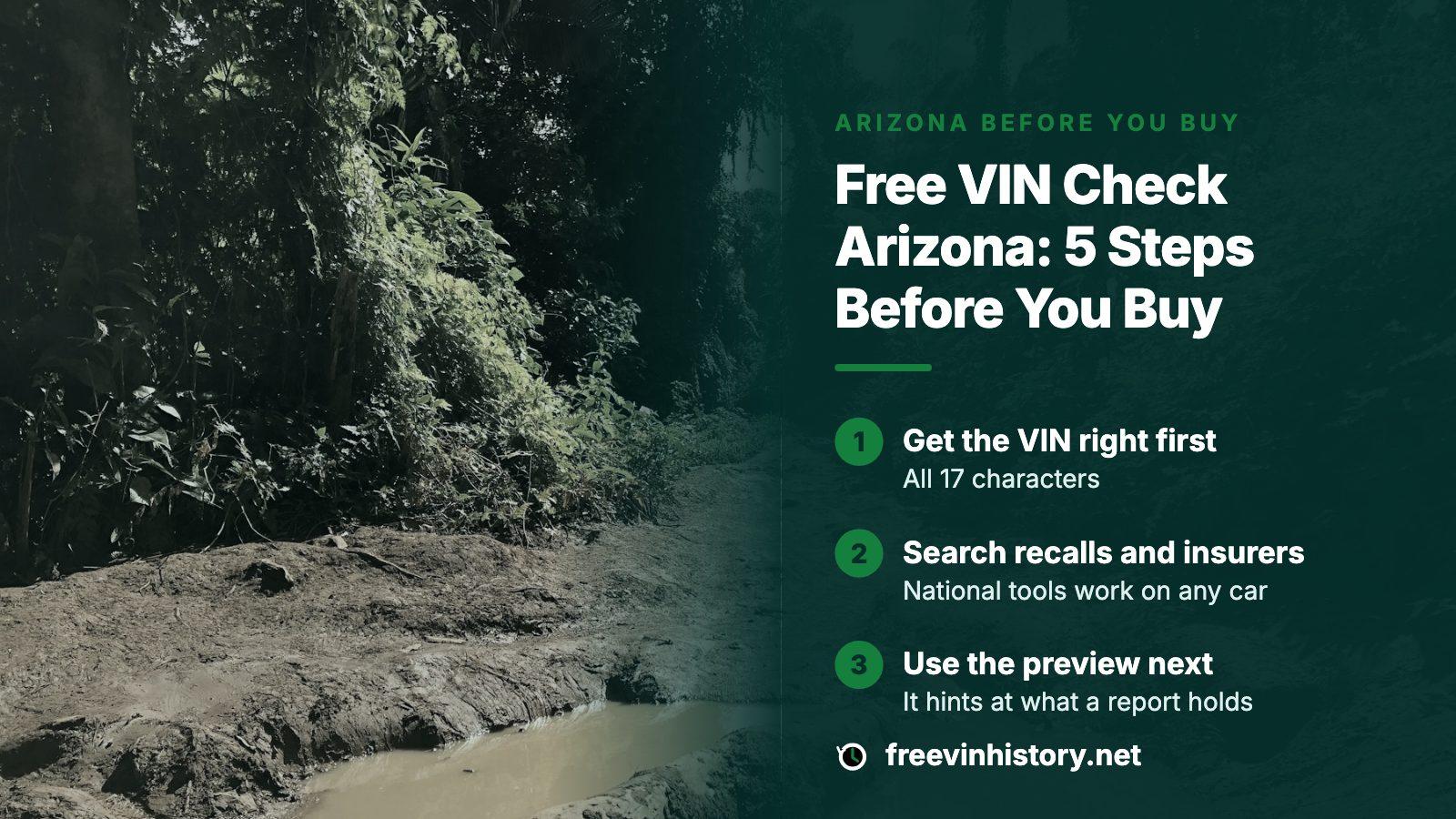
THE SHORT ANSWER
Yes, part of it. Copy the 17-character VIN, then feed it to NHTSA's recall search and NICB's VINCheck. Both cost nothing and both are national, so an Arizona car gets the same treatment as any other. Neither reads title brands or odometer history. A federal NMVTIS report covers those, and this site's preview, also free, hints at what a purchase would turn up.
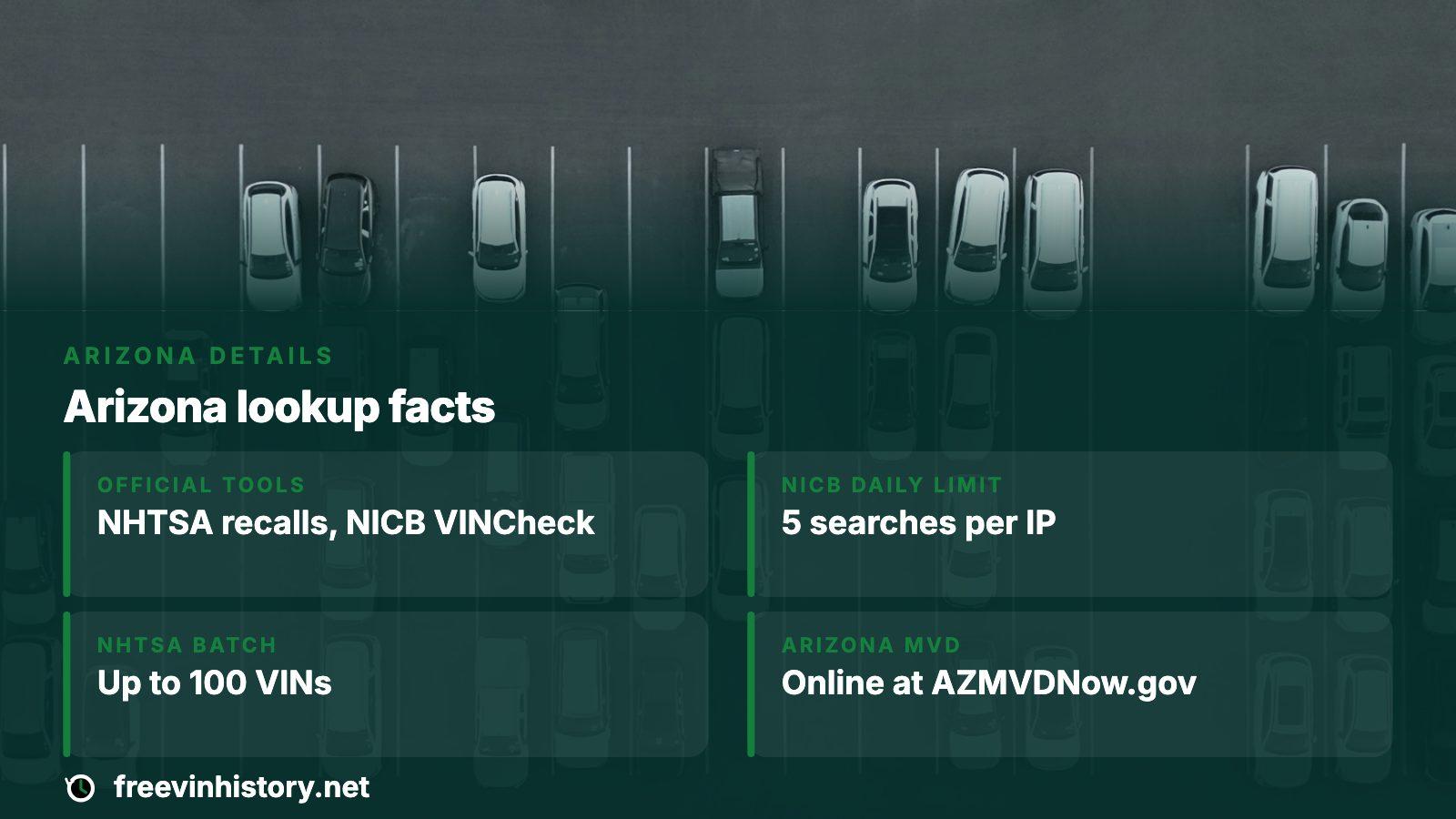
- Free tools
- NHTSA recalls and NICB VINCheck
- NICB daily limit
- 5 searches per IP address
- NHTSA batch
- Up to 100 VINs at once
- Arizona MVD
- Online services moved to AZMVDNow.gov
The sequence in one table
Think of the free check as a ladder. Each rung costs nothing until the last one, and each rung can end your interest in the car. Climb in this order and most bad cars drop out before you have spent a dollar.
| Step | Tool | Cost | Can end the deal if |
|---|---|---|---|
| 1 | Read and copy the VIN | None | Two places on the car show different VINs |
| 2 | NHTSA recall search | None | A safety recall is open and the maker has no fix |
| 3 | NICB VINCheck | None | The VIN is flagged stolen, salvage or flood |
| 4 | Free preview on this site | None | It shows records you were not told about |
| 5 | Full report, if the car survives | One payment | A brand, mileage gap or lien appears |
The rest of this page walks through each rung, with the limits of each. No step here depends on Arizona law, because these tools key on the VIN alone, whatever state the car sits in.
Step 1: get the VIN right
Every later step fails if a character is wrong. NICB warns that a mistyped VIN may simply return no match, which looks like a clean result and is not one. Take all 17 characters off the car, never from the listing.
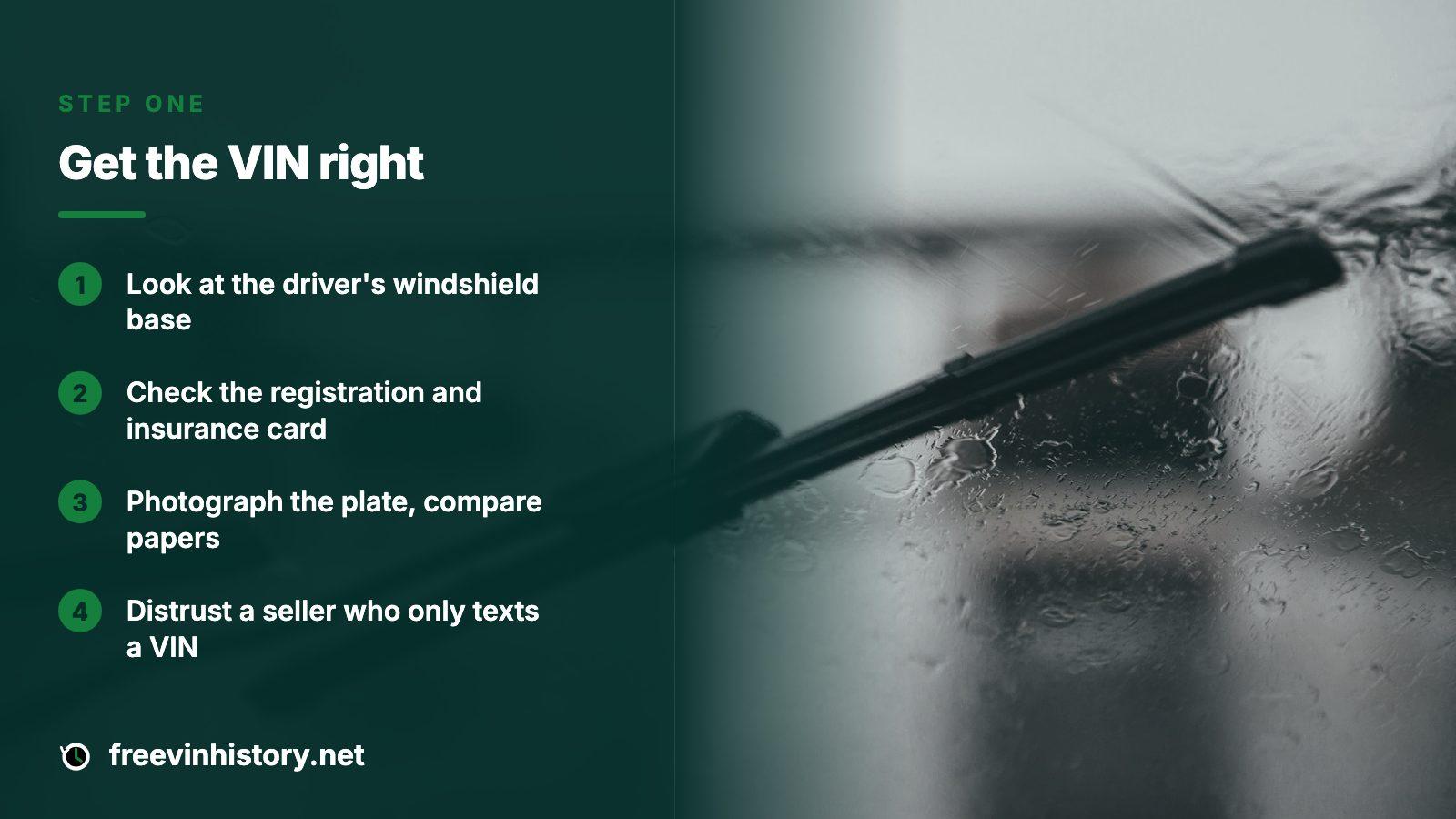
- NHTSA says to look at the driver's-side base of the windshield.
- The registration card carries it, and an insurance card may too.
- Photograph the windshield plate and hold it against the seller's paperwork.
- If the seller will only text a VIN and not let you see the car, treat that as a warning in itself.
A mismatch between the windshield VIN and the registration is a reason to stop, whatever any database says. Plates are no shortcut here: NHTSA notes that plate searches draw on state DMV data and can show a previous owner's vehicle, so use the VIN.
Step 2: search NHTSA for open recalls
Enter the VIN on NHTSA's recall page. You get one of two answers: a list of unrepaired recalls, or the message that zero unrepaired recalls are tied to that VIN. A recall repair is done by the manufacturer's dealer, so an open one is a negotiation point rather than a verdict.
What the recall search leaves out
Missing from the answer: recalls already fixed, some announced only days ago, goodwill campaigns that are not safety matters, anything older than 15 years where the maker has not extended coverage, and small-volume makers. A clean answer means no open recall that NHTSA can see. It says nothing about crashes or title history.
A batch form takes as many as 100 VINs together, handy when you are weighing a dealer's whole row of cars, and the SaferCar app pushes an alert if a recall lands after you buy.
Step 3: run the insurer theft and salvage lookup
NICB's VINCheck is free and answers a narrow question: has any member insurer filed this VIN as a theft never recovered, a salvage total loss or flood damage. NICB reports that its member insurers account for 92.49 percent of earned premium nationwide, a figure dated August 2026. That is wide, but it is not everything.
Two practical limits. The cap is five searches a day from one IP address, so settle your shortlist first. And only insurance records appear: NICB states that law enforcement records and non-participating insurers are not queried.
A salvage result, in NICB's wording, means an insurer paid out because repair cost passed a set share of the car's value. The car may have been rebuilt and re-titled since, which is how a damaged vehicle ends up in an ordinary-looking listing.
What the free steps cannot see
NICB itself cautions that VINCheck falls short of a full history report and that a clean result guarantees nothing. Both free tools are built around one kind of record each. Neither reads the state title file, so a title brand applied after a total loss can sit undetected behind two clean answers.
- Title brands from any state, including junk, salvage and flood labels
- Odometer readings over time, which is how rollbacks show up
- Total loss declared by a carrier that does not feed NICB
- Liens, auction records and ownership changes
- Accident detail beyond a yes or no
The federal NMVTIS system exists to fill part of this gap. The Department of Justice lists five things it reports: the state holding the title and the last title date, any brands, an odometer figure, a total loss record and a salvage record. Insurers, recyclers and salvage yards must report to it under federal law.
Step 4: use the free preview before spending
Enter the VIN into this site's preview. It is a look at whether a vehicle history report holds records for that VIN, shown before any payment. You pay nothing for the preview. The report behind it is a separate purchase.
The preview earns its place between the free tools and a purchase because it answers the question that matters at that moment: is there anything here to find. If the preview shows records that no free tool surfaced, you have a concrete reason to go further. If it shows little, you still inspect the car, but you have spent nothing to learn that.
Step 5: decide on the full report
Buy the report when a car is a serious candidate and you are close to paying a deposit, not for every listing you scroll past. One VIN, one payment, no subscription; the pricing page lists current options.
The NMVTIS site's buying tips put a basic NMVTIS report at up to $4, which gives you the low end for a title-only record. A broader report adds more record types than that bare title file, which is the reason it costs more.
Read the report against the car
A reading in the history that is higher than the dashboard, a brand the seller never mentioned, or a different VIN from the windshield all mean the same thing: stop and ask. The report is evidence for a conversation, and a mechanic's inspection still comes after it.
Where Arizona's own offices come in
Title transfers and registration run through Arizona's Motor Vehicle Division. Its older ServiceArizona site now tells visitors that online MVD services are available at AZMVDNow.gov, so look there for current forms, fees and any title-record tools instead of trusting a figure from an old page.
Arizona's MVD pages refused our automated access, so we did not read any state fee, form number or title lookup tool, and none is quoted here. Confirm those with the MVD directly. What the national steps above give you is a way to arrive at that conversation already knowing the car's recall, theft and salvage status.
Where this information comes from
- NICB: VINCheck lookup — what the free insurer lookup covers, its daily limit and its stated limits
- NHTSA: Check for recalls — VIN recall search, what it shows and what it leaves out
- VehicleHistory.gov: Understanding an NMVTIS report — the five indicators in the federal title record
- VehicleHistory.gov: Used car buying tips — inspection advice and the cost note for NMVTIS reports
- VehicleHistory.gov: Approved NMVTIS data providers — where consumers can buy NMVTIS reports
Sources and photos: Facts checked against the sources above in November 2026. Photos by Frederick Rosa, Thibault Valjevac and Iain on Unsplash; diagrams by FreeVINHistory.
Keep reading
- Free VIN check in Texas: what costs nothing and where the paid step startsThe same free-first sequence for a car registered in Texas.
- Free open recall check by VIN: GM, Polaris and every other makeA closer look at what the recall search can and cannot show.
- Free stolen car check online: what each lookup coversMore on the insurer theft lookup used in step three.
- Car title search by VIN free: what you can see before you payHow title brands are checked once the free tools run out.
Frequently asked questions
Is there a completely free VIN check in Arizona?
Two national tools cost nothing: NHTSA's recall search and NICB's insurer theft and salvage lookup. Together they catch open recalls and insurer-reported theft, salvage or flood flags. They do not read title brands or mileage history, so a car can pass both and still carry a brand. This site's preview is also free, while its full report is a paid purchase.
Does NICB VINCheck work on Arizona cars?
Yes. It matches the VIN against participating insurers' records nationwide, so the state of registration does not matter. NICB caps lookups at five a day per IP address, and a mistyped VIN can return no match. Treat a clean result as one input, since NICB itself says more checking is needed.
Can I run a VIN check with just a license plate?
NHTSA's recall search accepts plates, but it draws on state DMV data and may display a previous owner's car. For a purchase, use the VIN from the windshield and the registration instead. This page does not promise any plate lookup or owner details.
What does a free check miss that matters most?
Title brands and odometer history. A wrecked car can be written off, rebuilt and re-titled without appearing in the recall search, and it appears in NICB's data only if a participating insurer reported it. NMVTIS, the federal title system, is built to cover those gaps.
When should I pay for a full report?
When you are about to put down a deposit on a specific car and the free steps came back clean or unclear. The preview here shows whether records exist before you pay. Skip it for cars you have already ruled out on price, a VIN mismatch or an open safety problem.
Now check the car itself
The guide explains what to look for. The report shows what this VIN has on record.