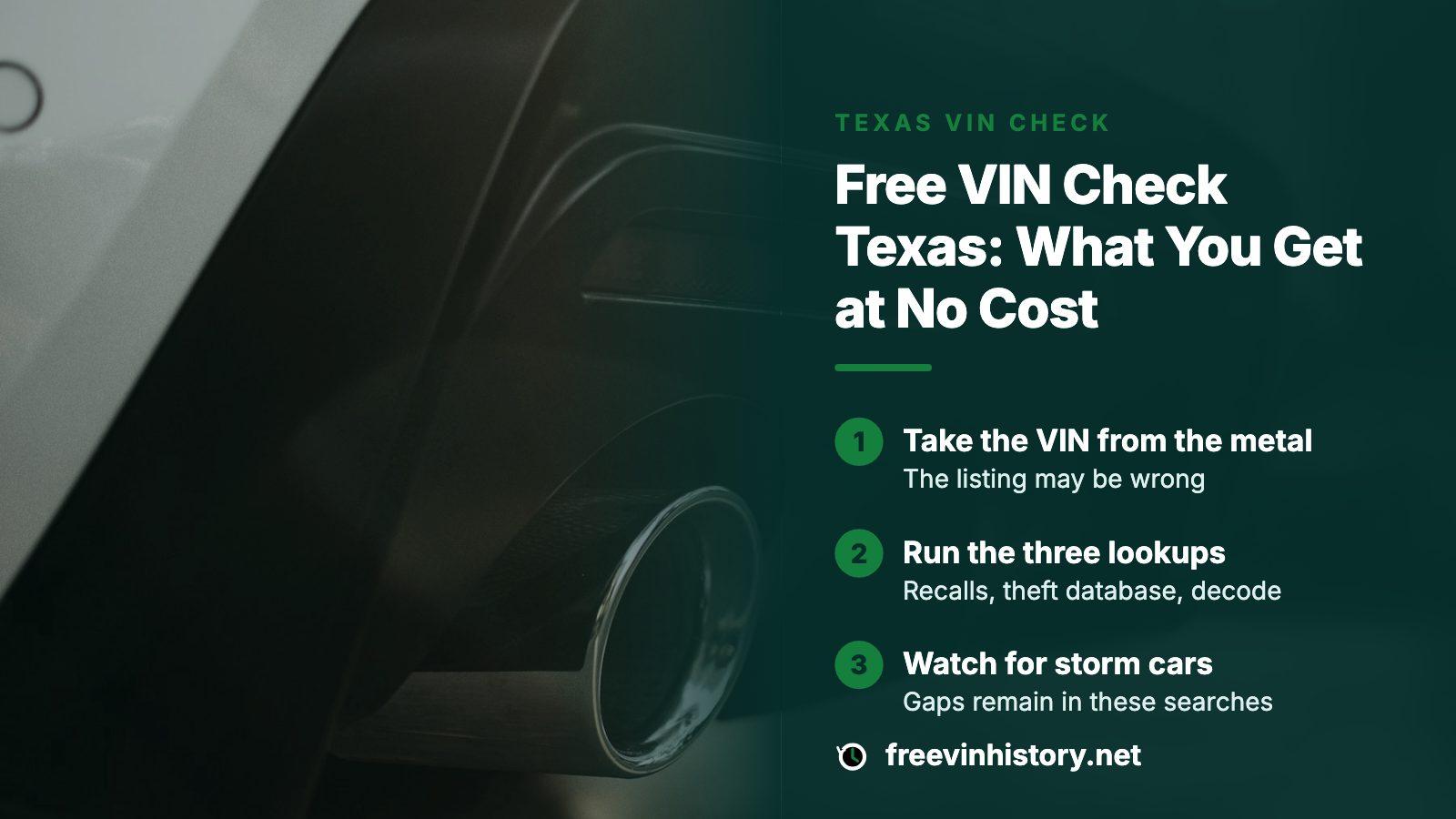
THE SHORT ANSWER
Partly. Three lookups cost nothing in Texas: NHTSA's recall search, the insurer-fed theft and salvage database run by NICB, and a factory decode of the VIN. Title brands come from TxDMV's Title Check, which hands the VIN to an approved provider for a small fee. Accident records, mileage readings and auction photos need a full report, and the preview on this site shows whether such records exist before you pay.
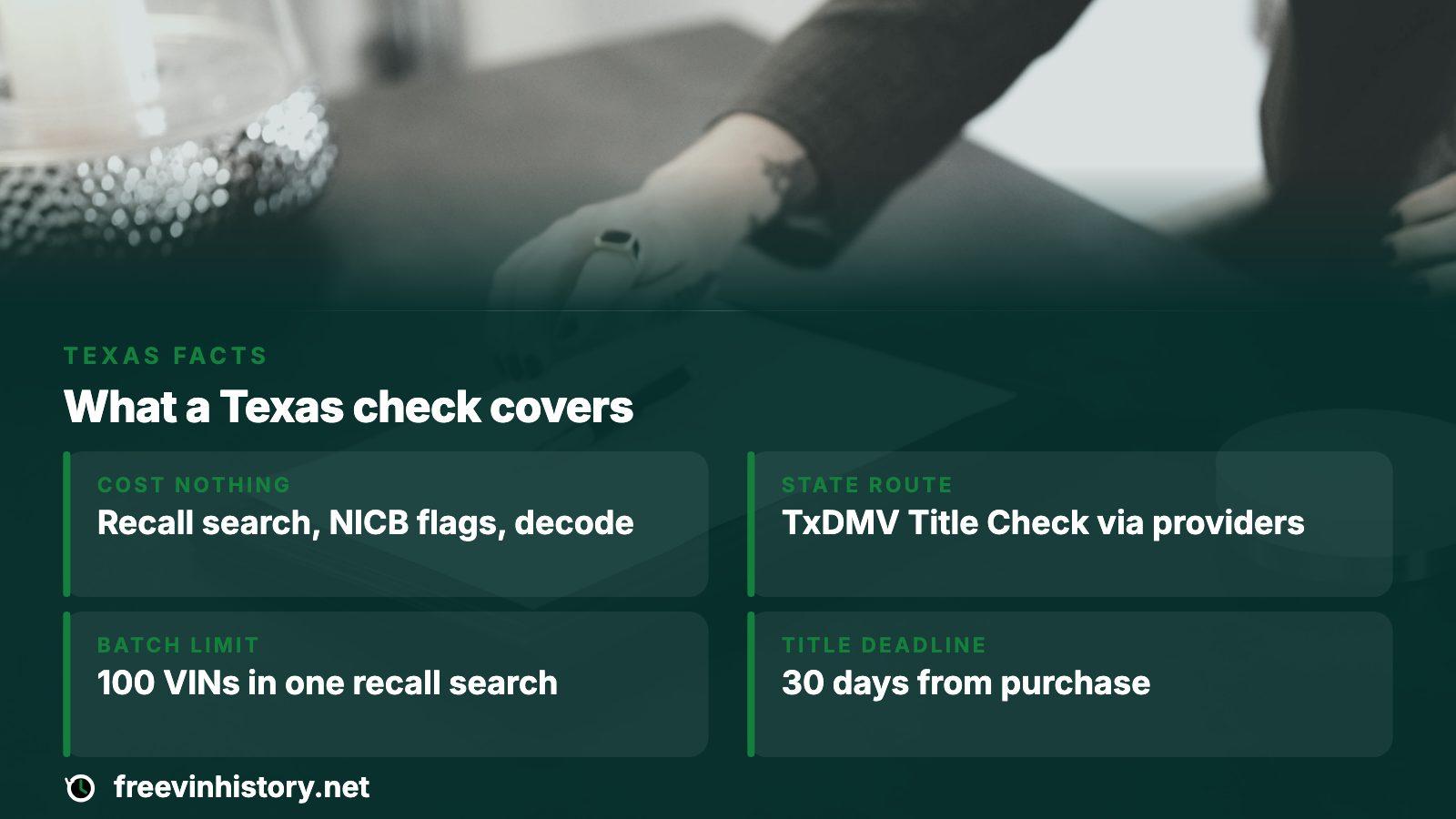
- Cost nothing
- Recall search, NICB theft and salvage flags, factory decode
- State route
- TxDMV Title Check, sold through approved providers
- Batch limit
- NHTSA takes up to 100 VINs in one recall search
- Title deadline
- 30 days from the purchase date
What a free Texas VIN check covers, and what it skips
Search for a free VIN lookup in Texas and you meet three kinds of tool: lookups that cost nothing, a state page that routes you to paid data, and paid reports. The table sorts them by what each can say about the car in front of you.
| Lookup | Cost | What it answers | What it misses |
|---|---|---|---|
| NHTSA recall search | None | Whether a safety recall on this VIN is still unrepaired | Repaired recalls, very old recalls, non-safety campaigns |
| NICB VIN check | None | Insurer-reported theft, salvage or flood damage | Cars that were uninsured when damaged |
| Factory decode (vPIC) | None | What the maker reported for the VIN | Everything after the car left the factory |
| TxDMV Title Check | Small fee | Title brands, junk or salvage yard stays, insurer write-offs | Accident repairs and maintenance |
| Full history report | One payment | Accident, mileage, auction and lien records with title data | Damage nobody reported |
Take the VIN from the metal, not the listing
Every lookup below keys on the VIN, so one misread character spoils the result.
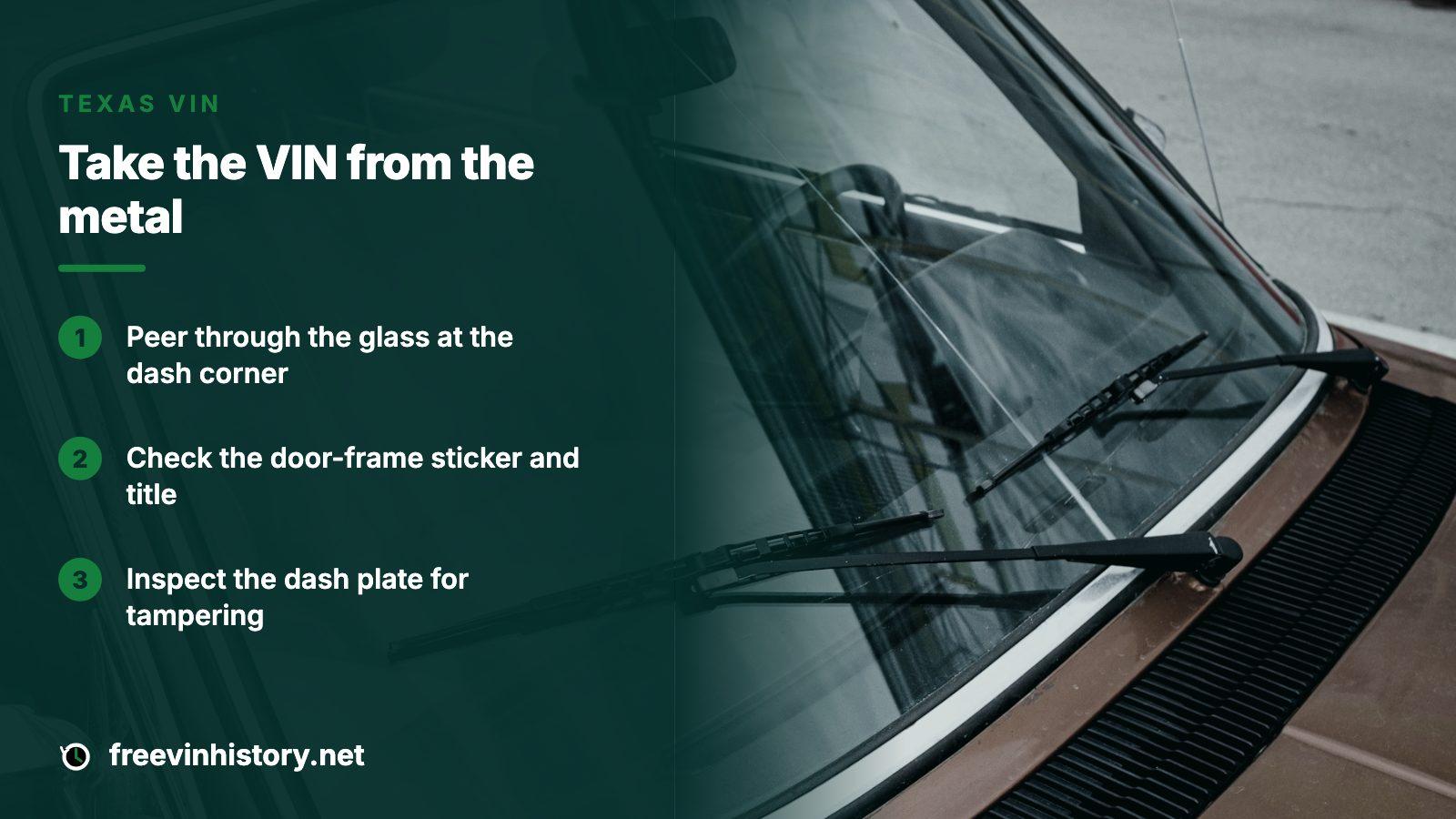
- From outside the car, peer through the windshield at the dashboard corner nearest the driver and copy all 17 characters.
- Check it against the sticker inside the driver's door frame, then against the title and insurance card the seller offers.
- Inspect the dash plate. A repainted patch or digits that look hand-stamped are reasons to stop; for a doubtful plate, TxDMV points you to a dealer selling that model new, or to law enforcement.
The three lookups that cost nothing
- Recalls, from NHTSA: the answer is either an unrepaired recall on that car or none, and the repair costs the owner nothing at a dealership. Fixed recalls, small makers and non-safety service campaigns stay out of the result.
- Theft and salvage flags, from NICB: the FTC describes this database as flagging flood damage, a theft never recovered or a salvage declaration. The catch is insurance. If no insurer was involved when the damage happened, the database has nothing to hold.
- Factory decode, from NHTSA's vPIC tool: it returns the basics the manufacturer reported, for model years 1981 and forward, so you can check the car is what the ad claims.
Together they screen out an open safety defect, a reported theft and an insurer's write-off, but not title trouble.
TxDMV's Title Check, the first paid step
The state does not run this report itself. Its Title Check page sends the VIN to a provider the U.S. Department of Justice has approved to sell national title data, and clicking one takes you off the TxDMV site. Have a credit card ready; TxDMV says the cheapest start at a couple of dollars and tells buyers to compare what each vendor includes.
What returns is title history: whether the car ever sat in a junk or salvage yard, whether an insurer wrote it off, and any brands. TxDMV says this does not replace a mechanic's inspection. Some large history companies sell the same data to dealerships only, so a Texas buyer picks from the consumer providers.
Reading the brands a Texas title check returns
TxDMV publishes its own decoder for the entries buyers meet most.
| Brand | TxDMV's reading | What a buyer does |
|---|---|---|
| Clear | No brand had been reported when the report ran | Treat it as a starting point |
| Salvage | Repair cost passed a state-set share of retail value | Ask for repair records and an inspection |
| Rebuilt | A salvage car that later passed anti-theft and safety inspections | Price it well below a clean car |
| Junk | Good only for parts or scrap, with no title or registration ever | Walk away |
| Water Damage | Damaged only by flood water | Pass, or bring a specialist |
| Odometer | States whether the mileage is true | A not-true flag must show in the price |
Rebuilt is legal but not neutral
TxDMV's rebuilt page warns that insurers often refuse these cars, that a misaligned frame puts extra load on the drivetrain, tires and brakes, and that repair bills can pass what the car is worth. Ask your insurance agent about coverage before agreeing a price.
Storm cars and the gap in the free searches
The FTC warns that cars hurt by a hurricane or flood are sometimes cleaned up and sold in another state. The insurer database flags flood damage only when the car was insured at the time, so an uninsured flood car can come back clean. Check for:
- sand or mud tucked beneath the seats or the dash
- rust showing near the door edges
- carpet that is loose, stained or off-color
- a mold or decay smell, or strong cleaner masking something
Water damage works slowly on electrical and mechanical systems, so a mechanic's look is part of the FTC's advice.
Where the free layer runs out
The national record behind TxDMV's page is short by design: DOJ says it carries five indicators and no more. DOJ puts coverage at about 87 percent of vehicles in the country, over half the states report to it, and states define brands differently, so a car called salvage in one state may carry no brand in the next.
A clean answer can be wrong. A car handled by a salvage yard may never have been branded, because states differ on when a brand is required. And nothing in the free layer lists accident repairs, mileage across several owners, auction photos or impound entries. That is where a full report starts.
The preview, the report and the cost
The preview on this site costs nothing. Type in a VIN and it reports whether title or auction entries turned up, which tells you if a deeper look is justified. The report is one payment, whether for one VIN or for 3, 5 or 10 VINs bought together when the shortlist is long. Nothing renews, and current rates sit on the pricing page.
When the report earns its cost
Run the free lookups on every car you consider. Buy the report for the one you would make an offer on, and do it before a deposit changes hands, while a surprise can still move the price or end the deal.
Texas paperwork to settle before money moves
- The seller signs the title, prints a name, dates the sale and records the odometer reading on its back. Do not pay for a private-sale car that comes without a title to sign over.
- The seller fills in Form 130-U, adding a printed signature and the sales price. You need it for the title application.
- Ask about past financing, then confirm it with the bank or finance company. A release of lien belongs in the file when a lender existed.
- The plates stay with the seller. A Vehicle Transit Permit covers 5 days of driving to the county tax office.
- Submit the title application within 30 days of buying, or risk penalties.
- A county tax office representative can read the signed-over title before you apply and say whether it shows salvage or legal issues.
The state offers buyers no protection on a used car's reliability, so TxDMV urges a mechanic's inspection before anything is signed or paid, a deposit included.
Where this information comes from
- Texas DMV: Title Check, look before you buy — How the state routes a buyer to approved title-data providers, the brand guide and the buyer paperwork.
- Texas DMV: Rebuilt vehicles — What a rebuilt brand means and the cautions TxDMV gives about insurance, frames and value.
- Texas DMV: Buying a vehicle — Dash plate checks, the county tax office title review and the lender questions.
- NHTSA: Check for recalls — What a VIN recall search returns and the categories it leaves out.
- U.S. Department of Justice: NMVTIS for consumers — What the national title record holds, how many vehicles it covers and where false negatives come from.
- FTC: How to steer clear of a flood-damaged car — Signs of flood damage and the limit on what the insurer database can flag.
Sources and photos: Facts checked against the sources above in November 2026. Photos by Farhan Abid, Max Tokarev and Annika Wischnewsky on Unsplash; diagrams by FreeVINHistory.
Keep reading
- Free VIN check through the DMV: what a state agency will and will not showHow state DMV tools compare, and what they stop short of showing.
- Free flood check by VIN: what the free tools show and missThe flood question in depth, for cars that may have come through a storm.
- Free salvage title check by VIN: what the free lookups showWhat free tools can and cannot say about salvage and rebuilt brands.
- PricingWhat one report costs, and the multi-report packs, with no subscription.
Frequently asked questions
Is there a free VIN check in Texas?
Parts of one. NHTSA's recall search, the NICB insurer database and a factory decode cost nothing. TxDMV's Title Check is not free: it forwards the VIN to an approved provider, and the page says the cheapest start at a couple of dollars. The preview on this site costs nothing too, while the report is a paid step.
Should I search by VIN or by license plate?
Use the VIN. NHTSA's plate search works from state DMV records, so it can return the car that plate belonged to before, and the VIN names the exact vehicle in front of you. Reports on this site run on the VIN only.
Does a clear Texas title check mean the car has no history?
No. Clear means no brand had been reported when the report ran. DOJ says the national record has gaps and can produce false negatives, and damage no insurer or titling agency ever recorded appears nowhere. Pair the check with a mechanic's inspection.
Can I check a Texas car for liens without paying?
TxDMV's advice is to ask the seller about past financing and then confirm it with the bank or finance company directly. It also lists a release of lien among the supporting papers a sale can involve. A phone call to the lender settles the question faster than any database.
Do I still need a report if a mechanic is inspecting the car?
Yes, because they answer different questions. No history report replaces an independent inspection, the FTC notes, and a mechanic sees today's condition but not the paper trail. Ask the mechanic to write up findings, repair costs and the VIN.
Now check the car itself
The guide explains what to look for. The report shows what this VIN has on record.