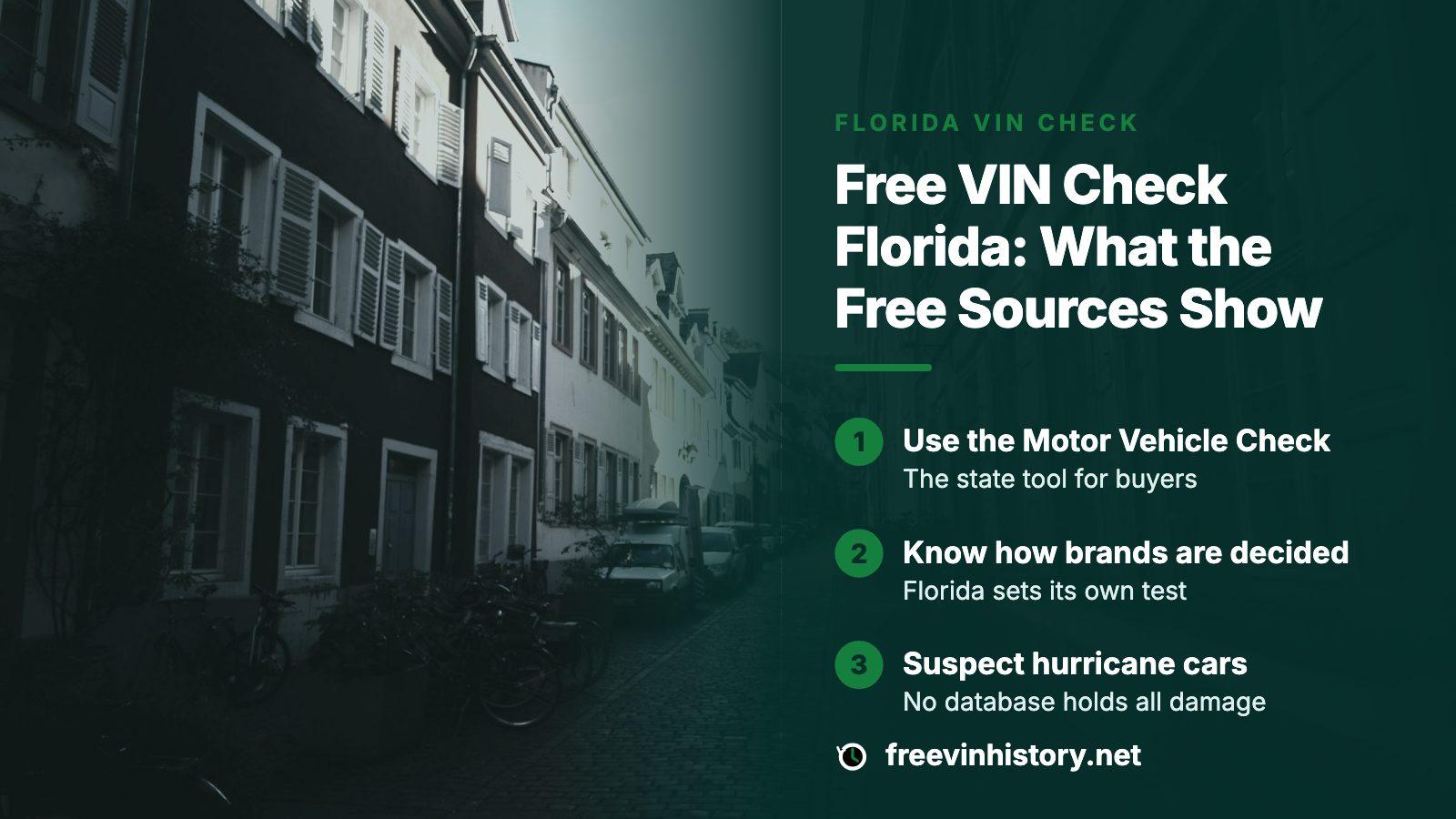
THE SHORT ANSWER
Partly. Two no-charge tools do the heavy lifting: NHTSA for open recalls and NICB for insurer-reported theft, salvage and flood loss. Florida's Motor Vehicle Check adds the title's status and any lien still on record. Together they catch an open recall, an insurer's total-loss flag and an unpaid loan. They miss repair history, mileage over time and water damage on cars that were never insured. The preview on this site shows whether deeper records exist before you pay for a report.
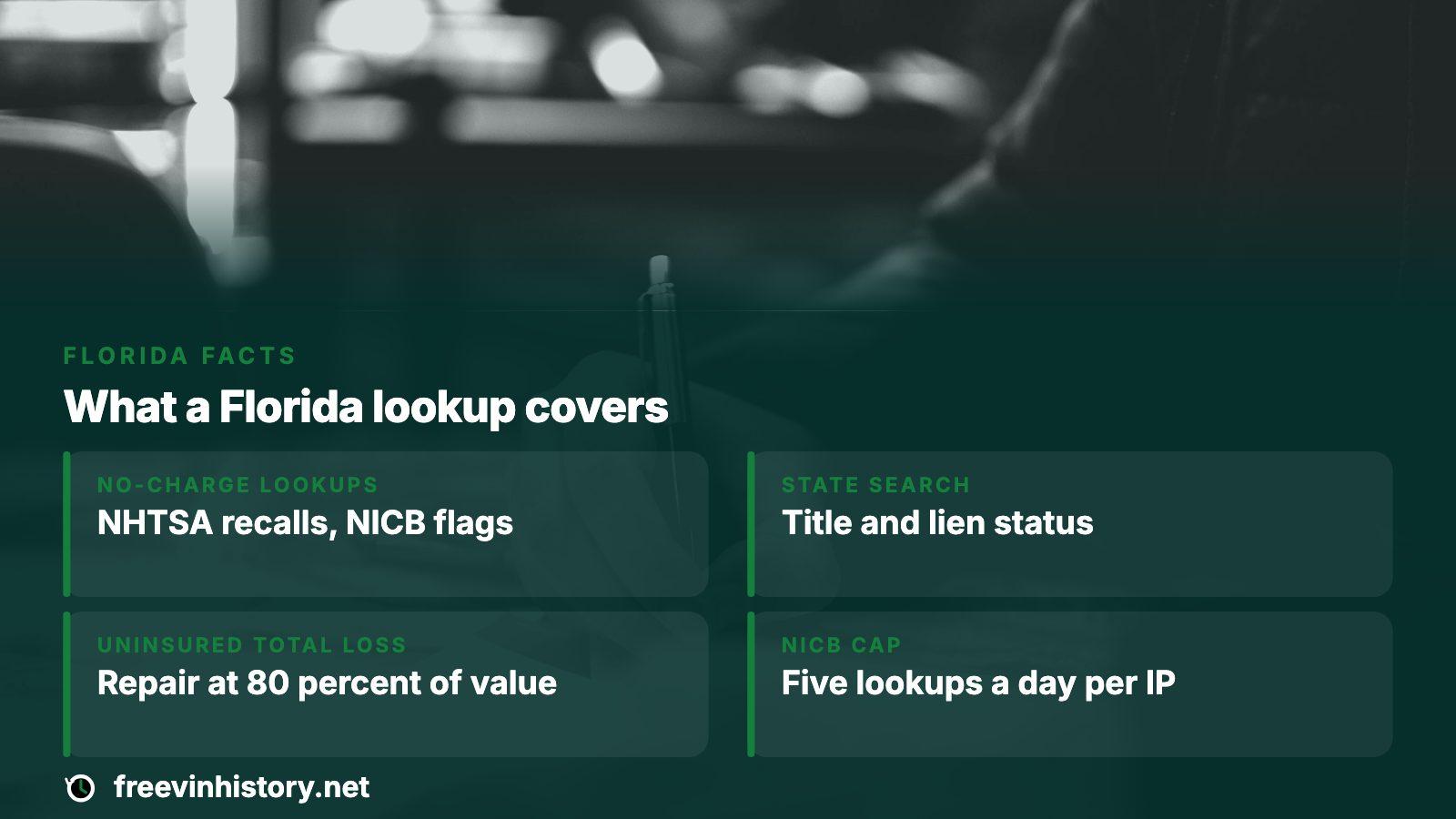
- No-charge lookups
- NHTSA recalls and NICB theft, salvage and flood flags
- State search
- Title and lien status through the Motor Vehicle Check
- Uninsured total loss
- Repairs costing 80 percent or more of a like-kind replacement
- NICB cap
- Five lookups a day from one IP address
What the official lookups cover for a Florida car
Four official sources come before a full history report. The table sets out what each can say about the car, and what it can miss.
| Lookup | Cost | What it answers | What it can miss |
|---|---|---|---|
| NHTSA recall search | Free | Whether a safety recall on this VIN is still unrepaired | Repaired recalls, small makers, non-safety campaigns |
| NICB VINCheck | Free, capped at five lookups a day per IP address | Whether a member insurer reported theft, salvage or flood loss | Insurers outside the program, damage nobody claimed |
| Florida Motor Vehicle Check | No charge mentioned in county instructions | Title status and any electronic lien still recorded | Everything past status: repairs, mileage, auctions |
| NMVTIS report | Provider's fee | Title state, brands, last odometer reading, total loss and salvage history | Service records, recalls, unreported damage |
| Full report from this site | Preview at no charge, then one payment | Accident, mileage, auction, lien and theft records together | Damage no one ever reported |
Take the VIN from the car, then ask about the paper
Each lookup keys on the VIN, so one misread character sinks the result. Copy it from the car, not from the listing.
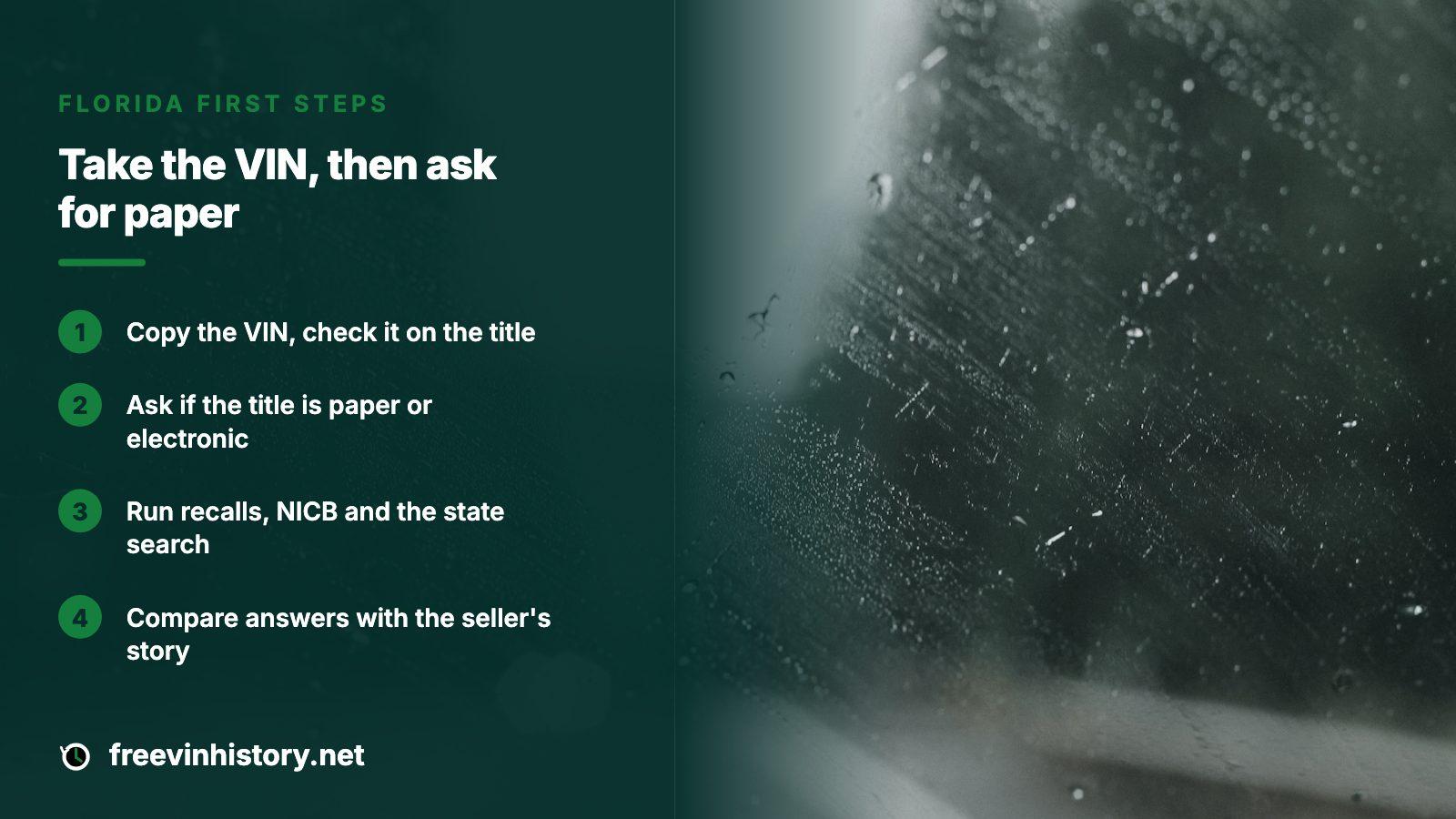
- Copy the 17-character VIN from the bottom-left corner of the windshield, then check it against the registration card and, if the seller has one, the insurance card.
- Ask whether the title is on paper or electronic. A private seller holding an electronic title has to have it printed first, and the state mails it through its online portal in 7-10 business days.
- Run the recall search, the NICB lookup and the state status search on that exact VIN, and note each answer.
- Compare the answers with what the seller told you before you talk price.
What Florida's Motor Vehicle Check tells a buyer
This is a status lookup against the state's own record. Manatee County's tax collector tells owners to enter a title number or a VIN, press Search, and read the title and lien status shown under the Net Weight field. The result separates a paper title from an electronic one.
In a private sale the lien line matters most. A line reading Electronic Title with Electronic Lien says the state's system still lists the loan as open, whatever the seller says about payoff. The county's instructions describe nothing beyond title and lien status, so treat the search as a check on loans and title format, not as a damage report.
Loan paid off, lien still on file
Ask to see the lender's release, or hold off until the status stops showing an electronic lien. The search is quick enough to repeat on the day you sign.
How Florida decides a car carries a brand
The statutes do the sorting, and the tests are specific.
| Term | Florida's test | What a buyer does |
|---|---|---|
| Total loss, insured car | The insurer pays out for a replacement vehicle, or on a theft claim | Expect salvage history and ask for the paperwork |
| Total loss, uninsured car | Repair cost hits 80 percent of replacement value | Same, and ask who did the repair |
| Total Loss Vehicle brand | An agreed repair ended up costing over 100 percent of replacement cost | Ask for the repair invoices |
| Rebuilt | Built from salvage or junk; the state examines it, then affixes a decal | Look for the decal and the stamped title |
| Flood vehicle | Declared a total loss because of water damage | Insist on the written disclosure |
| Certificate of destruction | Unrebuildable, such as a higher-value late-model car with repair estimates at 90 percent of retail value or more | Walk away; the state may not title it |
The brand follows the car. Any brand on a title, foreign ones included, must repeat on every later title and registration, and removing a rebuilt decal to hide the history is a third-degree felony.
What a Florida seller has to put in writing
Before the sale closes, Florida sellers must give the buyer a written statement if the car was rebuilt, a flood vehicle, a taxi, a police unit, a short-term lease unit or a maker buyback. Ads have to say so too, and a violation is a second-degree misdemeanor.
The same section shields a seller from a civil suit when the notation never appeared on the title and registration that seller received. A title that looks plain is therefore weaker evidence than it seems, so ask for the disclosure on paper even when the listing sounds clean.
Hurricane cars and the damage no database holds
NICB's results come only from insurers in the program, and they hold insurance records, not police files. The FTC adds the catch that matters in a storm state: the flood flag appears only if the car was insured when the water hit. Florida's flood brand follows the same logic, since it attaches to a car declared a total loss, so a car dried out and sold privately can carry nothing at all.
- sand or mud beneath the seats or the dash
- rust at the door edges
- carpet that is loose, stained or a different shade from the rest
- a musty odor, or heavy cleaner covering one
Water works slowly on electrical and mechanical parts, so the FTC also advises a mechanic's inspection before any money moves.
Where the national title record picks up
Florida law requires an insurer that pays a total loss, and a salvage dealer that takes in a vehicle, to notify the national title system, NMVTIS. A consumer search through an approved provider returns five indicators: the title state and last title date, brands, the latest mileage reading, and entries for insurer total losses and salvage handling. DOJ counts roughly 87 percent of the country's vehicle population in its records, with over half the states feeding it data.
A brand applied by one state remains in the record even when another state retitles the car. Gaps still exist. Reporting lags, and states use different thresholds and names, so a car branded elsewhere can look clean in a second state. DOJ's provider list runs alphabetically with no prices, and a clean result there is no guarantee either.
Where the free layer ends, and what the report costs
Between them, the lookups above say nothing about accident repairs, how the odometer moved across owners, auction photos or impound entries. NICB itself notes that wider reports pull from state title files, auction sales and maintenance entries, and that most are sold at a cost.
The preview on this site is the free step, and it shows whether such records exist for a VIN. A full report is a single purchase covering one car, with packs for shoppers who have several candidates, and nothing renews. You will find the current amounts on the pricing page. Start with the preview when:
- the car arrived from another state
- the state search still shows a lien
- the price sits well under similar cars
Where this information comes from
- Florida Statutes chapter 319 (2025): sections 14 and 30 — Supports the total-loss tests, the stamp, decal and written disclosure rules, the NMVTIS notices and the unrebuildable rule.
- NHTSA: check for recalls — Supports what the VIN recall search shows and leaves out.
- NICB: VINCheck — Supports the insurer-only scope, the search limit and the clean-result caution.
- FTC: used cars — Supports the point that NHTSA's recall listings cost nothing and that a history report does not replace an inspection.
- U.S. Department of Justice: NMVTIS for consumers — Supports the five indicators, coverage figures and false-negative warning.
- FTC: how to steer clear of a flood-damaged car — Supports the insured-only flood flag, the physical signs and the mechanic advice.
- Manatee County Tax Collector: electronic titles — Supports how the state's Motor Vehicle Check is used and what electronic lien readings mean.
Sources and photos: Facts checked against the sources above in November 2026. Photos by Karwin Luo, Cole Keister and Owen Michael Grech on Unsplash; diagrams by FreeVINHistory.
Keep reading
- Free flood check by VIN: what the free tools show and missThe flood signs and the insurer-data gap in more depth.
- Car lien search free: what the free tools show and what they missHow a lien shows up and what to ask the lender.
- Free salvage title check by VIN: what the free lookups showWhat a salvage brand means and which lookups can spot one.
- Sample reportSee what a full report lays out before you buy one.
Frequently asked questions
Is there a completely free VIN check for Florida cars?
Not a complete one. Neither NHTSA's recall search nor NICB's VINCheck charges a fee, and between them they cover recalls plus insurer-reported theft, salvage or flood loss. The state's Motor Vehicle Check adds title and lien status. Accident, mileage and auction records need a report, and the preview on this site shows whether they exist first.
Can I run a Florida license plate instead of the VIN?
The recall page at NHTSA will take a plate, but it returns recall status only, and it builds the result from state DMV records, so it can show a car the plate used to belong to. Use the VIN for every check on this page and for any report from this site.
If NICB comes back clean, was the car ever flooded?
It might have been. NICB sees records only from participating insurers, which account for 92.49 percent of earned premium, and only insured damage appears. A car flooded while uninsured, then dried and sold, returns nothing. NICB itself says a clean result is no guarantee, so add a physical inspection.
Why would the state search show a lien after the loan was paid?
The status reflects the state's record, not the seller's payment history. Per the county instructions, a line reading Electronic Title with Electronic Lien means the state's system still shows the loan as open. Ask for the lender's release, or run the search again after the lender files it.
How many VINs can I check at once?
NHTSA's recall tool takes up to 100 VINs in one search, handy for a long list of cars. NICB's cap is five searches in a day from one address, so save it for your shortlist. A report from this site covers one VIN, with packs for longer lists.
Now check the car itself
The guide explains what to look for. The report shows what this VIN has on record.