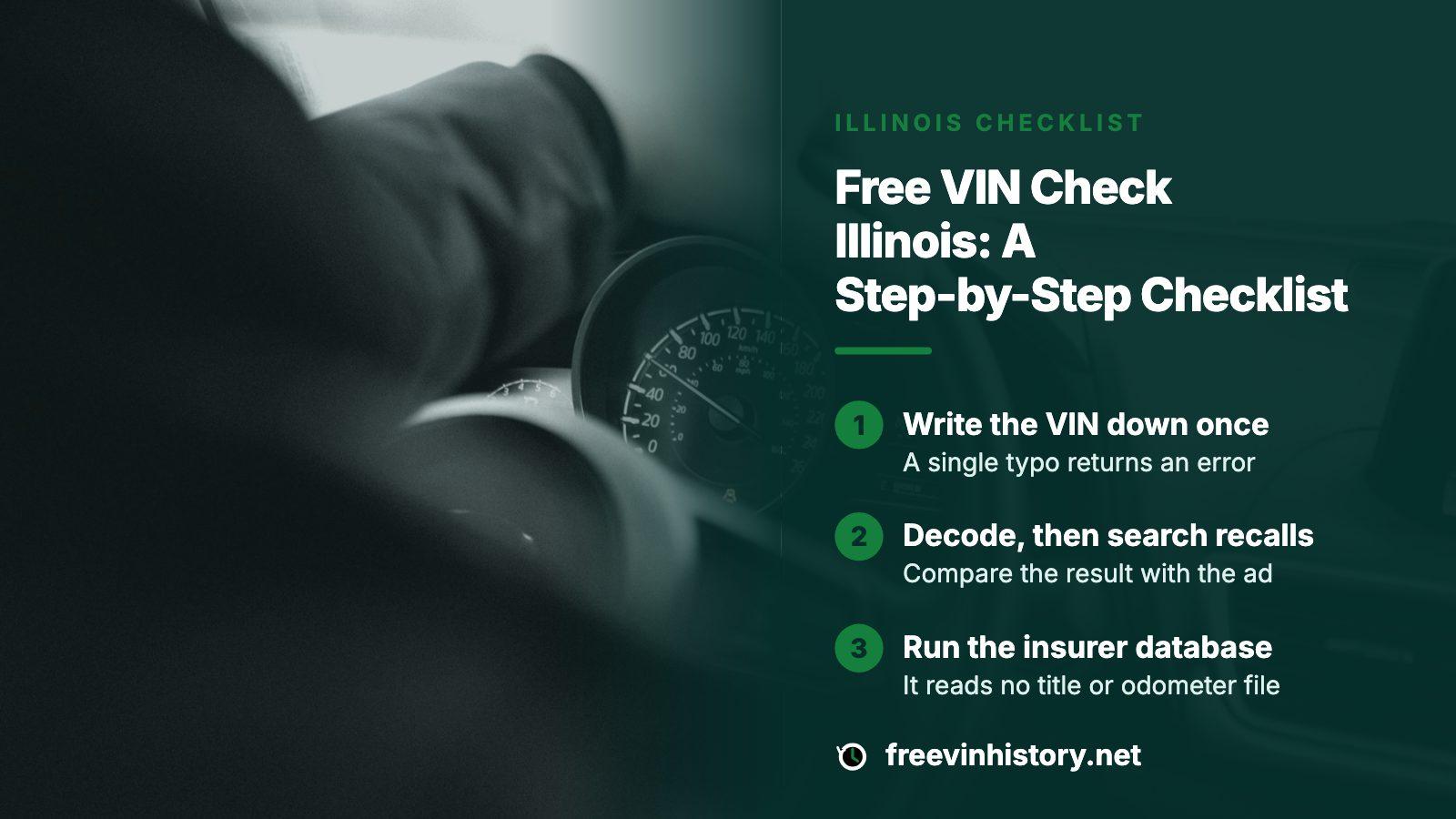
THE SHORT ANSWER
You can check an Illinois VIN at no cost with three federal or nonprofit tools: NHTSA's decoder confirms what the car is, NHTSA's recall search flags unrepaired safety recalls, and NICB VINCheck surfaces what insurers have reported as theft, salvage or flood. None of them reads a title file, an odometer history or an accident record. Before paying for the full report, this site's free preview shows whether any such records exist.
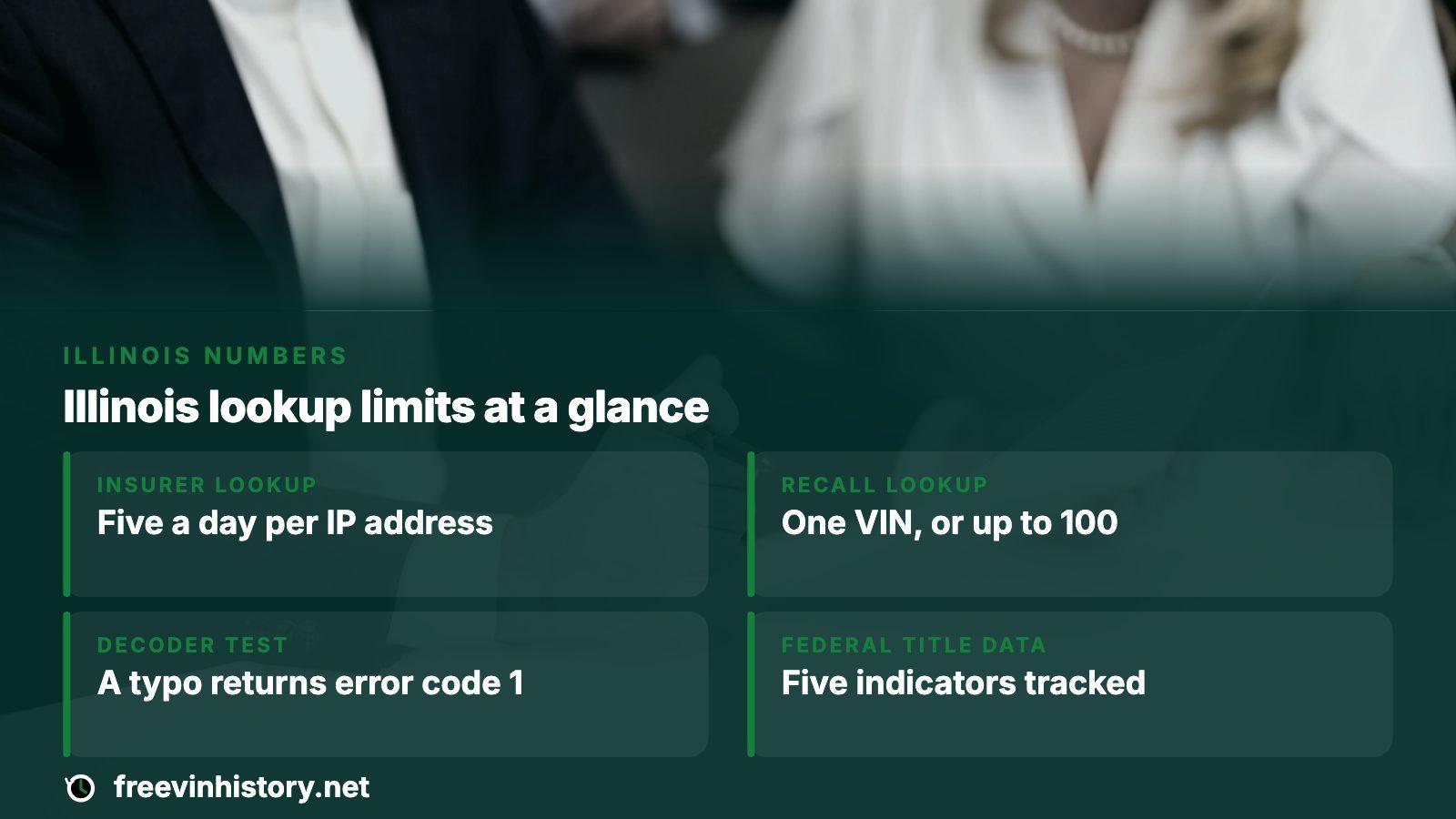
- Insurer lookup
- NICB caps VINCheck at five lookups a day per IP address
- Recall lookup
- One VIN at a time, or up to 100 in a batch
- Decoder test
- A one-digit typo returns error code 1
- Federal title data
- NMVTIS tracks five indicators, at up to $4 a report
The checklist at a glance
Treat this page as a form to fill in beside the car. Each line is a lookup that costs nothing, and the last column says what you still will not know once it is ticked.
| Tick | Lookup | Run by | Still unanswered |
|---|---|---|---|
| 1 | Copy the VIN | You | Whether the number matches the car and the paperwork |
| 2 | Factory decode | NHTSA vPIC | Everything that happened after the car left the plant |
| 3 | Recall search | NHTSA | Repaired recalls, small makers, non-safety campaigns |
| 4 | Theft, salvage and flood flags | NICB VINCheck | Insurers that do not take part, police files |
| 5 | Ask for the paperwork | The seller | Whatever the seller leaves out |
Everything in the first four rows works the same for a car sitting on an Illinois lot or one being sold out of a driveway in another state.
Step 1: write the VIN down once, correctly
NHTSA's page places the 17-character number in the lower corner of the windshield on the driver's side, with the registration card as a second place to read it and the insurance card as a possible third. When the windshield plate, the card and the seller's listing all agree, tick the box.
Accuracy matters more than speed. NICB warns that a wrong VIN can mean a real match never shows up, so a mistyped number can leave you reassured about the wrong car. Photograph the plate and paste from the picture instead of retyping.
Mismatch rule
One character off between the car and its paperwork is enough to pause here. Put the question to the seller and hold the other lookups until you have an answer.
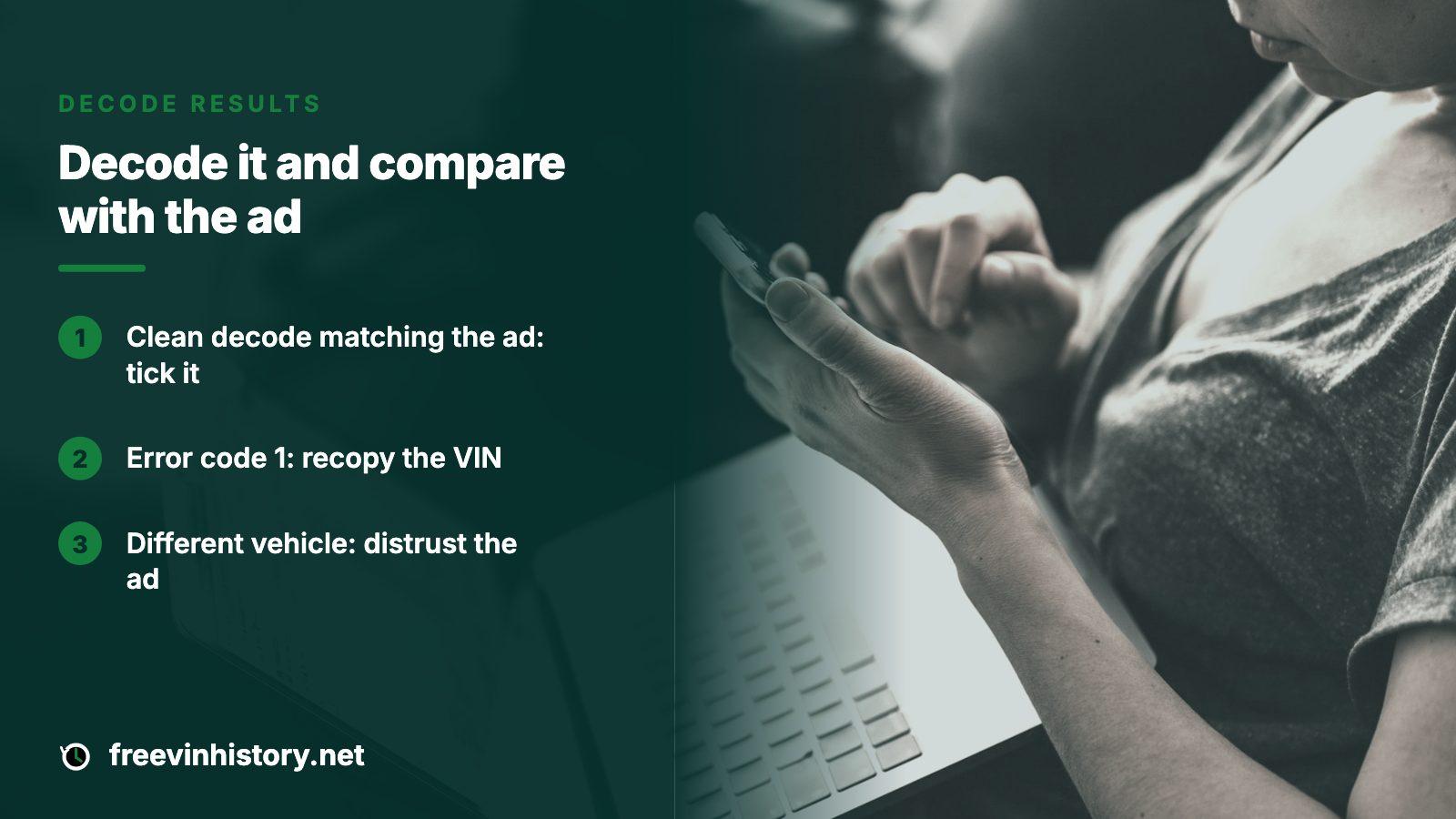
Step 2: decode it and compare with the ad
NHTSA's vPIC decoder builds its answer from what manufacturers submitted. Expect model year, make, model, and engine details. Hold the result next to the listing: a trim, engine or year that does not match deserves a direct question.
It doubles as a typo detector. In a test through NHTSA's API, a 2003 Honda Accord VIN decoded cleanly with error code 0. Changing only its last digit produced error code 1 and a note that the ninth-position check digit did not calculate. A failed check digit means the number was copied wrong or is not genuine.
- Clean decode with the expected year and model: tick the box.
- Error code 1: recopy the VIN from the car.
- Decodes to a different vehicle than advertised: treat the ad as unreliable.
Step 3: search for unrepaired recalls
On NHTSA's recall page, a VIN search says whether the car has a recall still waiting for a repair. No open items produces the message of 0 unrepaired recalls for that VIN. A hit is useful a bargaining point: the dealer repair is normally part of the recall, so ask whether it has been done.
Know the blind spots. The search skips recalls that were already fixed, brand-new announcements whose VIN lists are still filling in, campaigns past the 15-year mark (a maker may stretch that), small manufacturers, non-safety campaigns and imports. An older Illinois commuter car therefore gets a thinner answer than a recent one.
The same page accepts a plate and state, Illinois included. That only returns recall information. It does not give you an owner, and it is no substitute for the VIN.
Step 4: run the insurer database
NICB's VINCheck asks participating member insurers if any member company has a theft claim on the VIN that was never recovered, or has written the car off as salvage or flood. NICB says its database represents 92.49% of earned premium in the country, so coverage is wide but not total.
- Limit: five lookups in any 24 hours per IP address, no more, so decide which cars on your shortlist deserve one.
- Hit: a salvage or flood result means an insurer paid out rather than repaired. Rebuilding is legal, but the car needs real scrutiny.
- Clean: NICB itself says this is not a guarantee, because insurers that opt out and police records are not searched.
Read the limits yourself
NICB calls VINCheck useful but not a full history. Take that at face value and plan for more checks on any car you intend to buy.
What the free lookups cannot tell you
Put the four results side by side and the gaps are easy to see. None of them reports odometer readings over time, none lists past titles from other states, and none describes an accident that never reached an insurer. A privately settled fender-bender, or damage fixed with cash, appears nowhere.
The federal title system, NMVTIS, exists for part of this. The Department of Justice describes five indicators in a report. Title status with the latest title date comes first, then brands, the odometer figure, any total loss and any salvage history. Federal law obliges state title offices, scrapyards, recyclers and insurers to feed it. In its buying tips the DOJ says a report runs up to $4 and urges an inspection too.
Where Illinois state records fit in, I could not confirm. The Secretary of State's pages refused automated access when I tried to read them, so no fee or form is quoted here. Check that agency directly before you rely on any state-level lookup.
When the paid report earns its money
Stop at the free checks only if the car is cheap enough to walk away from. Once you are close to a deposit, the questions the checklist cannot answer are the expensive ones: has the title ever been branded, did the mileage ever move backward, was there an auction or damage record with photos, is there a lien.
Begin with this site's free preview. Enter the VIN and it tells you whether records of those kinds are on file, with no payment step. If something turns up, buy one report and nothing recurs; for a longer shortlist, there are packs of 3, 5 or 10 reports. See the pricing page for what each costs today.
- Free preview first: see if records exist.
- One payment for one report when a car is a serious candidate.
- A pack only when you are weighing a handful of cars.
Finish with the car and the seller
A clean database result does not replace looking at the car. The DOJ's own buying tips call for a mechanic's inspection, a test drive over varied roads, and a request for the service records. Ask for them, and if the seller has none, ask which shop did most of the work.
- Hold the checklist results up against what the seller told you.
- Ask about every mismatch out loud and note the answer.
- Get an independent inspection, then decide on the price.
If any step produced a flag you cannot explain, the cheapest answer is usually to move to the next car on your list.
Where this information comes from
- NICB: VINCheck — What the insurer lookup covers, its daily search limit and its stated limitations.
- NHTSA: Check for recalls — Where the VIN sits, what the recall search shows and what it leaves out.
- NHTSA: vPIC API — How the factory decoder works, with the check-digit test.
- NMVTIS: Understanding a vehicle history report — The five federal title indicators and who reports them.
- NMVTIS: Used car buying tips — Report cost and inspection advice.
Sources and photos: Facts checked against the sources above in November 2026. Photos by Miles Loewen, Michal Biernat and Carrie Allen www.carrieallen.com on Unsplash; diagrams by FreeVINHistory.
Keep reading
- Free VIN check through the DMV: what a state agency will and will not showWhat a state motor vehicle office can and cannot tell you by VIN.
- Free salvage title check by VIN: what the free lookups showA closer look at the salvage result NICB can return.
- Free open recall check by VIN: GM, Polaris and every other makeRecall searches beyond the single-VIN lookup.
- Free vehicle history report: what the free sources showThe wider picture of free versus paid history data.
Frequently asked questions
Is there a free VIN check for Illinois cars?
Yes, in pieces. NHTSA handles the VIN decode and open recalls, while NICB covers insurer theft, salvage and flood reports. All three work for an Illinois car, since none depends on the state where it is titled. They do not read title files or odometer history.
What is the daily limit on NICB VINCheck?
The cap is five a day for each IP address. Searches stay unlimited over time, so a long shortlist can be split across days. Enter a correct 17-character VIN, because a wrong one may miss a real record.
Does a clean free result mean the car is safe?
No. NICB states that a clean result guarantees nothing, since only participating insurers appear and police records are not searched. An accident paid privately, a title brand from another state or a rolled-back odometer can all sit behind a clean screen.
Will a plate number get me the owner of an Illinois car?
Not through anything on this page. NHTSA's recall search accepts a plate and state, but returns recall status only. Get the VIN from the seller or the car itself and run the checklist from that number.
What does the paid report add after the free checks?
It covers the ground the free tools leave bare: brands on past titles, mileage readings, auction and salvage entries, liens. Try the free preview on this site to learn whether any exist, and buy one report only for a car that is still in the running.
Now check the car itself
The guide explains what to look for. The report shows what this VIN has on record.