THE SHORT ANSWER
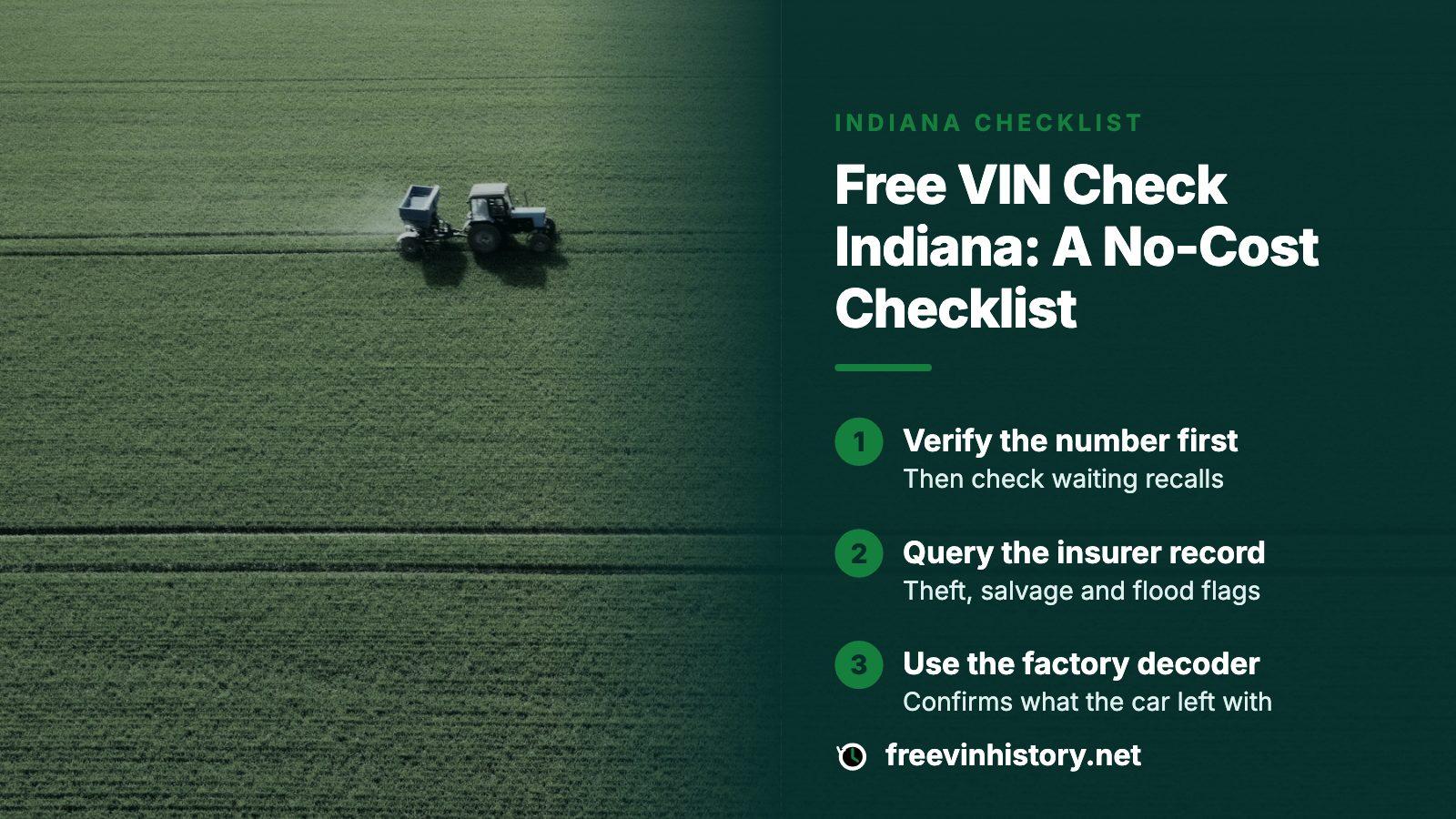
Partly. Recalls (NHTSA), insurer-reported theft, salvage and flood flags (NICB) and the factory build (NHTSA decoder) are all no-cost. None of them reads mileage over time, brands from other states, liens or auction photos. Our preview flags which of those categories hold data for a VIN, and the report is one payment afterward.
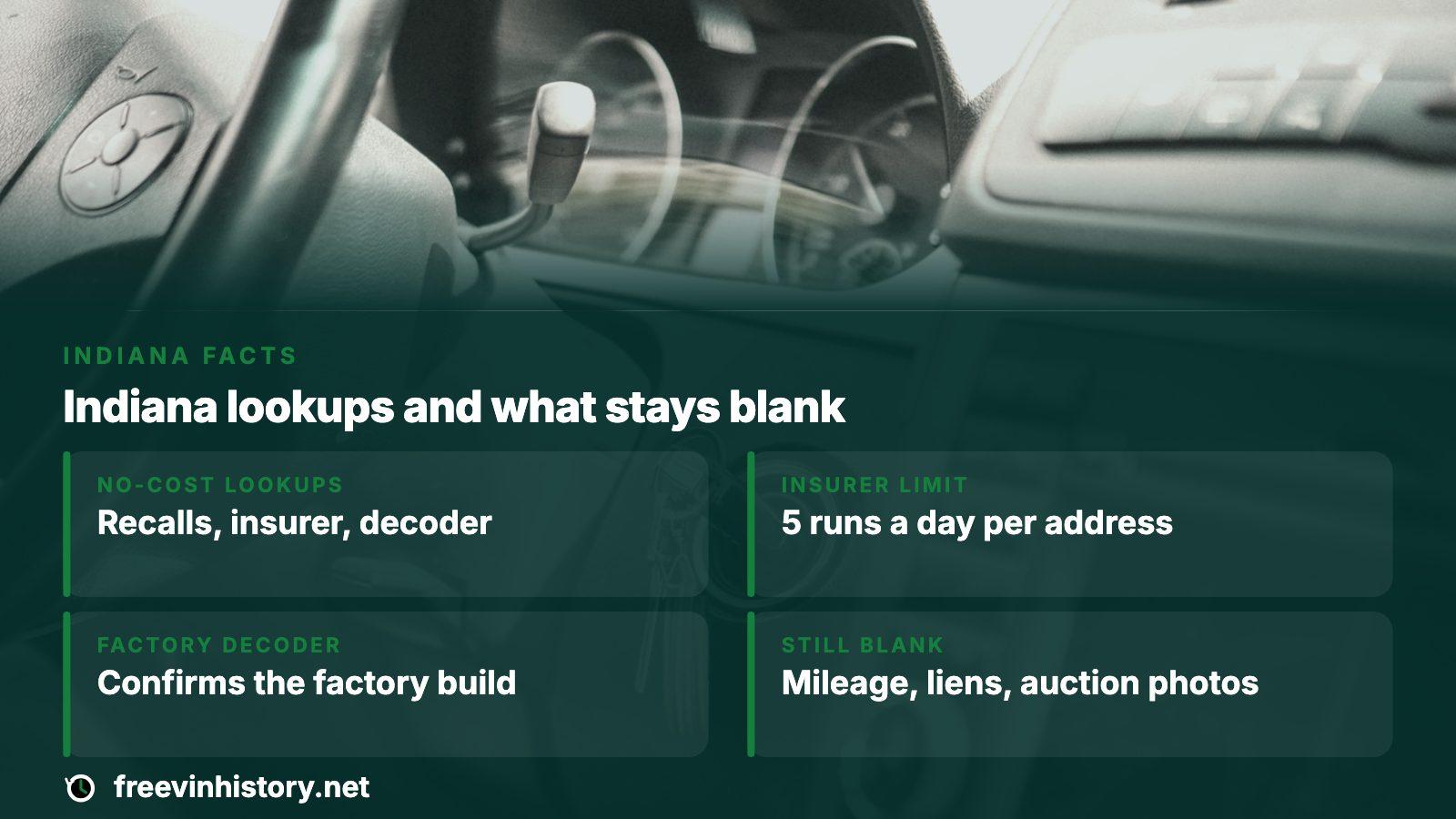
- No-cost lookups
- Recall search, insurer lookup, factory decoder
- Insurer lookup limit
- Capped at 5 runs a day per network address
- Federal title report
- Federal site says to expect up to $4
- Still blank afterward
- Mileage history, liens, auction photos
How to use this checklist
FreeVINHistory treats a used-car check as layers. The bottom layers cost nothing because an agency or a nonprofit funds them. The upper layers cost money because someone has to license and assemble records. A buyer in Indiana can finish the bottom layers in about ten minutes with a phone and the car in front of them.
One limit on this page: the Indiana BMV's own site would not open during research, so nothing here states a state deadline, fee or form. Anything about titles and transfers in Indiana should be confirmed with the BMV itself.
The checklist at a glance
| Item | Who runs it | Answers | Leaves blank |
|---|---|---|---|
| VIN match | You, with the car | Whether glass, paper and ad agree | Nothing about history |
| Open recalls | NHTSA | Is a safety fix still owed on this VIN | Repaired recalls, small makers |
| Theft, salvage, flood | NICB | Did a participating insurer report one | Insurers that opted out, mileage |
| Factory build | NHTSA decoder | What the maker says it built | Life after the factory |
| Title and brands | Federal title system via a provider | Brands, odometer, total loss, salvage | Repairs and maintenance |
The first four rows cost nothing. The fifth is the cheapest paid layer, and the federal site puts the usual fee at up to $4 per report.
Item 1: make sure the number is right
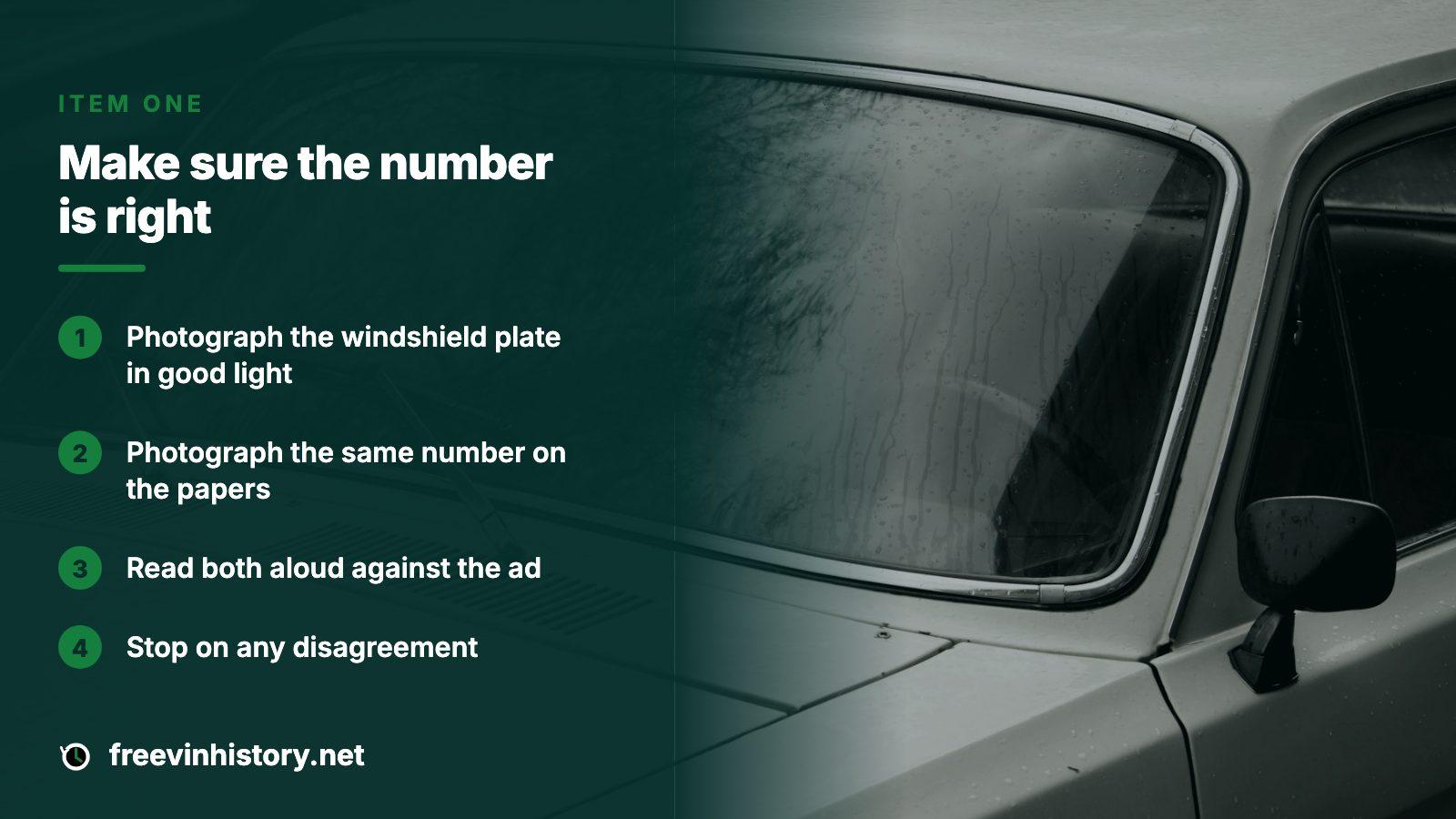
Every later lookup keys off these 17 characters. NICB notes that a mistyped VIN can fail to match a record that exists. NHTSA says to look at the windshield's lower left, then compare it with the registration card and any insurance card.
- Snap a clear photo of the windshield plate in good light.
- Photograph the same number on the paperwork the seller holds.
- Set both photos next to the ad and read them out loud, character by character.
- Any disagreement ends the check until the seller explains it.
The federal title site describes cloned cars as stolen vehicles wearing a genuine VIN lifted from a twin, which is one reason a mismatch is never a typo to shrug at.
Item 2: recalls still waiting on a repair
Feed a VIN to NHTSA's recall page and the answer is about that one car. When nothing is outstanding it prints the line about 0 unrepaired recalls tied to the VIN. When something is open, the repair is owed to the vehicle at no charge to its owner, which is worth raising in price talks.
What the screen skips matters as much as what it shows. Fixed recalls drop off. Brand-new campaigns may not list every VIN yet. Campaigns older than 15 years are excluded unless the maker stretched coverage. Tiny manufacturers, goodwill service bulletins and overseas-market cars are left out too. A shopper weighing a dozen listings can load up to 100 VINs at once.
Reading a zero
A zero says only that the agency lists no open safety fix for this VIN right now. It is silent on crashes, floods, odometer tampering and liens.
Item 3: insurer-reported theft, salvage and flood
NICB runs VINCheck from data its member insurers share. NICB put its members at 92.49 percent of earned insurance premium nationwide, as of August 2026. That is broad, yet it is not everyone, and law enforcement records are not queried at all.
- Cap: 5 searches per IP address in any 24 hours, with no lifetime limit.
- A salvage result: the insurer decided repairs would cost too large a share of the car's value, so it paid a claim.
- A salvage car can be repaired and titled again, so a hit calls for questions, not panic.
- A clean return is not a guarantee, which is NICB's own wording.
Write down the result with the date, because a record can be added later.
Item 4: the factory decoder
NHTSA's vPIC decoder turns a VIN into the build details the maker reported, delivered free as structured data. Use it to test the seller's story. A listing that claims a trim, engine or body style the decoder does not list deserves a direct question.
NHTSA warns that an empty field in the decoder output is not evidence the feature is missing. It means NHTSA holds nothing on that item, so treat blanks as unknown, not as proof.
What is still blank after four items
Indiana buyers see plenty of cars that moved through other states. The three no-cost lookups above do not read brands applied elsewhere, so a flood or salvage label from a neighboring state can slip past them.
- State-applied brands such as junk, salvage or flood, kept in the federal title database.
- Odometer readings over time, where a drop or a stall can expose tampering.
- Total-loss and salvage entries from yards and recyclers, who must report by federal law.
- Liens, impound events and auction records with photos.
The federal site recalls floodwater cars driven out of the Gulf Coast and sold in distant states, with saltwater damage that leaves wiring and airbag sensors prone to failure.
Item 5: when to pay
Start with this site's preview. Entering the VIN there costs nothing, and the result names the record categories that hold data for the car, such as title brands, damage entries, odometer readings or salvage and auction activity. If nothing interesting appears and the car passed items 1 to 4, you may be done.
Where the preview lists records, the full report opens them. You pay once, with no subscription attached, and the current amount is on the pricing page. Buy it before you pay the seller, not after.
Matching each finding to a next move
- Open recall: book the repair with a dealer before closing, or negotiate the price.
- Salvage or flood flag: request repair receipts and pay for an independent inspection.
- Theft flag: stop. NICB takes reports on 800-835-6422.
- VIN disagreement: leave until the seller explains it in writing.
The federal buying tips add a mechanic's inspection, a drive over mixed roads and a request for maintenance records, because a database cannot hear a worn transmission. Before signing, confirm Indiana's title steps with the BMV.
Where this information comes from
- NICB: VINCheck lookup — Backs the insurer coverage figure, the search cap and the tool's own caveats.
- NHTSA: Check for recalls — Backs the VIN location, the zero-recall message and the list of exclusions.
- NHTSA: vPIC VIN decoder — Backs the note on decoder output and blank fields.
- NMVTIS: Understanding a vehicle history report — Backs the federal title report's contents and its list of reporting parties.
- NMVTIS: Buying tips — Backs the inspection advice and the fee note.
- NMVTIS: Consumers — Backs the cloned-VIN and floodwater examples.
Sources and photos: Facts checked against the sources above in November 2026. Photos by Ilia, Tigran Shishmanyan and tim on Unsplash; diagrams by FreeVINHistory.
Keep reading
- Free open recall check by VIN: GM, Polaris and every other makeMore on what a recall result can and cannot tell you.
- Free salvage title check by VIN: what the free lookups showNext steps once a salvage flag appears.
- NMVTIS report: what the federal title record shows and missesWhat sits behind the federal title record.
- Free VIN check through the DMV: what a state agency will and will not showWhat a state motor vehicle office will hand over without a fee.
Frequently asked questions
Is any VIN check for Indiana truly free?
Parts of one are. Recalls, insurer flags and factory data cost nothing, and so does this site's preview. Mileage history, brands from other states, liens and auction photos sit behind a paid report, which is a single purchase here.
Does NICB only cover Indiana cars?
No. The lookup compares the VIN with participating insurers' records from any state, so where the car lives is irrelevant. Coverage depends on which insurers share data, and the sponsor warns that nothing found is not proof of a clean past.
What if I hit the daily limit on NICB?
Each network address gets five runs per rolling day, though total searches across weeks are not limited. Wait a day, switch to a different network, or narrow your shortlist before you start so each run counts.
Can a license plate stand in for the VIN?
NHTSA's recall page accepts a plate with a state, yet plate answers come from state records and can show an earlier owner's car. Stick to the VIN for every item in this checklist, because the insurer lookup and any report need it anyway.
When is a paid report worth it?
When the car has survived the no-cost items and you are close to paying. A report adds title brands from any state, odometer readings, total-loss entries and liens, which is the ground the free tools leave uncovered.
Now check the car itself
The guide explains what to look for. The report shows what this VIN has on record.