THE SHORT ANSWER
You can check a Kentucky VIN for free in three places: NHTSA for unrepaired recalls, NICB VINCheck for insurer theft, salvage and flood flags, and the state's VIN lookup for vehicle tax data. A title history request to the Transportation Cabinet adds owner and odometer records but is limited to residents and takes days. None of these shows accidents, auction photos or out-of-state titles, which is what the preview and report on this site are for.
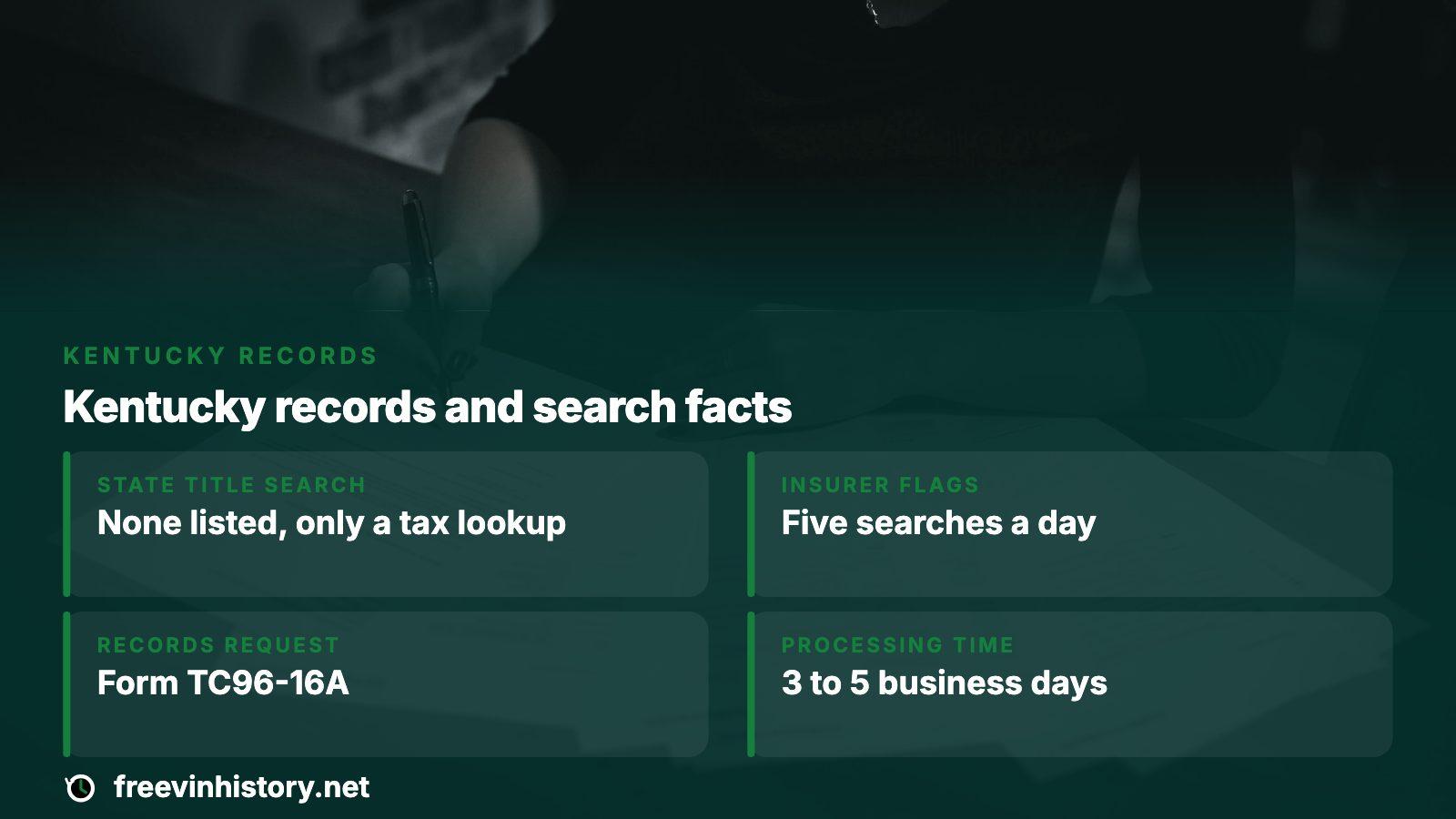
- State title search
- None listed; the cabinet offers a tax lookup and a records request
- Insurer flags
- NICB caps free searches at five a day
- Records request
- Form TC96-16A, processed within 3 to 5 business days
- Recall search
- Repaired recalls and very old ones do not appear
The sequence: quickest answers first
Most buyers work through the no-cost tools in whatever order a search engine offers them. Putting the fastest answers first lets a bad car drop out before you lose a week to paperwork. Each row is one step; the sections after the table explain how to read what comes back.
| Step | Where | What it tells you | What it cannot tell you |
|---|---|---|---|
| 1. Copy the VIN | The car and its papers | The 17 characters every lookup depends on | Whether the plate and papers are honest |
| 2. Recall search | NHTSA | Unrepaired safety recalls on this exact VIN | Repaired recalls, very old ones, small makers |
| 3. Insurer flags | NICB VINCheck | Theft, salvage or flood reports from participating insurers | Law enforcement records, insurers that opted out |
| 4. Tax lookup | Kentucky Transportation Cabinet | Whether tax data exists for the VIN | Title brands, owners, damage |
| 5. Records request | Kentucky Transportation Cabinet | Transfer dates, odometer entries, salvage notes | Anything from another state's files |
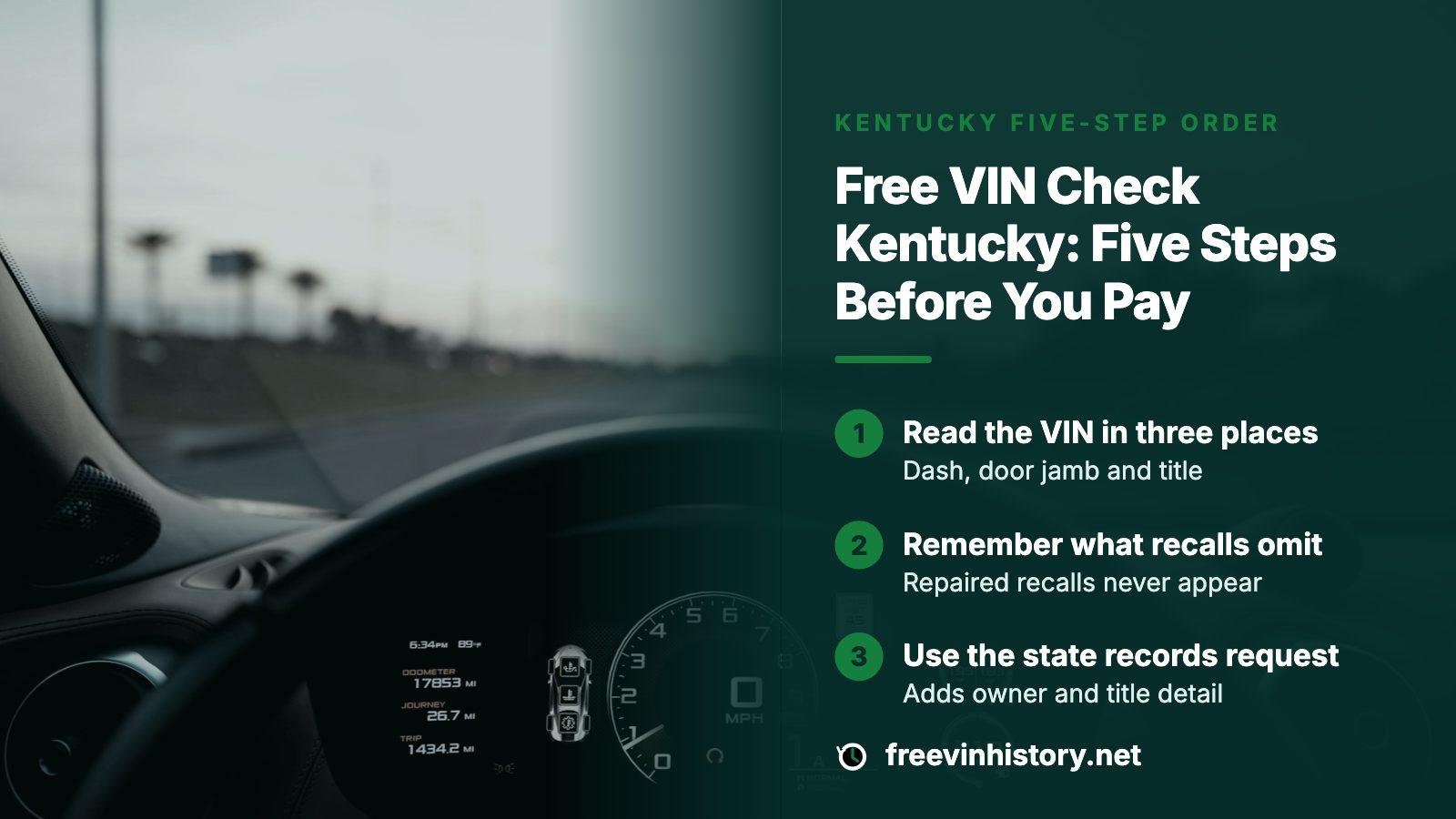
Step one: read the number in three places
Every later lookup hangs on the VIN, and one wrong character returns nothing, or somebody else's car. NICB warns that a mistyped number can miss every record, and an empty answer looks just like a clean one.
Begin with the plate visible through the glass on the driver's side, move to the sticker inside the driver's door frame, then compare against the title or registration in the seller's hand. Kentucky's own lookup page names those same spots, plus the insurance card. Every copy should match, character for character. If the dashboard and the paperwork disagree, stop there; that mismatch is a bigger finding than anything the free tools will turn up later.
Step two: the recall search and its blind spots
NHTSA's recall page takes a VIN and answers one question: does this vehicle have an unrepaired recall? A car with none returns a message saying zero unrepaired recalls are associated with the VIN. The lookup is free and takes seconds.
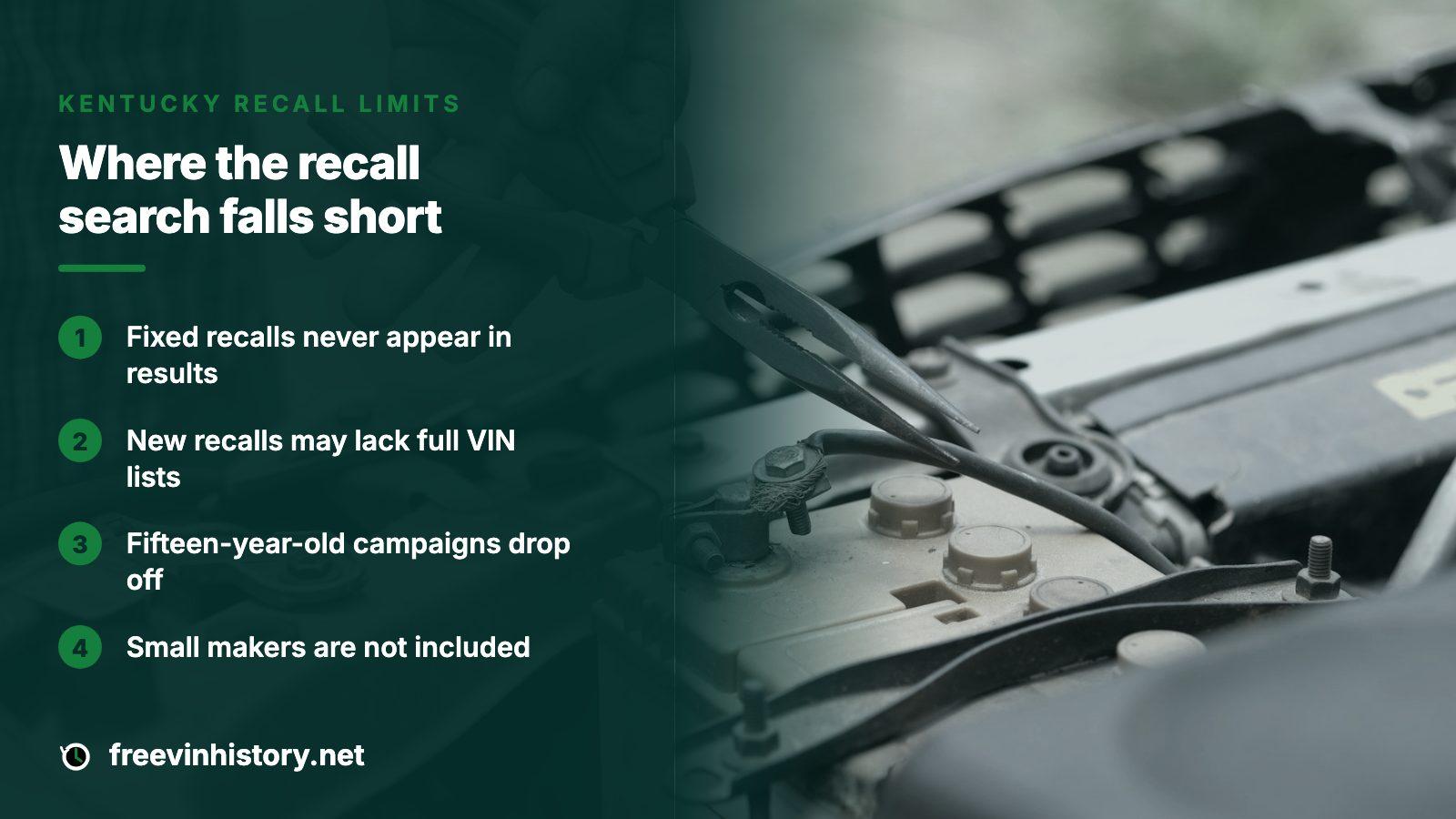
- It will not list a recall that was already fixed, so a clean result says nothing about past defects.
- Newly announced recalls may not cover every VIN yet; check again if the campaign is recent.
- Anything beyond fifteen years old falls off the list, unless the maker keeps covering it.
- Small manufacturers and non-safety service campaigns are not included.
Treat an open recall as a negotiating point, not a verdict. Better to learn about it before you own the car.
Step three: what the insurers have reported
NICB VINCheck matches a 17-digit VIN against theft, salvage and flood reports from member insurance companies. Each connection gets five searches a day, so spend them on your shortlist rather than every listing you scroll past.
A clean result is not a clean history
NICB itself calls this tool a useful extra, not a stand-in for a full history report. It reads insurance records from participating companies only. A car repaired out of pocket, or wrecked while insured with a company that stays out of the program, can return nothing.
A salvage hit means a carrier wrote the car off and paid out the claim. The car can legally be rebuilt and retitled, so a hit is the start of a conversation with the seller, and a reason to look hard at the title itself.
Step four and five: what Kentucky itself offers
The Transportation Cabinet's online VIN lookup searches vehicle and boat tax data by VIN. It is useful as a quick sign that the number exists in state tax records, but the page describes a tax tool and nothing more. Do not expect brands, owners or damage from it.
For deeper state records, the cabinet takes title history requests on form TC96-16A. What comes back can cover mileage entries, the dates ownership changed hands, owner details, salvage notes and a check of signatures, and copies of the transfer paperwork can be had too. Two limits matter to a buyer. Only Kentucky residents, or businesses on file with the Secretary of State, may ask. And the cabinet quotes 3 to 5 business days to process it. No fee appears on that page, so ask the cabinet before mailing anything.
What the free steps still leave open
Put the lookups together and the gaps show. They come from separate agencies and one insurer program, and none is set up to answer the questions that usually decide a purchase.
- Accident and damage records that never became an insurance total loss
- Auction listings and the photos taken when the car was sold
- Odometer readings from other states' titles and inspections
- Liens and impound records
- Title brands carried over from a state outside Kentucky
Federal title data exists for exactly this problem. The federal NMVTIS database exists so buyers are not defrauded, do not end up in unsafe vehicles, and cannot be sold cars that were stolen. Consumers reach it through approved data providers, not through a public search box.
Reading a Kentucky title and its paperwork
Kentucky's rules give you clues you can check at the kitchen table. In a private sale, the seller signs the back of the title in front of a notary, and the title must be transferred to the buyer within 15 days. A signature that was not notarized, or a seller who cannot produce the title itself, is a reason to walk away.
Rebuilt vehicles leave a paper trail too. A car rebuilt from salvage needs a notarized affidavit on form TC 96-215, a repair list on TC 96-353, original receipts for parts and the original salvage title. Ask a seller of a rebuilt car to show those documents. Someone who really did the work will have the receipts.
If the car is from out of state
Kentucky asks for proof of a passed sheriff's inspection before it titles an out-of-state vehicle, and the application is form TC 96-182. That inspection confirms identity. It does not grade condition, so it cannot stand in for a history check.
Where the full report earns its place
Everything above costs nothing, and for a cheap commuter you may stop after steps one to three. When the car costs real money, or any free step turned up something odd, run the VIN here for the free preview. It shows whether records such as title brands, damage, odometer entries or auction history exist for that car before you decide to pay.
Moving from preview to report is a separate, paid decision: a single payment, with no subscription behind it. See the pricing page for current rates. Only the preview costs nothing.
If something does not add up
- Stop the sale and keep every document and message the seller gave you.
- Tell NICB if you suspect a fraudulent sale; it takes online reports and phone calls at 800-TEL-NICB.
- For a possible title problem in Kentucky, the Division of Motor Vehicle Licensing takes fraud complaints on form TC 96-349, by mail to Frankfort or by email.
- Hold off on any deposit until the number on the car lines up with the number on the title.
Where this information comes from
- NICB: VINCheck — what the insurer database covers, its search limit and its own caveats
- NHTSA: Check for Recalls — what the VIN recall search shows and omits
- Kentucky Transportation Cabinet: Title History Requests — who can request records, the form and the processing time
- Kentucky Transportation Cabinet: Vehicle Titling — private sale notarization, transfer window and out-of-state titling
- Kentucky Transportation Cabinet: Rebuilt-Salvaged Titles — paperwork required for a rebuilt vehicle
- Kentucky VIN/HIN Lookup — the state's tax-data lookup and where a VIN is printed
- NMVTIS VehicleHistory — purpose of the national title information system
Sources and photos: Facts checked against the sources above in November 2026. Photos by Dennis Eusebio, Towfiqu barbhuiya and Dimitri Karastelev on Unsplash; diagrams by FreeVINHistory.
Keep reading
- Free VIN check through the DMV: what a state agency will and will not showWhat a state motor vehicle agency can tell you from a VIN, and what it cannot.
- Free open recall check by VIN: GM, Polaris and every other makeA closer look at the recall step and what it leaves out.
- Free salvage title check by VIN: what the free lookups showWhat to do when an insurer flag points to salvage.
- Rebuilt title check free: what you can learn before payingHow to vet a car that was rebuilt from salvage.
Frequently asked questions
Can I check a Kentucky VIN for free?
Yes, in pieces. NHTSA's recall search and NICB's insurer database are free, and the state offers a tax lookup by VIN. Together they flag open recalls, reported theft, salvage and flood records, and confirm tax data exists. They do not add up to a full history, which is why many buyers add a report.
Can I search a Kentucky VIN for title history online instantly?
The Transportation Cabinet's vehicle pages list a tax lookup and a title history request, not an instant public title search. The request uses form TC96-16A and is processed within 3 to 5 business days. It is open to Kentucky residents and to businesses registered with the Secretary of State.
Is a clean NICB result enough to buy on?
No. NICB states that a clean answer guarantees nothing about the past. It reads only participating insurers' records and skips law enforcement files. A car repaired without an insurance claim can come back clean while still carrying unreported damage.
Does the free preview here replace the other free checks?
It complements them. The agency lookups are worth running because they are free and official. The preview shows whether deeper records exist for the VIN, such as brands or damage. If they do, the full report, a one-time payment, lays them out.
What if the seller stalls on the VIN?
Treat that as an answer. A VIN is printed on the dashboard, the door jamb, the title and the registration, so a seller can read it in seconds. A seller who stalls is either hiding the car's identity or has not got the title in hand. Either way, pause the deal.
Now check the car itself
The guide explains what to look for. The report shows what this VIN has on record.