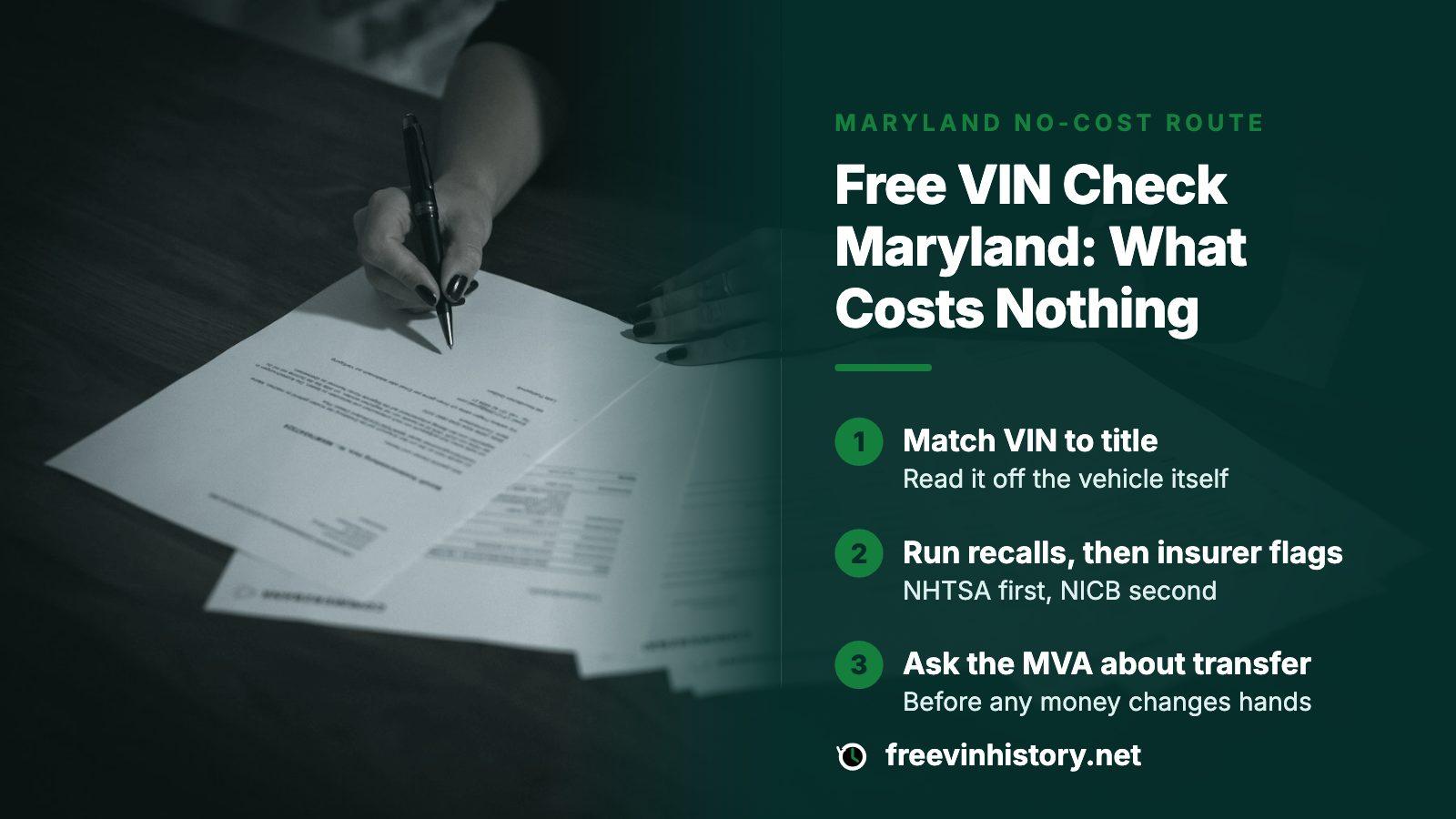
THE SHORT ANSWER
Maryland buyers can check a VIN at no cost with NHTSA's recall search, NICB VINCheck for theft, salvage and flood losses that insurers reported, and NHTSA's decoder. None of them shows title brands from other states, odometer readings or accident detail. This site's free preview hints at whether those records exist, and the full report is bought once.
- Free tools
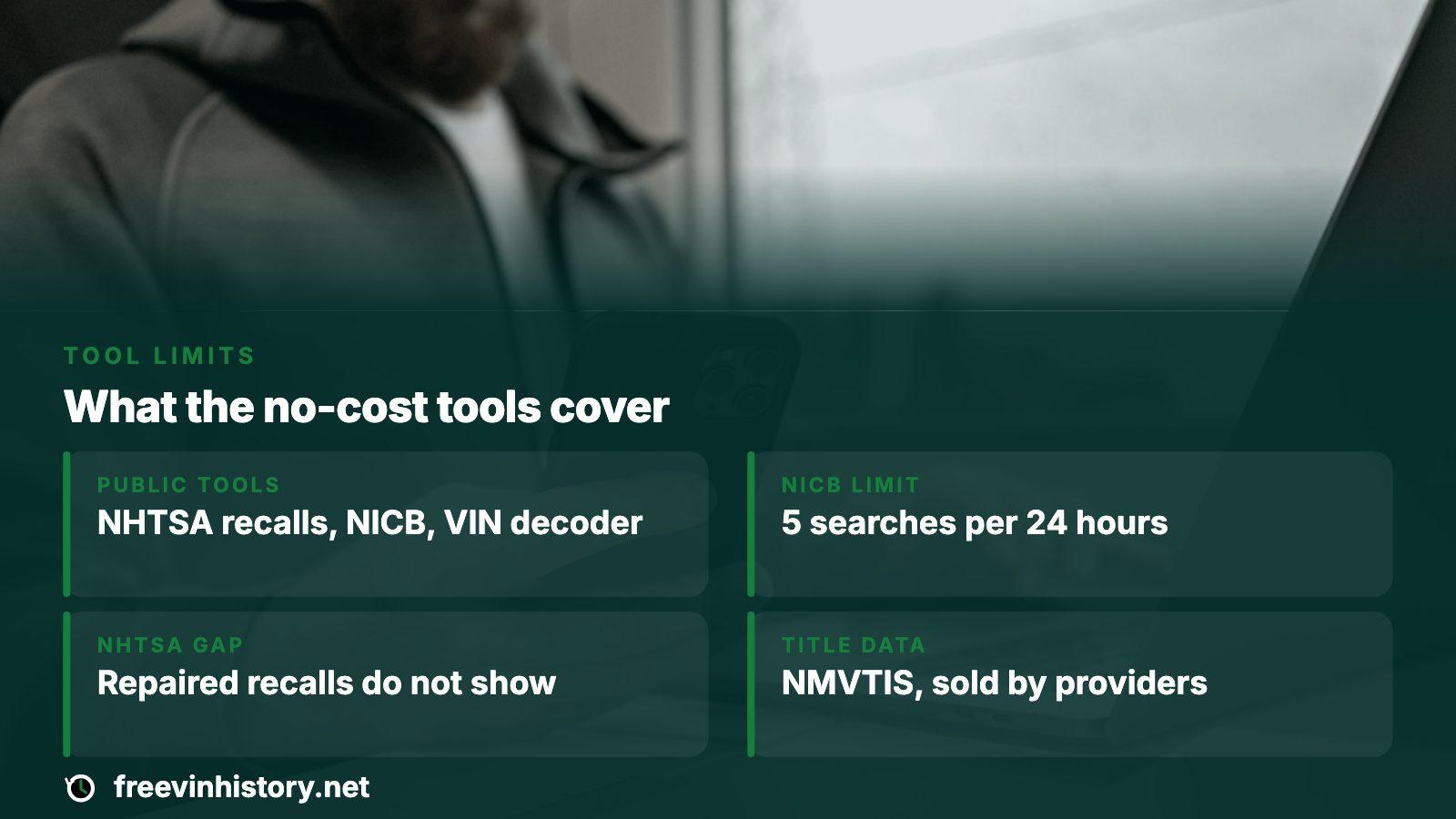
- NHTSA recalls, NICB VINCheck, VIN decoder
- NICB limit
- 5 searches per 24 hours per IP address
- NHTSA gap
- Repaired recalls and very new recalls do not show
- Title data
- NMVTIS covers five indicators, sold by approved providers
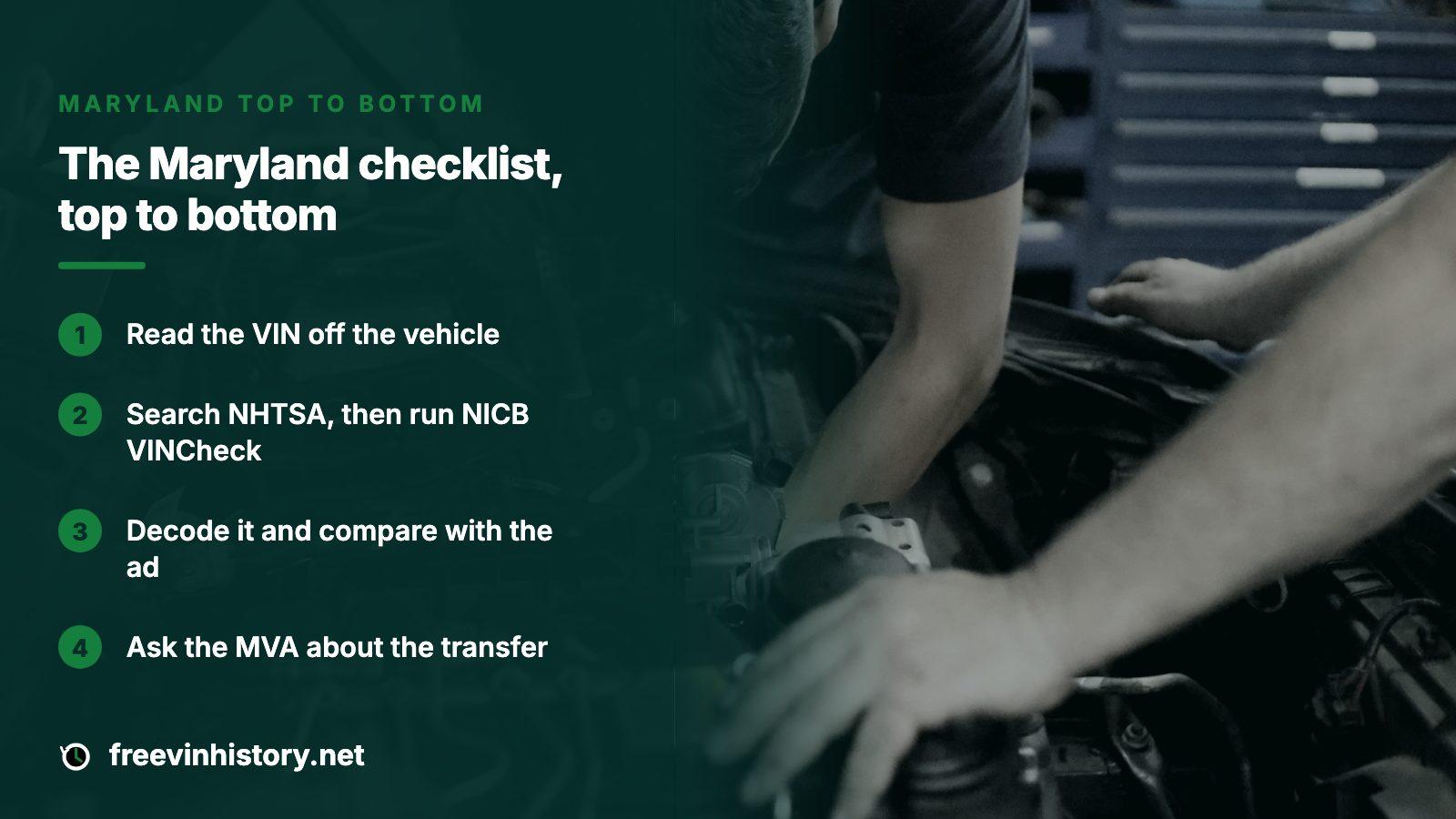
The checklist, top to bottom
Print this or keep it open on your phone while you look at the car. Each line is free, and each one can end the deal on the spot. Take them top down, and quit looking at a car once a line fails.
- Read the VIN off the vehicle, then compare it with the title or registration.
- Search NHTSA for unrepaired recalls on that VIN.
- Run the VIN through NICB VINCheck for losses that insurers reported.
- Run a decode and hold the output up against the ad.
- Preview a full report for title, odometer and damage records.
- Ask the Maryland MVA what it requires for the transfer, before you pay.
Steps one to four cost nothing. Step five starts with a free preview, and step six is a phone call or a visit to the state's own pages.
Step one: make the VIN match
Every other check depends on a correct VIN. NHTSA names the windshield's lower left corner, the registration card and sometimes the insurance card. Read it off the car itself, not only off the listing.
NICB adds a warning that matters here: a wrong VIN may simply fail to match any record, which looks identical to a clean result. One mistyped character can make a flagged car appear spotless, so copy and paste where you can, and read the characters back twice when you cannot.
Step two: the recall search and its blind spots
NHTSA's VIN search tells you whether a car has an unrepaired recall. With none, the site shows a message reading 0 unrepaired recalls associated with this VIN. Dealers fix recalls without billing the owner, so an open one strengthens your hand in the haggling rather than a reason to leave.
| NHTSA search shows | NHTSA search leaves out |
|---|---|
| Unrepaired recalls tied to the VIN | Recalls already repaired |
| Open items from many makers | Recalls announced so recently that VINs are not loaded |
| Maker-supplied recall data | Recalls older than fifteen years, with exceptions the maker sets |
| A quick yes or no | Small manufacturers and non-safety campaigns |
Recheck a few days before you sign if the car is a recent model year. Recalls are added continuously.
Step three: what NICB VINCheck can and cannot tell you
NICB's tool puts one question to member insurers: did any of them log this VIN as a theft still open, a salvage loss or a flood loss? NICB says member insurers write 92.49% of earned premium across the country, so coverage is wide but not total. Searches are capped at 5 per 24 hours per IP address, which is plenty for a shopper comparing a few cars and awkward for someone checking a whole lot.
NICB itself says the tool is not a complete history and a clean result is no guarantee. It does not search police files or insurers that opted out, so a car that never went through an insurance claim, or went through one with a non-participant, can pass.
What a salvage hit means
NICB describes salvage as an insurer deciding the repair cost was too high and paying a claim instead. A car like that may lawfully be repaired and titled again, so a hit means studying the title and the repair work, not rejecting it outright.
Step four: decode before you trust the listing
NHTSA's decoder returns what the maker filed for a VIN, such as where it was built. A shortened VIN still works in the box, which helps when a seller blurs the last digits in photos.
Compare the decoded year, body and engine with the ad. A mismatch may be a typo in the ad, or the number may belong to some other vehicle. You want to find out before the test drive.
What the free tools miss
Put the three tools side by side and the gaps are easy to see. The free set answers safety recalls and insurer theft or salvage questions. It stays quiet on how the title has changed, what the odometer read at earlier dates, and what happened to the car between owners.
- Title brands applied in other states are not in the free set.
- Odometer readings over time are not in the free set.
- Total-loss and auction history beyond NICB's insurers are not in the free set.
- Liens, impounds and use type are not in the free set.
For a car that spent years elsewhere before reaching a Maryland lot, those gaps are the ones that matter most.
The national title record behind a full report
The federal NMVTIS system keeps five things on file: the current titling state and the date of the latest title, brands, an odometer figure, any total loss and any salvage event. Reporting is mandatory by federal law for state titling offices, scrap and salvage operators, recyclers and insurers.
The Justice Department's page says a clean NMVTIS report is good news and that the report is deliberately short. It also notes that consumers buy these reports from approved data providers, and that repair histories and recall data belong to private providers rather than NMVTIS itself.
Where the full report fits
If the free steps come back clean and you still intend to pay real money for the car, a full report is the next layer. Here you type in the VIN and get a free preview that hints at title, damage or odometer records. Unlocking the detail is one payment, nothing recurring, and the pricing page has the options.
Treat the preview as a sieve. A car you only half like, with nothing to read, can be dropped. Where records show up, the report spells them out so your questions to the seller are specific.
The Maryland part: confirm with the MVA
Title transfers, taxes and inspection requirements are set by the state, and they change. The MVA's own pages were not readable when this page was prepared, so this page states no Maryland fee, deadline or form number. Check the current rules on the MVA site, or ask a branch, before you hand over money.
Questions for the MVA
Ask which documents a private-sale transfer needs, whether a vehicle inspection is required before titling, and how excise tax is figured on the purchase. Write down the answers and bring them to the sale.
Where this information comes from
- NICB: VINCheck lookup — The free insurer search, its daily cap and its own stated limits.
- NHTSA: Check for recalls — What the VIN recall search shows and omits, and where the VIN sits.
- NHTSA: vPIC VIN decoder — Maker-reported data a decode returns, including build plant.
- NMVTIS: Understanding a vehicle history report — The five indicators and where the data comes from.
- NMVTIS: Approved data providers — Who may sell NMVTIS reports to the public.
Sources and photos: Facts checked against the sources above in November 2026. Photos by Dimitri Karastelev, Mustafa Sheikhmouss and Anastasiia Nelen on Unsplash; diagrams by FreeVINHistory.
Keep reading
- Free VIN check through the DMV: what a state agency will and will not showWhat a state DMV tool can and cannot show you.
- Free open recall check by VIN: GM, Polaris and every other makeA closer look at open recalls before you buy.
- Free salvage title check by VIN: what the free lookups showWhat to do when a salvage flag turns up.
- NMVTIS report: what the federal title record shows and missesThe national title record explained in full.
Frequently asked questions
Is there a free VIN check for Maryland cars?
Yes, in pieces. NHTSA's recall search, NICB VINCheck and NHTSA's decoder cost nothing and work for any state's vehicles. Together they cover open recalls, insurer-reported theft and salvage, and what the VIN says about the build. They do not show odometer readings or title brands from other states.
Does NICB VINCheck show accident history?
No. It searches only the theft, salvage and flood entries that participating insurers filed. A minor accident that never produced a total loss will not appear. NICB itself warns against reading a clean answer as proof, and says the tool is no substitute for a full report.
How many VINs can I search for free?
NICB lets one IP address run five lookups per day. NHTSA's recall tool takes a batch of VINs in one go, up to 100. The decoder has no limit stated on its page, though it only reports what the maker supplied.
Why can a clean result still hide a bad car?
Each free tool reads one narrow slice of the record. NICB sees only participating insurers, and NHTSA sees only unrepaired recalls it has loaded. A car with a title brand or rolled-back odometer can pass both. Treat clean results as the absence of two specific problems.
What does the preview on this site add?
The preview is no charge and hints at whether title, damage or odometer records are on file for your VIN. The detail sits in the report, bought once with no recurring charge. Current options are on the pricing page.
Now check the car itself
The guide explains what to look for. The report shows what this VIN has on record.