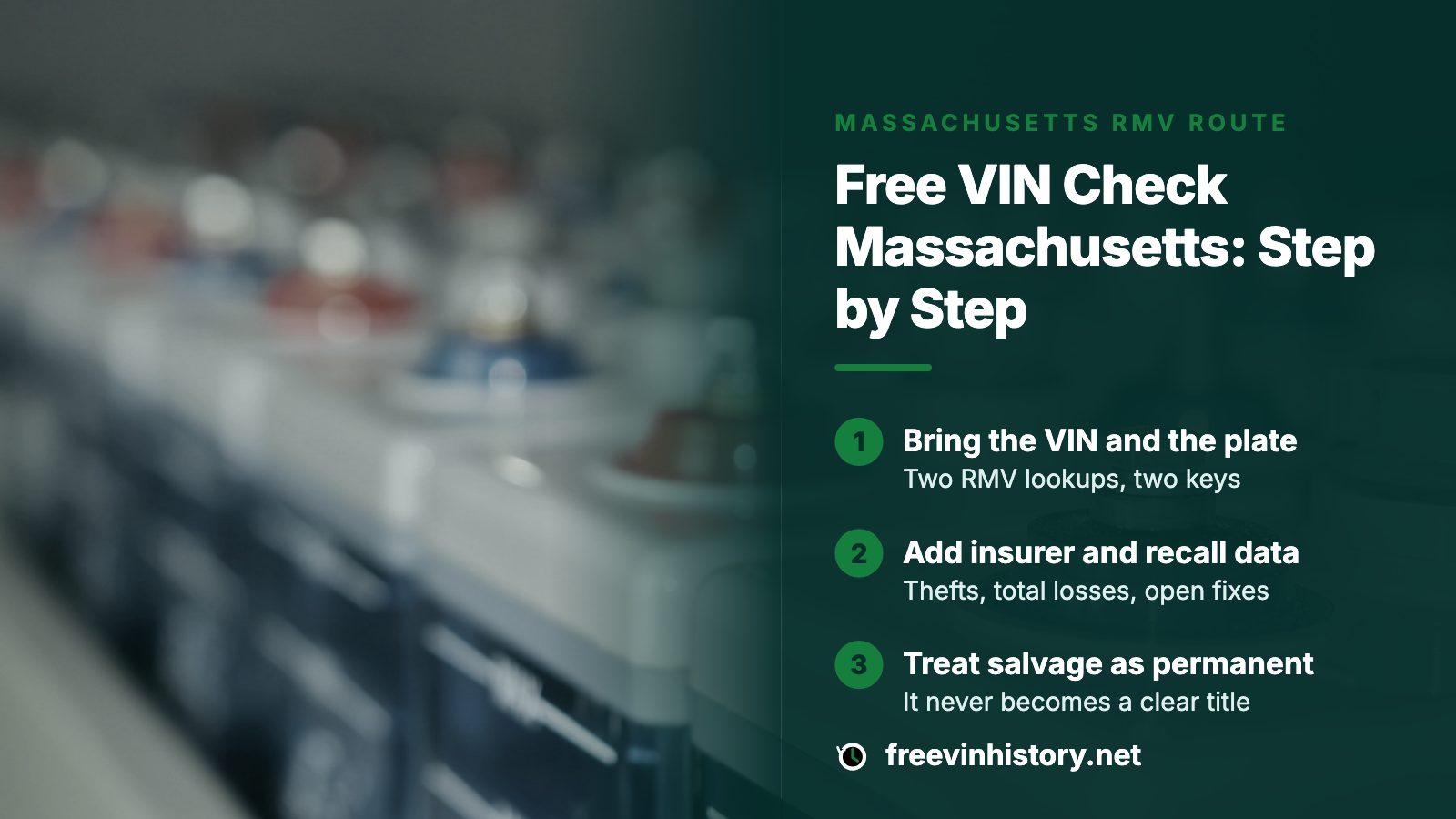
THE SHORT ANSWER
Massachusetts has no single free VIN history tool. The RMV offers a free registration status check by plate and a free title status check by VIN, NICB flags thefts and total losses that insurers filed, and NHTSA lists open recalls. Crash detail, mileage readings and auction photos need a paid report, which on this site begins with a free preview.
- RMV registration check
- Free, keyed to the plate, and shows how the last inspection went
- RMV title check
- Free, keyed to the VIN, shows lender and title format only
- NICB limit
- Five VINCheck searches per day, per IP address
- Salvage in Massachusetts
- Permanent: a salvage title never becomes a clear one
The free toolkit at a glance
Each free source answers one narrow question, and the questions barely overlap. Here is what you get from each, and what stays hidden.
| Lookup | You enter | It tells you | It cannot tell you |
|---|---|---|---|
| RMV registration status | Plate type plus plate number | Whether the registration is current, when it lapses, the car's year and model, the last inspection and how it came out, coverage on file | Anything about damage or title brands |
| RMV title status | VIN, or its last eight characters with the title number | When the title was issued, where it was mailed, paper or electronic, any lender on record | Brands, accidents, mileage |
| NICB VINCheck | Full VIN | Thefts still open, plus total-loss and water-damage entries filed by participating insurers | Police records, insurers outside the program, unclaimed damage |
| NHTSA recall search | VIN | Safety recalls still waiting for a fix | Repaired recalls, old recalls, non-safety campaigns |
| Full report from this site | VIN | Crash, odometer, auction, lien and ownership entries, after a free preview | Damage nobody ever reported |
Step 1: get the VIN and the plate before you call anyone
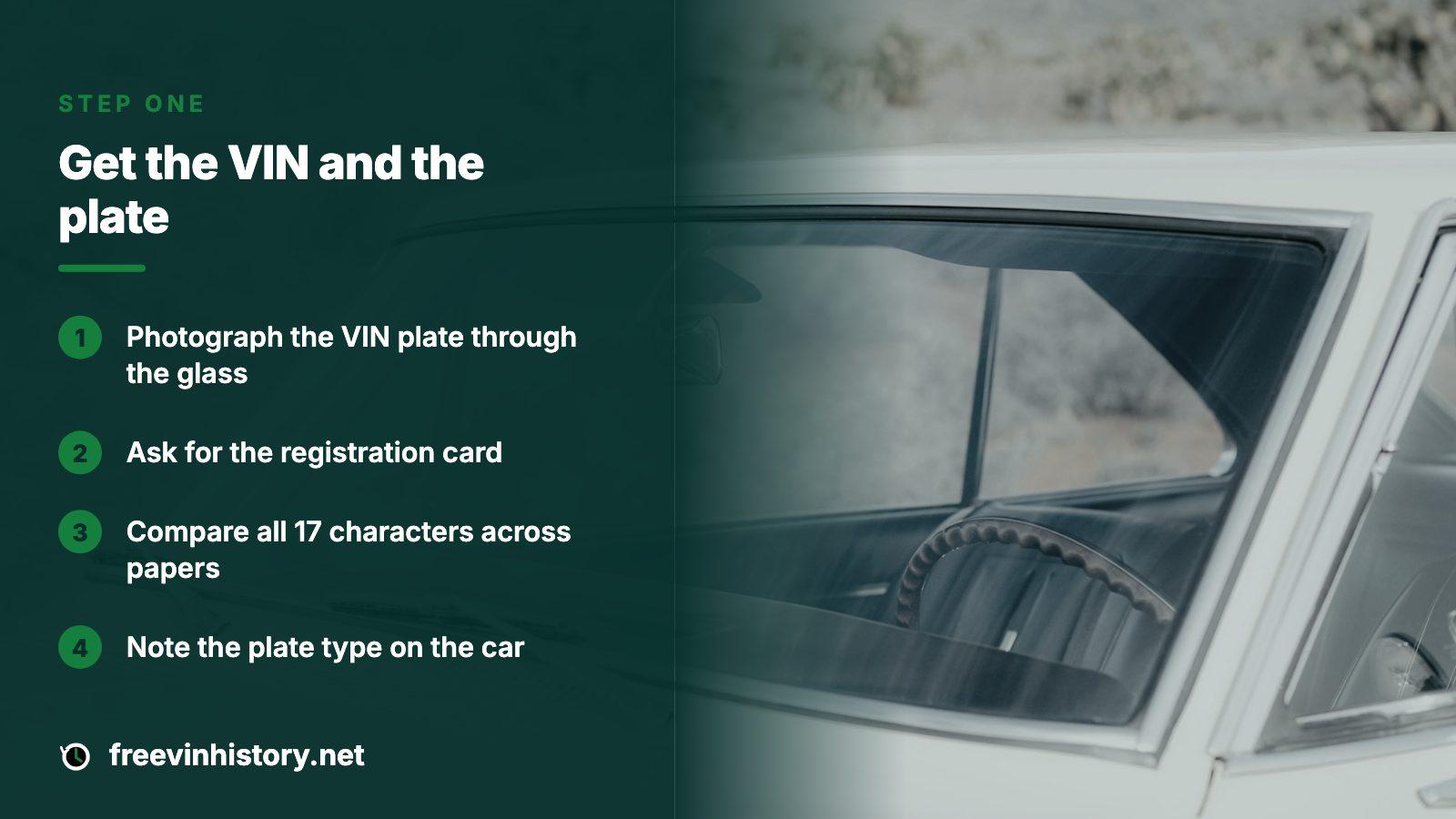
In this state the plate matters nearly as much as the VIN, since the registration lookup runs on it. Request both when you first reply to the ad. If a seller balks at sharing a plate for a car already listed publicly, treat that as information.
- Shoot a clear photo of the VIN plate through the glass on the driver's side, down by the dash.
- Photograph the plate, then ask for the registration card, which carries the plate number, the VIN and the title number.
- Compare all 17 characters across the windshield, registration and title. One wrong character sends every later search to the wrong car, or to none.
- Note which plate type is on the car. Repair, dealer, farm and a few other plate types are not served by the online registration check.
Step 2: the two RMV lookups
Both RMV lookups are free. The registration check is the more revealing one for a used-car buyer, since it reports the date and the result of the most recent inspection. A car that failed lately, or one that has not been inspected in years while the seller calls it a daily driver, deserves a question.
The title lookup is narrower. It confirms when the current title was issued, whether it is paper or electronic, and who holds the lien. That last detail is the useful one: if a lender appears, the title will not come to you directly after the sale, so the payoff has to be settled in writing first.
What the RMV title check leaves out
The state's own page for the title lookup lists no damage or brand field. A tidy answer there says the record exists and who is on it, not that the car was never wrecked.
Step 3: NICB for insurer records, NHTSA for recalls
NICB's VINCheck is the free spot where an insurer's total-loss decision can surface. Its data comes from member companies that together cover 92.49% of earned premium nationwide. VINCheck permits just five lookups daily per IP address, so save them for the cars you might actually buy.
NHTSA's recall search takes the VIN and reports unrepaired recalls. A car with none returns a message saying zero unrepaired recalls. Repaired recalls do not appear, and neither do very new ones whose VINs are not loaded yet or those from small manufacturers.
- An open recall means the maker owes you a repair, which is also a legitimate point in price talks.
- A salvage or flood hit on NICB does not end the conversation by itself. The car may have been rebuilt and re-titled, so ask to see the title.
- A clean NICB answer is not a guarantee, and NICB says so on its own page.
Step 4: read the Massachusetts title brands
Massachusetts spells its brands out. A salvage title carries a primary brand and a secondary one. The primary brand says whether the car can ever return to the road, and the secondary one says what wrecked it.
| Brand or title type | What it means |
|---|---|
| Salvage, repairable (REPR) | Declared a total loss but repairable; stays off the registry until a salvage inspection is passed |
| Salvage, parts only (PART) | The insurer marked it unfit; Massachusetts will never register it |
| Secondary brands | Collision, fire, flood, flood and salt, theft, vandalism, or other |
| Reconstructed | A former repairable salvage car that was fixed and passed salvage inspection |
| Recovered theft | A stolen car found with minimal damage |
| Memorandum | A non-negotiable title used while an out-of-state lender holds the original |
| Junk | Scrapped; can never be titled or registered again |
Two Massachusetts details matter to buyers. A salvage title is permanent, so a reconstructed label never turns back into a clear one. And cars from other states with salvage titles must pass a Massachusetts salvage inspection, because the state does not accept other states' inspections without an agreement.
Where free stops, and what the next step adds
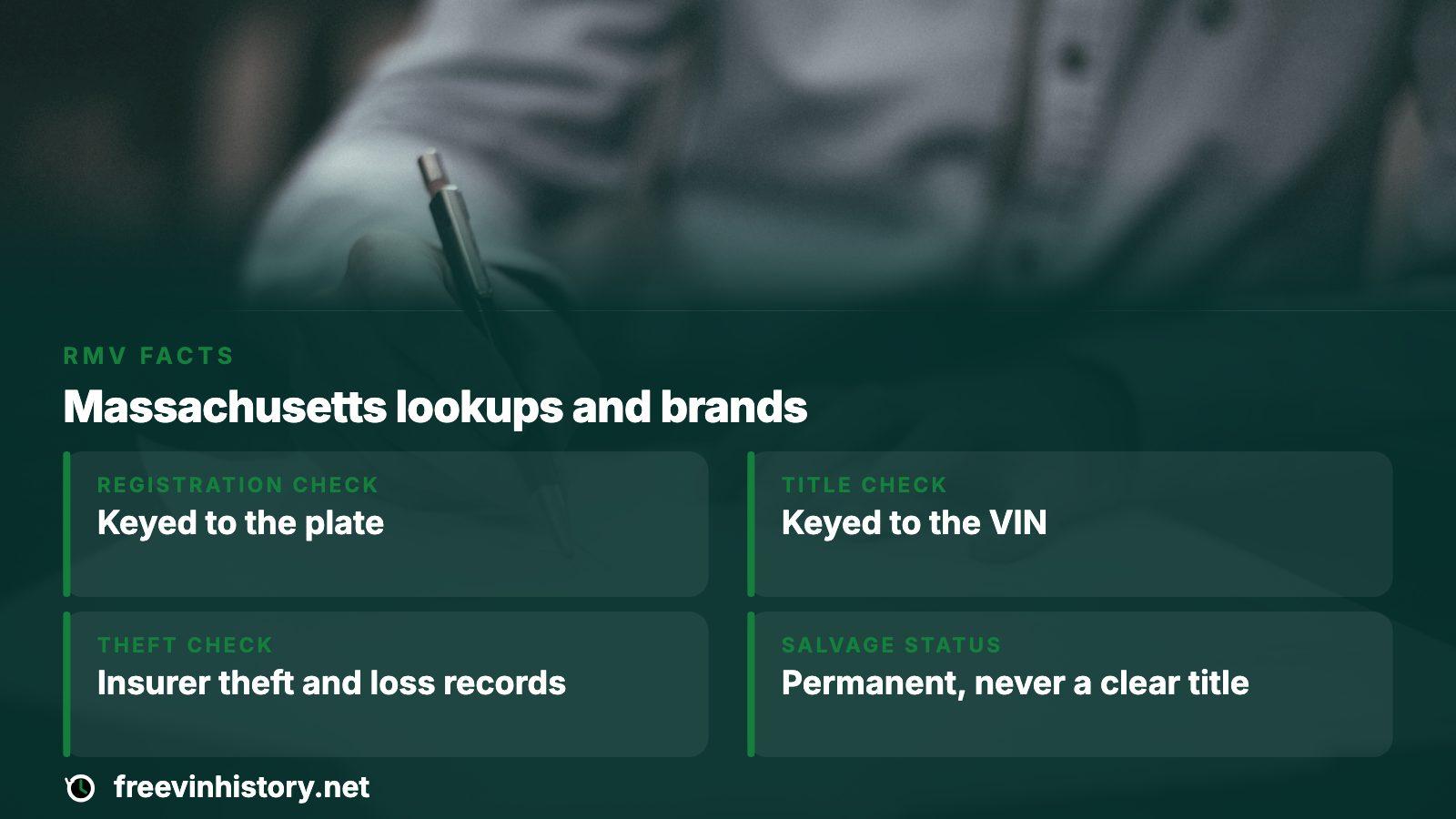
Lay the five answers side by side and the gaps are plain. The state tells you about registration and title standing, NICB about insurer-reported losses, NHTSA about open recalls. None of them lists crash records, how the mileage changed over time, auction listings with photos, or who owned the car before the seller.
There is also a federal option. NMVTIS gathers title records, the most recent odometer reading and brand history from state agencies, salvage yards and insurers, and only approved providers may sell reports built on it.
This site's route is simpler to start. Enter the VIN and the preview, which is free, shows which record types exist for that vehicle. A complete report is bought one time for that one VIN, with no renewal after it. You will find today's prices on the pricing page. Order it ahead of any deposit, while walking away or haggling is still easy.
After the check: Massachusetts paperwork and the inspection clock
A clean result still leaves a to-do list, and Massachusetts sets short deadlines for it.
- Title the vehicle within 10 days of purchase. In a private sale you pay the registration fee, the $75 title fee and 6.25% sales tax.
- The tax uses the larger of the sale price and the NADA trade-in value, which means a low handshake price will not cut the bill.
- The seller must state the mileage on the transfer paperwork, and the RMV rejects erasures, white-out and alterations.
- A newly bought car needs an inspection sticker within 7 days of registration. Most cars pay $35.
- Paper titles arrive in roughly 6 to 8 weeks, and go to the lender if there is a loan.
Where this information comes from
- Mass.gov: Check the status of your vehicle registration — Supports the registration lookup's inputs, fields and excluded plate types.
- Mass.gov: Check the status of your vehicle's title — Supports what the title lookup returns and its VIN inputs.
- Mass.gov: Total loss and salvage vehicles — Supports the primary and secondary brands, permanence and out-of-state inspection rule.
- Mass.gov: Title types and definitions — Supports the reconstructed, recovered theft, memorandum and junk definitions.
- Mass.gov: Registration and title for a vehicle bought from an individual — Supports the 10-day titling rule, fees, tax basis and mileage statement.
- NICB: VINCheck — Supports the free insurer-record lookup, its daily cap and its limits.
- NHTSA: Check for recalls — Supports what the VIN recall search does and does not show.
Sources and photos: Facts checked against the sources above in November 2026. Photos by Vanya Smythe, Wesley Tingey and Scott Graham on Unsplash; diagrams by FreeVINHistory.
Keep reading
- Free VIN check through the DMV: what a state agency will and will not showHow state motor vehicle agencies treat a free VIN check request.
- Free salvage title check by VIN: what the free lookups showMore on catching a salvage history before you pay.
- Car title search by VIN free: what you can see before you payWhat a title check by VIN can and cannot show.
- Free open recall check by VIN: GM, Polaris and every other makeReading NHTSA recall results in more detail.
Frequently asked questions
Is there a free VIN check for Massachusetts vehicles?
Several partial ones. The RMV checks registration and title status at no charge, NICB flags theft, salvage and flood records, and NHTSA lists open recalls. A complete history is not free anywhere, but this site's preview shows which deeper records exist before you pay.
Can the RMV registration check run on a VIN?
No. It needs the plate type and registration number. The separate title status lookup does take a VIN, or the last 8 characters plus the title number. If a seller only gives you the VIN, ask for the plate as well.
What does a Massachusetts salvage title mean?
An owner or insurer treated the vehicle as a total loss. A repairable car stays unregistrable until a salvage inspection is passed, a parts-only car is shut out for good, and the salvage record never expires. After repair and inspection the title reads reconstructed.
Is a clean NICB result proof the car has no problems?
No. NICB says a clean result is no guarantee. It sees only participating insurers' records, never police files, so a theft or serious wreck that nobody reported to a member company will not appear.
How long does a Massachusetts buyer have to title a car bought from a private seller?
Ten days from the purchase. You will owe the registration fee, a title fee, and sales tax of 6.25 percent. The car also needs an inspection sticker within 7 days of registration.
Now check the car itself
The guide explains what to look for. The report shows what this VIN has on record.