THE SHORT ANSWER
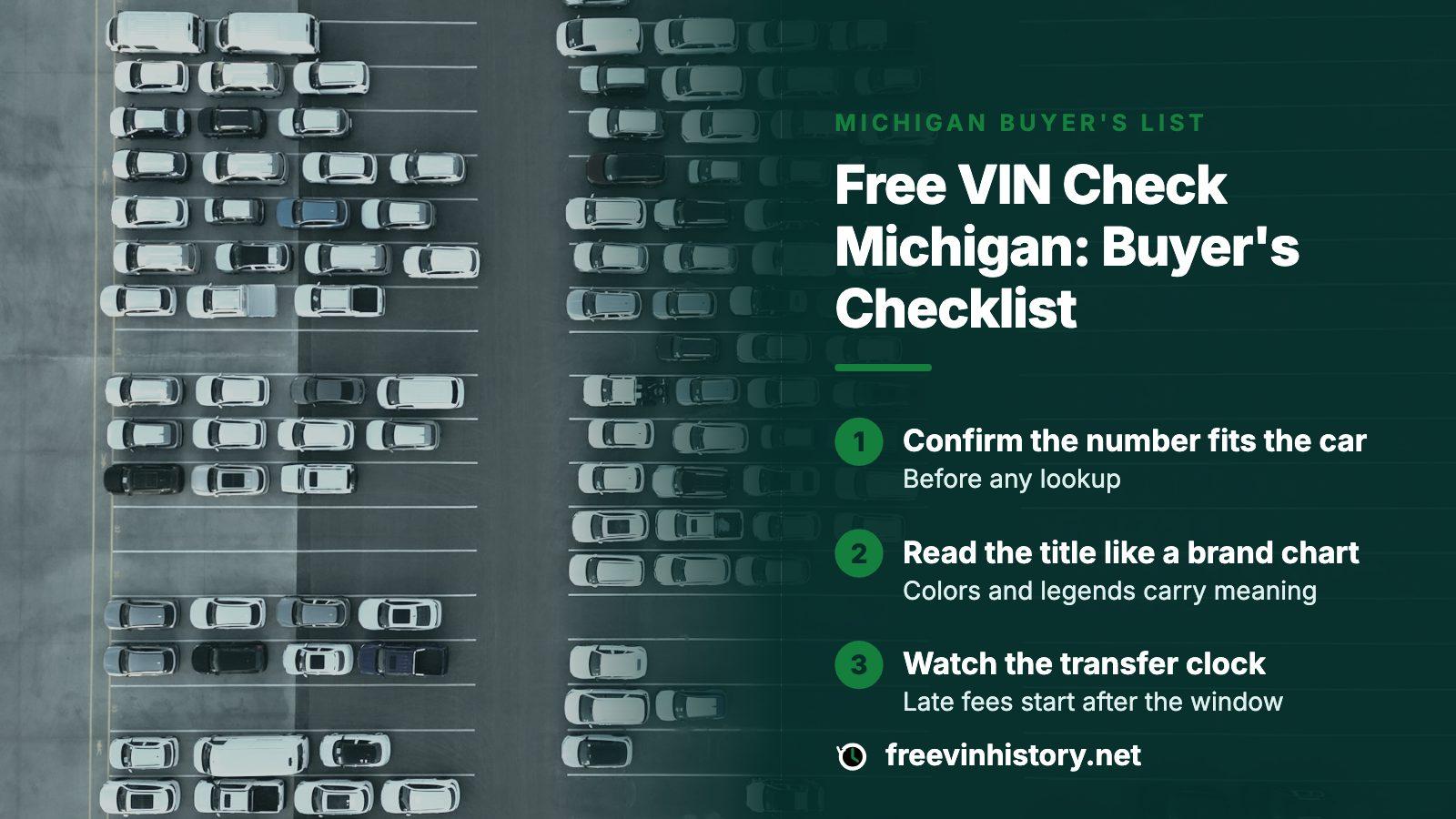
No single free tool in Michigan returns a car's whole history. NHTSA lists open recalls and NICB lists insurer-reported theft, salvage and flood entries, both at no charge, while the state's title colors and legends add Michigan's own brands. Mileage trail, auction photos and damage detail take a report, and a free preview hints at which of those records exist ahead of payment.
- Free lookups
- Recall search from NHTSA, insurer flags from NICB
- NICB limit
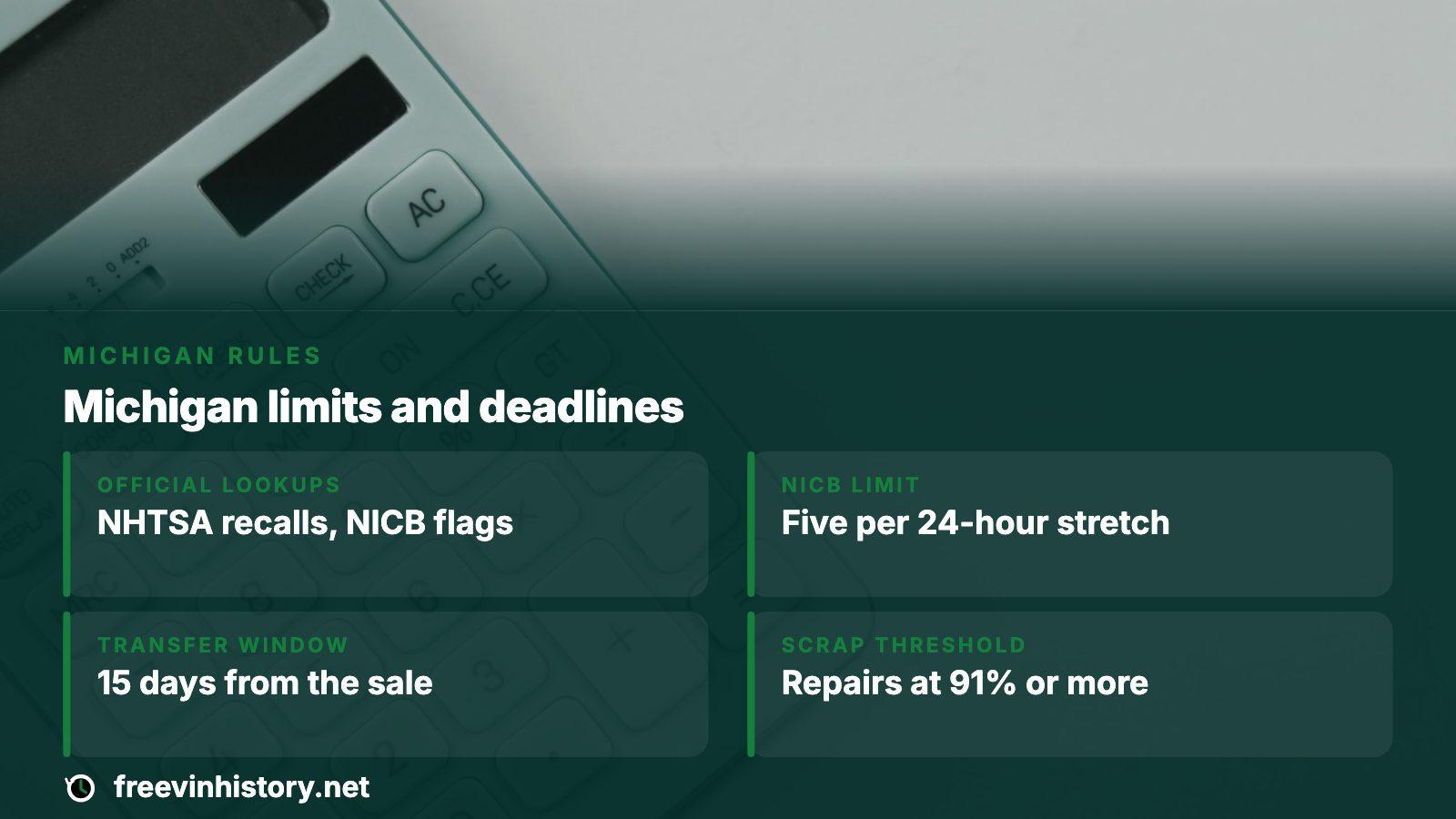
- Five lookups in any 24-hour stretch, per IP address
- Michigan transfer window
- 15 days from the sale, then a $15 late fee
- Scrap title threshold
- Repair cost of 91% or more of pre-damage value
What each free step covers, and what it leaves out
Free sources answer narrow questions. Line them up before you spend an evening on them, so you know which gaps remain when the last one finishes.
| Step | Cost | Answers | Blind spots |
|---|---|---|---|
| Check VIN against title | None | Does the paperwork match this car | Nothing about its past |
| NHTSA recall search | No charge | Safety recalls still unrepaired | Repaired recalls, small makers, non-safety campaigns |
| NICB VINCheck | No charge, capped daily | Theft not recovered, salvage, flood, as reported by member insurers | Police files, insurers outside the program, damage nobody claimed |
| Michigan title color and legend | None | Salvage, scrap, rebuilt and use brands | Repair quality, mileage over time, owner count |
| NMVTIS report | Provider's fee | Brands, latest odometer, insurer total-loss entries | Brief by design, can read falsely clean |
| Full report from this site | Preview at no charge, then one payment | Crash, odometer, auction and lien entries for a single VIN | Damage that was never recorded anywhere |
Item one: make sure the number belongs to the car
Every later lookup depends on the VIN you type. NICB warns that a wrong digit can leave a real record unmatched, so a clean answer on a mistyped number proves nothing.
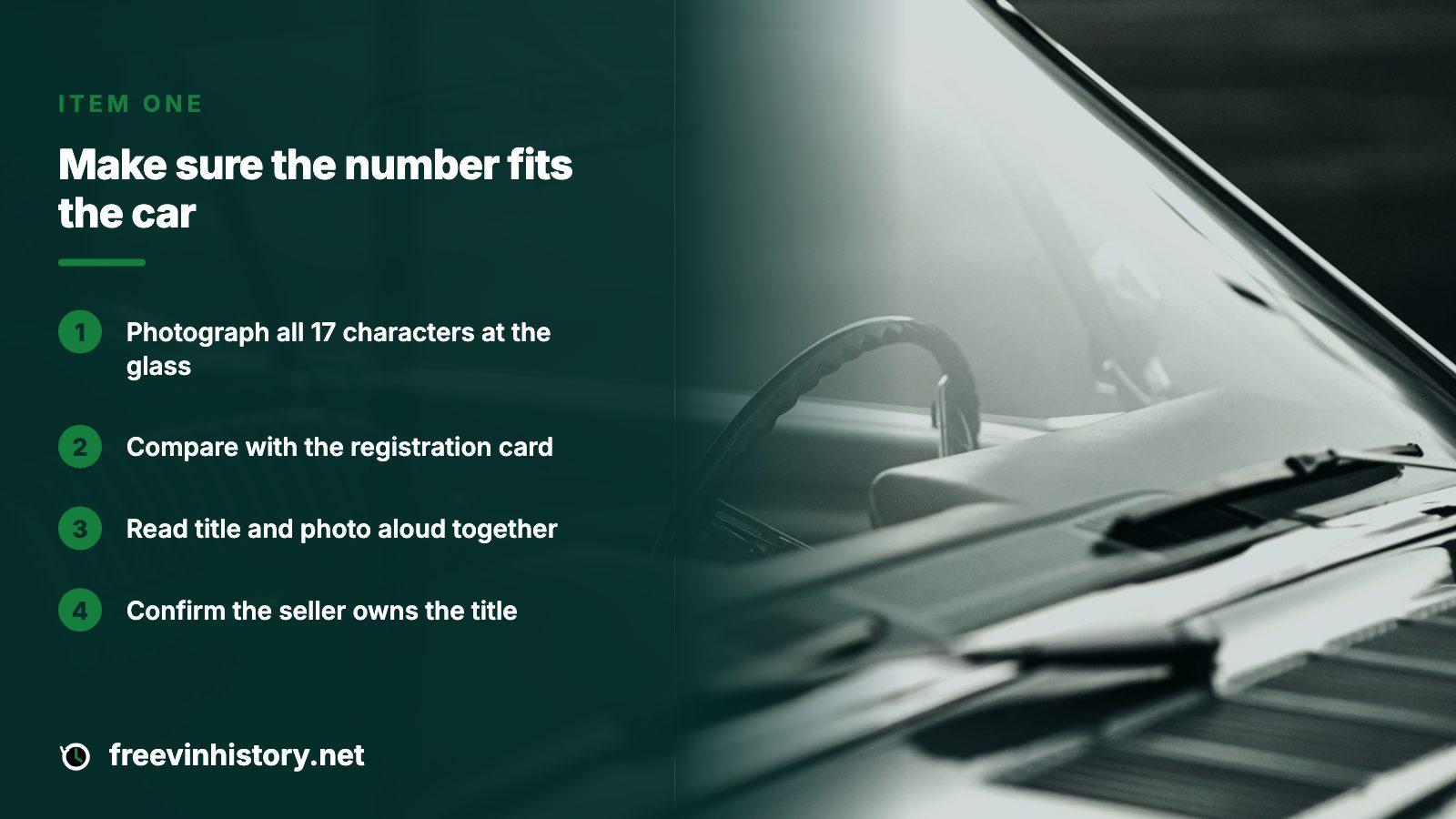
- Crouch at the windshield's lower left edge, outside, and take a clear photo of all 17 characters.
- Compare the photo with the registration card, and with an insurance card if one is handy.
- Hold the title next to your photo and read both aloud, character by character.
- Make sure the title shows the seller as owner, and that its mileage line holds a real figure.
Michigan's own guidance asks buyers to confirm the seller completed the title properly, odometer included. A title with blanks is a reason to stop the sale, not a detail to fix later.
Item two: the recall search
NHTSA's tool takes the VIN and tells you whether a recall is waiting for repair. A car with none shows the message 0 unrepaired recalls, and a car with one gives you a repair that the maker owes at no cost to you, which is also a fair point to raise during price talks.
- It will not list a recall that was already fixed.
- A very new recall may not have its VINs loaded yet, so a second look a week later is cheap.
- Recalls over 15 years old are left out unless the maker extends coverage.
- Small manufacturers, non-safety campaigns and vehicles built for other countries are not covered.
Item three: insurer records through NICB
VINCheck is the one free place where an insurer's total-loss decision can surface. Its answers draw on unrecovered thefts, salvage declarations and flood entries filed by member companies that together hold about 92.49 percent of earned premium nationwide.
NICB allows five searches a day from any one IP address, so save them for cars you really mean to buy. NICB says plainly that a clean answer is not a guarantee, and that its lookup is no replacement for a full report. It never queries police records, and an insurer outside the program leaves no trace.
Read a hit correctly
NICB describes a salvage result as an insurer paying out because repair cost passed a set share of value. The car can legally be rebuilt and retitled afterward, so a hit means you need the title, not that you walk away.
Item four: read the Michigan title like a brand chart
Michigan's Secretary of State prints brands on the title itself, and several come with a color you can spot across a desk. Orange, or gray with yellow, marks salvage and rebuilt titles. A scrap title is red.
| On the title | What it means in Michigan |
|---|---|
| Salvage | Insurer-estimated damage from 75% up to just under 91% of pre-damage cash value; no plates and no road use until an inspector signs it off and it is retitled |
| Scrap | Damage at 91% or more; parts or scrap metal only, never registered |
| Rebuilt salvage | A former salvage car that passed inspection; flags that an insurer once treated it as totaled |
| Police, taxi or municipal use | Use brands, kept on all later titles |
| Flood | Water-damaged vehicles are branded too |
The state says brands stay on all future titles. If a seller shows you a clean-looking title for a car that your NICB search flagged, compare the dates and ask for an explanation in writing.
Where free ends: NMVTIS and the state's own records
Michigan's Secretary of State points buyers to NMVTIS, the federal database fed by state title agencies, insurers and salvage yards. Only approved providers sell reports built on it, and the state describes the fee as small. The Justice Department describes its own report as deliberately brief and cautions that holes in reporting can make a car look clean.
The state also sells vehicle records through Online Services, but with a catch. Anything beyond your own records needs a permissible purpose under the federal Driver Privacy Protection Act, lookups match an exact name and address, and a full history request can cost far more than a single record. That route suits a lawyer or an insurer better than a buyer in a parking lot.
Item five: the full report, after a free preview
When the free items come back clean and the price is serious money, the next question is what none of them can answer: accident records, mileage readings over time, auction photos, liens, earlier owners. Type the VIN into this site and the preview reveals which of those categories have entries for the car. The preview alone costs nothing. The report is bought once for that one VIN, no subscription involved, and the pricing page lists what that purchase costs today.
Run it before the deposit, not after. A report that shows a hidden total loss gives you bargaining room while you still hold the money.
After the check: Michigan's paperwork clock
A clean check ends with the title transfer, and Michigan sets a short window for it.
- Transfer the title within 15 days of the sale, or a $15 late fee applies.
- For three days after the sale the car may travel plateless, directly to its parking place, with the assigned title and proof of insurance on board. The seller's plate stays with the seller.
- A Michigan No-Fault policy for the car is required to register it.
- If a loan is still open on a paper title, the lien must be terminated or the lender must send a letter approving the transfer. An electronic title waits until the lien is released.
- Online transfer is limited to one individual selling to one individual, both with Michigan IDs, and only for a paper title with no buyer financing.
Where this information comes from
- Michigan SOS page on transferring a title and registering — Supports the 15-day window, plate rule, lien paperwork and online transfer limits.
- Michigan SOS page on titles, salvage and scrap — Supports the salvage, scrap and rebuilt thresholds, colors and brands.
- Michigan SOS page on ordering vehicle records — Supports the permissible-use rule and how state record requests work.
- Michigan SOS page for buyers, sellers and lessees — Supports the title review advice and the NMVTIS suggestion.
- NICB: VINCheck lookup — Supports the free service, daily cap and insurer-only scope.
- NHTSA: Check for recalls — Backs the points about what the VIN recall search can and cannot list.
- Bureau of Justice Assistance: NMVTIS for consumers — Supports what NMVTIS holds and where it can miss.
Sources and photos: Facts checked against the sources above in November 2026. Photos by Iain, Dylan Michaud and Sasun Bughdaryan on Unsplash; diagrams by FreeVINHistory.
Keep reading
- Free VIN check through the DMV: what a state agency will and will not showHow state motor vehicle agencies handle a request for a free VIN check.
- Free salvage title check by VIN: what the free lookups showMore on catching a salvage history before you pay.
- Rebuilt title check free: what you can learn before payingWhat a rebuilt title means for a buyer.
- Free open recall check by VIN: GM, Polaris and every other makeReading recall results in more detail.
Frequently asked questions
Is there a free VIN check for Michigan cars?
Pieces of one. NHTSA's recall page and NICB's theft and salvage lookup are free, and so is reading the Michigan title's color and legend. A full history is not free anywhere: state records and NMVTIS reports carry fees, and this site's preview shows what deeper records exist.
Does the Michigan Secretary of State offer a VIN lookup?
No. The Department of State sells title and registration records through Online Services, and a requester needs a permissible purpose under the federal privacy law for anything beyond their own records. For buying advice, the department directs people to NMVTIS.
What does a Michigan salvage title mean?
The owner's insurer put the damage between 75 percent and just under 91 percent of the car's pre-damage cash value. No plate and no public roads until an inspector recertifies it and a new title issues, which then reads rebuilt salvage.
Can I run a free check with only a license plate?
The federal Driver Privacy Protection Act limits how states release personal information from vehicle records, and Michigan requires a permissible purpose for requests. Get the VIN from the seller instead; the registration and insurance cards carry it as well, and every lookup above starts from it.
How soon must a title move to the new owner in Michigan?
Fifteen days from the date of sale, after which the state adds a $15 late fee. For the first three days you may drive without a plate, straight to where the car is kept, carrying the assigned title and proof of insurance.
Now check the car itself
The guide explains what to look for. The report shows what this VIN has on record.