THE SHORT ANSWER
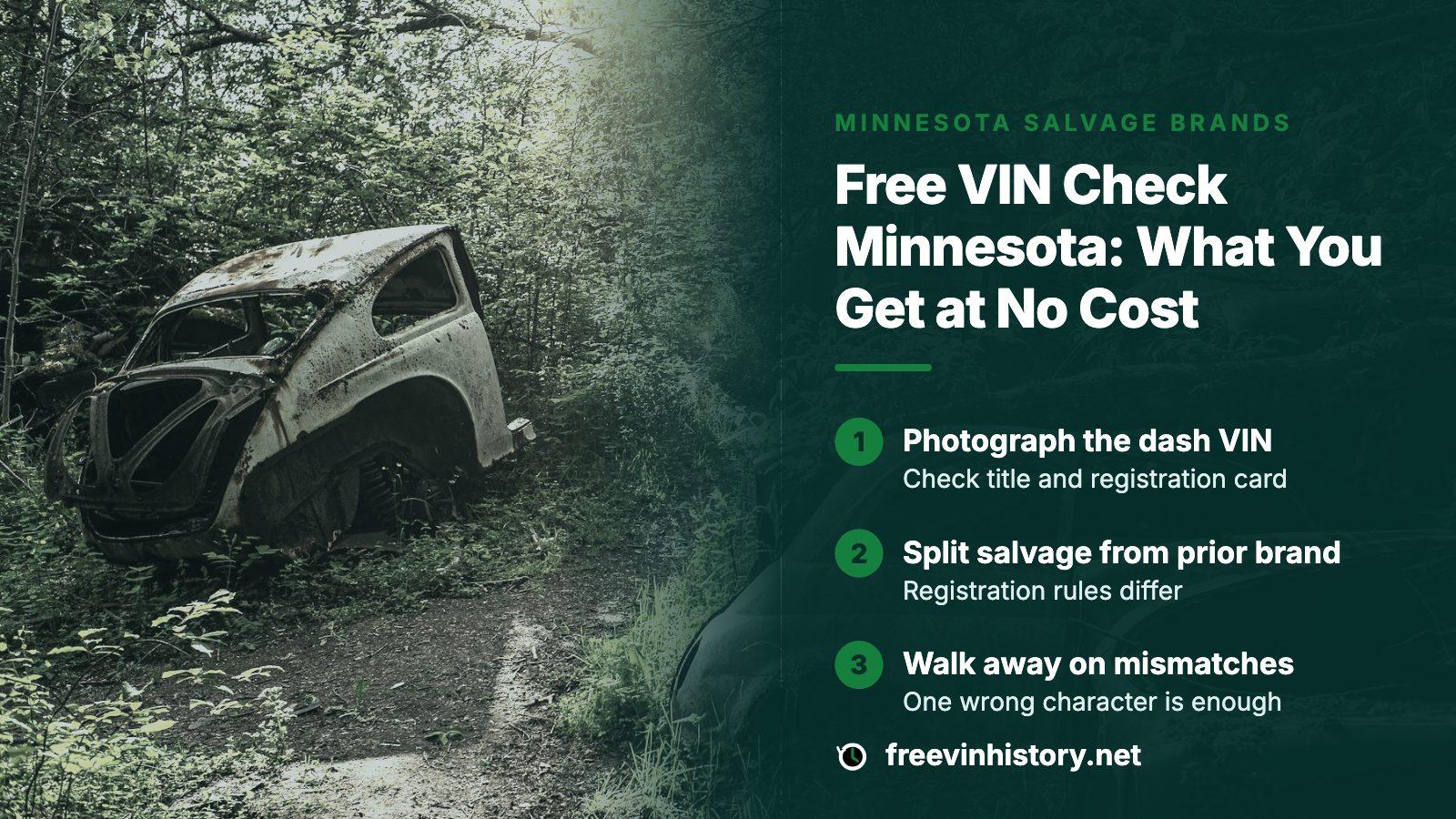
You can check a Minnesota car's VIN for free in two places. NHTSA says whether a safety recall is still unrepaired, and NICB VINCheck says whether participating insurers reported the car stolen, salvage or flood-damaged. Neither reads state title files or police records. Our preview, which costs nothing, hints at what deeper records a report would add.
- No-cost tools
- NHTSA recall search and NICB VINCheck
- NICB limit
- Capped at five a day per address
- Minnesota damage brands
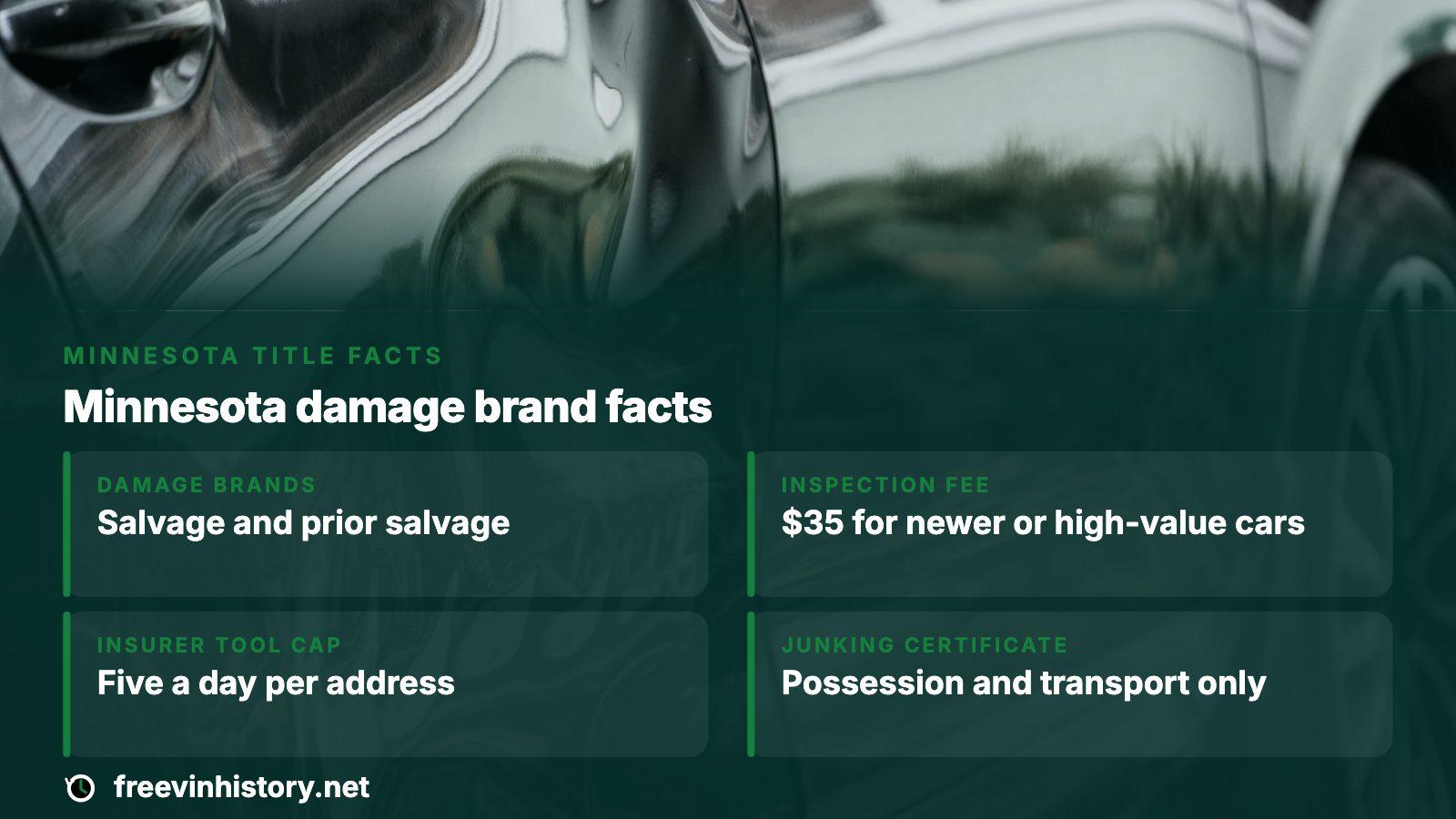
- Salvage and prior salvage
- Inspection fee
- $35 charged before a newer or high-value car gets its prior salvage title
What you can learn for nothing, and what stays hidden
Think of the free tools as a filter, not a verdict. They knock out the obvious problems cheaply, so you only spend money on cars that survive. The table lays out each source next to the gap it leaves.
| Source | Cost | Answers | Leaves out |
|---|---|---|---|
| NHTSA recall search | None | Is a safety recall still unrepaired on this VIN? | Repaired recalls, small makers, non-safety campaigns |
| NICB VINCheck | None, capped daily per IP | Reported stolen and not recovered, salvage, flood | Police files, insurers that do not take part |
| Minnesota title in hand | None | Salvage or prior salvage wording, seller's disclosure | Repairs, mileage trail, earlier owners |
| NMVTIS report | Provider's fee | Title state, brands, odometer, total loss, salvage | Repair history and recalls, by design |
| Full report after the free preview | One payment | Accident, damage, odometer and auction records for the VIN | Damage nobody ever recorded |
Run the check in this order
The sequence matters because each step costs less effort than the one after it, and a failure early on saves you the rest.
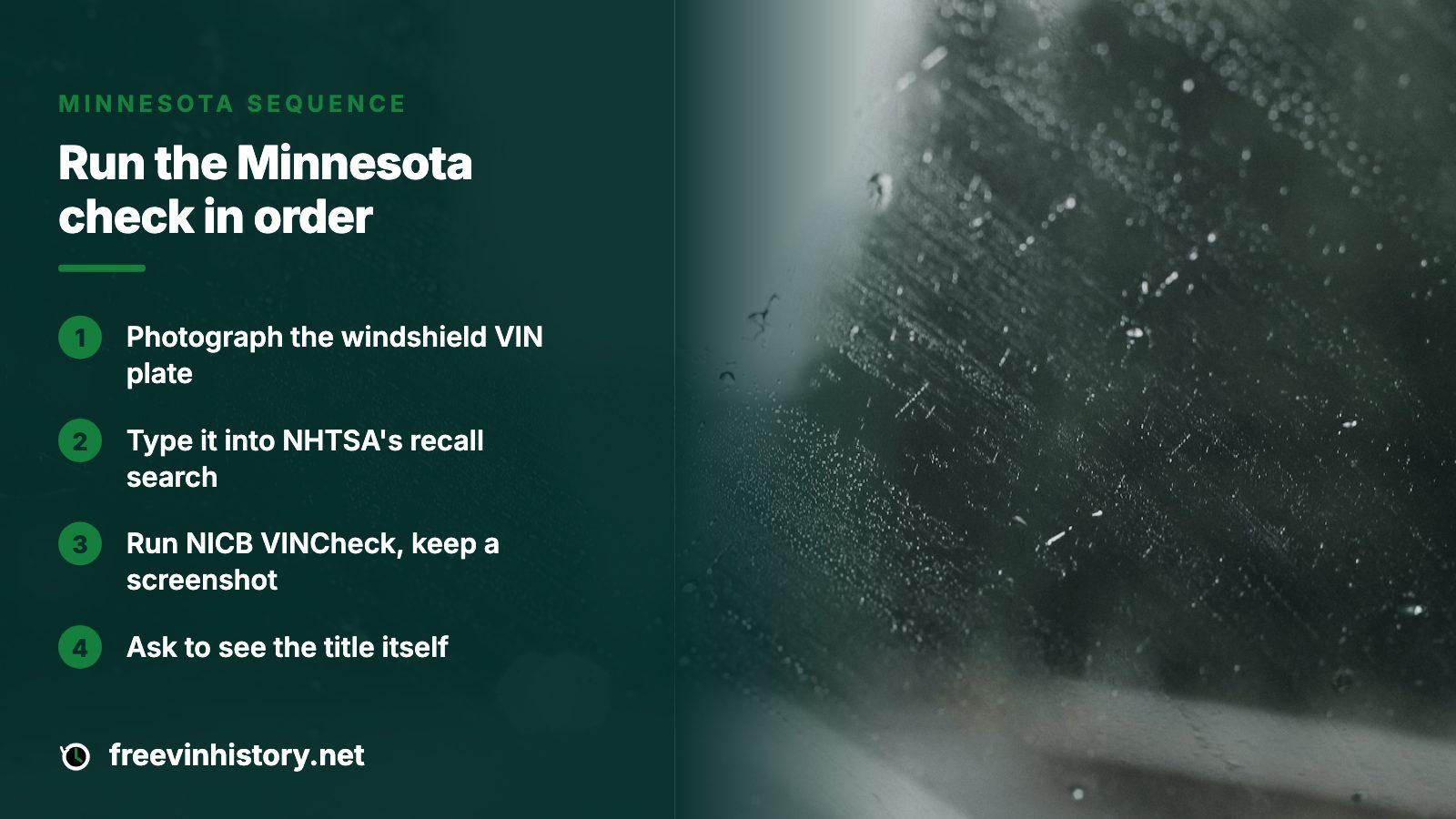
- Photograph the VIN plate visible through the windshield on the driver's side, then check it against the registration card and the title. A mismatch ends the deal on the spot.
- Type the VIN into NHTSA's recall search. Anything other than the zero-unrepaired message needs a call to a dealer for that make.
- Run the same VIN through NICB VINCheck, and keep a screenshot of the answer.
- Ask to see the title, not a photocopy, and read the brand area before anything else.
- Request the seller's written damage disclosure, then compare it with what the lookups said.
- Only now decide whether a full report is worth paying for.
The federal recall search
NHTSA's tool answers a narrow question: does this particular car still owe a safety fix? A car with nothing owed gets a zero-count message, not a campaign listing. That is useful for a negotiation, since recall repairs are the manufacturer's job, not a cost the next owner should absorb.
Know its limits. It skips recalls that were already fixed, some new announcements that have not reached every VIN, campaigns once they pass 15 years, unless the maker stretches its coverage, and anything from small manufacturers. So a clean screen says nothing about crashes, floods or odometer tampering.
The insurers' theft, salvage and flood lookup
NICB's VINCheck compares the VIN with reports from member insurers, which together account for 92.49 percent of earned premium in the country as of August 2026. It flags a vehicle reported stolen and never recovered, or one an insurer called salvage or flood-damaged. Searches are capped at five per day from one IP address, so save them for cars you are seriously considering.
A clean answer is not a guarantee
NICB says plainly that only participating insurers' records appear, that police records are not searched, and that the tool should not be your only check before buying. A car wrecked and then fixed with the owner's own cash never reaches an insurer, so it can look spotless.
Reading a Minnesota title: salvage versus prior salvage
Minnesota statute gives insurers two words. When an insurer pays damages and takes a car, a late-model or high-value vehicle gets a salvage brand and any other vehicle gets prior salvage. The split follows the vehicle's category, not how bad the damage was, so do not treat prior salvage as the mild one.
- Salvage: the holder may possess, transport and sell the vehicle but may not register it.
- Prior salvage: the brand that remains once a vehicle can be registered again. On a late-model or high-value vehicle it needs an inspection certificate and a $35 fee.
- Junking certificate: for an unrepairable total loss, permitting only possession and transport.
Prior salvage also catches imports of history. A damaged vehicle that carries wording such as repairable or reconditioned, or that was branded salvage by any other state at any point, must be titled prior salvage when it arrives, wherever the earlier paperwork came from.
What a Minnesota seller has to tell you
State law adds a layer the lookups cannot. A seller with real knowledge of damage above 80 percent of the car's pre-damage cash value must put that disclosure on paper, on the document used to apply for title or transfer the car. The figure comes from a written retail repair estimate or invoice.
Licensed dealers go further. They owe you written disclosure of known prior damage and any known title brand, plus an oral version except on online sales, and the signed copy stays in the dealer's file. A dealer must also disclose if a car on the lot sat in water deep enough to pass the lower edge of the dash. Ask for these papers before you sign, and compare the answer with your lookups.
Mismatches worth walking away over
- The seller says nothing was ever claimed, yet VINCheck returns a salvage record.
- The title shows no brand, but the VIN turns up a salvage record from another state.
- The VIN on the dash differs from the title in even one character.
- A disclosure form is blank, unsigned or says the car was not damaged while the repair invoices say otherwise.
- The seller will not let a mechanic look at the car.
Each of these earns a pointed question. Two at once are reason enough to move on to the next listing.
When the step up is worth it
NMVTIS is the federal title database. Federal law requires state title offices, junk and salvage yards, recyclers and insurance carriers to feed it. Its reports stay deliberately brief, covering five indicators: where the title sits, brands, an odometer figure, total loss and salvage. They omit repair history and recalls, and the federal site itself urges buyers to add an independent inspection.
A full report fills that gap. Run our no-charge preview first to see whether deeper records turn up for that number. If they do, the report is one purchase, not a subscription, and the cost is listed on the pricing page. Buy it for the finalists, after the free steps have already cut the list down.
Where the state office fits
Minnesota's Driver and Vehicle Services holds the title record. We could not open its pages while writing this, so we state no fee, form or online tool for it here. Before relying on any claim about a state title lookup, confirm it with the agency, and use the statutes linked below for the brand rules.
Where this information comes from
- NICB: VINCheck lookup — what the insurer lookup covers, its daily cap and its limits
- NHTSA: Check for recalls — what the recall search shows and omits
- Minnesota Statutes 168A.151 — salvage and prior salvage brand rules
- Minnesota Statutes 168A.152 — registration limits and the inspection fee
- Minnesota Statutes 325F.6641 — seller and dealer damage disclosure
- VehicleHistory.gov: Understanding an NMVTIS report — what the federal title report includes
Sources and photos: Facts checked against the sources above in November 2026. Photos by Patrick von der Wehd, Cole Keister and Maxim Tolchinskiy on Unsplash; diagrams by FreeVINHistory.
Keep reading
- Free salvage title check by VIN: what the free lookups showGo deeper on salvage results and what to do with them.
- Free open recall check by VIN: GM, Polaris and every other makeA closer look at the recall lookup used in step two.
- Free VIN check in Wisconsin: a five-stop walk-through, then the step upShopping across the border? See how its checks differ.
- NMVTIS report: what the federal title record shows and missesWhat the federal title report adds to the free tools.
Frequently asked questions
Is there a completely free VIN check in Minnesota?
Two tools cost nothing: NHTSA's recall search and NICB's VINCheck. Between them they cover open safety recalls and insurer-reported theft, salvage and flood. They do not cover accidents that never reached an insurer, mileage history or auction records, so treat them as a first screen.
Does NICB VINCheck show Minnesota title brands?
Not directly. It reports what participating insurers recorded, not what a state title says. A car can carry a prior salvage brand and still return nothing there if its insurer does not take part. Read the title itself alongside the lookup.
Can a salvage-titled Minnesota car be registered?
No. Under state statute a salvage-branded title lets the holder possess, transport and transfer the vehicle but not register it. A newer or high-value vehicle cannot get a prior salvage title without an inspection certificate first, and the statute sets a $35 fee for that step.
What if the seller claims there was never any damage?
Ask for it in writing. Minnesota requires a seller who knows of damage above 80 percent of the car's value to disclose it on the transfer paperwork. Then run the lookups and compare. A written claim that contradicts a record is a strong reason to stop.
Why pay for a report if the lookups were clean?
Clean results only mean no insurer flag and no open recall. A report can show accident entries, odometer readings over time and auction photos that those tools never see. Our preview hints at whether such records exist before any payment.
Now check the car itself
The guide explains what to look for. The report shows what this VIN has on record.