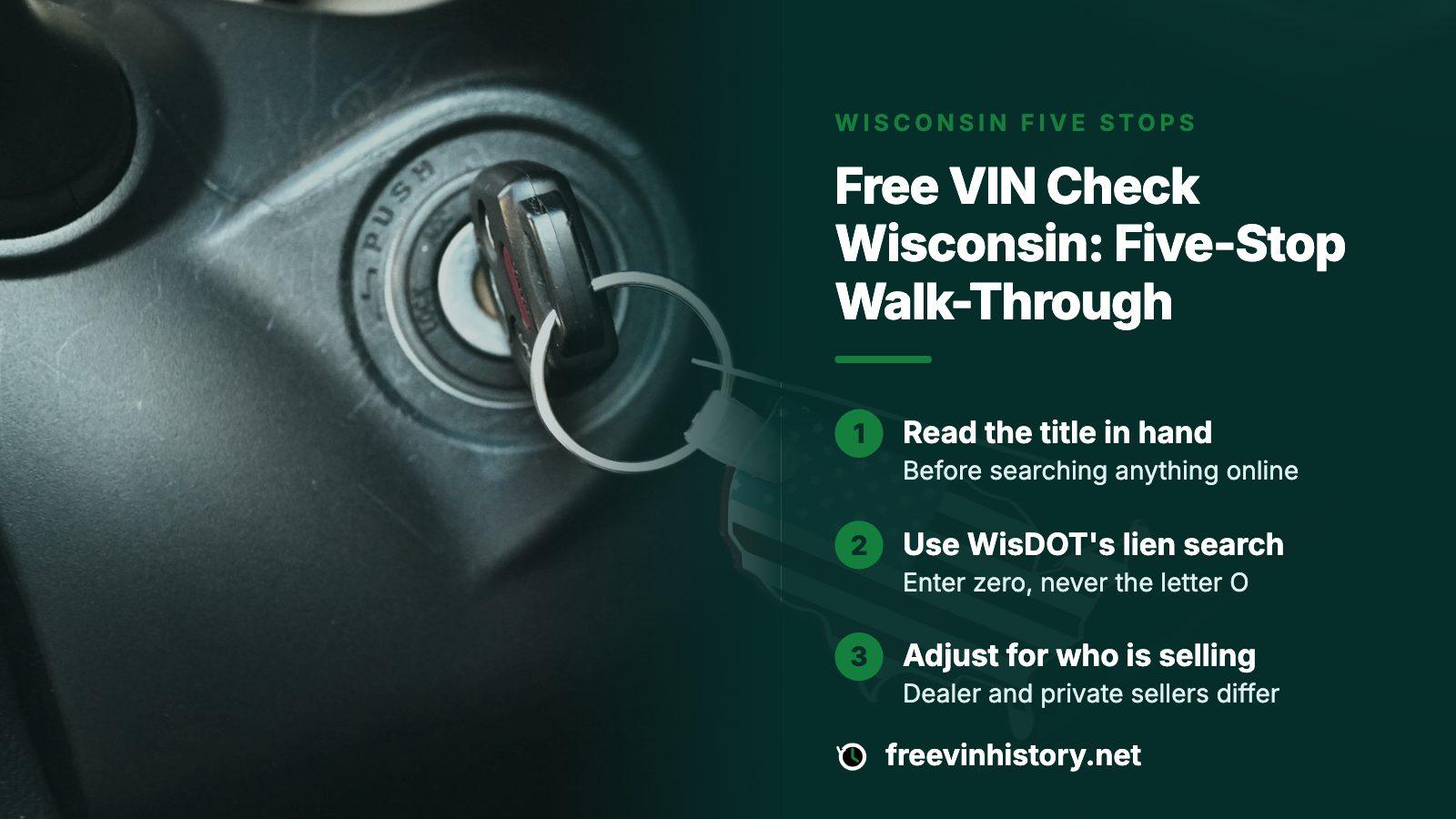
THE SHORT ANSWER
In Wisconsin the free pieces are WisDOT's lien holder search, NHTSA's open-recall lookup and NICB's insurer lookup. WisDOT does not publish a free history report by VIN, and its own vehicle-history page points buyers to a fee-based NMVTIS provider. A free preview on this site shows which record types exist; the report behind it needs one paid purchase.
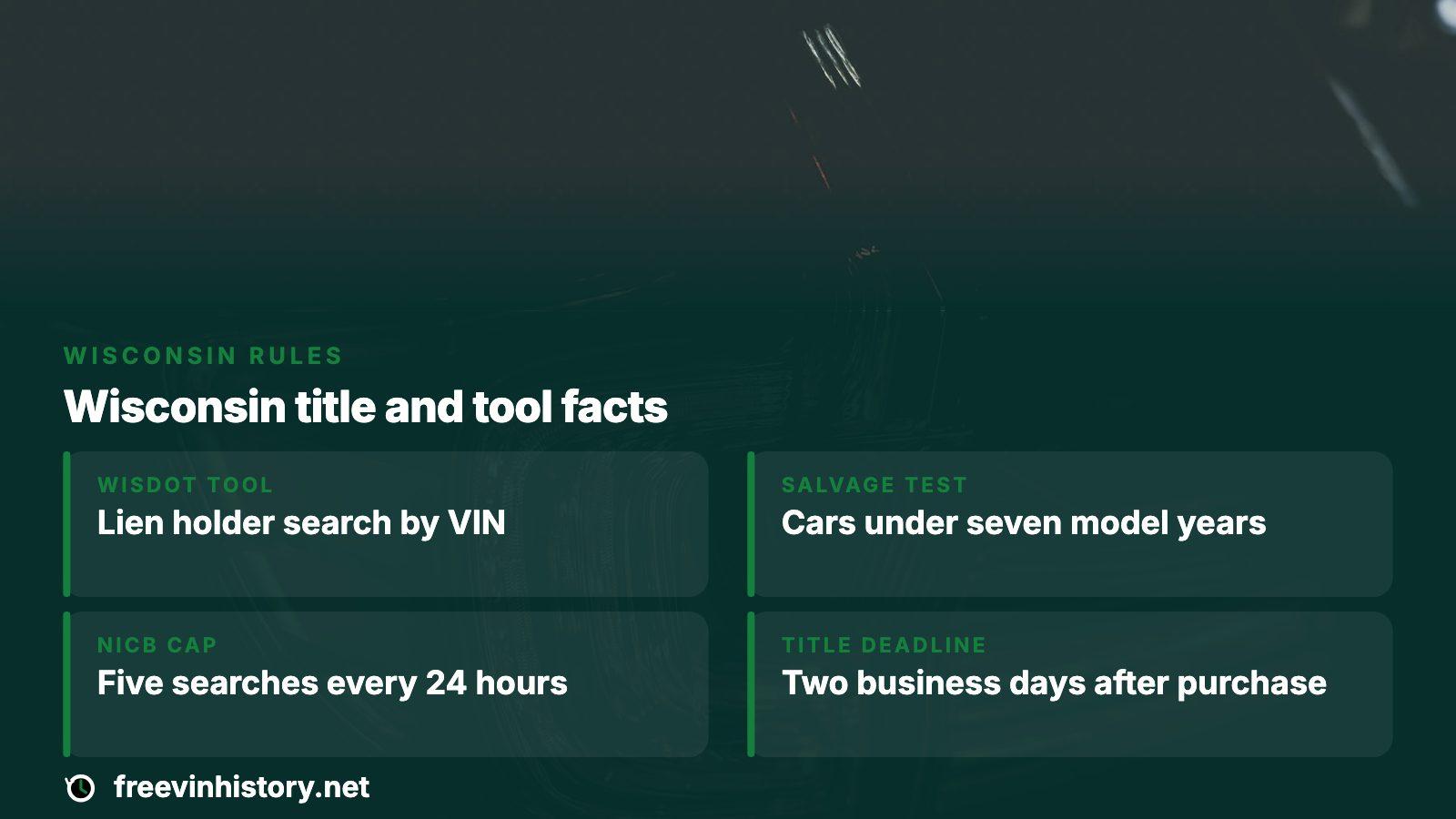
- WisDOT tool
- Lien holder search by VIN, plus a title-transfer date search
- Salvage line
- Salvage test applies to cars younger than seven model years, at 70% of value
- NICB cap
- Five searches per IP address every 24 hours
- Title deadline
- Two business days after purchase, if the car will be driven
Stop one: read the title in your hands
Before typing anything into a website, look at the paper. In Wisconsin the seller marks any brands in a box near the seller's signature, and WisDOT tells buyers that those brands must be recorded when the title is transferred. A brand is the state's label for the car's condition or its eligibility for plates.
Most brands stay for good and print again on every later title. The state also copies over brands that other states reported into the national title system. A seller who says the brand was removed is describing something WisDOT says rarely happens.
Hold the title next to the car and compare the two numbers character by character. If they differ by a single character, stop, because every later lookup would be run on the wrong vehicle.
Stop two: WisDOT's lien holder search
This is the one Wisconsin-run tool that works from a VIN. It reveals whether the title was sent to the owner or to a bank or finance company, and for a business loan it shows the lender's name and address. A loan from a private individual does not show the person's details.
The reason it matters: since July 30, 2012, Wisconsin mails a title that lists a loan to the lender, not the owner. The owner holds only a Confirmation of Ownership, which cannot transfer the car to you. A seller who cannot hand over a real title may still owe money on the vehicle.
- Enter a zero, not the letter O, wherever the VIN has one.
- Standard VINs never use Q or I, so one containing either was copied wrong.
- If nothing comes back, the page suggests WisDOT's separate title-transfer lookup, which can reveal a title processed lately.
- When the page was opened for this guide, a banner said online services were down. Try again later rather than skipping the step.
Ask for the release
If the title shows a lien, the seller must give you a lien release. Without one, WisDOT says the loan carries forward onto your new title.
Stop three: open recalls at NHTSA
NHTSA's recall page takes a VIN and answers one question: does this car have a safety recall nobody has repaired yet. A car with nothing open gets a plain message saying no unrepaired recalls match. WisDOT's vehicle-history page sends buyers to this same lookup.
Read the limits too. The search leaves out recalls already fixed, fresh campaigns still being matched to VINs, recalls past fifteen years old unless the maker covers more, small manufacturers and non-safety service campaigns. When you are comparing a long shortlist, the page also takes as many as 100 VINs in one go.
A recall result says nothing about accidents or title problems. It is a safety check and nothing more.
Stop four: theft, salvage and flood flags from NICB
NICB's VINCheck is free and answers whether member insurers reported the car stolen and not recovered, or salvage or flood damaged. The daily cap is five searches from one IP address, so line up your candidates before you start.
NICB is open about the gaps. Only records from participating insurers appear, police files are not searched and a mistyped VIN can miss a record that exists. Its FAQ cautions that a clean answer proves little about the car's past. A salvage hit means an insurer paid out a total-loss claim. The car may have been rebuilt and re-titled since, which is where the Wisconsin brands below come in.
What the Wisconsin brands tell you
WisDOT's glossary ties several brands to a repair-cost percentage. Fair market value, in WisDOT's wording, reflects the car's condition right before the damage, drawn from price guides, dealer quotes and valuation services.
| Brand | What WisDOT says triggers it | What to ask |
|---|---|---|
| Salvage | Repair cost over 70% of value on a car younger than seven model years, or any age if last titled as salvage in Wisconsin or elsewhere | Has it passed the repaired-salvage inspection? |
| Rebuilt salvage | Last titled as salvage in Wisconsin, then passed the state inspection and became eligible for plates | Who did the repair, and where are the receipts? |
| Flood | Water damage with repairs above 70% of value | Where did the flooding happen, and was the electrical system replaced? |
| Claim paid | Under seven model years old, repairs above 30% of value, car passed to an insurer | What was damaged, and who fixed it? |
| Hail | Under seven years old, hail damage alone, above 70% | Were panels replaced or repaired? |
One detail catches people out: age limits apply to the percentage-based definitions, but a car last titled as salvage in another state carries the salvage brand regardless of age.
Stop five: the national title record, and where free ends
WisDOT's own history page says NMVTIS, the Justice Department's title database, reaches consumers through a third-party site that charges a fee. Through it a buyer can see brand history, the newest reported odometer figure, any insurer salvage or total-loss call and any report of a vehicle going to a junk or salvage yard, with Wisconsin plus the other participating states in the data.
The federal page describes the report as deliberately brief and cautions that results may look falsely clean, since not every reporting entity feeds it yet. It adds that each state's own title file holds more than NMVTIS carries. NMVTIS will not show service visits, photos from auction listings or a detailed damage map.
Those are the pieces a full report adds. Begin with the preview on this site, no charge, to learn whether odometer, damage, auction and lien entries exist for the VIN. Opening them takes one payment, with the amount on the pricing page.
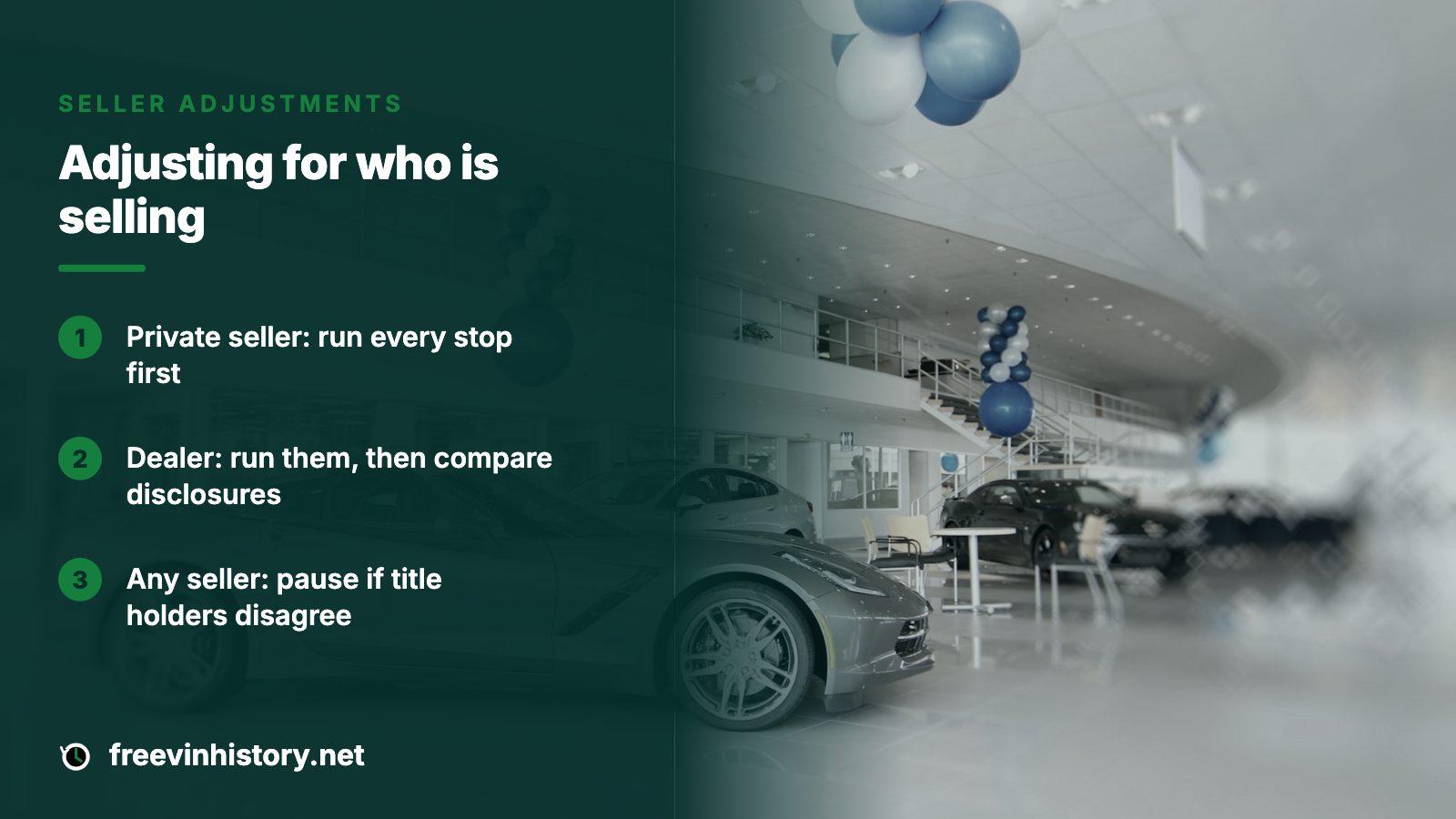
Adjusting for who is selling the car
WisDOT's consumer pages draw a clear line. Buying from a licensed Wisconsin dealer brings the state's motor vehicle trade practice law into play, while someone buying from a private party is not covered the same way. That makes the lookups above more important in a driveway sale than on a dealer lot.
- Private seller: run every stop before handing over money.
- Dealer: run them anyway, then compare what the dealer discloses with what you found.
- Any seller: if the lien search and the title disagree about who holds the title, pause the deal.
After the sale, WisDOT expects a buyer who will drive the car to title and register it inside two business days of purchase.
Deciding whether to go past the free stops
If the five stops came back quiet and the car is cheap, you may be done. If you are about to pay a lot for a car, or any answer felt thin, a fuller record is a reasonable next purchase. Odometer history, auction photos and insurance entries can contradict a clean-looking result, and none of them come from the free sources.
Run the preview first. It costs nothing, and it shows you what sits behind the paywall before you decide.
Where this information comes from
- WisDOT: eMV Public FAQs on brands and liens — Brand definitions, the percentage thresholds and how liens carry onto a new title.
- WisDOT: Lien holder search — What the VIN lookup shows and where the title goes when a loan exists.
- WisDOT: Vehicle history and recall information — The state's pointer to NMVTIS and to NHTSA's recall lookup.
- NICB: VINCheck — Insurer theft, salvage and flood lookup, its daily cap and its stated limits.
- NHTSA: Check for recalls — What a VIN recall search shows and leaves out.
- NMVTIS: For consumers — What the national record covers and why a clean result can mislead.
Sources and photos: Facts checked against the sources above in November 2026. Photos by Jake Kling, Richard R and A n v e s h on Unsplash; diagrams by FreeVINHistory.
Keep reading
- Free VIN check through the DMV: what a state agency will and will not showHow state DMV lookups compare and where each one stops.
- Car lien search free: what the free tools show and what they missThe lien question in more depth, for cars with a loan behind them.
- Free salvage title check by VIN: what the free lookups showSalvage and rebuilt brands and how to confirm them.
- Free open recall check by VIN: GM, Polaris and every other makeReading recall results and what to do about an open one.
Frequently asked questions
Is there a free VIN check in Wisconsin?
In pieces. WisDOT's lien search, NHTSA's open-recall lookup and NICB's insurer database cost nothing. None of them is a history report, and WisDOT sends buyers to a fee-based provider for national title data. The preview here costs nothing as well; opening the full report needs one paid purchase.
Does WisDOT show a car's accident history?
No. The tools read for this guide cover liens and the date a title was last processed, not accidents. Title brands appear on the title itself and in national title data. Crash details and repair photos come from other record types, which is where a full report adds information.
Why can the lien search show no record?
The VIN may have been typed wrong, using the letter O for zero for example. WisDOT suggests trying its title transfer search if no record appears, since a title may have been issued recently. The service was also down when we opened it, so an empty result may just call for another attempt later.
Can a Wisconsin car have heavy damage and a clean title?
Yes. The percentage-based salvage rule applies to cars under seven model years old, and unreported damage never reaches any database. A car last titled as salvage in another state still carries the brand. A clean answer from any one source should not close the question.
What should I do first with a used car's VIN?
Make sure title and car carry an identical VIN, then run the lien search, the NHTSA recall lookup and NICB. Write down what each returns and what it cannot see. If gaps remain on a car you are serious about, run the free preview here before paying for anything.
Now check the car itself
The guide explains what to look for. The report shows what this VIN has on record.