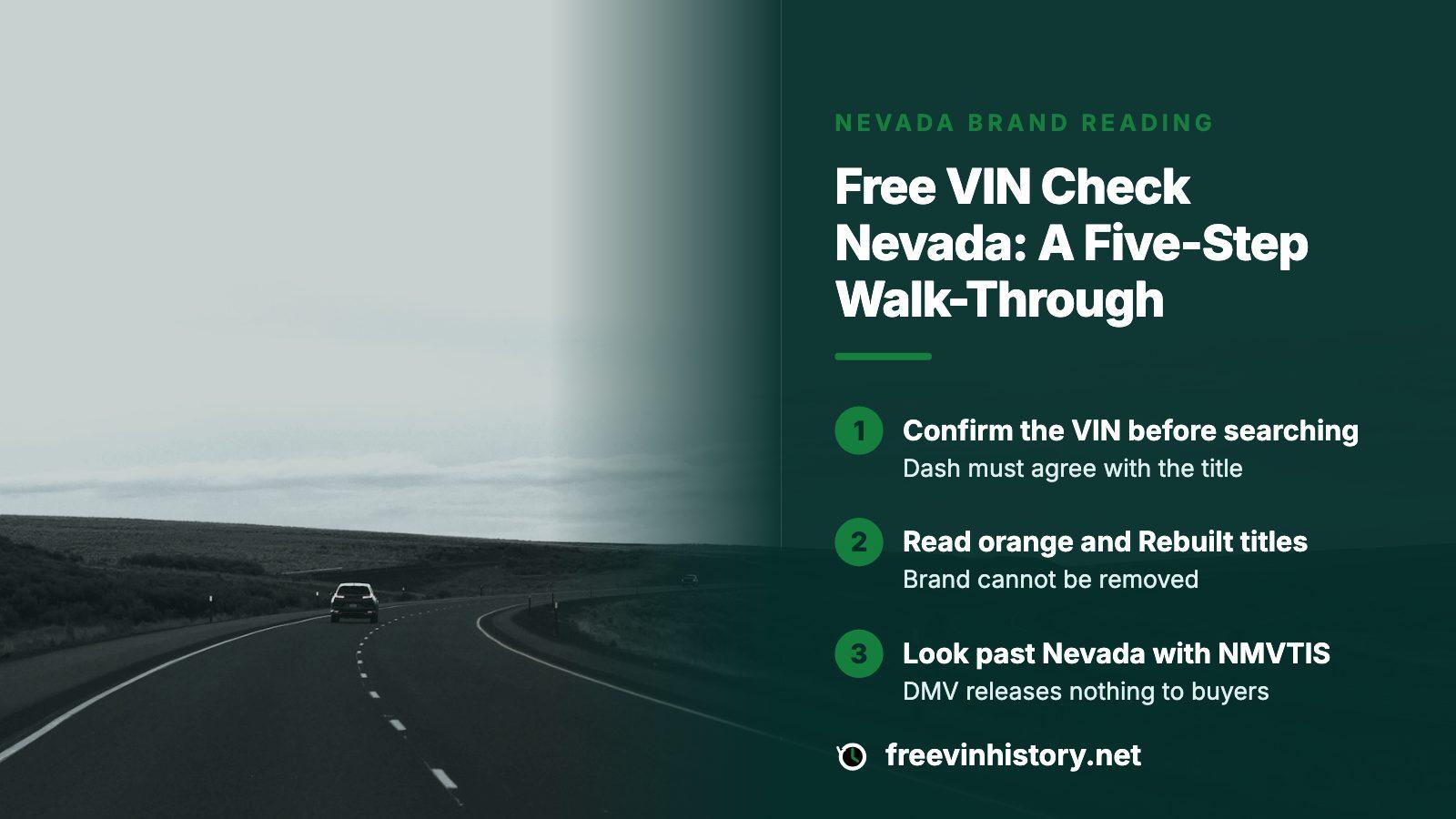
THE SHORT ANSWER
Begin with NICB VINCheck, built on insurer files, then NHTSA's recall page. Study the Nevada title for an orange color or a Rebuilt brand, and confirm the number on the car agrees with it. Earlier owners and brands from other states sit beyond the DMV, which releases nothing to buyers, so a report fills that gap.
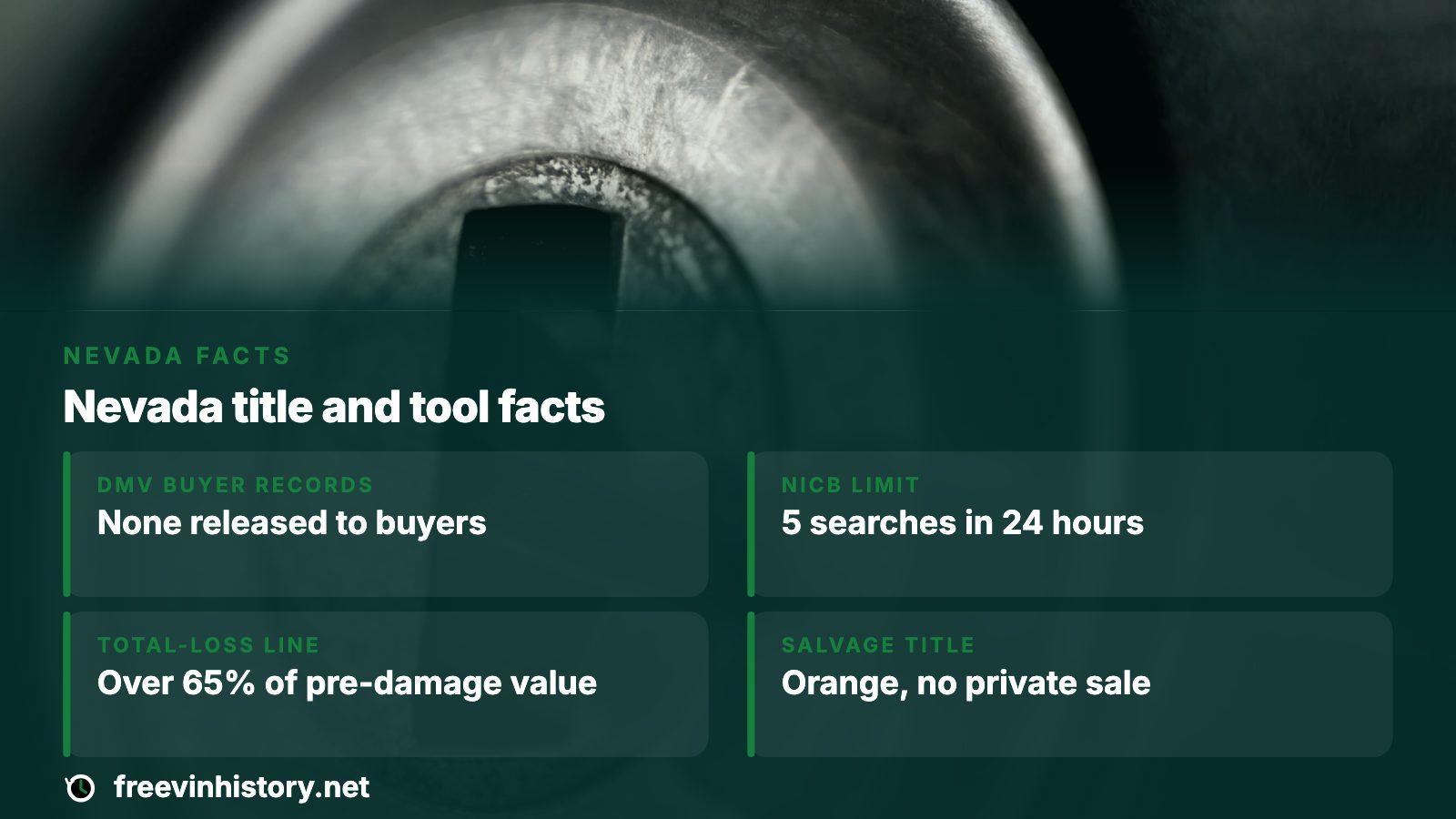
- DMV records for buyers
- None released to prospective buyers
- NICB limit
- 5 searches per IP address in 24 hours
- Total-loss line
- Repair cost above 65% of pre-damage value
- Salvage title color
- Orange, and illegal to sell to a private buyer
Why a Nevada check is a patchwork
Ask the Nevada DMV for the history of a car you might buy and you will be turned down. Its records page states that prospective buyers are not given vehicle records, and the registration page adds that owner details stay private from them. In place of records, the agency lists outside tools that take a VIN.
That list is the backbone of any free check here: NICB for stolen, salvage and flood flags, NHTSA for recalls, and NMVTIS for title data from every state. Only the first two cost nothing. The steps below use them in the order that wastes the least time.
Step 1: confirm the VIN before you search it
Every lookup depends on a correct 17-character number. NICB warns that a wrong VIN may simply return nothing, which looks identical to a clean result. Copy the number from the car itself, straight off the vehicle, and compare it character by character with the title and registration card.
The DMV has its own caution about bargain listings on social media that insist on cash. Such deals, it says, frequently involve stolen cars, swapped VINs or rolled-back odometers. Its suggestion is a VIN inspection station at a DMV office as the meeting place, or VIN history tools when that is out of reach.
Walk away without a title
A bill of sale does not satisfy the DMV by itself. If the seller cannot produce the title, the agency's advice is to leave. Nothing in a search result fixes that.
Step 2: NICB VINCheck for insurer flags
VINCheck is a no-cost lookup from the National Insurance Crime Bureau. Member insurers supply its data. A VIN gets flagged when one of them logged the car as a stolen car never found, a salvage write-off, or a flood loss. Those members write 92.49 percent of premium nationwide. That is broad, and still short of everyone.
The tool allows five searches per IP address each day, so save them for cars you are serious about. A blank result clears nothing. NICB itself notes that police files and insurers who opt out never feed the tool.
Step 3: NHTSA's recall search
Put the VIN into NHTSA's recall page. Nothing pending brings back a line reading zero unrepaired recalls. One with a live campaign lists the defect that still needs attention.
| The recall search shows | It leaves out |
|---|---|
| Recalls still waiting for a repair on this VIN | Recalls already repaired |
| A zero message when none are open | Safety campaigns from before the 15-year window, unless the maker keeps covering them |
| Up to 100 VINs in one batch search | Campaigns from small makers, and non-safety campaigns |
A recall result tells you nothing about crashes or titles. It is a repair question, so use it as a bargaining point rather than a history.
Step 4: read the title the way Nevada brands cars
A paper title can show what a database misses. Nevada treats a car as salvage after a total loss, flood damage or a non-repairable finding, and a total loss means the repair estimate exceeds 65 percent of the car's pre-damage market value. That stage gets an orange title, and the DMV's advice to buyers is blunt: do not buy it.
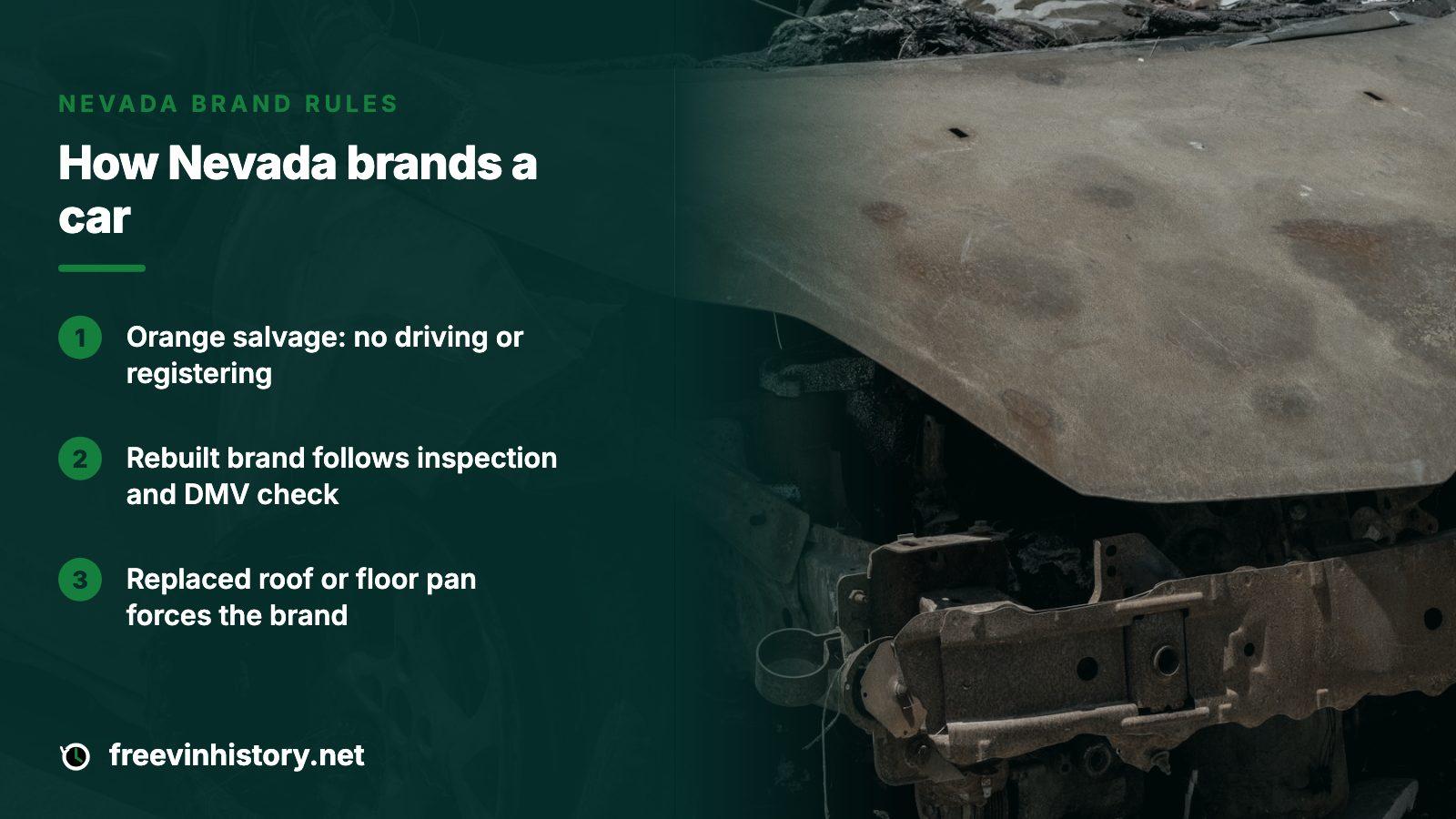
- Orange salvage title: no driving, no registering, and no private sale until the car has been rebuilt and inspected.
- Rebuilt brand: a normal Nevada title carrying the word Rebuilt, issued after a garage inspection and a DMV check of the VIN and the repairs. The brand cannot be removed.
- Rebuilt without salvage: replacing parts such as the roof, floor pan or rear clip also forces the brand.
NRS 487.830 obliges a seller to put salvage, rebuilt or reconstructed status in writing before the sale. Concealing it on a vehicle worth $250 or more is a felony, and civil damages can reach $5,000 or three times the actual loss, whichever is larger.
Step 5: look past Nevada with NMVTIS
Nevada's own brands only cover cars titled in Nevada. A car that arrived from somewhere else carries its earlier history in a different state's files. The national title system, NMVTIS, gathers brand history, the most recent odometer reading, insurer salvage decisions and junkyard transfers from many sources, and a brand stays attached when the car changes states.
The DMV lists NMVTIS as a paid option with small fees. This is where the free route runs out for most buyers, and where a full report from this site comes in. Try the free preview with the VIN first, and pay only if the car survives your shortlist.
What the free steps will not tell you
Files on crash-involved or abandoned vehicles are closed to the public here, open only to insurers, tow yards and attorneys, so a determined buyer cannot request them. Flood damage is a second gap. The DMV cautions that a flooded car can appear with a title from any state, and no service may flag it.
- Accidents that no insurer paid for, or never reported.
- How many owners the car had and how it was used.
- Liens that remain on a car's record.
- Water damage that was never branded anywhere.
For the last item, the DMV's tips are a musty smell, damp carpet, silt under the mats and rust on bare screws. It also wants a mechanic of your choosing to look the car over before money changes hands.
After the check: paperwork and cost
Once a car passes, the title work begins. For 2011 and newer models the seller must fill in the mileage on the title at the sale, even if the title claims an age exemption. Those years also need a paper title, and the DMV will not take a bill of sale paired with a duplicate-title application.
In Clark or Washoe county, a private buyer is responsible for the emissions test, and a passing result must be recent enough when you register. The full rules sit on the DMV's emission page. Our report does not replace any of this.
On this site the preview costs nothing. The full report is paid for once instead of by subscription; see the pricing page for the options.
Where this information comes from
- Nevada DMV: Records — why buyers get no vehicle records, and the outside tools it lists
- Nevada DMV: Register a vehicle — scam warnings, VIN inspection stations and the title requirement
- Nevada DMV: Salvage vehicles — total-loss line, orange title, Rebuilt brand and the disclosure law
- Nevada DMV: Flood-damaged vehicles — limits of reporting and signs of water damage
- NICB: VINCheck — coverage, the daily search cap and its own warnings
- NHTSA: Check for Recalls — what a VIN recall search shows and omits
- NMVTIS: Information for Consumers — what the national title system holds
Sources and photos: Facts checked against the sources above in November 2026. Photos by John Kakuk, engin akyurt and Derek Nelson on Unsplash; diagrams by FreeVINHistory.
Keep reading
- Free VIN check through the DMV: what a state agency will and will not showWhat a state motor vehicle agency can and cannot tell you from a VIN.
- Free salvage title check by VIN: what the free lookups showWhat to do when an insurer flag or an orange title points to salvage.
- Free open recall check by VIN: GM, Polaris and every other makeA closer look at what the recall search covers.
- Free flood check by VIN: what the free tools show and missSpotting flood history that the title may not show.
Frequently asked questions
Can I run a free VIN check in Nevada?
In part. NICB and NHTSA charge nothing and cover insurer flags and open recalls. The DMV supplies buyers with no vehicle records, so out-of-state title history and ownership detail need a paid source. Use the free results as a first filter.
Does the Nevada DMV give out VIN history?
No. Buyers are outside the group it serves, and crash and abandoned-vehicle files stay closed to the public. Its pages send shoppers to NICB, NHTSA and NMVTIS instead.
What does an orange title mean in Nevada?
It marks a salvage vehicle: a total loss, flood-damaged or non-repairable car. It cannot be driven or registered, and it cannot be sold to a private person until it is rebuilt and inspected. After that, the title carries a Rebuilt brand.
Why did NICB show nothing for my VIN?
Possibly the car has no record at a member insurer, or the VIN has a typo. NICB notes that a wrong number can miss a match. Re-read it from the car and try once more, keeping the five-search cap in mind.
Is a Nevada VIN check different for out-of-state cars?
The steps are the same, but the risk is higher. Brands applied by another state sit in that state's records, and states define salvage and flood differently. NMVTIS keeps brands across state lines, which is why a national record matters on any car that did not start in Nevada.
Now check the car itself
The guide explains what to look for. The report shows what this VIN has on record.