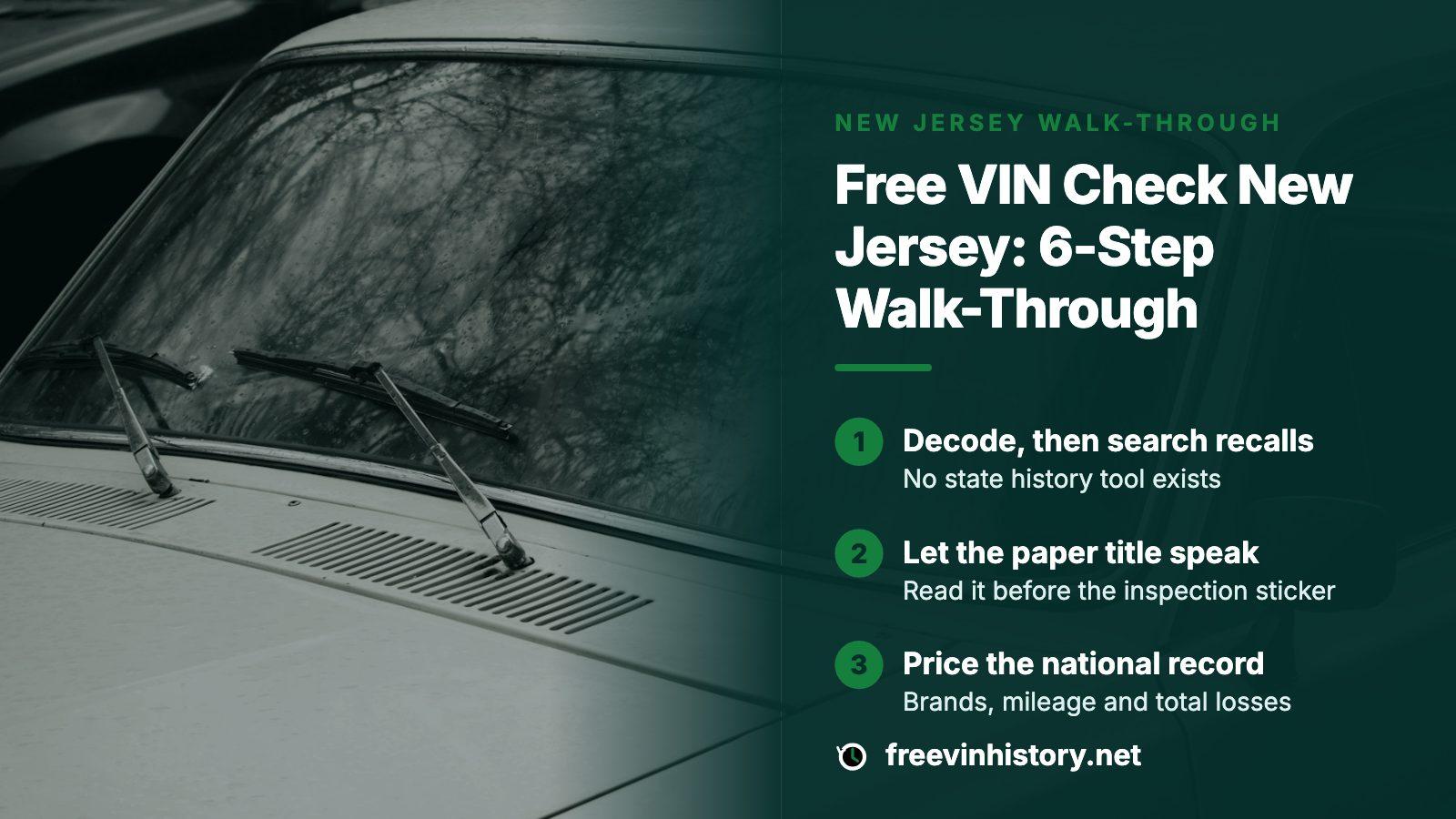
THE SHORT ANSWER
New Jersey has no state website that returns a car's full history by VIN. What you can do at no charge is decode the VIN through NHTSA, search NHTSA's recall data, and study the seller's title and inspection sticker. Past brands, mileage and insurer total-loss entries live in the national title system, which approved providers sell as a report.
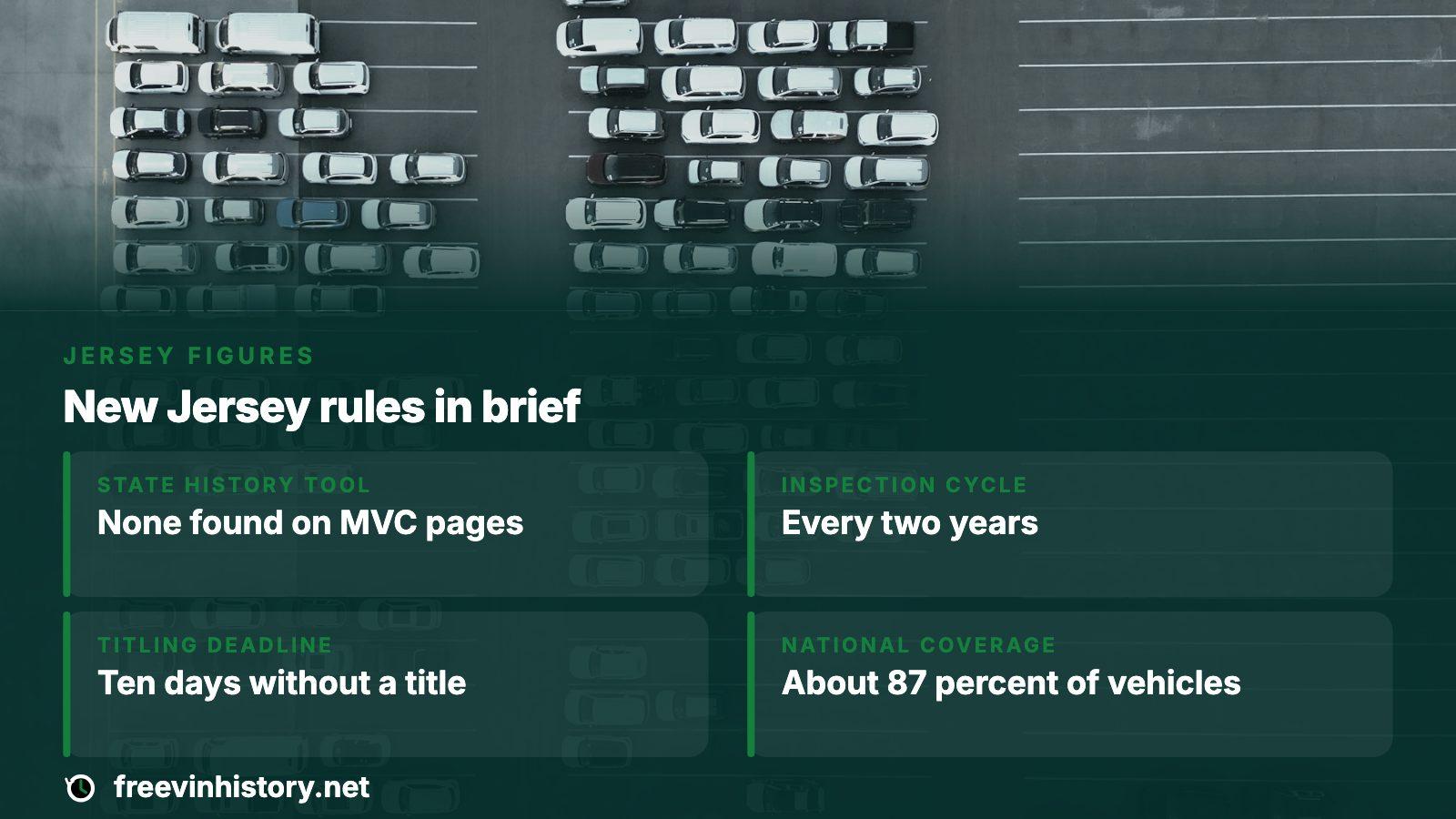
- State history tool
- None found on the MVC pages opened
- Inspection cycle
- Every two years, five years for new vehicles
- Titling deadline
- Ten days when the dealer gave no title
- National title system coverage
- About 87 percent of U.S. vehicles
The six steps in order
Free official sources answer narrow questions, so the order matters. Early steps cost a few minutes and can end the deal before you spend anything. Later ones cost a little money and tell you what the free tools cannot.
| Step | Cost | What you learn | What stays hidden |
|---|---|---|---|
| 1. Decode the VIN with NHTSA | None | Make, model, body style, equipment fields | Anything about the car's past |
| 2. Search NHTSA recalls | None | Campaigns on that make, model and year | Whether this exact car was repaired |
| 3. Read the seller's title | None | Names, brands, lien notes on paper | Brands a prior state never wrote down |
| 4. Read the inspection sticker | None | When the next inspection is due | Mechanical condition |
| 5. Pull a national title report | Provider's fee | Brands, last odometer reading, total-loss flags | Damage never reported anywhere |
| 6. Run a full report | Preview at no charge, then one payment | Crash, mileage, auction and lien entries for the VIN | Repairs paid in cash |
Steps one and two: decode the number, then search recalls
NHTSA runs a public VIN decoder that returns the make, model, body class and a long list of equipment fields. Run your VIN through it first and compare the output with the listing. A coupe that decodes as something else, or an engine that does not match the ad, should make you pause and press the seller.
Blank fields in a decode do not prove a feature is missing; NHTSA says only that it holds no data for that item. Next, search NHTSA's recall data for the same make, model and year. The recall interface returns a campaign number, a report date, the affected component and a summary. A popular model can carry many campaigns, so read which ones apply to your trim and confirm with a dealer that the work was done.
Step three: the paper title does the state's job
The MVC pages I opened describe titling, not a lookup tool for buyers. So the title in the seller's hand is your primary state record. For a used car, the former owner must have completed and signed the assignment section. If something on it looks wrong, the MVC tells people to check with it before going further.
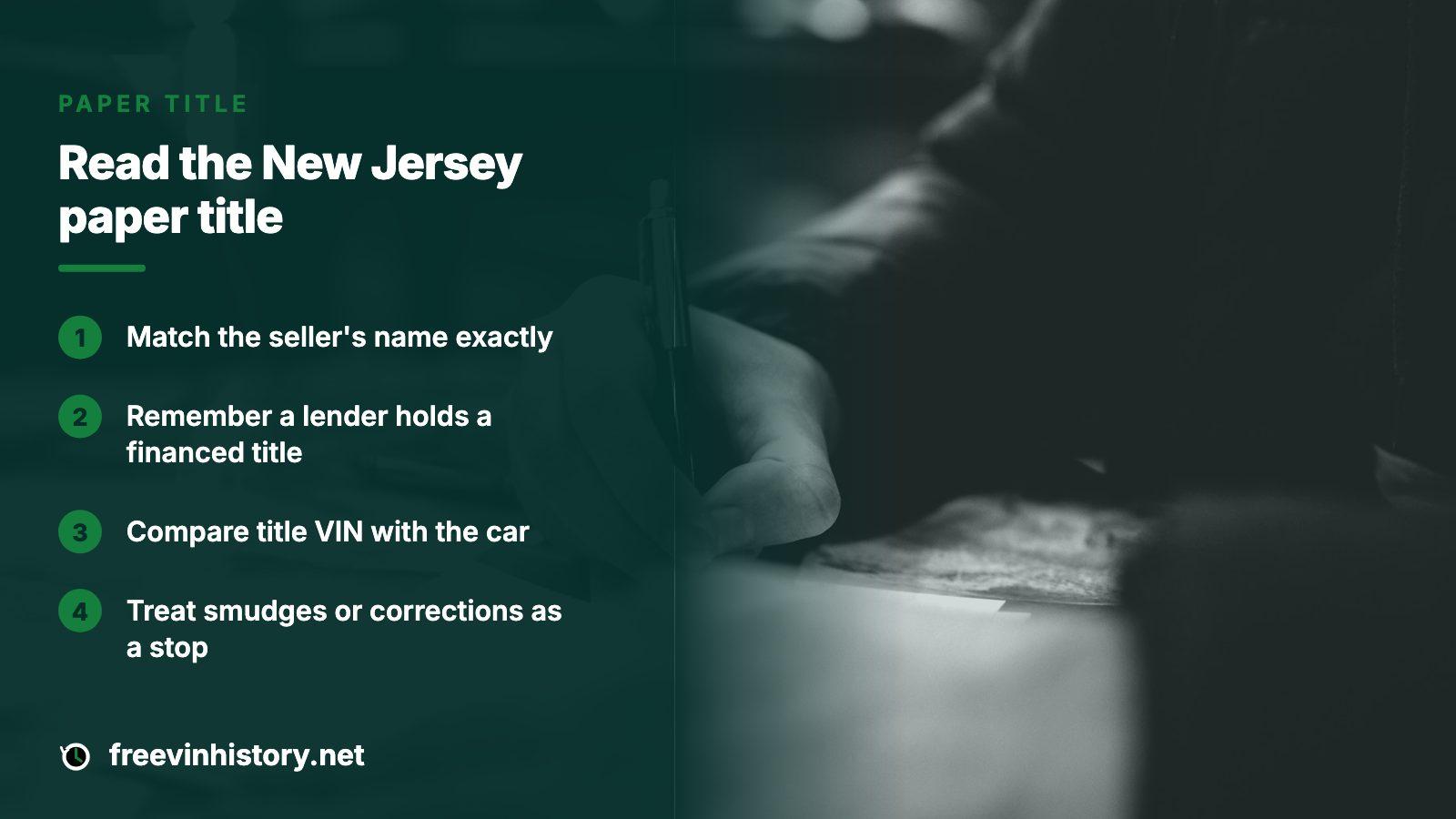
- The seller's name should match the name printed on the title exactly.
- Any lienholder on a financed car receives the original title, so a seller with a loan cannot simply hand one over.
- The VIN on the title and the one on the car must read identically.
- Treat corrections, smudges or a missing assignment as a stop sign.
Mail is not an option for the transfer: the new owner shows up at a Vehicle Center with an appointment booked online.
Step four: what the inspection sticker tells you
Basic passenger vehicles in New Jersey go through inspection once every two years, while brand-new ones get a five-year interval. The windshield sticker shows the due date, and a driver may inspect up to two months ahead of it. A passed test earns a new sticker; a failed one earns a red sticker, which does not prevent citations.
Read the sticker as a date, not a verdict
The MVC pages I opened explain intervals, stickers and emissions repairs, but did not spell out what the test covers beyond that. Treat a fresh sticker as proof the car was tested, and hire an independent shop to judge brakes, tires and structure.
An overdue or red sticker also hints at a car the seller wants gone. Ask why, and ask to see the inspection report, which names the cause of a failure.
Step five: the national title record, and its blind spots
The MVC's own titling page points to the federal title records network (NMVTIS), which is the closest thing to a nationwide check. Approved providers sell reports built from it. Its inputs come from state title offices, recycling and salvage businesses, and insurers.
A report is deliberately short: title details, brand history (junk, salvage, flood labels), the latest reported odometer reading, total-loss determinations and transfers to a recycler. Coverage reaches about 87 percent of the vehicle population, with a little over half of states reporting. Missing data can produce a false negative, and brand definitions differ from state to state, so a vehicle branded elsewhere may look ordinary under New Jersey rules. One quirk: an unrecovered theft can earn a total-loss label after 30 days, even if the car later turns up undamaged.
Step six: where a full report earns its fee
Everything above is a screen. Once a car passes it, the remaining question is how it was treated, and that needs records from more places than a title system holds. Our report gathers crash entries, mileage readings across the years, auction listings with photos and lien records for a single VIN. A free preview shows whether such records exist before any money changes hands.
Pricing sits on the pricing page. Buying is a single payment for one report, with larger bundles available when you are shopping across several listings. Nothing renews. Only the preview carries no charge, and the report is a paid product.
- Take the VIN off the vehicle itself, never from the advertisement.
- Open the preview and note which record types appear.
- Buy the report only for the car you are seriously considering.
- Set the report beside the title and the seller's account and look for mismatches.
After the check: closing the sale in New Jersey
If the car passes, titling is next. When a dealer handed over no title, the buyer has ten days from the purchase date to get one issued, and a late fee follows after that. The standard title fee is $60, rising to $85 with one lien and $110 with two. Sales tax that was skipped at the dealership gets collected at the counter, based on the real price paid.
Fees and rules change, so confirm the current figures with the MVC before booking. If a dealer closes without delivering a title, the MVC points buyers to its Special Titles unit and to the Division of Consumer Affairs for complaints.
Where this information comes from
- NJ MVC: Titling a vehicle — Source for the ten-day rule, in-person titling, fees and lien handling.
- NJ MVC: About vehicle inspections — Source for inspection intervals and the windshield sticker.
- NJ MVC: If your vehicle fails inspection — Source for red stickers and what the failure report names.
- NMVTIS: Consumer information — Source for the contents of the national title record and its limits.
- NHTSA: VIN decoder API (vPIC) — Source for the decode fields and the blank-field caveat.
Sources and photos: Facts checked against the sources above in November 2026. Photos by Tigran Shishmanyan, Owen Michael Grech and Iain on Unsplash; diagrams by FreeVINHistory.
Keep reading
- Free VIN check through the DMV: what a state agency will and will not showHow state motor vehicle agencies fit into a no-cost VIN check.
- Car title search by VIN free: what you can see before you payGoing deeper on the title record behind step five.
- Free open recall check by VIN: GM, Polaris and every other makeThe recall search from step two in more detail.
- Free flood check by VIN: what the free tools show and missWater damage is the brand a title may never show.
Frequently asked questions
Is there a free VIN check in New Jersey?
Pieces of one. NHTSA decodes VINs and lists recalls at no charge, and the seller's title and sticker add paper evidence. None of them returns a full history, so crash, mileage and title-brand records need a separate report, which here starts with a free preview.
Does the NJ MVC offer a VIN lookup for buyers?
The MVC pages I opened covered titling, registration and inspections, not a buyer-facing history lookup. The titling page does link to the national title system. Ask the MVC directly if you need a record of a particular vehicle.
Does a clean national title record mean the car is clean?
No. The system itself warns that missing data can give a false negative, that states define brands differently, and that it omits parts of a state title record. Add the paper title, a mechanic's inspection and a fuller report.
How often are New Jersey cars inspected?
Every two years for basic passenger vehicles, while newer vehicles wait five years. The sticker on the windshield shows the due date, and you can inspect up to two months early. A failed test gets a red sticker and a repair window.
What does the paid report add to the free steps?
Crash entries, mileage readings across the years, auction history with photos, and lien records tied to the VIN. The preview shows which categories hold records before you pay, and the purchase is a single payment.
Now check the car itself
The guide explains what to look for. The report shows what this VIN has on record.