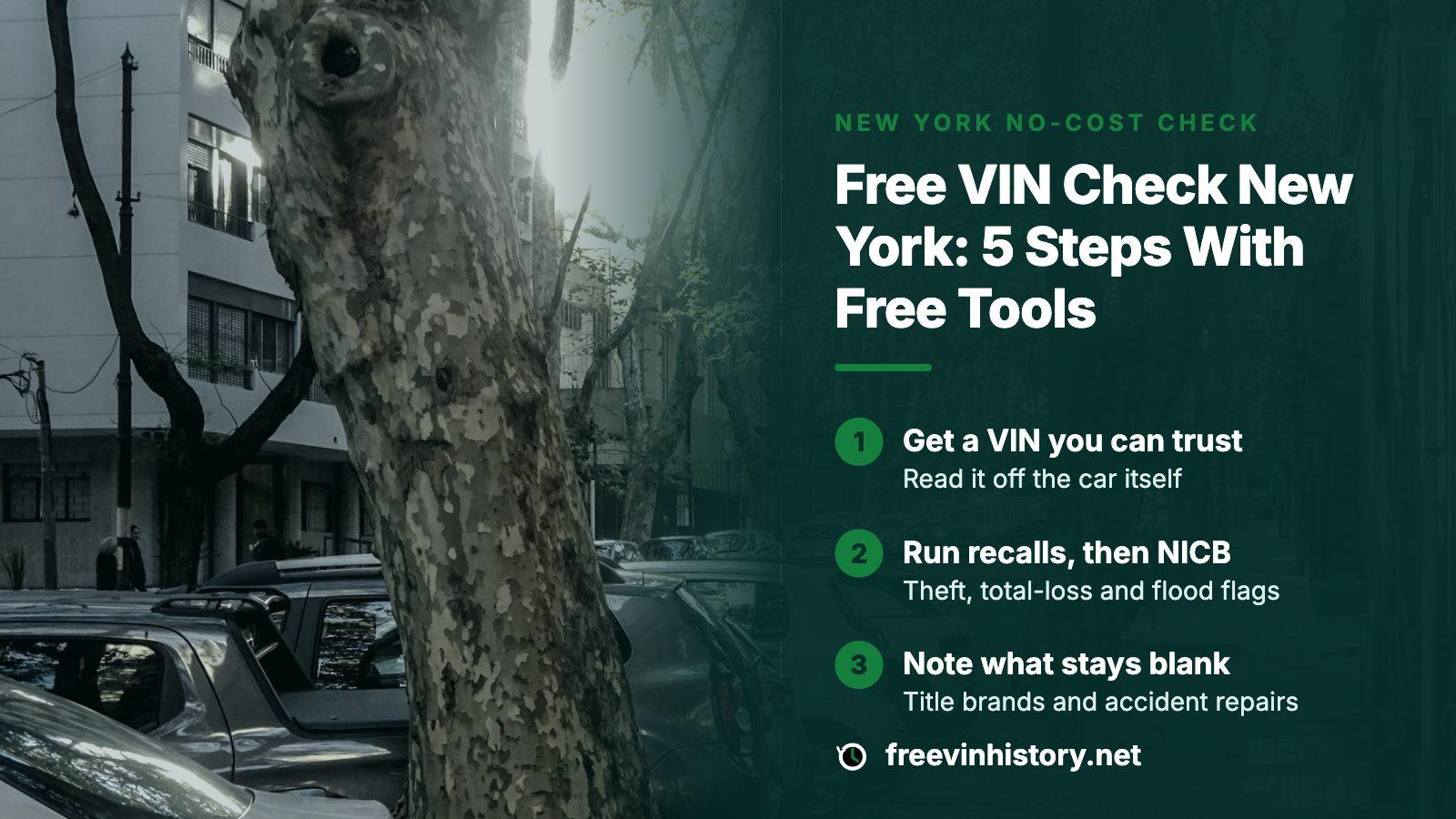
THE SHORT ANSWER
Partly. Two official lookups need no payment and only the VIN: NHTSA's recall search lists unrepaired safety recalls, and NICB's VINCheck lists theft, total-loss and flood records that insurers reported. Neither shows title brands from the state, mileage over time or accident repairs. The free preview on this site lists which of those records turn up for the car, before you commit any money.
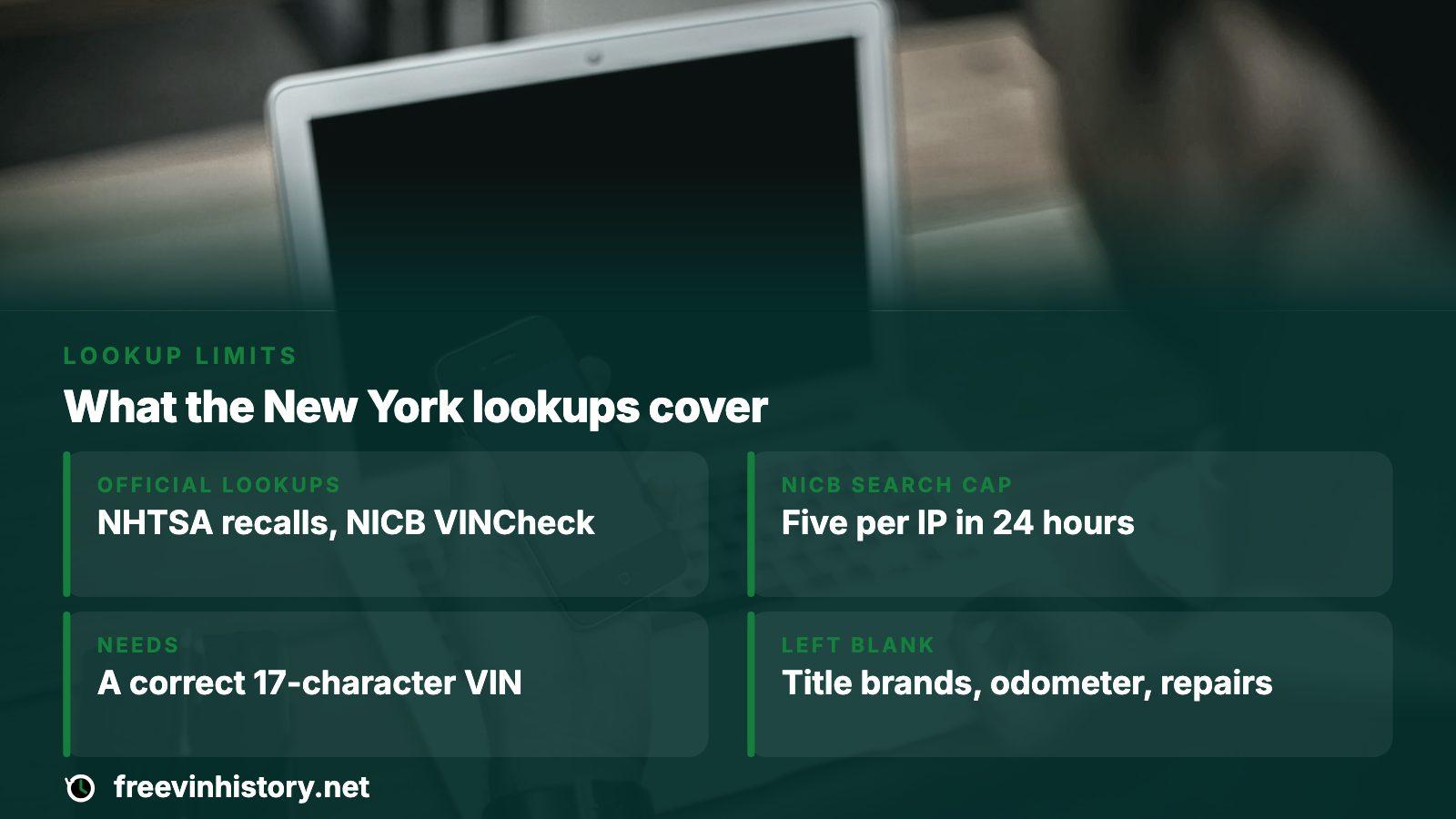
- Free official lookups
- NHTSA recall search and NICB VINCheck
- NICB search cap
- Five per IP address in 24 hours
- Needs
- A correct 17-character VIN, nothing else
- Not covered for free
- Title brands, odometer history, accident repairs
What free actually means for a New York car
Search results for this topic suggest a New York-only database. There is none that works for a buyer at a kitchen table. What exists is a pair of federal and industry lookups that take any American VIN, including one from a Buffalo driveway or a Queens curb. They are good at two narrow jobs and silent on the rest.
This page is built as a short checklist you can run from your phone while standing next to the car. Each step says what to type, what the answer means and what it leaves out. Where the free layer runs dry, the last steps explain what a paid report adds. Rules and fees set by the New York DMV are not covered in detail here, because its pages would not open for our research; confirm current requirements with the agency directly.
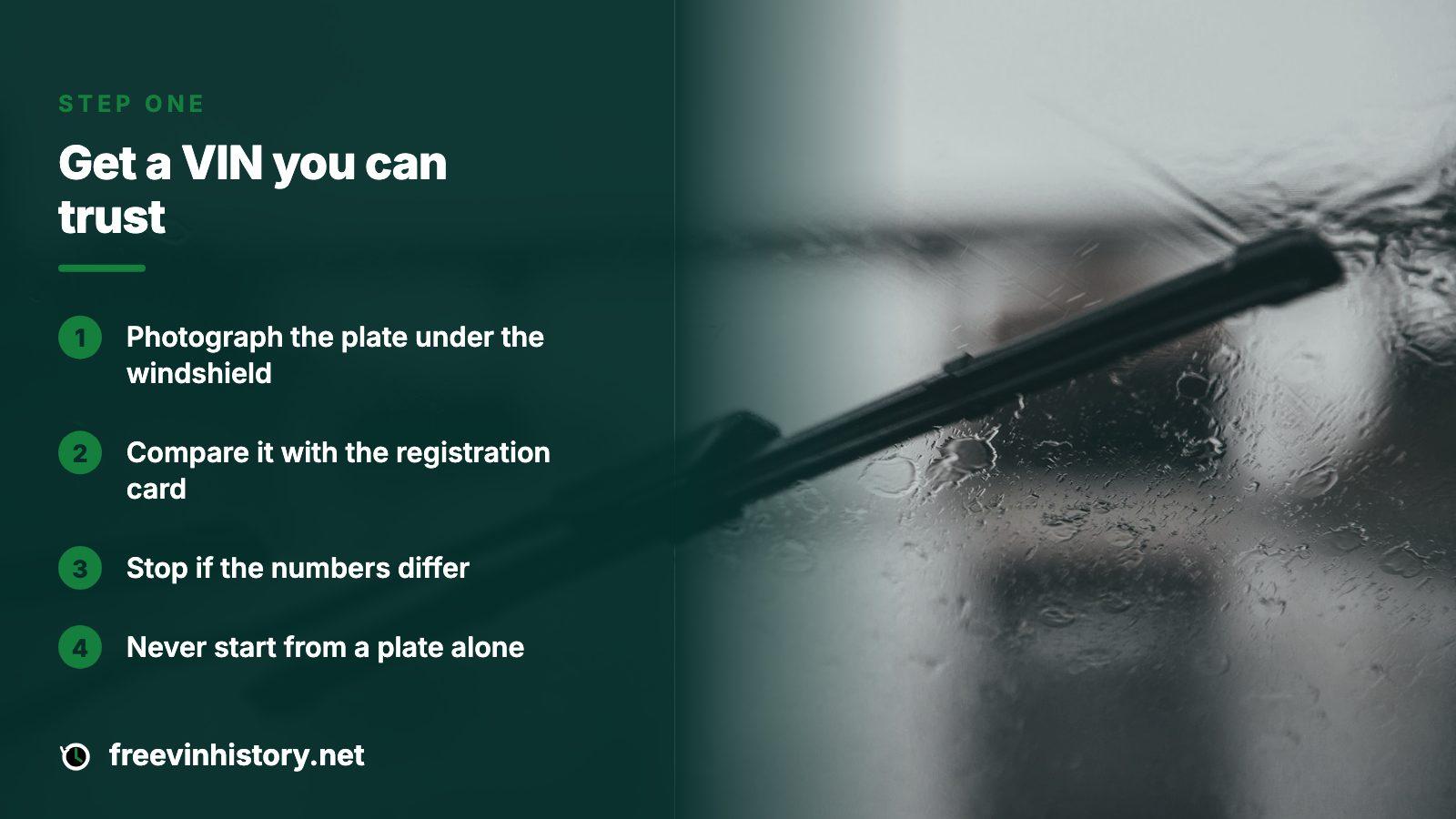
Step 1: Get a VIN you can trust
Everything downstream depends on a correct VIN. NICB warns that a wrong character can mean a real record never matches, so a clean answer from a mistyped number proves nothing.
- Find the VIN plate on the dash corner under the windshield, driver's side, and photograph it.
- Compare it with the registration card, which carries the same number, and with the insurance card if the seller has one handy.
- If the numbers differ between the windshield and the paperwork, stop the check there and ask why.
- A plate number alone will not do. Nothing free on this list takes a license plate as the starting point for history.
Step 2: Run the NHTSA recall search
Enter the VIN at NHTSA's recall page. If nothing is open, the site answers with a line saying zero unrepaired recalls are associated with the number. If something is open, the manufacturer must repair it at no charge, and the dealer can tell you whether parts are on hand.
Read the limits before trusting a zero. The search skips recalls already fixed, brand-new recalls whose VINs have not been loaded yet, campaigns that old, apart from makers who choose longer coverage, work by small manufacturers and non-safety service campaigns. Check again a few days before you buy, since VINs are added continuously.
Step 3: Run NICB VINCheck
VINCheck looks the number up against records from member insurers and reports whether the car was logged as stolen and never recovered, or as salvage or flood-damaged by an insurer. It stands in for roughly 92.49% of U.S. earned premium, according to NICB's own figure, which still leaves insurers outside it.
Mind the daily cap
NICB caps lookups at five a day for each IP address. If you are comparing several listings, keep the VINs in a note and spend your five on the cars that survive the recall step.
A salvage result means an insurer paid out as a total loss rather than repair the car. Many such cars get repaired and put back on the road, so the flag is a reason to dig, not an automatic no.
What the free layer shows and what it leaves blank
| Question you have | NHTSA recalls | NICB VINCheck | Left unanswered |
|---|---|---|---|
| Open safety recall? | Yes, for the VIN | No | Older or small-maker campaigns |
| Reported stolen, not recovered? | No | Yes, insurer records | Police files, non-member insurers |
| Insurer total loss or flood? | No | Yes | Unclaimed damage nobody reported |
| Title brand from the state? | No | No | Needs a title record |
| Odometer history? | No | No | Needs a title record |
| Accident repairs? | No | No | Needs a fuller report |
NICB says plainly that VINCheck is not a full history and should not carry a purchase decision alone.
Step 4: Look at the national title record
The federal NMVTIS system holds a vehicle's title, its latest odometer reading, its brand history and, in some cases, theft information. A brand is a state-assigned label for current or past condition, such as junk, salvage or flood. Inputs come from state motor vehicle agencies, auto recyclers, scrap and salvage operators and insurance carriers.
Consumers reach it through approved providers listed on the Justice Department's vehicle history site. The system exists partly because flooded cars have been trucked across state lines to buyers in places that do not brand them. After Hurricane Katrina, authorities described exactly that. Salt water in the electrics, airbag sensors included, makes failures more likely, so a flood brand is worth finding before you hand over a deposit.
Step 5: Decide whether the gaps justify a full report
If both free lookups come back quiet and the car is cheap and local, a careful inspection may be enough. When the price is high, the seller is a stranger or the car has traveled from another state, the missing pieces matter more.
- Enter the VIN on this site for the free preview, which shows what kinds of records exist.
- Read the preview against the car in front of you: mileage, title status, any damage sign.
- Buy a single report if those records are there and you want the detail.
- Walk away if the preview shows brands the seller never mentioned.
Looking at the preview costs nothing. If you go on, you pay once for that one report and nothing recurs; amounts sit on the pricing page.
Warning signs worth stopping for
- A VIN that differs between the windshield and the paperwork.
- A seller who holds back the number until a deposit is paid.
- A salvage or flood flag the listing never mentioned.
- An open recall the seller calls cosmetic.
- A clean free result paired with a price far under market, since the free tools miss plenty.
Any one of these justifies pausing. Two together justify leaving. A New York DMV office or a trusted independent shop can then confirm what the paperwork claims.
Where this information comes from
- NICB: VINCheck lookup — daily search cap, who reports, what a clean result does not prove
- NHTSA: Check for recalls — where the VIN sits and which recalls the search skips
- NMVTIS: What it is, for consumers — title, odometer and brand data and who supplies it
- NMVTIS: Approved data providers — how the public reaches title data
Sources and photos: Facts checked against the sources above in November 2026. Photos by Nikolai Kolosov, Thibault Valjevac and Alejandro Escamilla on Unsplash; diagrams by FreeVINHistory.
Keep reading
- Car title search by VIN free: what you can see before you payGoes deeper on the title record step.
- Free flood check by VIN: what the free tools show and missCovers flood flags and what slips past them.
- Free VIN check in Pennsylvania: what the official lookups show before you payA neighboring state's version of the same walk-through.
- Free open recall check by VIN: GM, Polaris and every other makeMore on reading recall results.
Frequently asked questions
Is there a free VIN check just for New York?
Not one a buyer can use directly. The practical free tools are national: NHTSA's recall search and NICB's VINCheck accept any American VIN. For state title paperwork, ask the New York DMV what it releases and on what terms, since we could not read its pages for this guide.
Can I check a New York car with only the license plate?
Not for history. NHTSA's recall page can search by plate, using state DMV data, but the free history tools here start from the VIN. Get the number from the windshield, the registration card or the seller, then run the checks.
How many free NICB searches do I get?
The cap is five a day per IP address, with no lifetime limit. Save them for cars that already passed your first screening, and write down each result with the date you ran it.
Is a clean NICB result proof the car is fine?
No. NICB says a clean answer is no guarantee. Only participating insurers appear, law enforcement records are not queried, and damage nobody claimed leaves no entry. Pair it with the recall search, a title record and an inspection.
When is the free preview worth running?
Once the two official lookups are done and you want to see which record types exist for the VIN before spending anything. The preview is where to start, with no charge. A report afterward is a one-off purchase, and the pricing page spells out the packs.
Now check the car itself
The guide explains what to look for. The report shows what this VIN has on record.