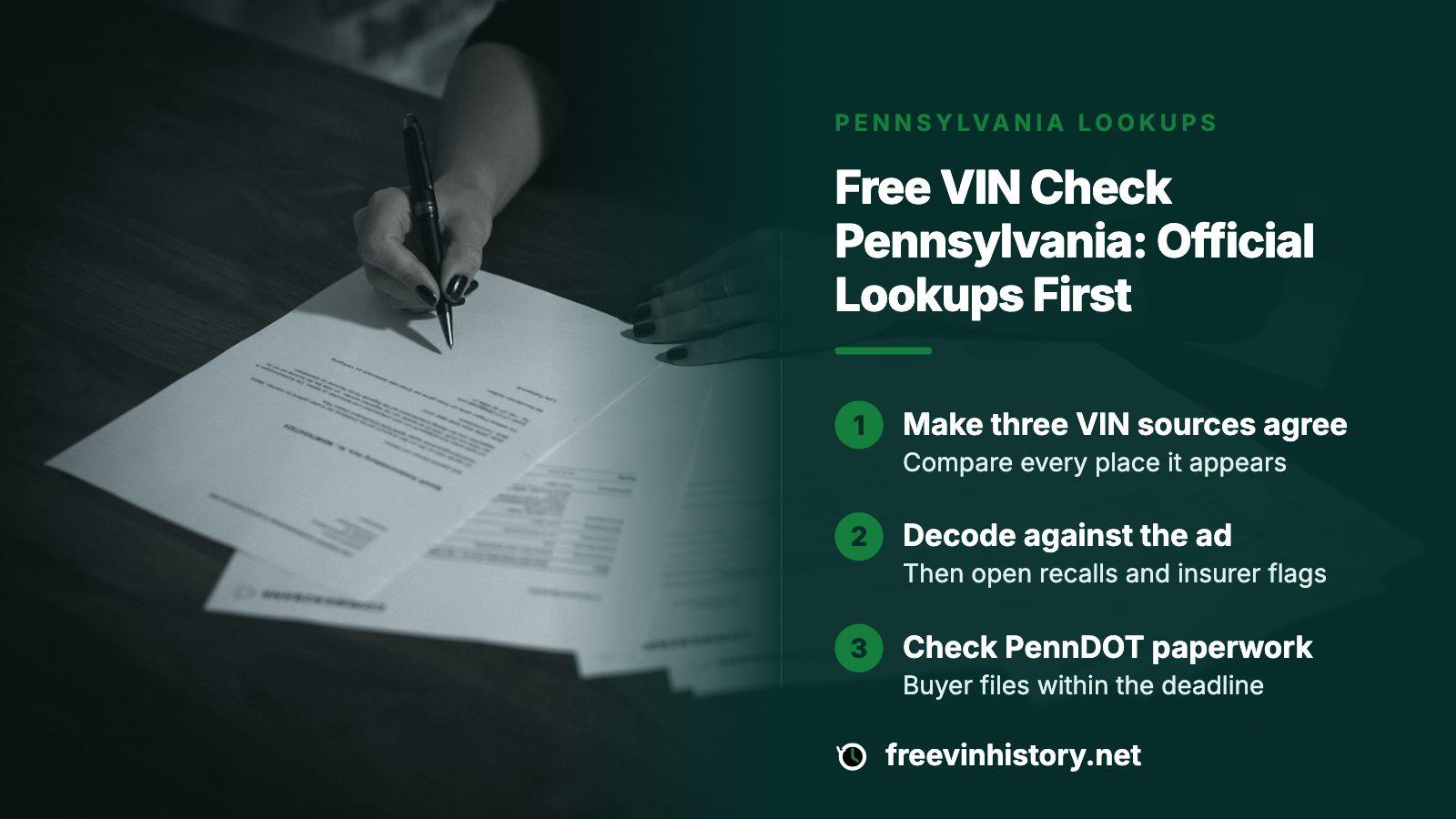
THE SHORT ANSWER
Yes, in part. Three lookups cost nothing and need only the VIN: NHTSA's decoder confirms what the car is, its recall search names any safety fix still owed, and NICB's VINCheck shows insurer theft, salvage and flood flags. I found no public PennDOT title search by VIN. Accident history, auction photos and a full title record sit outside the free tools, which is where this site's preview and one-time report come in.
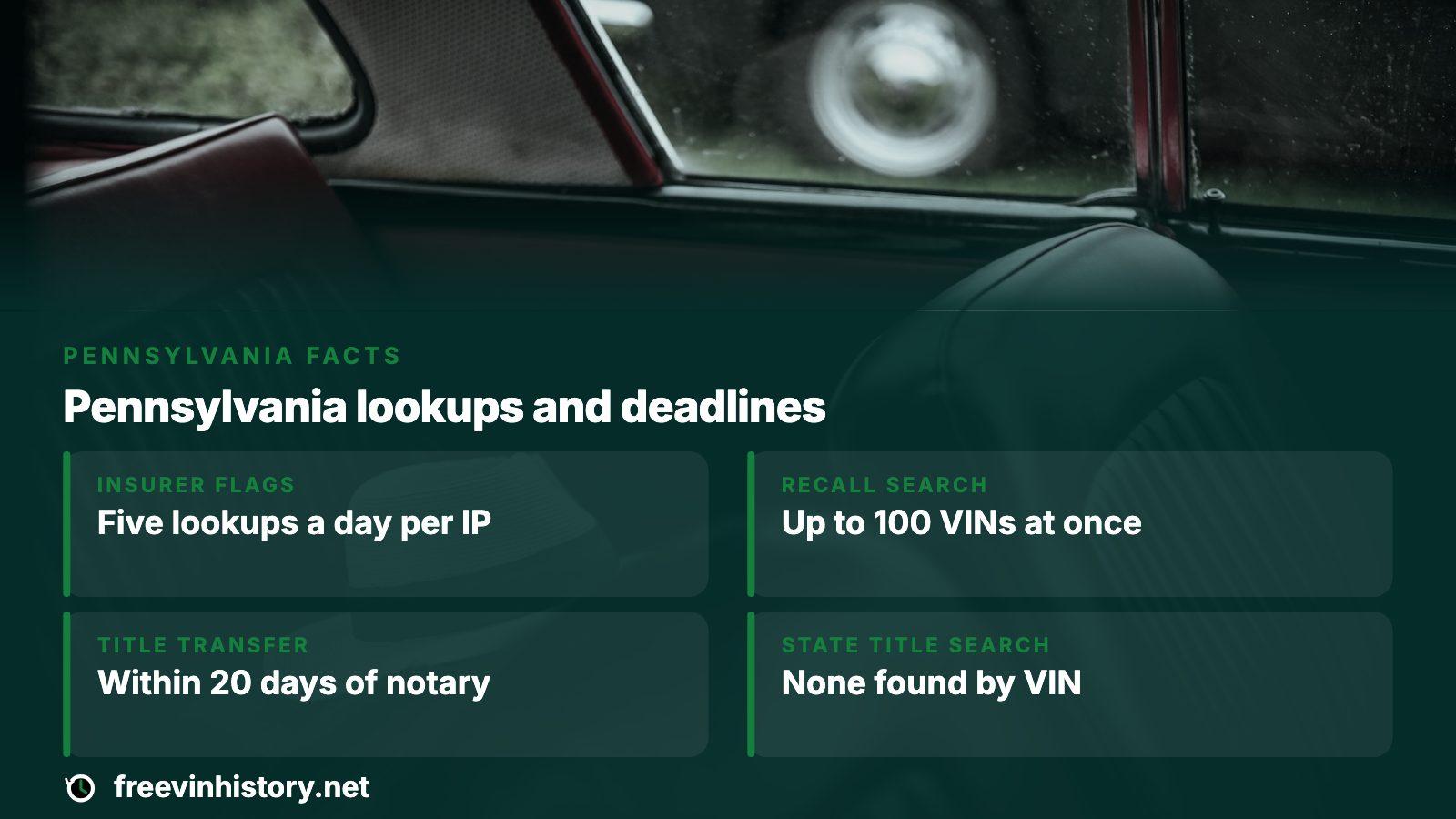
- Insurer flags
- NICB caps each IP address at five lookups a day
- Recall search
- NHTSA accepts up to 100 VINs at once
- Title transfer
- Buyer files with PennDOT within 20 days of notarization
- PennDOT check
- About 81 percent of U.S. vehicles checked at titling
The lookups at a glance
A careful Pennsylvania buyer can finish this list in an evening, before driving to see the car. Each row costs nothing and none of them comes from the seller. The right-hand column matters as much as the middle one, because every gap on it is a question you still have to answer some other way.
| Lookup | Run by | What it tells you | What it cannot tell you |
|---|---|---|---|
| VIN decode | NHTSA | Year, make, model, body, plant | Anything that happened after assembly |
| Recall search | NHTSA | Safety repairs still unrepaired | Repaired recalls, small makers, non-safety campaigns |
| Theft, salvage and flood flags | NICB | Reports from member insurers | Police files, uninsured damage, insurers that opt out |
| Title paperwork | You, with PennDOT's rules | Notarized signatures, mileage, liens | Titles issued elsewhere unless you dig |
| Title check at issue | PennDOT, behind the counter | Verification against NMVTIS | Nothing you can read yourself |
Step one: get the VIN from three places and make them agree
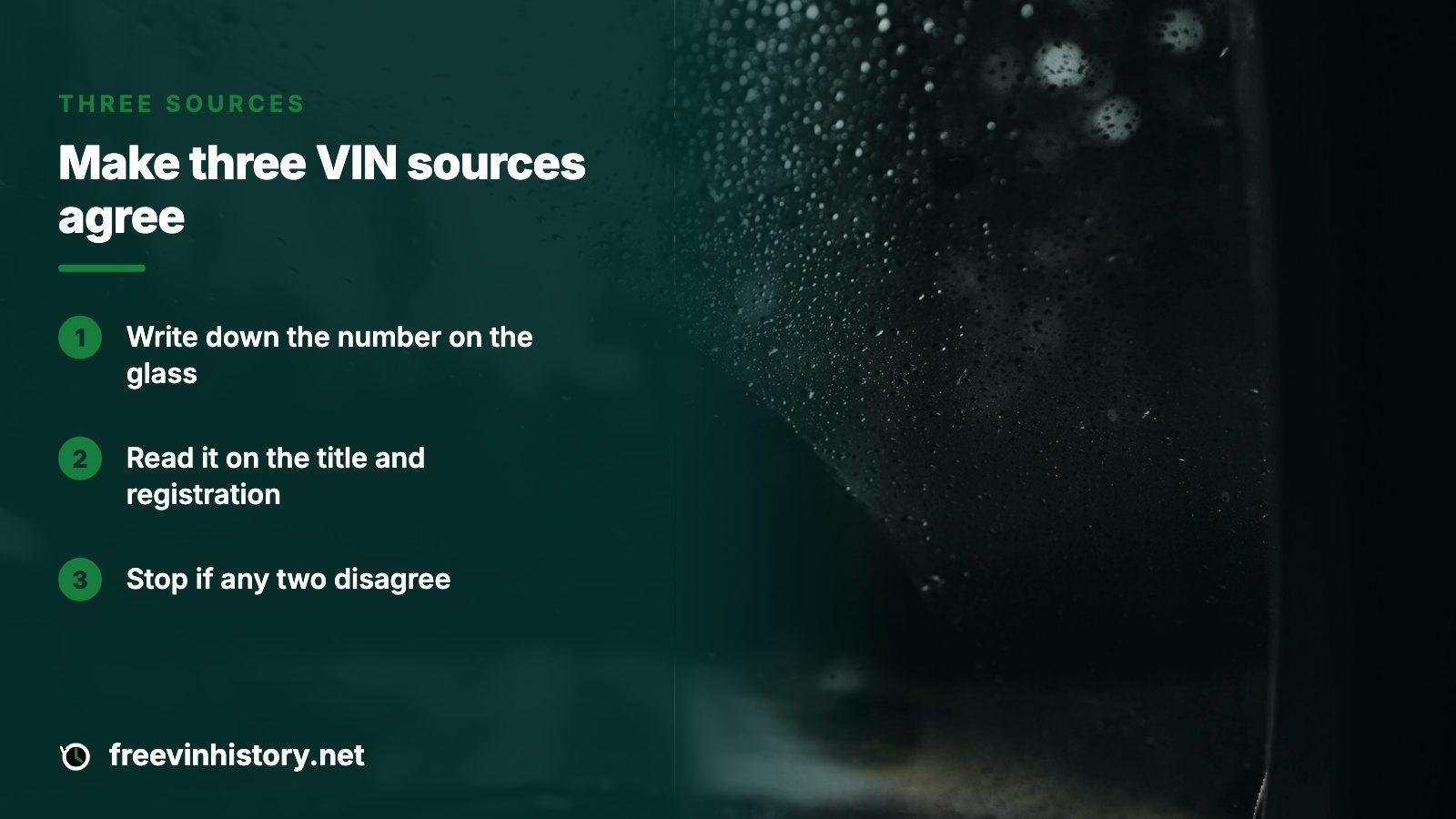
NHTSA says to look low on the left of the glass for the 17-character number, which is repeated on the registration card and sometimes the insurance card. PennDOT publishes a sample registration card marking the plate number, title number and VIN, so you know which line to read.
- Write down the number on the glass, character by character.
- Read the same line on the seller's title and registration card.
- Stop if any two disagree, and ask the seller to explain before you go further.
NICB warns that a wrong VIN may hide a match. A typo can return a calm answer about another car, or none.
Step two: decode it and hold the answer against the ad
NHTSA's decoder returns what the maker encoded: model year, make, model, body and the plant that built it. When I fed it a widely used sample number it described a 2003 Honda Accord coupe built in Marysville, Ohio, with the check digit accepted. Changing only the final character produced error code 1 and a note that the ninth-position check digit did not calculate, though the make and model still came back.
That second result is the useful lesson. A decode can look healthy even when the number is mistyped, so read the error line, not just the model name. If the ad says a trim or engine the decode does not support, you have found a question worth asking early.
A decode is a birth certificate
It records the car at the moment of assembly. Owners, crashes, flood water and the odometer all fall outside it.
Steps three and four: open recalls, then insurer flags
NHTSA's recall search answers one narrow question: does this exact car have an unrepaired safety recall? A clean answer reads zero unrepaired recalls. Missing from it: repairs already done, fresh recalls still waiting for their VINs, campaigns past the 15-year mark unless a maker stretches coverage, small manufacturers, and goodwill programs that are not safety recalls. An open recall is a repair task and a point for negotiation, not a reason to walk.
NICB's VINCheck asks a different question: did a participating insurer report the car stolen and unrecovered, declare it salvage or log flood damage? Its members account for 92.49 percent of earned premium in the country. The limit is five lookups daily from one connection, so save them for finalists. NICB admits that an empty result guarantees nothing and that police records are not searched.
- Salvage hit: an insurer judged repair costs too high against the car's value. NICB notes such cars can be legally rebuilt and retitled.
- Flood hit: look for water lines, silt and damp carpet before anything else.
- Theft hit: do not hand over money, and tell the seller you are checking.
What PennDOT does at titling that you never see
PennDOT says it checks a vehicle title electronically against the history of about 81 percent of U.S. motor vehicles, and that a car whose NMVTIS result raises questions is not titled until more research is done. Every state must run a similar check before issuing a title when ownership changes. That protects the system, but the answer is not shown to the buyer.
The Justice Department's NMVTIS page explains why a consumer search deserves some caution too. A report covers a handful of indicators, not every entity reports, and an empty result may simply mean a gap in reporting. It also notes that states brand damage differently, so one state's salvage can be another state's ordinary title. Looking at a state's own record is encouraged, but I found no PennDOT page that offers a public title lookup by VIN, so for a Pennsylvania car the practical route to national brand data is an approved NMVTIS provider's report.
Step five: the Pennsylvania paperwork check at the signing table
PennDOT's guidance for a used car turns into a short checklist you can run with the seller present. Most of it exposes problems that no database would.
- Seller and buyer sign the Pennsylvania title with a notary watching; the seller also handprints a name and fills in the mileage.
- Buyer and seller disclose the purchase price and mileage on Form MV-4ST, which only authorized PennDOT agents hold.
- Bring your insurance identification card, since registration needs it.
- The buyer owes PennDOT the transfer papers inside 20 days of the notary's stamp.
- Expect the seller to remove the plate once the title changes hands.
Salvage certificate means no road use
PennDOT states that a vehicle holding only a salvage certificate cannot be registered or driven. If a seller offers a car with that paper, you are buying a project, with sales or use tax owed on it.
When the title came from another state or a lender holds it
A car brought in from elsewhere needs Form MV-1 instead, and PennDOT requires VIN verification on out-of-state vehicles. Read the back of that title for the seller's signature space and the odometer line. PennDOT notes that some out-of-state titles need a notarized seller signature and suggests asking a dealer, tag service or notary when unsure.
Liens add a second problem. PennDOT cautions that a lender in another state frequently keeps the title until the loan is settled, and tells applicants to call that lender before filing. Pennsylvania lenders hold liens electronically, and once one is released the owner receives a paper title with no lien on it. Get the seller's payoff plan on paper and have the lender confirm it before money moves. None of the free searches above lists a lien, which is the reason this gap deserves its own conversation.
Where the free route stops and a report begins
NICB explains that a complete history report gathers title files from motor vehicle agencies, auction listings and maintenance entries, and that most of these reports are paid. Three things stay unanswered after every free lookup here: titles and brands from other states, accident and damage records, and auction history with photos.
This is where our preview fits. Enter the VIN and it shows, at no charge, whether those kinds of records exist for the car. If they do, you pay once for the report, with no renewal, and the pricing page lists the amounts. Run it on the one car you are ready to buy, before any deposit.
Where this information comes from
- PennDOT: Buying or Selling a Vehicle — Forms, out-of-state title steps, salvage certificate rule and seller duties.
- PennDOT: NMVTIS — The state's own electronic title verification and its coverage figure.
- PennDOT: Motor Vehicle Miscellaneous FAQs — Notarized signing and the filing window after transfer.
- PennDOT: Mandatory Electronic Lien and Titling FAQs — How electronic liens are released into a paper title.
- NHTSA: Check for Recalls — What the VIN recall search lists and leaves out.
- NICB: VINCheck — Search limit, insurer coverage share and NICB's own cautions.
- U.S. Department of Justice: NMVTIS for consumers — False negatives and state differences in branding.
Sources and photos: Facts checked against the sources above in November 2026. Photos by Dimitri Karastelev, Justin Cron and Nik on Unsplash; diagrams by FreeVINHistory.
Keep reading
- Car title search by VIN free: what you can see before you payThe title side of a car's story, beyond what a state counter shows.
- Free open recall check by VIN: GM, Polaris and every other makeA closer read of what a recall search finds and omits.
- NMVTIS report: what the federal title record shows and missesThe national title record that sits behind PennDOT's own check.
- Car lien search free: what the free tools show and what they missLearning if a bank or credit union still has a stake in the car.
Frequently asked questions
Is there an official Pennsylvania VIN lookup that costs nothing?
For recalls, theft and salvage flags, yes, through NHTSA and NICB. For titles, I found no public PennDOT search by VIN. PennDOT runs its own NMVTIS check when it issues a title, but the result is not shown to a buyer, so request the title itself and the lender's name from the seller.
Can I check a Pennsylvania car with only the plate number?
NHTSA's recall page accepts a plate and state, but it warns that plate results come from DMV data and may show a vehicle the plate once belonged to. The VIN identifies the car in front of you, so copy it from the windshield and the paperwork instead.
If NICB finds nothing, is the car clean?
No. VINCheck reflects only reports from participating insurers, and it does not search police records. NICB states that a clean result is no guarantee. Count it as one box ticked, then check the title paperwork and consider a full report before you pay.
What is the deadline after buying a used car?
PennDOT's FAQ gives the buyer 20 days from the notarization. The title is signed by both sides before a notary, and Form MV-4ST records price and mileage. Confirm current details with an authorized agent when you go.
What does it cost to go beyond the free lookups?
This site's preview, which shows whether records exist, has no charge. A report is one payment, with packs for several cars and nothing recurring. The pricing page lists the amounts, so check it before you decide.
Now check the car itself
The guide explains what to look for. The report shows what this VIN has on record.