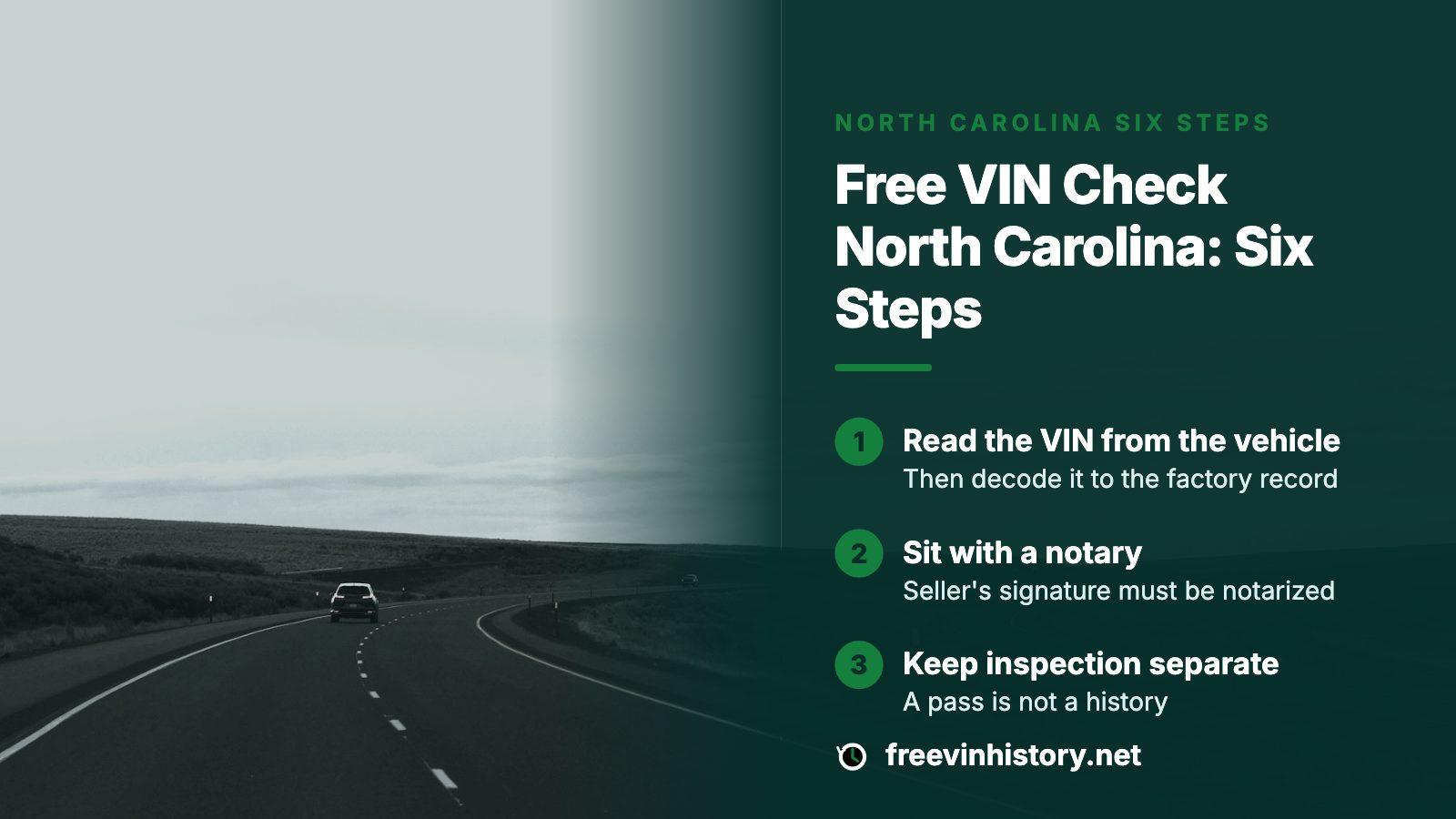
THE SHORT ANSWER
Yes, partly. For no charge you can decode the VIN with NHTSA, search NHTSA for open recalls, and run NICB for insurer theft, salvage and flood reports. Then read the North Carolina title, which must be notarized at transfer. None of that shows accident history, odometer trail or titles from other states. A free preview on this site shows whether those records exist before you buy a report.
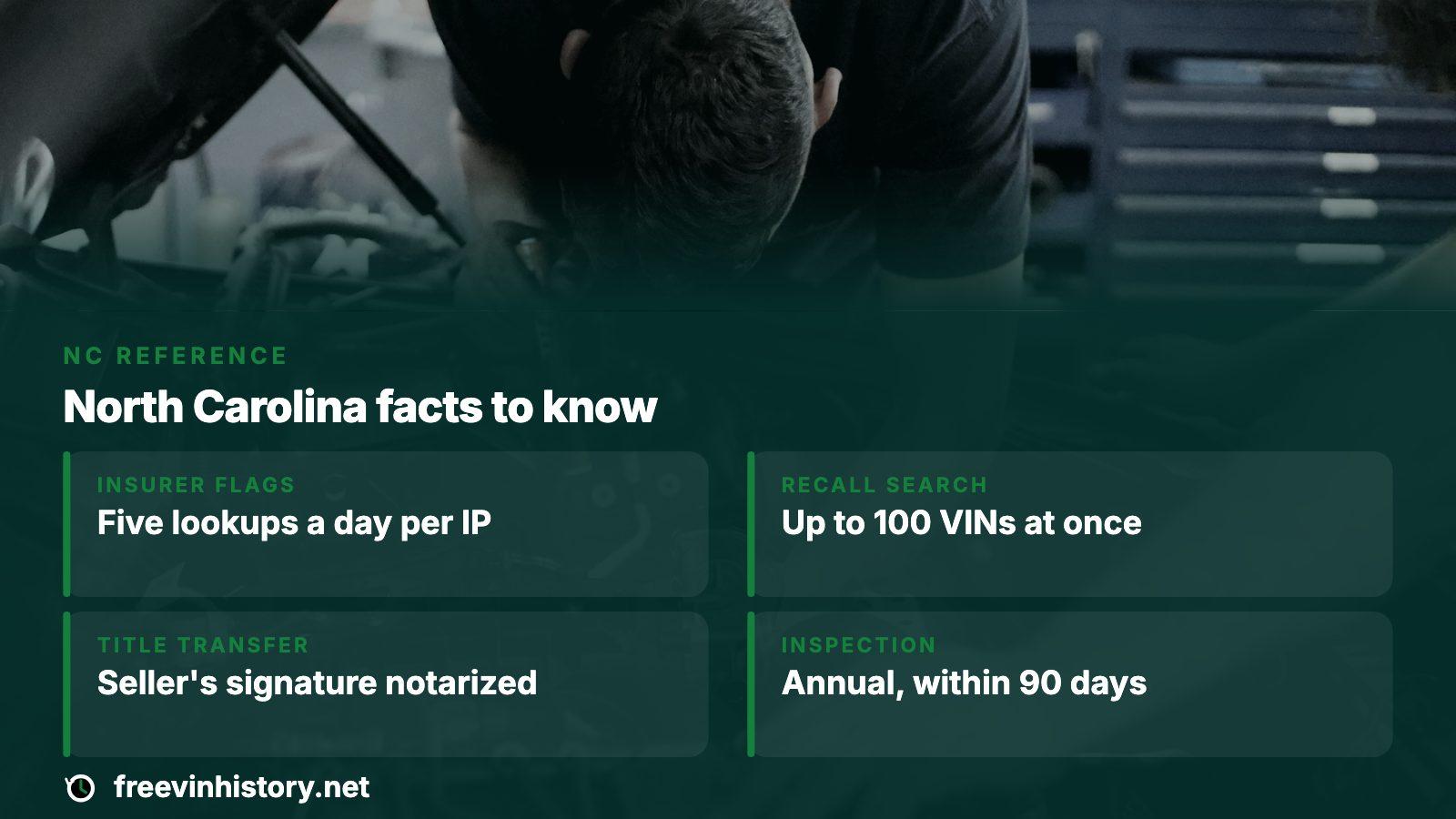
- Insurer flags
- NICB caps each IP address at five lookups a day
- Recall search
- NHTSA checks up to 100 VINs at once
- NC title
- Seller's signature must be notarized at transfer
- Inspection
- Annual, within 90 days of renewal
Why a North Carolina car gets a six-step check
Free sources each answer one narrow question. NHTSA knows what the factory built and which safety campaigns are unfixed. NICB knows what member insurers reported. The state knows what is printed on its own titles. No single free page joins those answers, so the order of the walk matters.
The steps below run from cheapest and fastest to slowest. Stop at any red flag. A VIN that will not decode, an open recall the seller never mentioned, or a title that was signed without a notary is each a reason to pause before you hand over a deposit.
- Steps 1 to 4 take about ten minutes and cost nothing.
- Step 5 happens at the sale itself, with the paper in your hands.
- Step 6 is slow, mailed or in person, and not needed for most purchases.
Step 1: read the VIN straight from the vehicle
Start at the vehicle, never the online ad. NHTSA names the windshield's lower left corner first, then the registration paperwork, and some insurance cards print it too. A phone photo of the plate taken through the glass lets you paste the number instead of typing it.
Compare that number with the one on the North Carolina title, character by character. A mismatch ends the conversation. NICB warns that a wrong VIN can hide a match, so a mistyped digit can look like a clean result when it is only a search for a different car.
Step 2: decode it against the factory record
NHTSA's vPIC decoder turns the 17 characters into the make, model and specifications that the maker filed. The point is simple: does the decoded car match the car in the driveway? A trim, engine or body style that differs from the listing is a question for the seller.
A decode is silent on the car's life after assembly. Treat it as an identity check rather than a history, then carry the same number into the next step.
Step 3: search for unrepaired recalls
The NHTSA recall page takes a VIN and answers one question: is a safety fix still outstanding. If nothing is open, it prints a line reading 0 unrepaired recalls associated with this VIN. Repairs go through a franchised dealer of that brand.
| NHTSA VIN search shows | NHTSA VIN search leaves out |
|---|---|
| Safety recalls still unrepaired | Recalls already fixed |
| Results for makers that supply VIN data | Some very new recalls not yet matched to VINs |
| Campaigns within the covered period | Anything fifteen model years back, barring extended maker coverage |
| Cars sold in the U.S. | Small makers, non-safety campaigns, international vehicles |
Anything you find belongs in the price talk, or in a promise from the seller to complete the repair before sale.
Step 4: ask insurers through NICB VINCheck
NICB's lookup costs nothing. Participating insurers feed it, and it flags a VIN they logged as stolen and still missing, or as salvage or flood-damaged. Per NICB, the participants write 92.49 percent of premiums nationwide: broad, not complete.
Only insurance records appear. Law enforcement files and companies that sit out the program never appear, and a spotless result, NICB warns, proves little. A salvage hit means an insurer paid out instead of repairing, so ask the seller to explain it.
Daily limit
Expect a ceiling of five lookups from one IP address in a day. If you are comparing several cars, keep the VINs in a list and run the likeliest ones first.
Step 5: read the North Carolina title with a notary beside you
NCDMV expects a buyer of a car already registered here to receive the title correctly assigned by the previous owner. When that is a North Carolina title, a notary must witness the transfer too. Where the car carries another state's title, NCDMV recognizes that state's requirements instead.
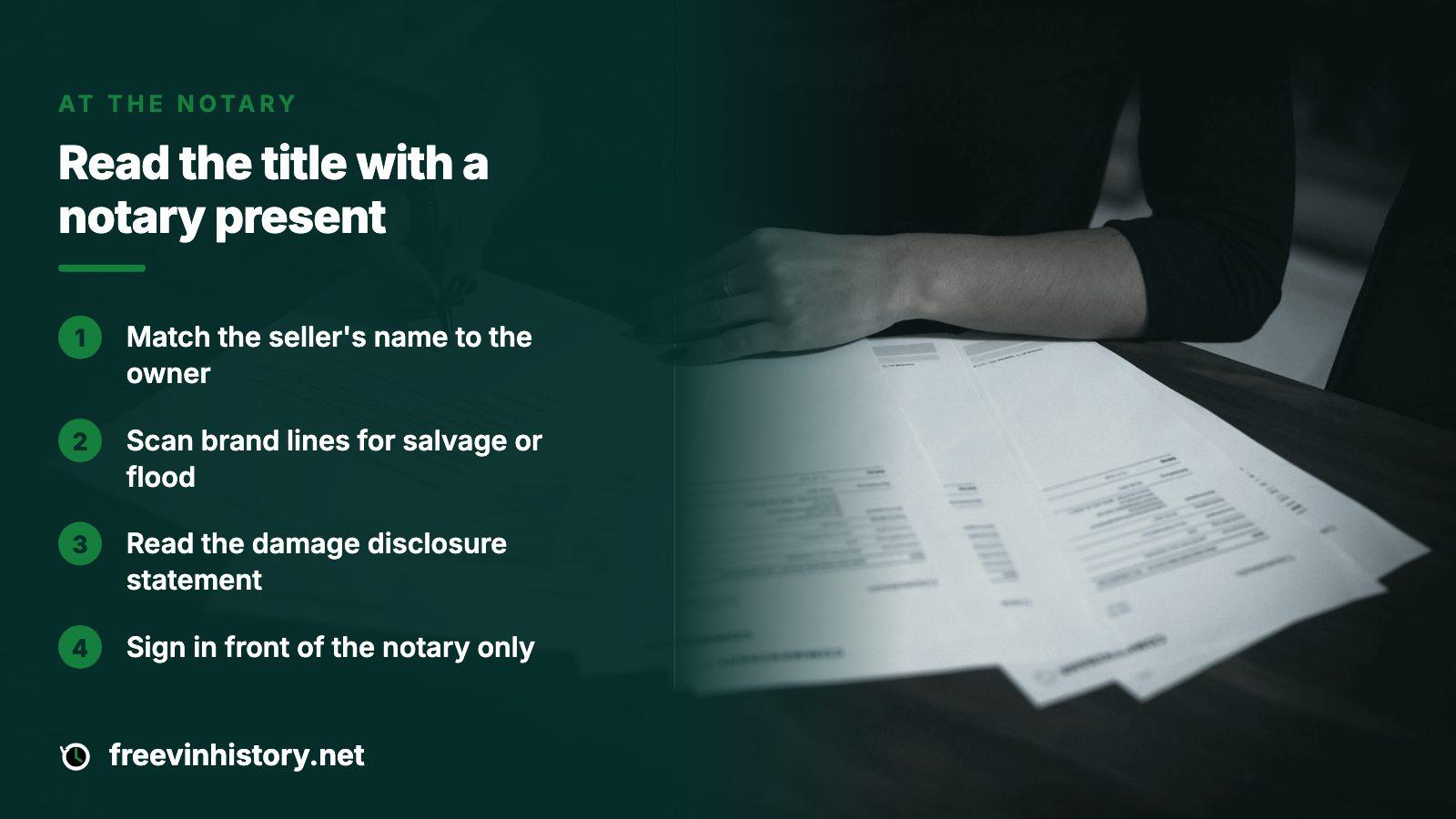
- Match the seller's printed name to the owner named on the front.
- Look at the brand lines for salvage, flood or similar wording.
- Confirm the seller completes the back, with a hand-printed name, the date and an odometer reading where required.
- Read the damage disclosure statement before anyone signs.
- Sign in front of the notary, not before.
A title is not a history
The paper shows what this state recorded. It cannot tell you what a previous state recorded, and it will not list an accident that never touched the title.
Step 6: request the DMV vehicle record, if the car warrants it
NCDMV sells vehicle records on form MVR-605A, in person at its Raleigh or Huntersville offices or by mail. In person, five or fewer records come back immediately. By mail, expect 10 business days from receipt. The listed fees are $16.75 for a certified copy covering previous owners and title paperwork, and $1.25 for the current registration details.
Federal law governs release. The Driver's Privacy Protection Act and a North Carolina statute close personal information to the public, with release to qualifying people and organizations. A casual buyer should not expect owner names from this route. For most purchases, the certified copy is a slow extra, useful when the paper trail itself looks doubtful.
The annual inspection is not part of the history
A car must pass a safety inspection before North Carolina registers it or renews the registration, within 90 days of renewal. In 19 counties an emissions test is added. The listed fees are $30 for the combined inspection and $13.60 for safety alone.
Passing proves the car met a checklist on one day. It does not search title brands, insurer flags or odometer records, so ask when the last inspection was done and still run the steps above.
What the free steps leave blank, and where a report fits
After six steps you know the car's identity, its open recalls, what insurers reported and what the NC paperwork says. You still have no view of accident records, the odometer trail across owners or titles from other states.
| Question | Free steps | Full report |
|---|---|---|
| Does the VIN match the listing? | Yes, decode | Yes, factory specs |
| Any open recalls? | Yes, NHTSA | Yes |
| Insurer theft or salvage flag? | Yes, NICB, member insurers | Yes, with title brand and auction records |
| Crashes and repair records? | No | Yes |
| Mileage trail across owners? | No | Yes |
| Titles from other states? | Only by reading paper | Yes, through NMVTIS data |
NMVTIS, the federal title system, is sold to the public through approved providers rather than as a free search.
The preview here carries no charge and hints at which record types exist for your VIN. Going further means one report purchase with nothing to cancel later; the pricing page has the going amounts.
Red flags that justify walking away
- A seller who will not meet at a notary or bank for the signing.
- Title and vehicle numbers that disagree.
- A salvage or flood result at NICB that the seller never mentioned.
- An open recall the seller says is not important.
- A price far below similar cars, with no explanation.
One of these means slow down. Two together mean walk.
Where this information comes from
- NCDMV: Vehicle Titles — Title assignment and notarization rules at transfer.
- NCDMV: Records and Reports — Vehicle record form, fees, offices and privacy law.
- NCDMV: Emissions and Safety Inspections — Inspection timing, counties and fees.
- NICB: VINCheck — What the free insurer search covers, its limits and its daily cap.
- NHTSA: Check for Recalls — What a VIN recall search shows and omits.
- NMVTIS: Consumer information — What the national title system records and why.
Sources and photos: Facts checked against the sources above in November 2026. Photos by John Kakuk, Dimitri Karastelev and Mustafa Sheikhmouss on Unsplash; diagrams by FreeVINHistory.
Keep reading
- Free VIN check through the DMV: what a state agency will and will not showWhat state motor vehicle agencies do and do not offer by VIN.
- Free open recall check by VIN: GM, Polaris and every other makeA closer look at recall searches and their gaps.
- Car title search by VIN free: what you can see before you payChecking title brands before you pay.
- Free flood check by VIN: what the free tools show and missSpotting water damage that records may miss.
Frequently asked questions
Is there a completely free VIN check for North Carolina cars?
There are free pieces: NHTSA's decode and recall search, and NICB's insurer lookup. Together they confirm identity, open recalls and insurer reports. They do not show accident history or titles from other states, so many buyers add a report after the free preview.
Does North Carolina require a notary on a title?
On a North Carolina title, NCDMV says the transfer must also be notarized, with both seller and buyer completing the back. Out-of-state titles follow that state's requirements. Do the signing inside a bank branch or notary shop, so the paperwork is finished on the spot.
Can I get a vehicle record from NCDMV?
Yes, through form MVR-605A, in person at Raleigh or Huntersville, or by mail. Fees listed are $16.75 for a certified copy and $1.25 for current registration details. Personal information is released only to qualifying requesters under federal and state privacy law.
Does passing NC inspection say anything about a car's past?
No. The inspection is a safety check, plus emissions in 19 counties, done within 90 days of renewal. It does not look at title brands, insurer flags or odometer records. Treat a fresh sticker as one small good sign.
What does the free preview on this site show?
It lists the record types found for a VIN ahead of any payment. After that the report is its own one-time purchase, and the pricing page shows the amounts.
Now check the car itself
The guide explains what to look for. The report shows what this VIN has on record.