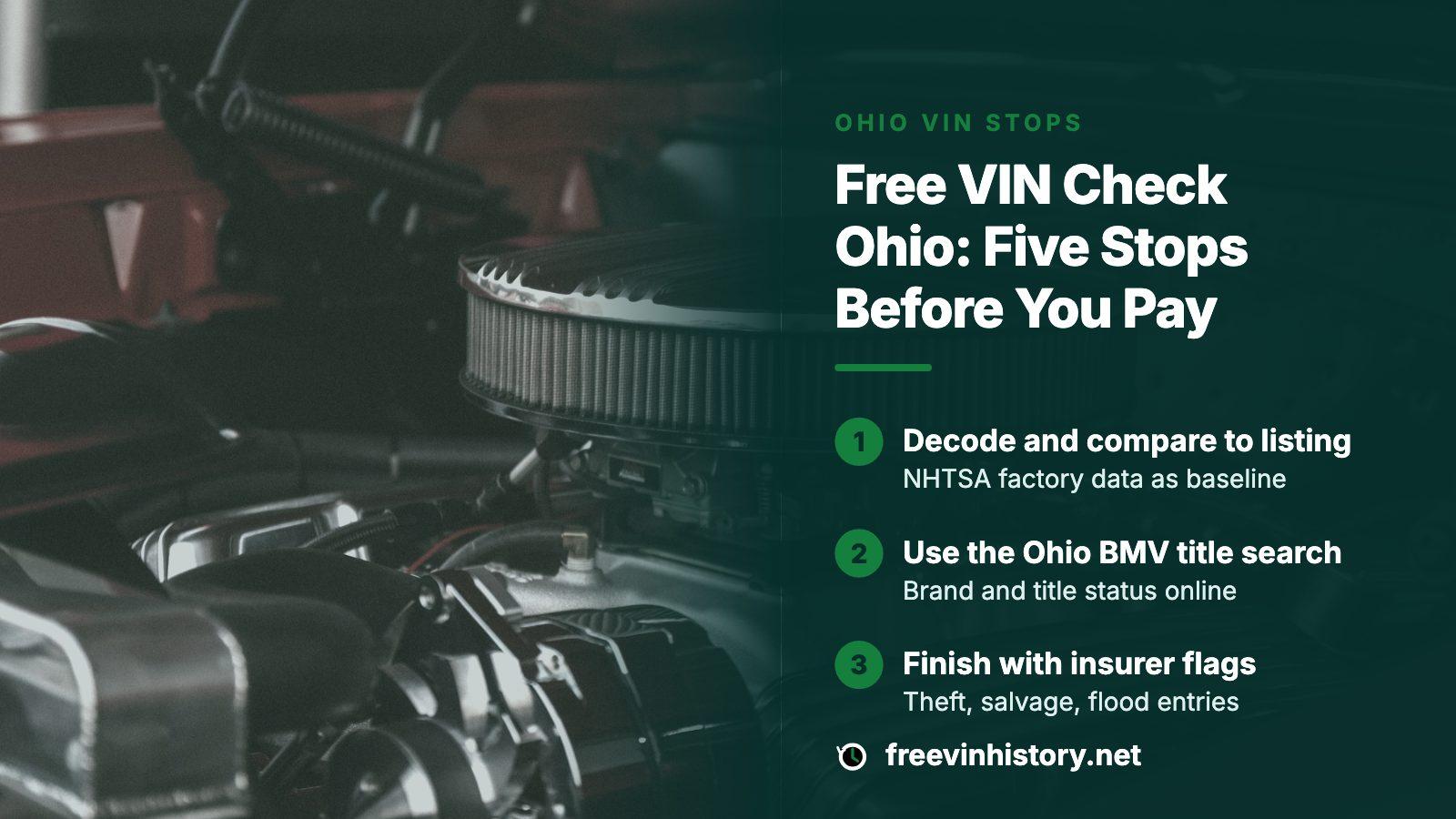
THE SHORT ANSWER
Mostly yes. Four lookups cost nothing: NHTSA's factory decode, the Ohio BMV's title search, a recall search and NICB's insurer database. They confirm what the car is, list its Ohio titles and any lien on file, flag open recalls and surface insurer theft, salvage or flood reports. They skip titles from other states, accident and repair records and auction photos. The preview on this site shows whether such records exist before you pay for a report.
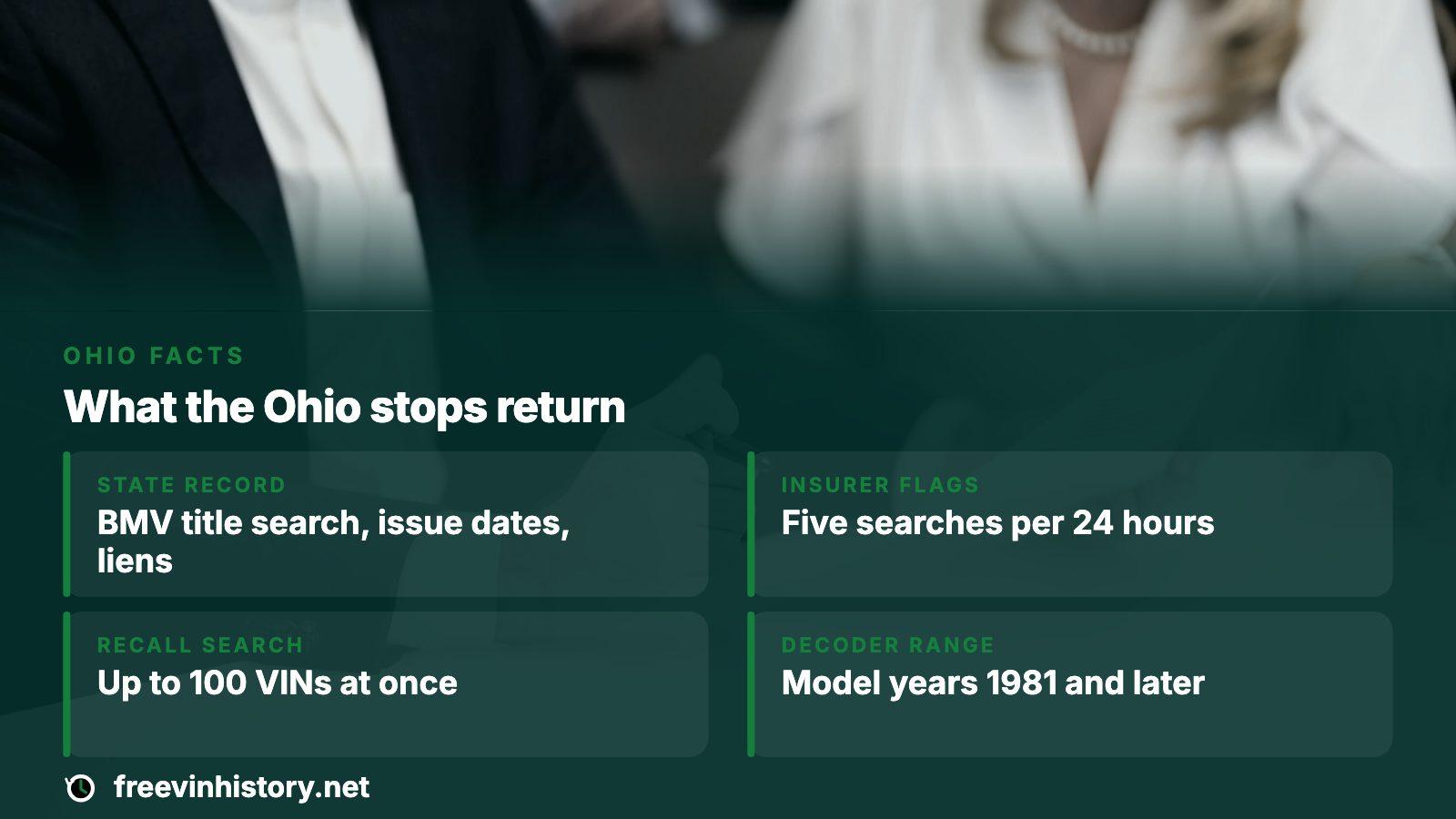
- State record
- BMV title search lists Ohio titles, issue dates, status and liens
- Insurer flags
- NICB allows five searches per 24 hours per IP address
- Recall search
- NHTSA takes up to 100 VINs at once
- Decoder range
- Model years 1981 and later
The five stops and what each one answers
Run them in order; each answer tells you whether the next lookup is worth the time. Every one comes from an agency or from the insurance-fraud nonprofit NICB, and none from a seller.
| Stop | Run by | What it answers | What it leaves out |
|---|---|---|---|
| 1. Read the VIN | You, from the car | The 17 characters every later lookup keys on | One misread character spoils the rest |
| 2. Factory decode | NHTSA vPIC | Model year, make, model, engine, build plant | Anything after the factory; years before 1981 |
| 3. Title search | Ohio BMV Online Services | Ohio titles, issue dates, status, any lien | Other states' titles, national brand data |
| 4. Recall search | NHTSA, also in BMV Online Services | Whether a safety recall is still unrepaired | Fixed recalls, small makers, non-safety campaigns |
| 5. Insurer flags | NICB VINCheck | Theft, salvage or flood reports from member insurers | Damage no insurer handled, police records |
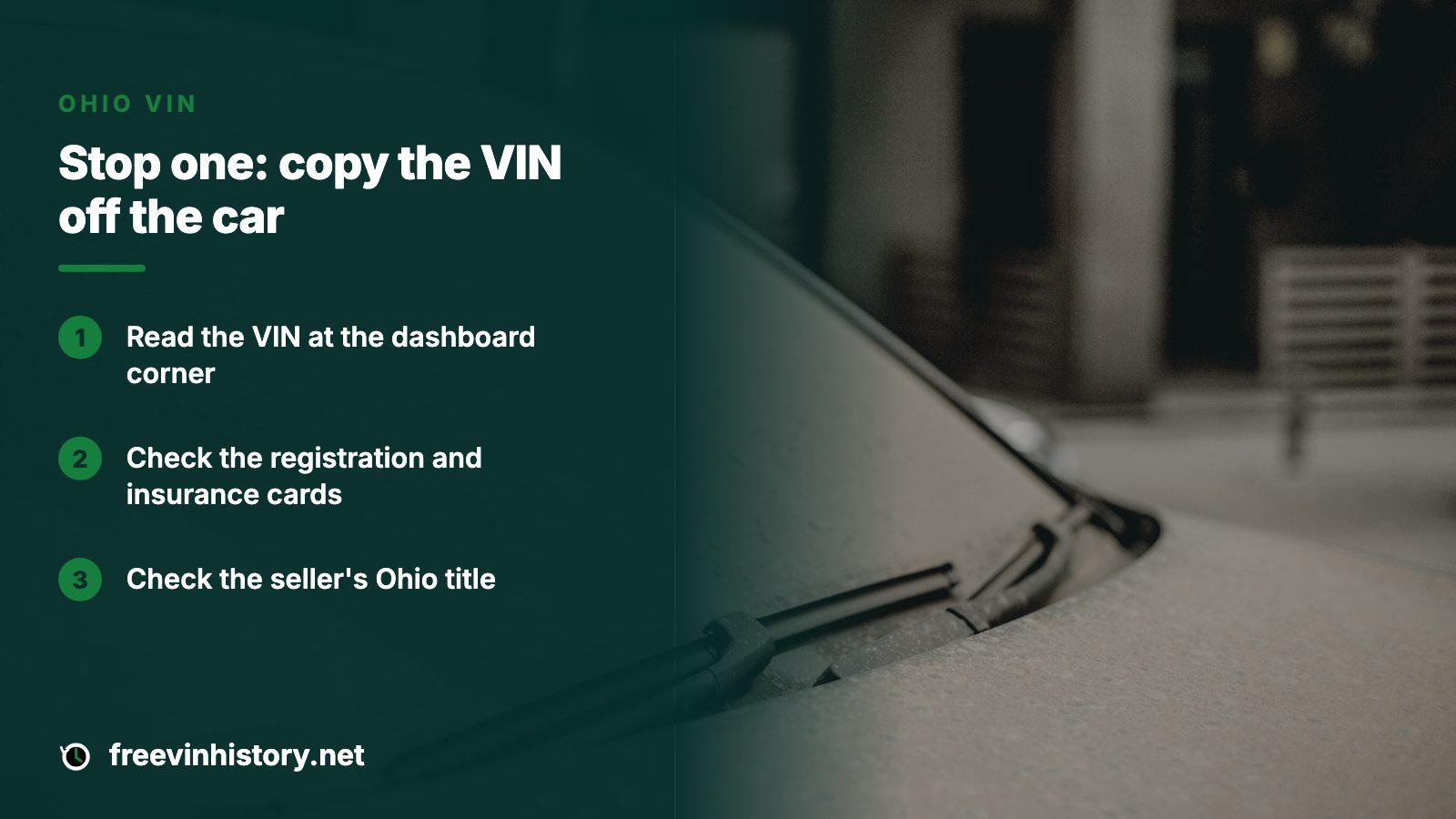
Stop one: copy the VIN off the car itself
- Lean in at the driver's corner of the dashboard, where it meets the glass, and write down the whole 17-character number.
- Check the registration card, and the insurance card if it lists the number.
- Check the seller's Ohio title. The Patrol's page says a VIN usually has no letter O and that S and 5 are easily confused.
Enter it twice, or photograph the plate and paste from the picture. NICB says a wrong VIN can hide a match, so a typo can reassure falsely instead of simply failing.
Stop two: decode it and compare with the listing
NHTSA's decoder returns what the manufacturer submitted for that VIN: model year, make, model, body class, engine, drive type and the assembly plant. Compare it with the listing, and settle any disagreement with the seller before price comes up.
It also works as a typo alarm. In a test through NHTSA's API, a sample VIN decoded clean with its ninth-position check digit accepted; the same number with one character altered returned error code 1 and a message that the check digit did not calculate. Model years before 1981 are refused.
A decode is not a history
The data is factory-reported. NHTSA says a label on the car may hold more, and that questions go to the maker. Nothing in it covers the car's life since assembly.
Stop three: the Ohio BMV title search
BMV Online Services has a title search with tabs for title number, VIN, hull number and motor number. A VIN search returns the vehicle line (the basics plus mileage, body type, condition and a mileage brand), then the Ohio titles on file. Every title row carries its issue date and shows whether it is still active. No payment step appears.
Open a title for the detail view: title type, owner count, county of residence, evidence type and any active lien with the lienholder's name. The BMV describes the page as a way to verify ownership, lien status and title history.
- Active lien: ask how and when the lender will release it before you pay.
- Several titles close together: ask what happened between the issue dates.
- Mileage brand: the record viewed read actual, so ask about anything else.
The BMV headlines the limits in capitals. Only Ohio-issued titles show, a title from another state stays invisible, and national brand data is withheld because agencies are prohibited from passing it to the public. When the seller's paper and the record disagree, the BMV's title office search finds the county clerk's office.
Stop four: recalls, through the BMV site or NHTSA
BMV Online Services also hosts a VIN recall search fed by NHTSA, so this stop can run without leaving the state's site. NHTSA's own page takes a plate and state too, but plate answers rely on DMV data and can describe an earlier owner's car. Use the VIN.
A clean answer shows zero unrepaired recalls. The search leaves out:
- Recalls already repaired, or new ones still waiting for VINs to be added
- Recalls past the 15-year mark, except where a maker stretches coverage
- Small manufacturers' recalls and maker campaigns that are not safety recalls
- Recalls on vehicles from other countries
Dealers do recall repairs for nothing, so an open recall is a task and a bargaining chip, not a verdict.
Stop five: insurer theft, salvage and flood flags
NICB's VINCheck asks whether a member insurer reported the car stolen and unrecovered, declared it salvage or logged flood damage. It caps searches at five per IP address within 24 hours, so run the finalists, not every ad.
Its members account for 92.49 percent of earned premium in the U.S. Only insurance records appear: no police files, no insurers that opted out, no damage that never became a claim. NICB says a clean result is no guarantee.
A salvage hit means an insurer paid a total-loss claim because repair costs passed a set share of the car's value. NICB notes such cars can lawfully be rebuilt and retitled, so treat a hit as a prompt to dig, not a rejection.
Reading the five answers together
- Decode disagrees with the ad: ask for the title and registration before going on.
- Lien on the BMV record: get the lender's release plan in writing before paying.
- NICB salvage or flood hit but a plain Ohio title list: the BMV sees Ohio only, and states brand differently, so move to a title-history report.
- Open recall: book a dealer repair and raise it in the price talk.
- All five clean: a short list of problems is ruled out, though the FTC still calls an independent inspection a good idea.
Clean is not clear
The Justice Department calls a clean national title report a good thing, then warns that reporting gaps can produce false negatives. Every free lookup here carries the same caveat.
When the car is an Ohio rebuild
The Highway Patrol schedules salvage inspections through an online gateway, and a counter there reads 54,127 inspections for 2025. An owner brings:
- A prepaid receipt from a deputy registrar, costing $50 plus registrar's fees
- An Ohio title showing the owner's name on its front (assigned titles are turned away)
- Original receipts for each replaced part, showing the donor car's VIN where parts were used
- Notarized receipts for parts bought from a casual seller instead of a licensed parts dealer
The car also has to meet Ohio Revised Code section 4513 for highway use. The checklist reads as paperwork and parts receipts, with no promise about repair quality. Ask the seller for those receipts and hire an independent mechanic.
Where the free route ends and a report begins
Three gaps remain after the five stops. The BMV record ends at Ohio's border. National brand and salvage data comes from an approved provider's report, not the BMV page. And none of the stops lists accident or repair records or auction photos. NICB says full reports pull from DMV title files, auction listings and service records.
That is where the preview on this site fits: type in the VIN and it shows, at no cost, whether the car has title, accident, mileage or auction entries on file. The pricing page lists the amounts, and a report is bought once. Use it on the one car you would buy, before any deposit.
Where this information comes from
- Ohio BMV Online Services: Title search — What the VIN search lists, its Ohio-only limit and the NMVTIS restriction on public results.
- Ohio State Highway Patrol: Vehicle Inspection Gateway — The salvage inspection paperwork, the receipt fee and the VIN reading tip.
- NHTSA: Check for recalls — What a VIN recall search shows and the categories it leaves out.
- NHTSA: VIN decoder — Manufacturer-reported data, the build plant line and the 1981 cutoff.
- NICB: VINCheck lookup — Search limit, insurer coverage share and the limits NICB states.
- U.S. Department of Justice: NMVTIS for consumers — How states differ on brands and why a clean search can still be a false negative.
- FTC: Used cars — The case for a history report plus an independent inspection.
Sources and photos: Facts checked against the sources above in November 2026. Photos by Victor Hughes, JavyGo and Carrie Allen www.carrieallen.com on Unsplash; diagrams by FreeVINHistory.
Keep reading
- Car title search by VIN free: what you can see before you payThe title side of the picture, beyond what Ohio's own search lists.
- Rebuilt title check free: what you can learn before payingHow to check a rebuilt brand before you agree on a price.
- Free open recall check by VIN: GM, Polaris and every other makeA closer look at what a recall search can and cannot show.
- NMVTIS report: what the federal title record shows and missesThe national title record the Ohio BMV cannot show you directly.
Frequently asked questions
Does Ohio have an official VIN lookup that costs nothing?
In part. BMV Online Services offers a title search by VIN listing Ohio titles with issue dates, status and any lien, and shows no payment step. It covers Ohio titles only, and national brand data is withheld from the public. A recall search sits on the same site.
Can I run an Ohio plate number instead of a VIN?
The BMV title search has tabs for title number, VIN, hull number and motor number, but none for a plate. NHTSA's recall search accepts a plate and state, yet plate results trace to DMV data and may name an earlier owner's car. The VIN names the car in front of you.
If NICB shows nothing, is the car clean?
No. VINCheck holds only what participating companies reported about thefts, salvage declarations and flooding. Police files, uninsured damage and titles from other states can be missing. NICB says a clean result is no guarantee, so count it as one box ticked.
Do the free lookups show accidents or past mileage?
Not accidents. The BMV result prints one mileage figure and a mileage brand, and none of the five stops lists accident or repair records. A history report is the usual source for those, per the FTC.
What does it cost to go beyond the free lookups?
No fee applies to the preview on this site, which shows whether records exist. A report is paid once, with packs for several cars and nothing recurring; the pricing page has the amounts.
Now check the car itself
The guide explains what to look for. The report shows what this VIN has on record.