THE SHORT ANSWER
Partly. Two lookups cost nothing: NHTSA's recall search and NICB's insurer lookup, and the title in the seller's hand adds Oregon's brand box. Anything deeper from the state is a fee-based certified letter for requesters who qualify, and an NMVTIS report carries a provider's fee. The preview on this site shows which accident, mileage and auction records exist for the VIN before any payment.
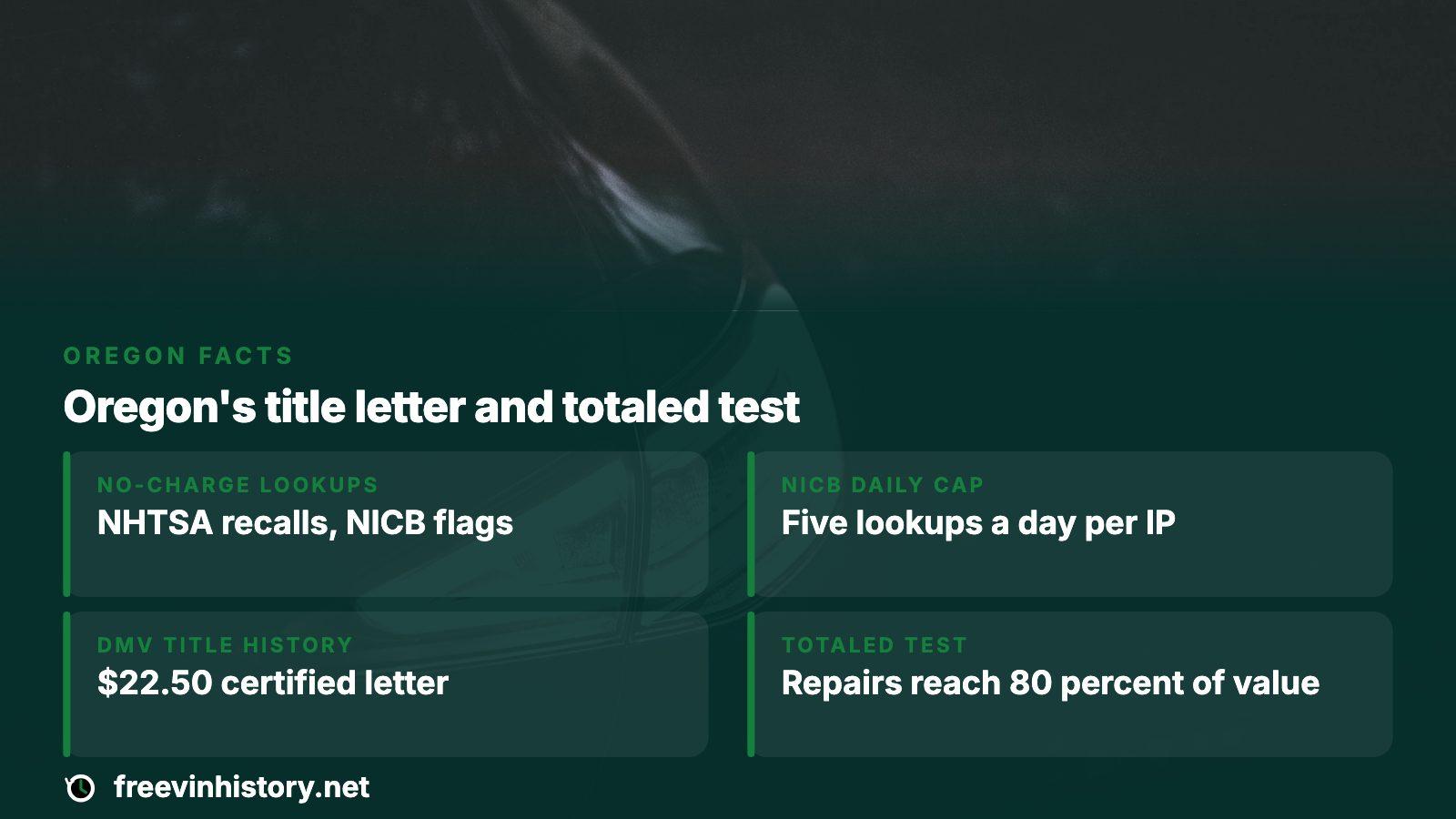
- No-charge lookups
- NHTSA recalls and NICB theft, salvage and flood flags
- NICB daily cap
- Five lookups a day from one IP address
- DMV title history
- $22.50 certified letter, for requesters who qualify
- Oregon totaled test
- Uninsured damage counts once repairs reach 80 percent of pre-damage value
The five steps, what each costs and what each can miss
Fees start at step five, and the paid report comes last.
| Step | Cost | What it shows | What it misses |
|---|---|---|---|
| 1. VIN on the car against the title | None | Whether the paperwork belongs to this car | Anything about its past |
| 2. NHTSA recall search | No charge | A safety recall still waiting for repair | Repaired recalls, small makers, non-safety campaigns |
| 3. NICB VINCheck | No charge, capped per IP address | Theft with no recovery, salvage or flood reports from member insurers | Police files, non-member insurers, damage nobody claimed |
| 4. Brand box on the Oregon title | None | Totaled, reconstructed, replica and state-named brands | Repairs, mileage trail, earlier owners |
| 5a. DMV certified letters | $22.50 title history, $14 previous owner, $25 odometer | Prior owners, title transactions, odometer readings given to DMV | Repair detail and auction photos are not listed |
| 5b. NMVTIS report | Provider's fee | Brand history, latest odometer reading, insurer total-loss entries | Short by design, and can read falsely clean |
| Then: full report | Preview at no charge, then one payment | Accident, damage, mileage, auction and lien records for one VIN | Damage that was never recorded anywhere |
Step 1: confirm the VIN before running anything
Every later step runs on that number. NICB notes that a wrong VIN can leave a real record unmatched, and Oregon's DMV asks buyers to check that the title's VIN matches the vehicle and that each owner and lienholder has released interest.
- Photograph the 17 characters printed near the bottom-left corner of the windshield glass, then check them against the registration card or an insurance card.
- Compare the photo with the title and the listing, character by character.
- When the title does not carry the seller's name, ask for a bill of sale instead. It needs the VIN, a statement releasing interest, a printed name, a signature and a date, or DMV will turn it away.
Steps 2 and 3: the two lookups that cost nothing
NHTSA's recall search says whether a maker's safety recall on this exact VIN is still waiting for repair. A clean answer reads 0 unrepaired recalls. Left out: recalls already repaired, small manufacturers' campaigns, and safety recalls past the 15-year mark, barring extended coverage.
NICB's VINCheck compares the VIN with theft, salvage and flood reports filed by participating insurers. It flags a car reported stolen and never recovered, or one declared salvage or flood-damaged. Expect a ceiling of five searches daily from any one IP address, so ration them for serious candidates. Police files are not searched, and NICB itself says a clean answer is no guarantee.
Step 4: read the brand box on the Oregon title
Oregon prints brands in a Title Brands box and repeats them on the registration card. The vocabulary is short:
- Totaled: the car met the state's total-loss definition.
- Reconstructed: a common label for a collision-damaged car that was repaired and re-titled.
- Replica or assembled: a body built to copy another model, or one that resembles no model in particular.
- Branded, Flood or Lemon Law followed by a state name: a brand another state applied, carried onto the Oregon title.
- Lemon Law Buyback: the manufacturer repurchased the car because of a defect, under Oregon's consumer warranty law.
Look for reconstructed, not rebuilt
A repaired Oregon wreck reads reconstructed. Oregon has no flood brand of its own: a car flooded in the state that met the totaled test is simply Totaled, while a Flood label with a state name came from elsewhere. Oregon titles also leave out taxi, rental and police use, so those histories need another source.
Why Oregon's totaled test reaches past the insurance claim
Oregon calls a vehicle totaled in three situations: an insurer declares the loss or takes the car or its title; a stolen vehicle stays missing for 30 days with no insurer covering it; or damage nobody insured would cost at least 80 percent of the car's pre-damage retail value to fix. Retail value is judged from the publications Oregon lenders use.
The third route matters because NICB reports only what an insurer recorded. A wreck paid for out of pocket leaves no insurer record, yet it can still be totaled under state law, and the owner is supposed to surrender the title within 30 days. A salvage title cancels registration, and the car stays off Oregon roads, trip permits aside, until it is re-titled.
Step 5: what DMV letters and NMVTIS add, and what they cost
DMV sells certified letters, but every requester must qualify under the state's records privacy law or be denied with the payment returned. Confirm your request qualifies before paying. Three letters matter to a buyer: title history at $22.50 lists every title transaction including prior owners; previous owner information costs $14 and covers the last transaction; and the odometer history search costs $25, returns readings given to DMV since 1986 and is charged even when nothing turns up.
Approved providers sell its report for their own fee, covering brand history, the latest odometer readings, insurer total-loss decisions and hand-offs to salvage or junk yards. The Justice Department calls it short by design, built on five key indicators, and says a search can come back clean because some reporters have not filed yet. Oregon DMV may brand a car from this record, and will not title one showing PARTS, CRUSHED or SCRAP unless the same reporter later logged a sale.
Where the free steps stop and what the preview adds
None of the no-charge sources shows auction photos or accident repairs, and only the DMV letter lists more than the latest odometer reading. NICB says complete reports pull from a wider pool, including DMV titles, auction sales and service records. A mechanic's independent inspection still belongs on the list.
Begin with the preview on this site: type in the VIN and see which accident, mileage, auction, lien and theft records exist, at no charge. If the car passes, a full report is a single payment for that VIN, or a bundle of 3, 5 or 10 when comparing several cars. Nothing auto-renews. Rates are on the pricing page.
Before money changes hands: the DMV's own checklist
- A title carrying the car's VIN, with the seller as owner and every lienholder released.
- A signed odometer disclosure when the car is a 2011 model or newer and under 20 years old.
- Proof the loan is gone, since Oregon says a car with an unpaid loan cannot be sold.
- A title application filed no later than 30 days after the sale. DMV keeps listing the seller as owner until the title moves into your name, even after the seller reports the sale.
A junk-type word on another state's title, such as crushed, scrap, parts only or wreck, can mean Oregon will not title the car at all. Treat it as a reason to walk away.
Where this information comes from
- Oregon DMV: Buying or selling a vehicle — Supports the DMV's buyer checklist, the 30-day title deadline, the loan rule and the odometer disclosure.
- Oregon DMV: Abandoned, stolen and totaled vehicles and title brands — Supports the brand vocabulary, the missing flood brand, what titles leave out and the junk wording.
- Oregon DMV: Title and Registration Handbook, chapter J — Supports the three totaled routes, the reconstructed label, salvage title effects and NMVTIS branding.
- Oregon DMV: Available records and fees — Supports the certified letters, their fees and the qualification rule.
- U.S. Department of Justice: NMVTIS for consumers — Supports what an NMVTIS report holds and where it can miss.
- NICB: VINCheck lookup — Supports the insurer-only scope, the daily search cap and the clean-result caution.
- NHTSA: Check for recalls — Supports what the VIN recall search shows and leaves out.
Sources and photos: Facts checked against the sources above in November 2026. Photos by Tigran Shishmanyan, Scott Graham and Maurice Sahl on Unsplash; diagrams by FreeVINHistory.
Keep reading
- Free VIN check through the DMV: what a state agency will and will not showHow state motor vehicle agencies answer a request for a free VIN check.
- Free salvage title check by VIN: what the free lookups showMore on spotting a salvage history before you pay.
- Rebuilt title check free: what you can learn before payingWhat a rebuilt or reconstructed title means for a buyer.
- Free open recall check by VIN: GM, Polaris and every other makeReading the recall results in more detail.
Frequently asked questions
Is there a completely free VIN check for Oregon cars?
Not one that covers everything. NHTSA's recall search and NICB's insurer lookup cost nothing, and the title's brand box is yours to read. DMV letters carry fees and go to requesters who qualify, and NMVTIS reports carry a provider's fee. The preview on this site shows which deeper records exist.
Does Oregon DMV offer a VIN lookup of its own?
DMV's buying tips send buyers to NHTSA, NICB and NMVTIS rather than to a lookup of its own. Its records page lists certified letters for fees, $22.50 for title history and $25 for the odometer search, and refunds requesters who do not qualify under state privacy law.
If NICB shows nothing, can the car still have been totaled?
Yes. NICB searches only participating insurers' records, so a car repaired privately or insured elsewhere can come back clean. Oregon's own definition reaches uninsured damage whose repairs would run to at least 80 percent of the car's earlier value, so read the title's brand box too.
Is a reconstructed brand a bad sign on an Oregon car?
It is a repaired-wreck label, not a verdict. DMV says the word often covers cars that were damaged or totaled in a crash and then repaired. Ask for the repair invoices, have a mechanic inspect the frame, and expect the title to show the frame's VIN with the original body year, make and model.
How soon must a private buyer title the car in Oregon?
Oregon DMV allows 30 days from the sale date. Until the title is transferred, DMV still lists the seller as owner, even after the seller reports the sale within 10 days, so do not wait. A 2011 or newer car under 20 years old also needs a signed odometer disclosure.
Now check the car itself
The guide explains what to look for. The report shows what this VIN has on record.