THE SHORT ANSWER
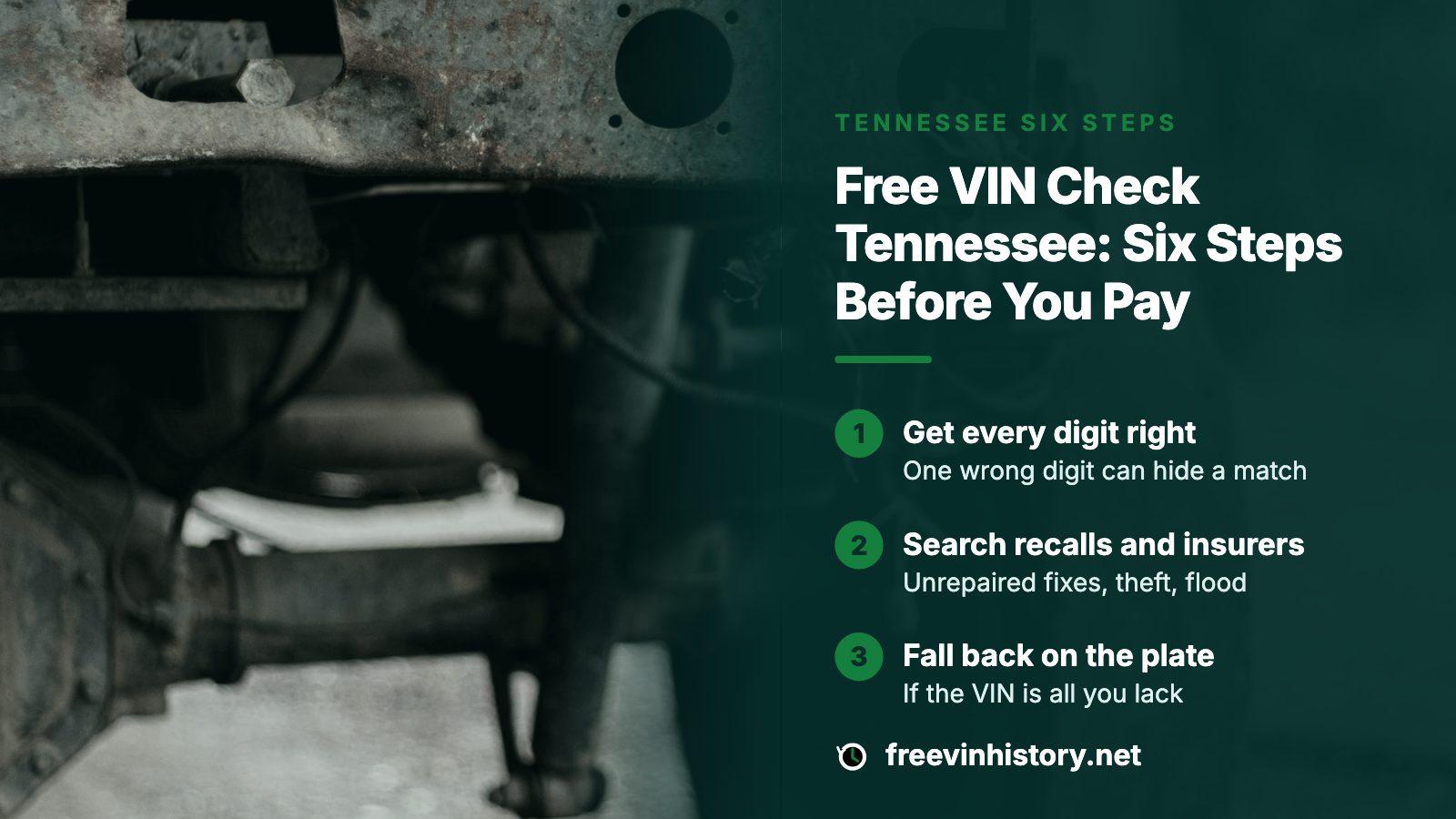
Partly. Two lookups cost nothing and work on any Tennessee vehicle: NHTSA's recall search and NICB's VINCheck. One shows an unrepaired recall, the other an insurer's theft, salvage or flood record. Neither shows accident repairs, owner-by-owner mileage or auction photos. Our preview shows which of those exist for your VIN; the report after it is one payment.
- Free lookups
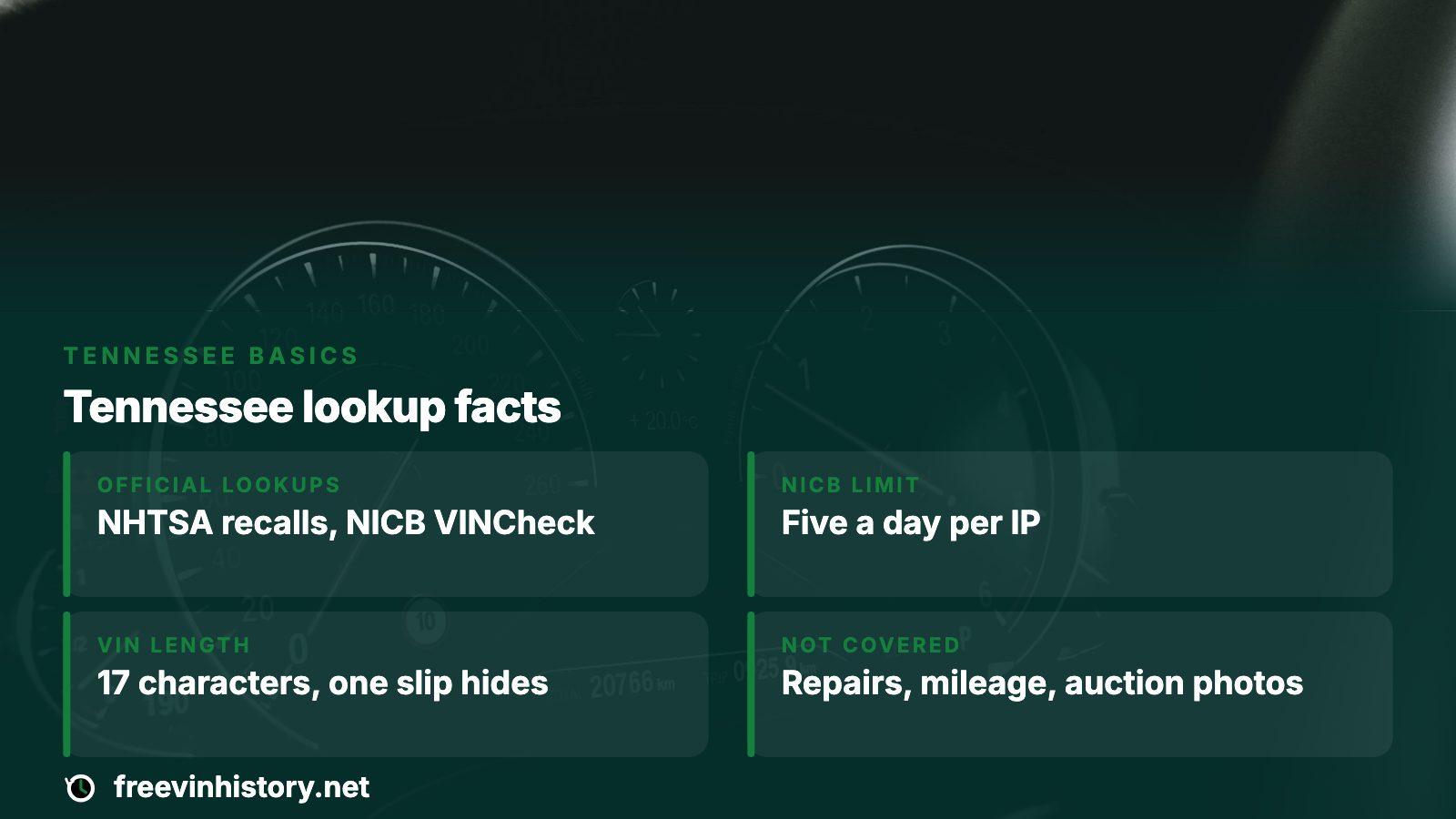
- NHTSA recalls and NICB VINCheck
- NICB limit
- Five lookups daily per IP address
- VIN length
- 17 characters, and one wrong digit can hide a match
- Not covered
- Repairs, owner mileage, auction photos
The six steps at a glance
Tennessee buyers get the best result by running the same short sequence on every car, cheapest lookup first. Each step either clears the car for the next one or ends the shopping. The rest of this page takes the steps one at a time.
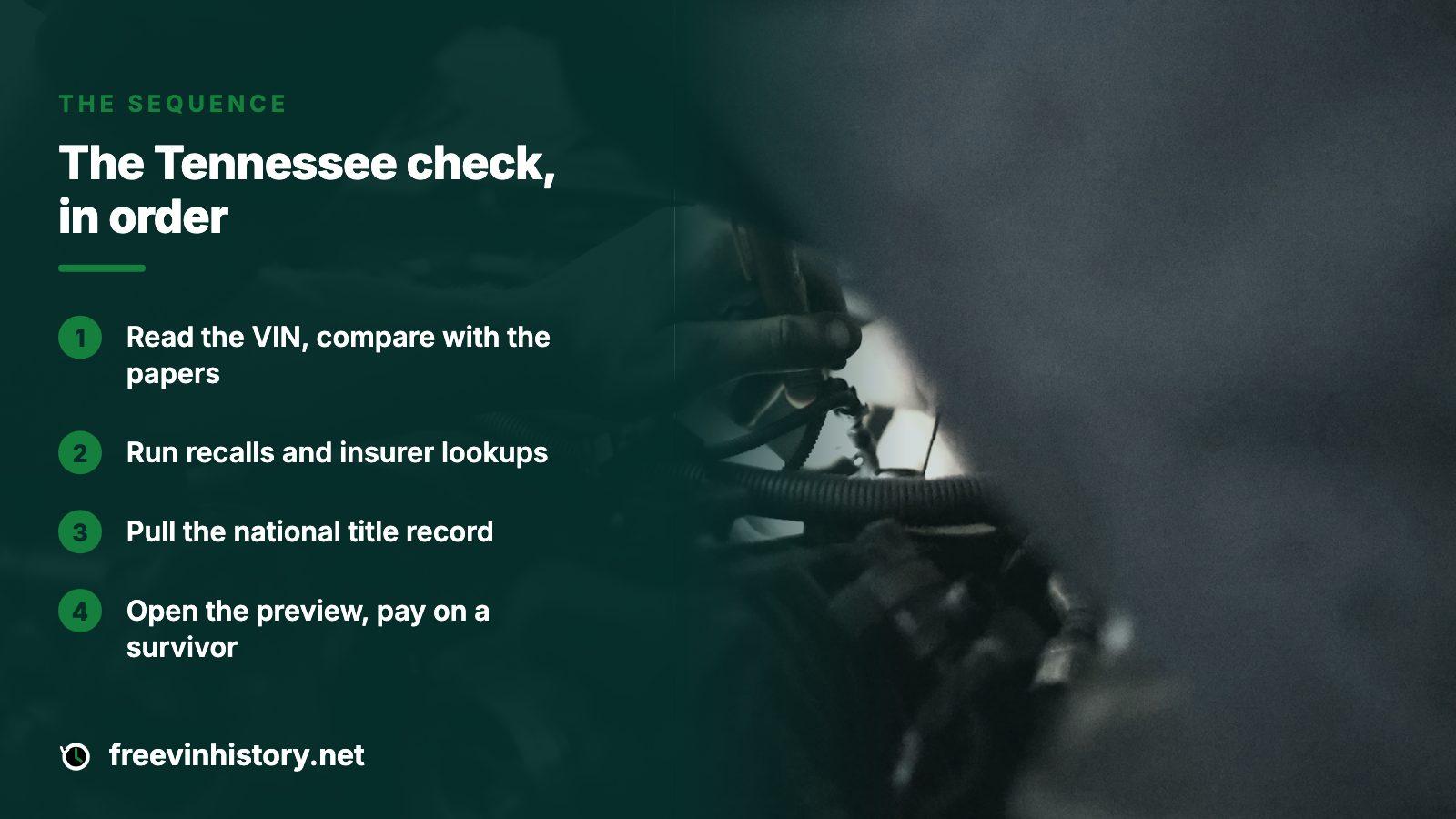
- Read the VIN off the vehicle and compare it with the seller's papers.
- Run the federal recall search.
- Run the insurers' theft, salvage and flood lookup.
- Pull the national title record and read the brands.
- Open this site's preview to see which other record types exist.
- Pay for the full report on a survivor of the first five.
Step 1: get the number right
Everything downstream depends on seventeen characters typed correctly. NICB says plainly that a wrong digit may mean no match is found, which looks exactly like a clean result. That is how a bad car passes a lazy check.
NHTSA gives the bottom-left corner of the glass as one spot; the registration card lists it too, and the insurance card might. Read the windshield copy yourself rather than trusting a typed listing, then compare it with the paperwork the seller hands you. If the two disagree, stop there and ask why.
A mismatch is the finding
Paperwork that does not match the car is a bigger problem than any record you could pull. Do not run further lookups on a number you cannot confirm on the vehicle.
Step 2: the recall search
Enter a VIN on NHTSA's page and it reports whether the car has a recall that was never repaired. With none open, it says so with a message reading zero unrepaired recalls for that VIN. The search is free, and the same page can check up to 100 VINs in one go, handy if you are comparing a shortlist.
Know the blind spots. Gaps: finished repairs, very recent recalls with VINs still being added, small-volume makers, and anything older than 15 model years unless the maker extends coverage. Non-safety service campaigns are not included either. An older Tennessee truck with a clean result may simply be too old to be listed.
Treat an open recall as a bargaining chip rather than a deal-breaker, since the maker handles the repair. Ask for the work to be done before you sign.
Step 3: theft, salvage and flood from the insurers
NICB's VINCheck asks whether participating insurers reported the car stolen and not recovered, or declared it salvage or flood-damaged. It is free. NICB limits every IP address to five searches inside a day, so run your shortlist in one sitting and jot the VINs down.
| Result | What it means | What to do |
|---|---|---|
| Stolen, not recovered | An insurer reported the car as taken | Do not buy; contact the police |
| Salvage | An insurer paid a total-loss claim | Request repair paperwork and a shop inspection |
| Flood | An insurer recorded water damage | Treat as a serious red flag |
| No record | Nothing from participating insurers | Not a guarantee; keep going |
NICB admits the tool reads only member insurers' files, skips police records, and should not be your sole safeguard. A car that was damaged and never claimed on will look spotless here.
Step 4: the national title record
The federal NMVTIS program is the usual way to see a car's title brands across state lines, which matters for a Tennessee car that spent time elsewhere. A report shows the current title's brand history, the latest reported odometer reading, any insurer salvage or total-loss determination and transfers to salvage yards, sometimes with theft data and a link to the state's full title record.
The program's own page lists limits worth repeating. A report holds less than the state's own file, a search can return a false negative, and Tennessee's brand rules are not the same as its neighbors', so a brand recorded elsewhere may not appear here. It also warns that a total-loss label can land on a recovered car in good shape.
Tennessee's own agency pages would not open for me while preparing this guide, so I cannot state its title lookups, fees or forms. Check the state's current options directly before relying on them.
Step 5: what the preview adds
After the free lookups, the question is what is still unknown. Mileage history, accident records and auction photos are what NICB says wider reports draw from, alongside DMV title records. The preview is free and names which record categories exist for that VIN before any money changes hands, which tells you whether this Tennessee car has a history worth buying.
| Question | Free lookups | Full report |
|---|---|---|
| Open recall? | Yes, NHTSA | Yes |
| Insurer salvage or theft flag? | Yes, NICB | Yes |
| Title brands from other states? | Via NMVTIS | Yes |
| Crash and damage entries? | No | Yes |
| Odometer readings over time? | Latest reading only | Yes |
| Auction photos? | No | Yes |
Step 6: when paying makes sense
Only a car that survived steps one through four deserves money. It is a single payment with no repeat charge, and the pricing page spells out the options. Anyone comparing several cars can take a multi-report pack, since each VIN needs its own report.
- The VIN matches the car and the paperwork.
- No open recall, or the dealer will fix it first.
- No insurer flag, and the title brands look clean.
- You are ready to put down a deposit if the report is clean.
Even a clean report is a screen, not an inspection. Pair it with a drive and a mechanic's look before the money moves.
If all you have is a plate
NHTSA's recall page does offer a plate search, which pulls the vehicle from state motor vehicle records and can show an old owner's car if the plate moved. That is a recall tool, not a title check. Ask the seller for the VIN instead, or read it off the windshield, and run the steps above.
Where this information comes from
- NICB: VINCheck lookup — Covers what the free insurer lookup checks, its daily limit and its stated gaps.
- NHTSA: Check for recalls — Supports where the VIN sits and what the recall search leaves out.
- NMVTIS: Consumer information — Lists what a title report shows and where it can miss.
Sources and photos: Facts checked against the sources above in November 2026. Photos by Zoshua Colah, Mustafa Sheikhmouss and Viktor Theo on Unsplash; diagrams by FreeVINHistory.
Keep reading
- Free VIN check through the DMV: what a state agency will and will not showHow state agencies in general answer a free VIN check request.
- Car title search by VIN free: what you can see before you payThe title lookups worth running on any car.
- Free salvage title check by VIN: what the free lookups showWhat a salvage result means and how to follow it up.
- Free open recall check by VIN: GM, Polaris and every other makeA closer look at the free recall search and its gaps.
Frequently asked questions
Is there a free VIN check for Tennessee cars?
Two national ones, and both accept a Tennessee VIN. The recall page lists open safety recalls; VINCheck lists theft, salvage and flood losses that member insurers reported. Repair and mileage history sit outside both, and that gap is where a paid report begins.
What is the daily limit on NICB VINCheck?
Five searches are allowed per IP address within any 24-hour window. Searches are unlimited over time, so a long shortlist can be split across days. Keep a note of each VIN and its result so you do not spend a search twice on the same car.
If NICB shows nothing, is the car fine?
No. NICB states that a clean result does not guarantee a clean history. The tool reads only participating insurers' records, so damage that was never claimed, or a loss at a non-participating insurer, will not appear. Treat a clean result as one step, then check title records and inspect the car.
Why does a wrong digit matter so much?
The search matches the exact 17-character VIN. NICB warns that an incorrect VIN may produce no match, which reads the same as a clean result. Copy the number from the windshield, compare it with the paperwork and double-check each character before you search.
What does a full report show that the free checks miss?
Crash and damage entries, mileage readings across several dates, auction listings with photos, and title events from other states. NICB describes wider reports as pulling in title files, auction sales and maintenance entries. Free steps come first.
Now check the car itself
The guide explains what to look for. The report shows what this VIN has on record.