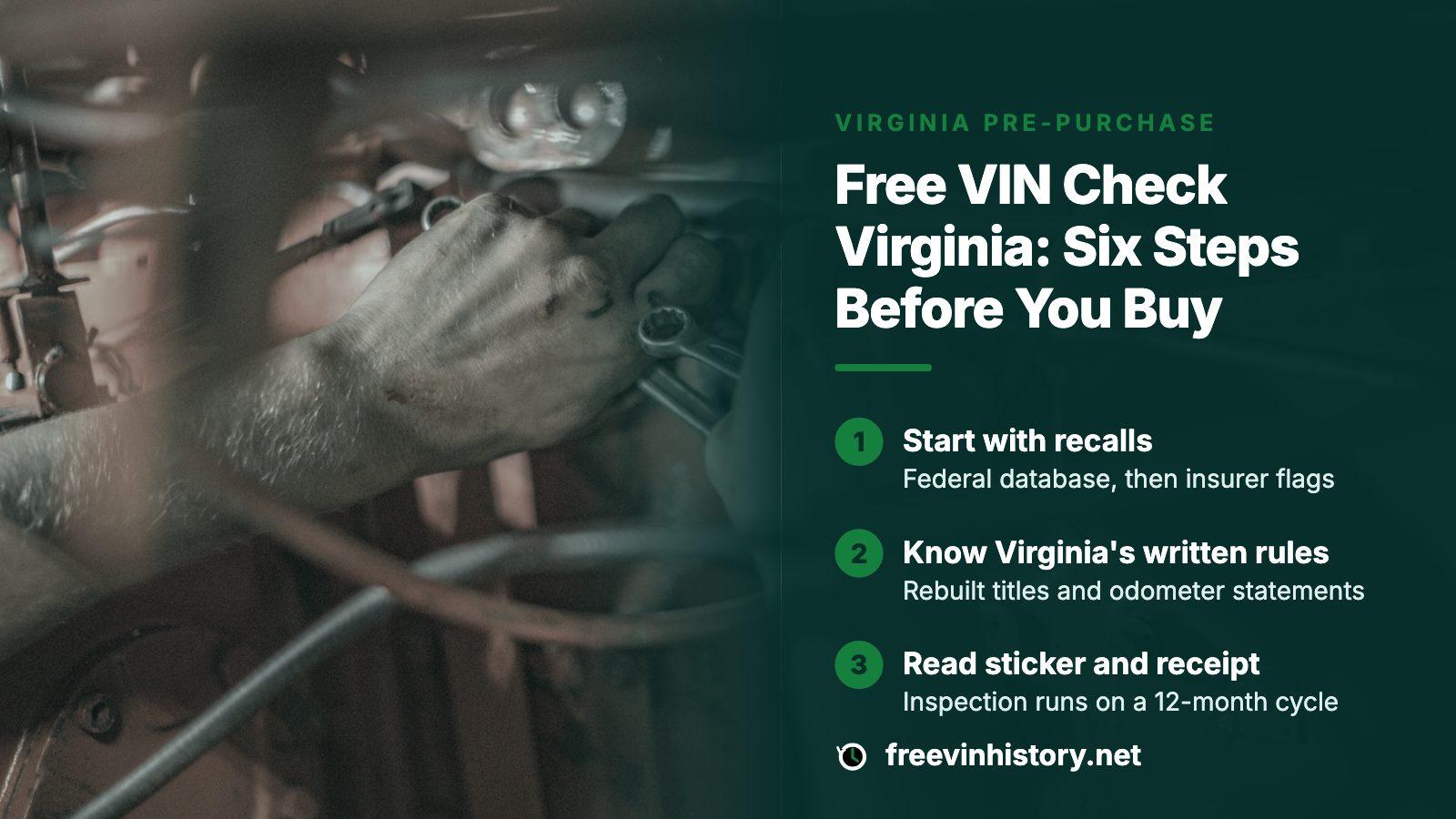
THE SHORT ANSWER
Virginia has no single free tool that returns a full history. The free pieces are NHTSA's recall search, the NICB database of insurer theft and salvage reports, and a VIN decode. Add the state's rules on rebuilt titles, odometer statements and safety inspections, and you cover a lot. Title brands from other states, mileage readings and damage records need a full report, and the preview on this site shows whether such records exist.
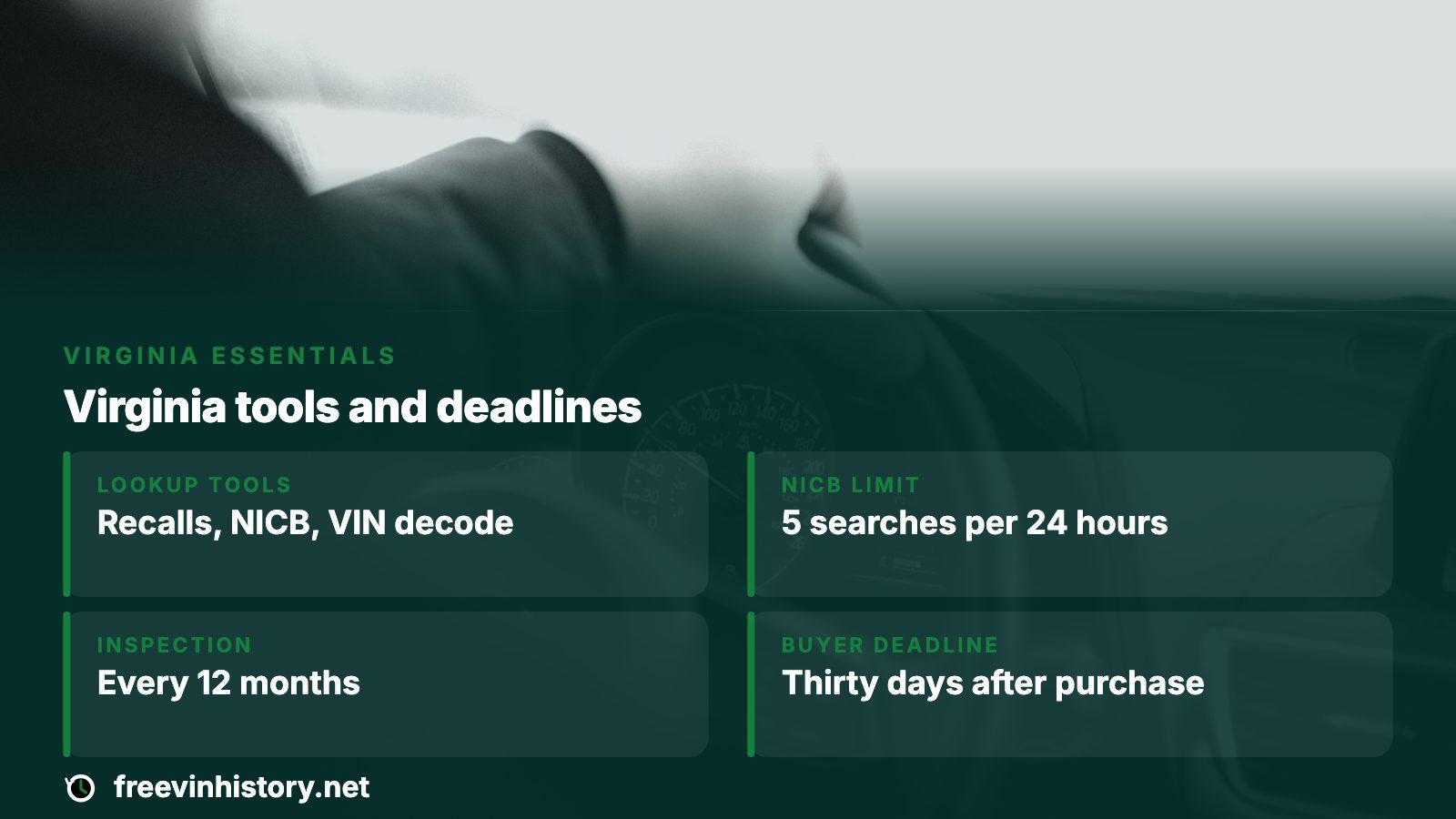
- Free tools
- NHTSA recalls, NICB VINCheck, VIN decode
- NICB limit
- 5 searches per 24 hours per IP address
- Inspection
- Every 12 months at an official station
- Buyer deadline
- Thirty days after purchase
The six steps at a glance
Work through these in order and stop the moment one of them raises a flag. Each step costs nothing except the last, and only one of them needs an internet connection beyond a browser.
| Step | What you do | What it settles |
|---|---|---|
| 1 | Copy the VIN and compare it in three places | Whether the car matches its paperwork |
| 2 | Search NHTSA for open recalls | Safety defects the maker still owes a fix for |
| 3 | Search NICB VINCheck | Theft and salvage reports from member insurers |
| 4 | Decode the VIN | Whether the listing describes the right car |
| 5 | Read the title and the inspection record | Rebuilt brands, odometer statement, sticker date |
| 6 | Judge whether a full report earns its cost | Everything the free tools cannot see |
Step 1: get a VIN you can trust
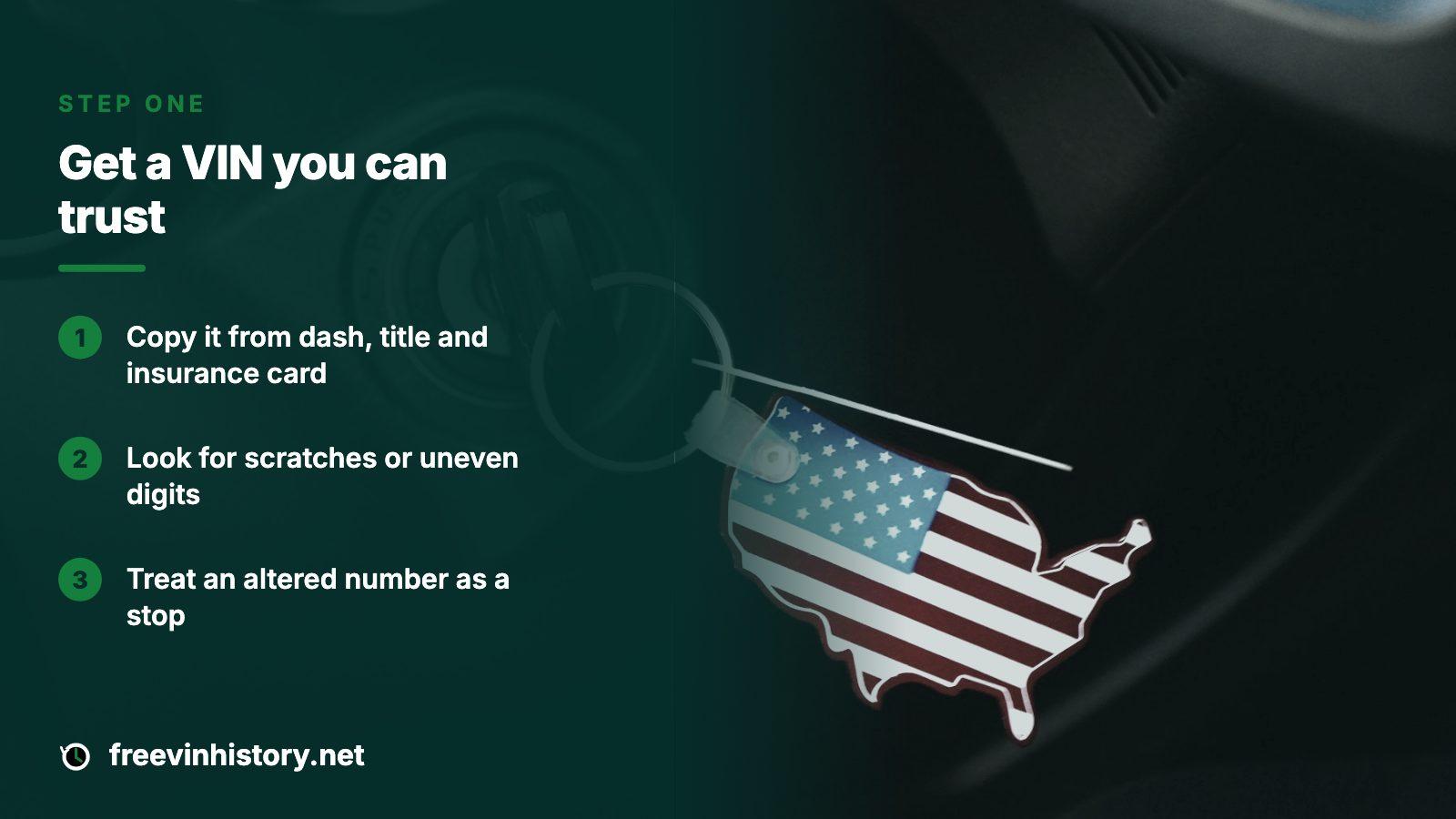
Every lookup depends on the 17 characters being right. NICB warns that a mistyped VIN may simply fail to match a record, which looks exactly like a clean result. Photograph it instead of retyping from the ad.
- Copy it from the dashboard plate, then from the title, then from the seller's insurance card. Every character should match across all three.
- Look at the stamped plate for signs of tampering: scratches, mismatched rivets or digits that sit unevenly.
- Treat a missing or altered number as a stop sign. Virginia law lets the state impound a salvage vehicle whose number is altered or missing until an investigation ends.
Step 2: open recalls, from the federal database
Virginia State Police points drivers to NHTSA's recall lookup and notes that makers must carry out recall repairs at no cost. The lookup takes the VIN and lists any campaign still open. The state police page also explains how owners miss them: letters follow the DMV registration address, and plenty of drivers relocate without changing it.
A used car can therefore carry a recall that no previous owner ever heard about. An open campaign rarely kills a deal. It does justify asking the seller to schedule the fix, or phoning a dealer yourself before any money moves. NHTSA also runs a hotline at (888) 327-4236 for questions the website does not answer.
Step 3: insurer theft and salvage flags
NICB's VINCheck asks member insurers' records one question: was this car reported stolen and never found, or written off as salvage or flood damage? Use is free but capped at five searches in a day from one IP address, enough for a short list and not for a long afternoon of browsing.
A quiet result says less than it seems
NICB says only participating insurers appear, that law enforcement records are not searched, and that silence from the database is no promise about the car. A car wrecked and repaired without an insurance claim, or insured by a company outside the program, will pass this check untouched.
If the result does say salvage, NICB explains what that means: an insurer judged the repair cost too high against the car's value and paid out instead. Such a car can be rebuilt and sold again, so the question becomes how well, and at what price.
Step 4: decode the VIN against the listing
NHTSA's vPIC decoder turns the VIN into the factory description of the car. It is fast, and it catches a surprising number of problems that have nothing to do with crashes. If the ad says one trim and engine and the decode says another, someone is guessing or something was swapped.
The decoder accepts the model year as an input and recommends you send it, and it will even work from a partial number. For a purchase, feed it the whole VIN. A decode proves what the car left the factory as. It says nothing about what happened afterward.
Step 5: what Virginia law lets you read for yourself
Virginia's own free signals sit on paper, not on a website. Ask the seller for the title and scan it for three things.
- A rebuilt brand. The Code of Virginia requires a lasting rebuilt brand on the title of such a car, carried onto each title after it.
- The odometer statement. Whoever transfers a vehicle, a dealer included, has to write down the mileage when ownership changes, so a blank or an odd figure deserves a question.
- The sticker. Inspections run on a yearly cycle, so the date on the windshield tells you roughly when a licensed station last examined the car.
What a rebuilt exam does and does not prove
A rebuilt salvage car first passes a safety inspection performed by someone unconnected to the rebuilder, then faces a DMV examination before a title issues. The statute describes that exam as a guard against theft and fraud, not a certificate of roadworthiness. The fee can be $125, and some older, cheaper cars are excused.
The definition matters too. Virginia's rebuilt category covers a late model car, meaning the current model year and five before it or any car worth at least $10,000 before damage, once repairs passed 75 percent of its value. An older, cheaper wreck may never get a brand at all.
Reading the sticker and the receipt
The State Police lists the items an inspector checks: brakes, lights, steering and suspension, tires, glass, exhaust, seat belts and the airbag readiness light, among others. One line is useful for used-car buyers. The airbag item fails a car whose airbag has deployed and not been replaced.
A rejection sticker lasts 15 calendar days, and repairs plus a recheck must fit inside it. The maximum fee for most vehicles is $20. Ask the seller for the receipt the station gave them, because it shows the date and shop. A fresh pass is mildly reassuring, but it is a safety check on one day, not a history.
Step 6: where the free layer stops
The federal title system, NMVTIS, tracks five indicators, among them brands, odometer and total loss history. Its own site calls an empty report a good thing, and leaves repair and recall data to private providers. NICB likewise says a full report draws on wider sources such as DMV title records and auction data.
Virginia buyers meet the gap most often with cars that moved in from another state. A brand applied elsewhere will not show on a Virginia paper title you have not yet seen, and the seller may not volunteer it. Mileage readings over time and damage records are the other blind spots.
Our preview costs nothing and shows whether such records exist for a VIN. A full report is bought once, nothing renews, and the pricing page lists today's cost. Save it for the single car you would really bid on.
After you agree on a car
After the sale, the new owner signs the title with a name and address in ink and has thirty days to file it with the DMV alongside the registration and title application. Keep your own copies of the odometer entry and the inspection receipt. If a check earlier in this page turned up something the seller denied, the paperwork you saved is your record.
Where this information comes from
- NICB: VINCheck lookup — What the free insurer search covers, its daily limit and its stated limits.
- Virginia State Police: vehicle recalls — How to search recalls by VIN and why owners miss recall letters.
- Virginia State Police: vehicle safety inspection — Inspection checklist, airbag rule, reinspection window and fee ceiling.
- Code of Virginia 46.2-1600: definitions — Late model, salvage and rebuilt definitions.
- Code of Virginia 46.2-1605: rebuilt vehicles — Rebuilt exam, fee, exemption and permanent title brand.
- NMVTIS: understanding a vehicle history report — The federal title record's five indicators and what it leaves out.
- NHTSA: vPIC API — How the federal VIN decoder works.
Sources and photos: Facts checked against the sources above in November 2026. Photos by Nina Mercado, Jake Kling and Miles Loewen on Unsplash; diagrams by FreeVINHistory.
Keep reading
- Free VIN check through the DMV: what a state agency will and will not showHow state DMV tools compare, and what they stop short of showing.
- Free open recall check by VIN: GM, Polaris and every other makeA closer look at the recall search from step two.
- Free salvage title check by VIN: what the free lookups showWhat a salvage or rebuilt result means for price and insurance.
- NMVTIS report: what the federal title record shows and missesThe federal title record that the paid step builds on.
Frequently asked questions
Is there a free VIN check in Virginia?
Parts of one. NHTSA's recall search, the NICB insurer database and a factory decode cost nothing. None of them reads Virginia DMV title files for you. The preview on this site is also free and shows whether deeper records exist, while the full report is a paid step.
Does a clean NICB result clear a Virginia car?
No. NICB itself cautions that a clean answer proves little, since only participating insurers report and police records are skipped. Treat it as one signal, then examine the title, the inspection receipt and, for a finalist, a full report.
How can I tell if a Virginia car was rebuilt?
Read the title. Virginia stamps a permanent rebuilt brand on such a car, and later titles keep it. Cars from other states may carry that state's brand instead, which is why a national title record helps when the car was not first titled in Virginia.
How often must a Virginia car be inspected?
Yearly, at an official station, counting from the month of the first inspection. The State Police sets a maximum fee, $20 for most vehicles. A rejected car gets a sticker valid for 15 calendar days while defects are fixed.
What is the deadline to title a purchased car in Virginia?
State law gives a buyer thirty days to send the signed title in with the registration and title application. Check the current fees and any exceptions with the DMV directly, since this page could not read the DMV's own site.
Now check the car itself
The guide explains what to look for. The report shows what this VIN has on record.