THE SHORT ANSWER
Copy the VIN off the car itself, run it through NHTSA's recall page, then through NICB's VINCheck. Both are free and work on any Washington car. They say nothing about title brands, odometer readings or accident records. For those you need the federal title system through an approved provider, or the report here once the free preview looks worth following up.
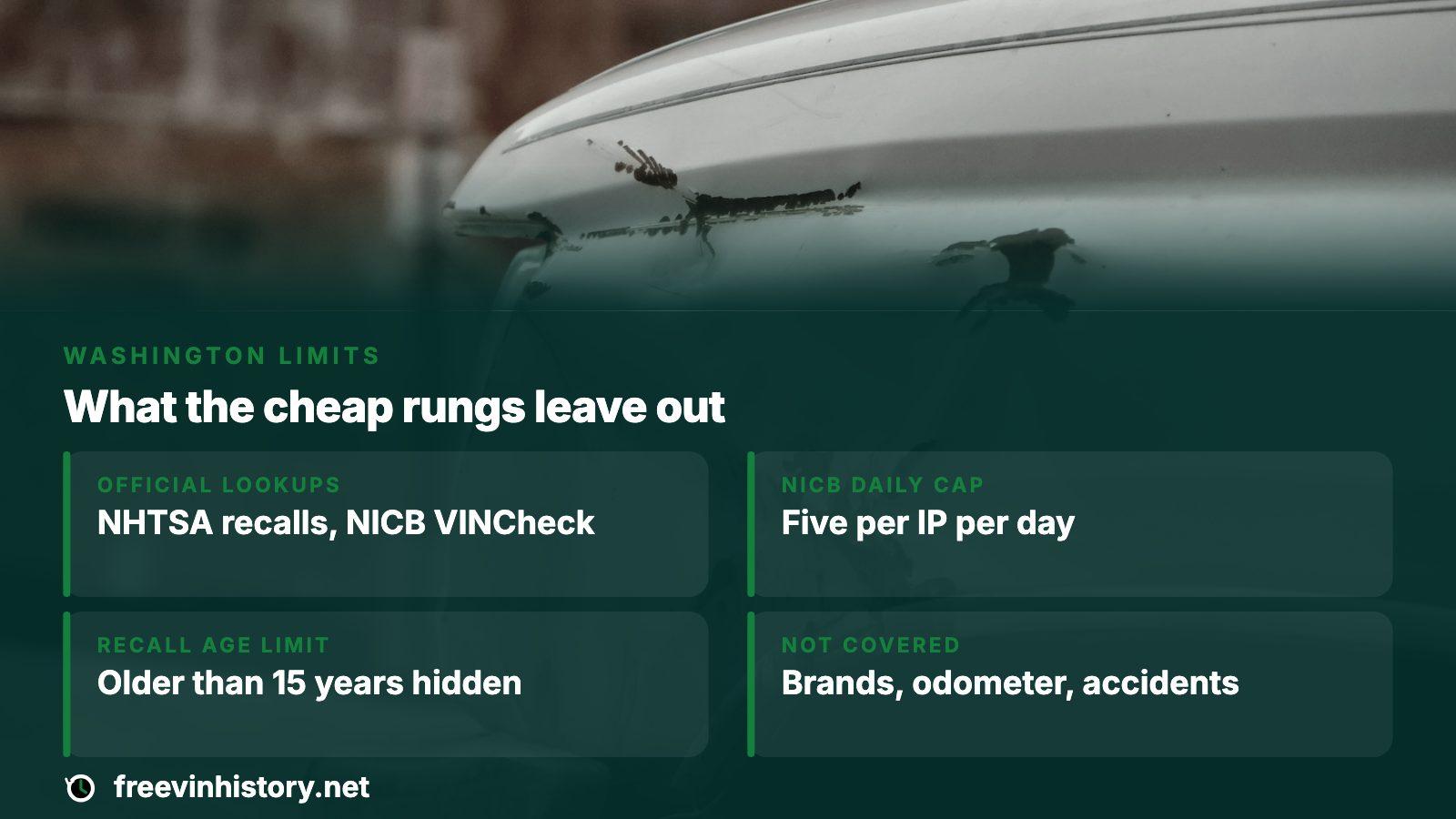
- Free lookups
- NHTSA recall search and NICB VINCheck
- NICB daily cap
- Five lookups per IP address per day
- Recall search age limit
- Recalls older than 15 years are not shown
- Not covered by free tools
- Title brands, odometer history, accident records
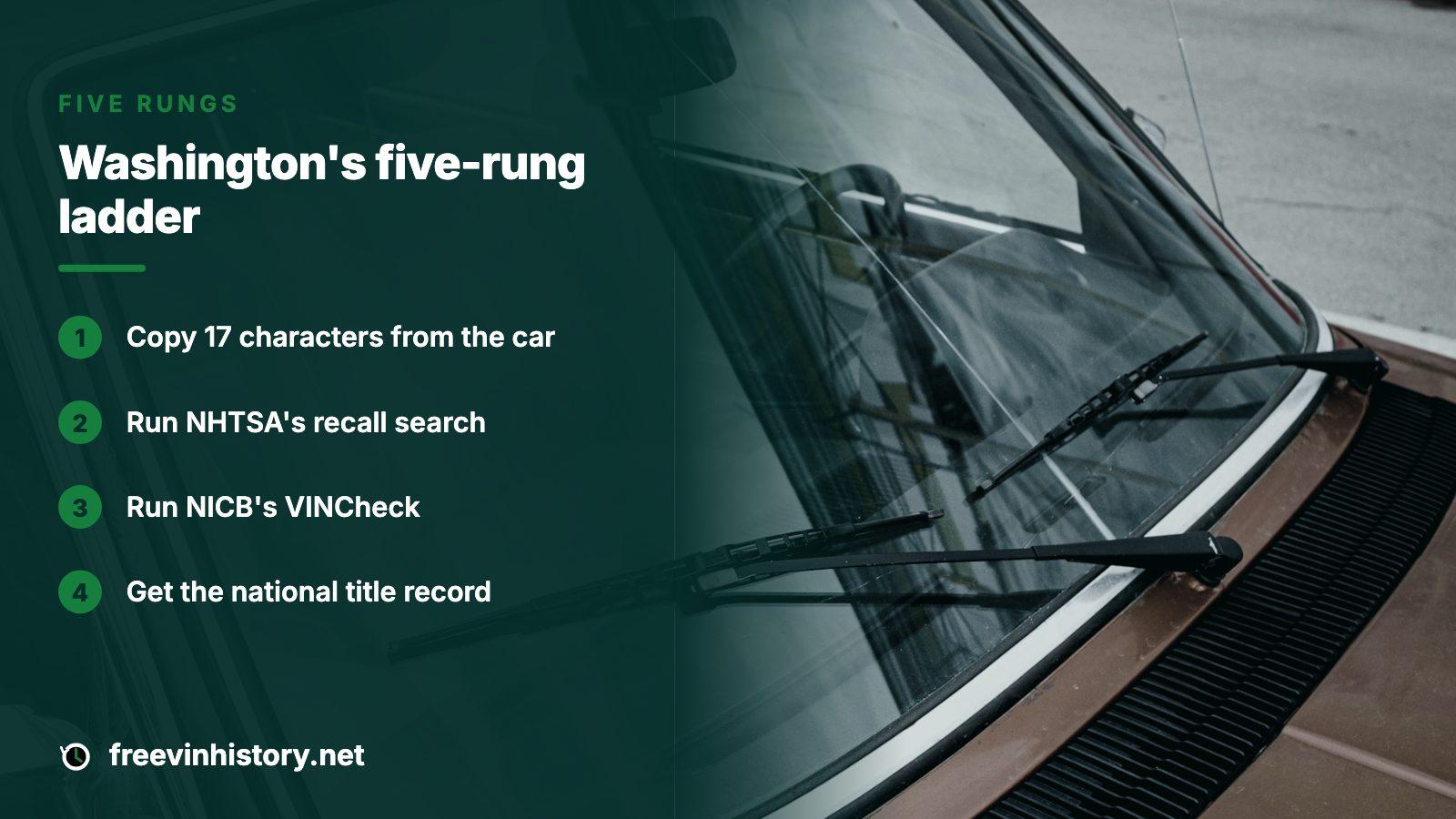
The ladder: five rungs, cheapest first
Free tools earn their place when you know where each one stops. This sequence asks the cheap questions first, so a bad car tends to get ruled out before any money moves.
- Copy the 17 characters from the car itself, then hold them up against every document the seller hands over.
- Run NHTSA's recall search for any open safety campaign.
- Run NICB's VINCheck, which draws on insurers' theft, salvage and flood files.
- Get the national title record, which holds brands and the newest mileage entry.
- Open the full report on any car still in the running and hold it against the seller's story.
Rungs two and three are free. Rungs four and five bring in paid data, while the preview on this site is a no-cost glance, so you can see whether records exist before deciding.
Rung one: trust the metal, not the listing
Everything after this depends on seventeen correct characters. NICB warns that a mistyped number may simply fail to match anything, and that looks identical to a clean result. A single slip can summon some other car's history.
NHTSA's advice: look through the windshield at the driver's-side bottom corner, or find it on the registration card; an insurance card may list it as well. Stand at the Washington car, read the windshield plate, and set it beside the title or registration the seller hands you. If they disagree, stop. A mismatch outweighs anything a free tool can return.
A plate is not a VIN
NHTSA's page does accept a plate plus a state, Washington among them. But the answer comes from state motor vehicle records and can describe a previous owner's car. Search by VIN so the answer is about the exact car you are inspecting.
Rung two: what the recall search says and what it hides
Type the VIN into NHTSA's recall page. A car with nothing outstanding gets a message saying zero unrepaired recalls. A car with an open campaign shows what needs fixing, which is the manufacturer's job to arrange.
Silence from this tool is easy to over-read. NHTSA lists what it leaves out: recalls already fixed, campaigns past 15 years old where the maker gave no extra coverage, small manufacturers, and service campaigns that are not safety-related. Brand-new announcements can also lag, because VINs are loaded as the maker identifies them.
- Clean on a young car: good news on recalls only.
- Clean on an old car: the age cutoff may be hiding a campaign.
- Open recall: ask whether a repair appointment exists and who waits for parts.
Shopping several cars? That page can also screen up to 100 VINs in a single go.
Rung three: insurers' theft, salvage and flood flags
NICB's tool asks whether participating insurers have logged the car as stolen and never recovered, or as salvage or flood-damaged. Member companies represent 92.49 percent of earned premium nationwide as of August 2026, so the net is wide but has holes.
Mind two limits. NICB lets each IP address run five lookups a day, enough for a shortlist but not a bulk sweep. And it reads only participating insurers' files, never police records, so a stolen or wrecked car can slip through with no match.
| Result | What it means | Next step |
|---|---|---|
| Stolen, not recovered | An insurer reported the car as taken | Walk away and call local police before anything else |
| Salvage | An insurer wrote the car off; legal rebuilding and re-titling remain possible | Ask for repair paperwork and find out how the title reads now |
| Flood | An insurer logged water damage | Expect electrical and airbag trouble, and inspect hard |
| No record | No match among participating insurers | Not a guarantee; go on to the title record |
Rung four: where free ends and the title record starts
Neither free lookup reads a title. The National Motor Vehicle Title Information System does, fed by state title offices, scrapyards, auto recyclers and insurance carriers. The federal consumer page says it can give a buyer title details, the latest odometer figure, brand history and sometimes theft data from the past.
A brand is the label a state attaches to a car's condition, now or earlier: junk, salvage, flood and similar. One purpose of the system is to stop a flood brand from vanishing when a car is retitled across state lines. The catch is access. Individuals buy these records from approved providers, and the federal site lists twelve that serve the public and companies alike. Some familiar names serve dealers only for this data.
Washington paperwork is the state's call
Transfer deadlines, forms and any state-run title lookup belong to Washington's licensing department. Confirm current rules there before paying, since this page does not quote them.
What free checks cannot say about a Washington car
NICB calls VINCheck useful but not a complete report, and says buyers should not lean on it alone. Its own FAQ adds that a fuller report pulls DMV titles, auction data and service history, and most of those carry a fee.
- Accidents that never ended in an insurance write-off
- Mileage readings taken on different dates, the trail that exposes a rollback
- Auction listings and photos from before the car reached the lot
- A lender's lien still attached to the title
- How often, and in what use, the car changed hands
That is no criticism of the tools. They answer narrow questions well. The danger is hearing a clean answer to a narrow question as a clean answer to the broad one.
Rung five: preview, then the paid report
FreeVINHistory follows exactly this order. Enter the VIN and the preview indicates whether title, damage, mileage or auction records exist for that car. You are charged nothing and need no account to look.
Opening the records behind the preview is a separate purchase: one payment per report, or a bundle if you are weighing several cars, never a recurring charge. The pricing page lists the choices. Only the preview is free.
Spend on it once a car has survived rungs two and three. Then read it beside what the seller told you. A gap between the two deserves a question before the deposit, not after.
Putting the answers side by side
No single lookup settles a purchase; the pattern across them does. Clean recalls plus a clean NICB result can sit beside a title brand found later, because those first two tools cannot see titles at all.
- Seller claims one owner, records show several: ask why the accounts differ.
- Seller claims no accidents, records show damage: request the repair bills.
- Newer reading lower than an older one: pause and get an explanation in writing.
- Open recall: settle the repair status before discussing price.
A mechanic's inspection still earns its fee. Records describe what got reported; an inspector finds what was repaired badly or hidden.
Where this information comes from
- NICB: VINCheck lookup — Daily search cap, insurer coverage share and the limits NICB states on its own tool.
- NHTSA: Check for Recalls — What the VIN recall search shows, what it omits and where the VIN sits on a car.
- VehicleHistory.gov: NMVTIS for consumers — What the national title system holds and why brands are tracked.
- VehicleHistory.gov: NMVTIS providers — How many providers sell to the public and which serve dealers only.
Sources and photos: Facts checked against the sources above in November 2026. Photos by Jakub Żerdzicki, Max Tokarev and Everett Pachmann on Unsplash; diagrams by FreeVINHistory.
Keep reading
- Free open recall check by VIN: GM, Polaris and every other makeA closer look at the recall search and its blind spots.
- Free stolen car check online: what each lookup coversHow theft records work and what a clean answer leaves open.
- Car title search by VIN free: what you can see before you payThe step after the free lookups: reading a title record.
- Free VIN check through the DMV: what a state agency will and will not showWhat a state motor vehicle agency can and cannot tell you by VIN.
Frequently asked questions
Is there a completely free VIN check for Washington cars?
Two free lookups work on any Washington car: NHTSA's recall search and NICB's VINCheck. Between them they cover open safety recalls and insurer-reported theft, salvage and flood records. Title brands, odometer history and accident records fall outside both, so a free check works as a screen rather than a full history.
Can a Washington plate number lead me to the VIN?
Entering a plate and state on NHTSA's recall page works for Washington, but the data comes from state motor vehicle records and may describe a past owner's car. Reading the number off the windshield or registration card is more reliable, and the seller can also supply it.
Why did NICB show nothing on a car that turned out to be damaged?
VINCheck reads only insurance records from participating companies. Damage fixed privately, paid in cash or never claimed would not appear. NICB itself says a clean result is no guarantee, which is why a title record and a full report matter.
How often can I use NICB VINCheck?
NICB caps searches at five per IP address across a single day, though there is no limit over a longer span. Comparing a long list of cars means spreading searches across days or checking the likeliest candidates first.
Does the preview here cost anything?
No. It needs no account and shows whether records exist for the VIN. Reading those records is a separate paid step, bought once rather than by subscription, and the pricing page has the current options.
Now check the car itself
The guide explains what to look for. The report shows what this VIN has on record.