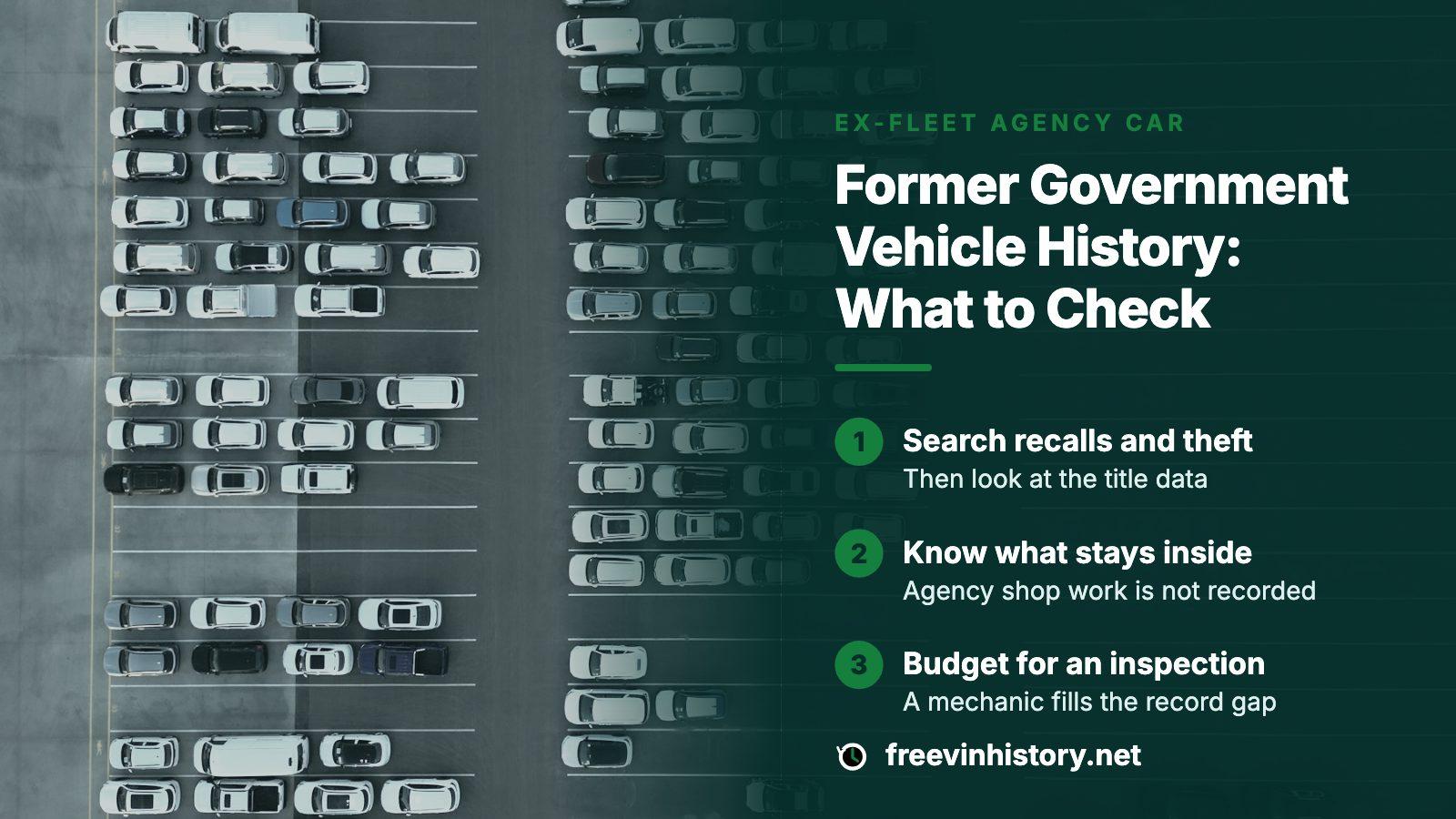
THE SHORT ANSWER
Search the VIN with NHTSA for open recalls and with NICB for theft and salvage reports, then look at title data. That covers the safety and insurance red flags. How hard an agency drove the car and what its shop did are outside those records, so budget for a mechanic's inspection as well.
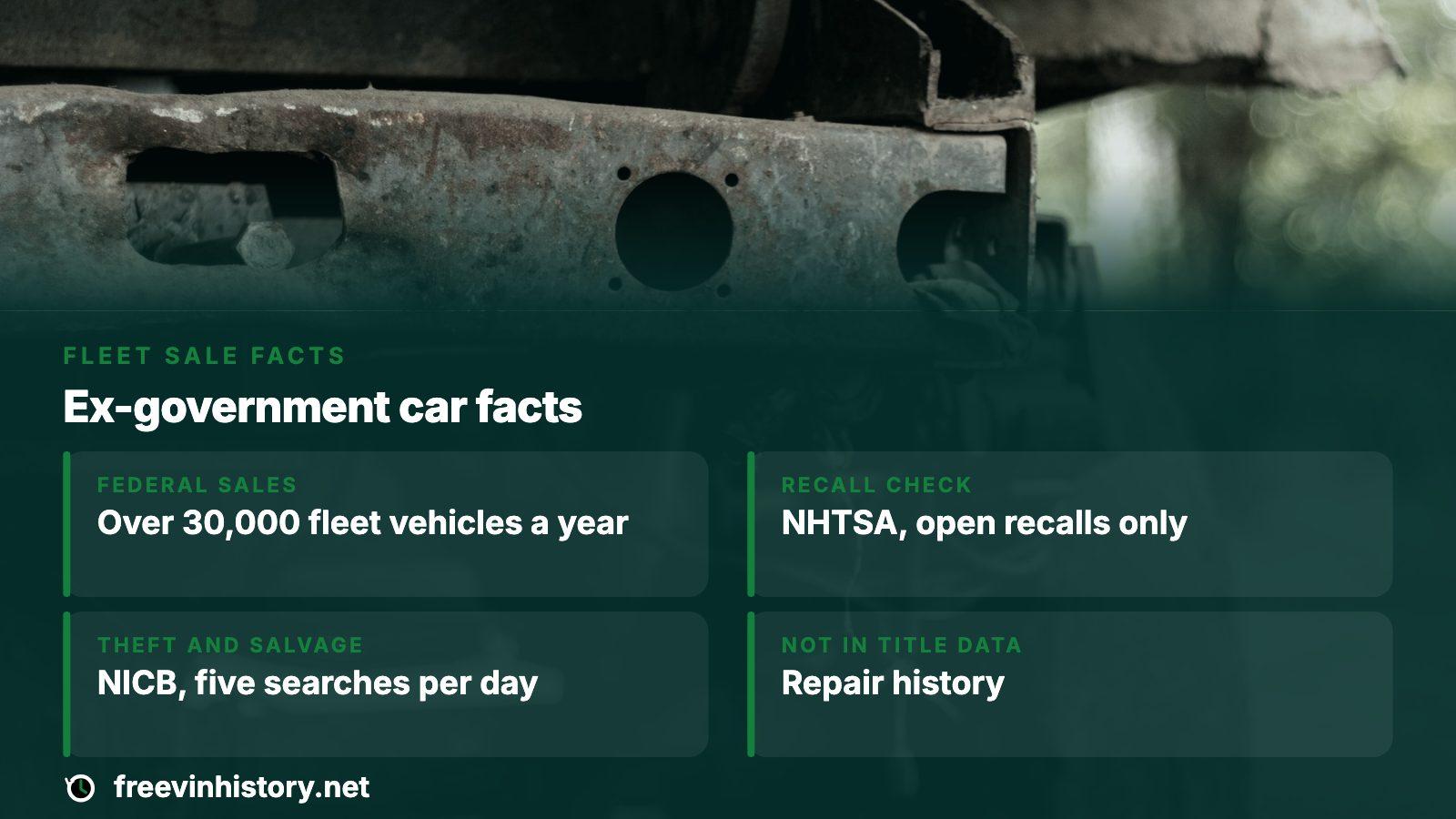
- Federal sales
- GSA sells more than 30,000 fleet vehicles a year
- Free recall check
- NHTSA, by VIN, open recalls only
- Free theft and salvage
- NICB VINCheck, five searches per 24 hours
- Not in federal title data
- Repair history
Where a former government car comes from
The phrase covers more ground than most listings admit. At the federal level, the General Services Administration leases non-tactical vehicles to other agencies. Once a vehicle meets the replacement criteria, GSA offers it to the public, and it says more than 30,000 are sold at auction each year.
Cities, counties and states run their own disposals, and each follows its own rules, so a sale notice from a county is a different animal from a federal one. Whatever the seller, ask which agency owned the car and for how long, because a seller who cannot answer that has told you something.
- Sedans, wagons and SUVs that served as staff transportation
- Vans, pickups and buses used for crews and passengers
- Ambulances and law enforcement vehicles
- Medium and heavy duty trucks, plus trailers
What the free sources actually show
Three public tools are worth running before you bid or sign. None of them cost anything, and each answers a narrow question. Together they cover the safety and insurance questions, which are the ones that can cost you the most.
| Free source | Question it settles | Blind spot |
|---|---|---|
| NHTSA recall search | Does this VIN have an unrepaired recall | Fixed recalls, and campaigns beyond the 15-year mark unless the manufacturer still honors them |
| NICB VINCheck | Did participating insurers report it stolen, salvage or flood damaged | Insurers that opt out, plus police records |
| State title record request | Title and brand data the titling agency holds, usually for a fee and a form | Daily use and shop work |
GSA itself tells fleet customers to use the NHTSA VIN lookup for a single vehicle and says open recalls matter as much as scheduled maintenance. If the agency says so about its own cars, a buyer should too.
Title data and brands on an ex-fleet car
Data reaches the federal system from insurers, salvage and junk yards, and the state offices that issue titles. For each car it can show where the title sits now and where it sat before, when it was issued, the last odometer figure on file, any theft entry, and dated brands, including an insurer's total loss call.
One gap matters here. Insurers must report, but the Justice Department's FAQ says an organization that insures its own fleet has no such duty. A government car that was wrecked and fixed in-house may never have generated a total loss entry, so a quiet record on such a car deserves some doubt.
Read a quiet record carefully
The Justice Department's disclaimer warns that earlier serious damage can go unlisted if neither an insurer declared the car totaled nor a state branded the title. No entry means nothing was filed. It does not prove the car was never hurt.
What stays inside the agency
Fleet managers keep their own records. GSA Fleet, for one, runs an Accident Management Center that logs accidents and coordinates repairs on leased vehicles, with reports started in its internal fleet system. Those files are not attached to the VIN in any public lookup.
Federal title data holds no repair history either. So the oil changes, the collision repairs and the tire replacements may exist on paper somewhere, but you will not see them through a VIN search. Ask the seller whether the sale includes maintenance records and take whatever exists.
Plates give one small clue. GSA-leased vehicles carry plates shaped like a G followed by letters and digits, and a plate without the leading G is not GSA-owned, though another federal entity may own it. GSA publishes a list of federal plate prefixes.
Recalls deserve their own look
An agency can hold a large group of one model, so a recall can touch many of them at once. Some get fixed through the fleet's own channels and some may sit open at the point of sale.
NHTSA's search is quick. The VIN plate sits on the dashboard where it meets the glass, closest to the driver. A clean result prints a line saying zero unrepaired recalls match it. Fixed recalls never appear, so a clean result says nothing about what was repaired. If you are weighing a whole lot of vehicles, NHTSA lets you enter up to 100 VINs in one search.
When paying for a full report makes sense
The free tools stop where the money starts. Once you are choosing between two ex-fleet cars, or about to bid on one, a paid VIN report puts odometer readings from each title, damage and accident entries, auction and salvage records, liens and ownership type side by side.
FreeVINHistory gives you a free preview first. Paid reports are one-time purchases without recurring billing; the pricing page shows the choices. Treat it as the second pass, after the free recall and theft checks come back clean.
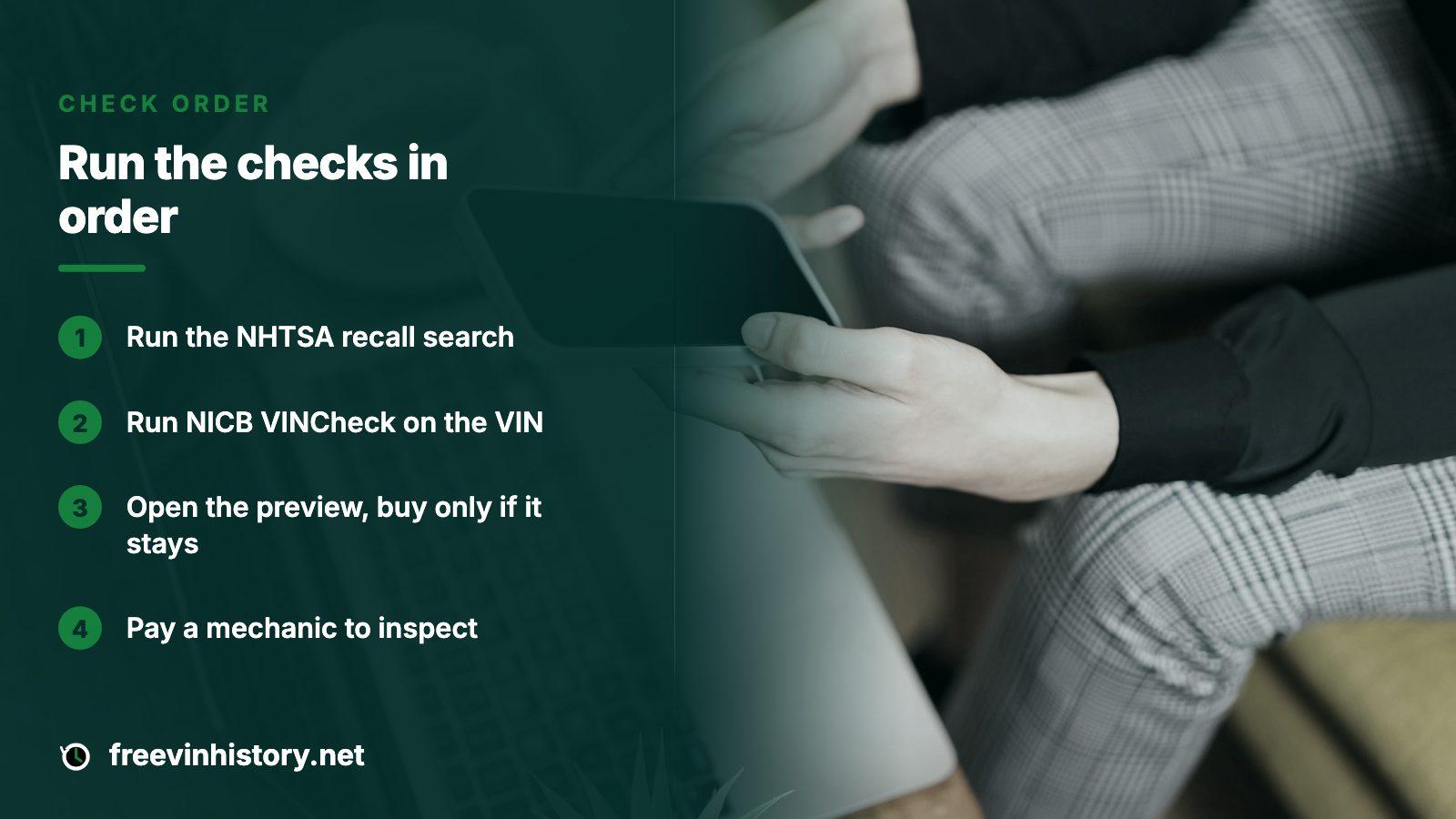
- Run the NHTSA recall search on the VIN.
- Run NICB VINCheck on the same VIN.
- Look at the free preview before anything else, and keep the full report for a car that makes it through your shortlist.
- Pay a mechanic to inspect it before you bid or sign.
Questions to put to the seller
Public sales often list a car as is, so the questions have to come before the sale. GSA's auction site would be the place to read the terms, but it refused to open for us, so check the sale notice itself and do not assume anything about warranties or title paperwork.
- Which agency owned the car, and how many years was it in service?
- Is the title in hand, and does it carry a brand?
- Are maintenance and accident records included?
- Can a mechanic look at it before the sale closes?
- Was it used for law enforcement, passenger transport or heavy hauling?
Write the answers down. If the listing and the title disagree about mileage or use, treat that as a reason to walk.
Where this information comes from
- GSA: Sales of GSA Fleet vehicles — Source for how federal fleet cars reach the public and the yearly volume.
- GSA: GOV Recalls — Shows the agency's advice to check recalls by VIN.
- GSA: Vehicle misuse and plates — Explains the plate format and prefix list.
- NMVTIS frequently asked questions (DOJ) — Covers what title records hold and who must report.
- NHTSA: Check for Recalls — What the VIN recall search returns and omits.
- NICB VINCheck — Free theft and salvage lookup and its limits.
Sources and photos: Facts checked against the sources above in November 2026. Photos by Iain, Jakub Żerdzicki and Zoshua Colah on Unsplash; diagrams by FreeVINHistory.
Keep reading
- Fleet vehicle meaning: what it says about a used car's pastWhat the fleet label means on a listing.
- Ex police car history: what to check before buying a retired cruiserPolice-use cars are a common government sale item.
- Free open recall check by VIN: GM, Polaris and every other makeThe recall step in more detail.
- NMVTIS report: what the federal title record shows and missesWhat federal title data includes and omits.
Frequently asked questions
Can I look up a former government vehicle's history for free?
Partly. NHTSA shows open recalls by VIN and NICB VINCheck lists theft and salvage entries from member insurers. Both are free. Neither shows how the agency used the car or serviced it, so you still need records from the seller and an inspection.
Are former government cars good buys?
They can be, but the label proves nothing either way. Some agencies service vehicles on a schedule and others drive them hard. Judge the individual car by its odometer, title, records and a mechanic's findings rather than the word government.
Where does the federal government sell its used vehicles?
GSA says it offers fleet vehicles to the public at auction once they meet replacement criteria. Its personal property office says the public bids at GSA Auctions on surplus not wanted by agencies or by state and local bodies. Check each sale's own terms.
Do government vehicles show up in title databases?
Titled vehicles generally do, but reporting has gaps. Insurers and salvage yards must report, while an owner that carries its own fleet risk has no such duty. A wreck handled in-house might leave no total loss entry, so a clean record has limits.
Should I pay for a full report on an ex-fleet car?
Consider it when you are close to buying. Run the free recall and theft checks first, look at the free preview here, and spend money only on a car that is still in the running. It is one payment, with no subscription.
Now check the car itself
The guide explains what to look for. The report shows what this VIN has on record.