THE SHORT ANSWER
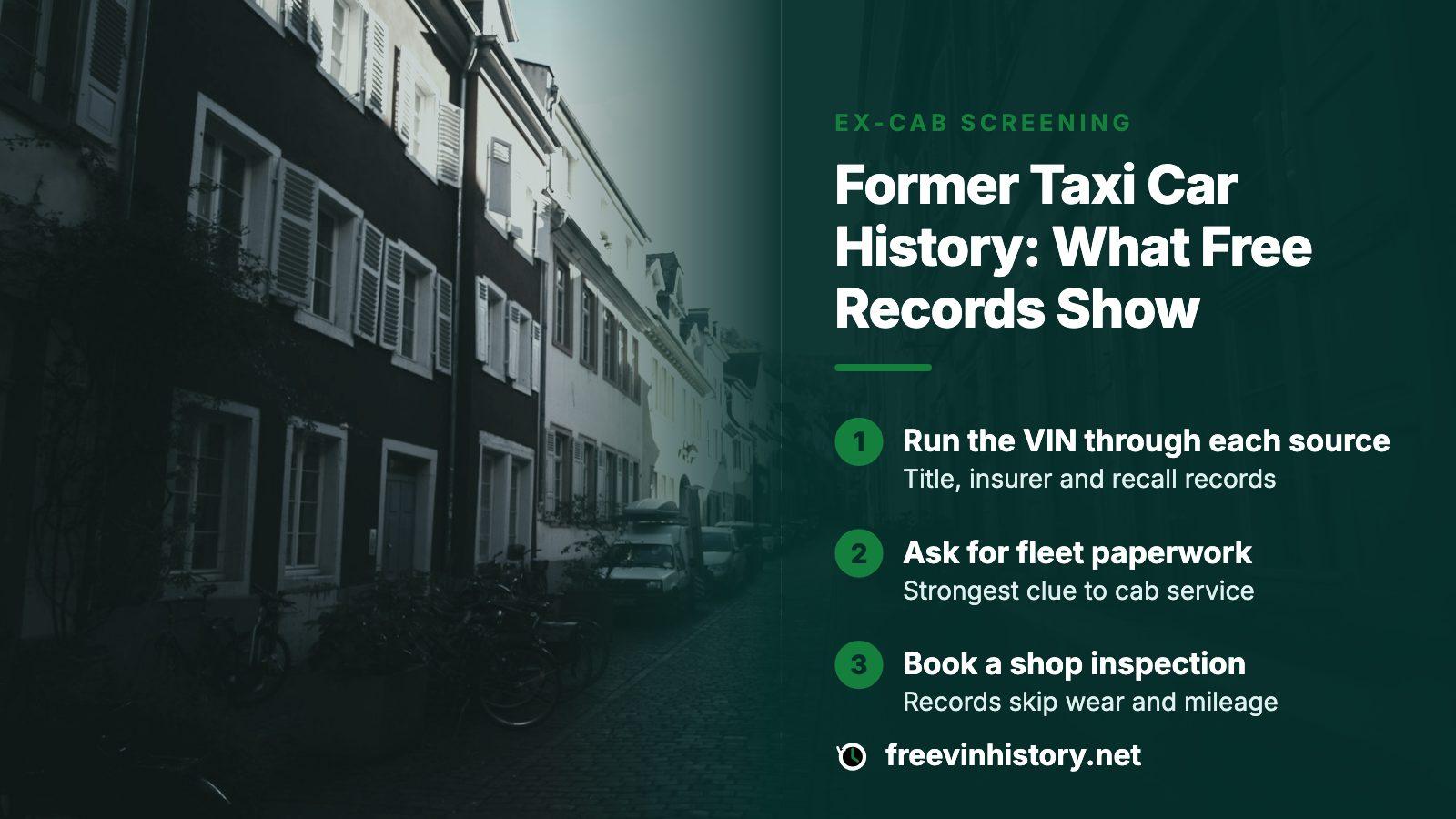
No free official lookup flags a car as an ex-cab. NMVTIS handles title, brands, mileage, total loss and salvage; NICB handles theft, salvage and flood; NHTSA handles open recalls. Put the VIN through each, ask the seller for fleet paperwork, and book a shop inspection. A free preview of the full report comes after that.
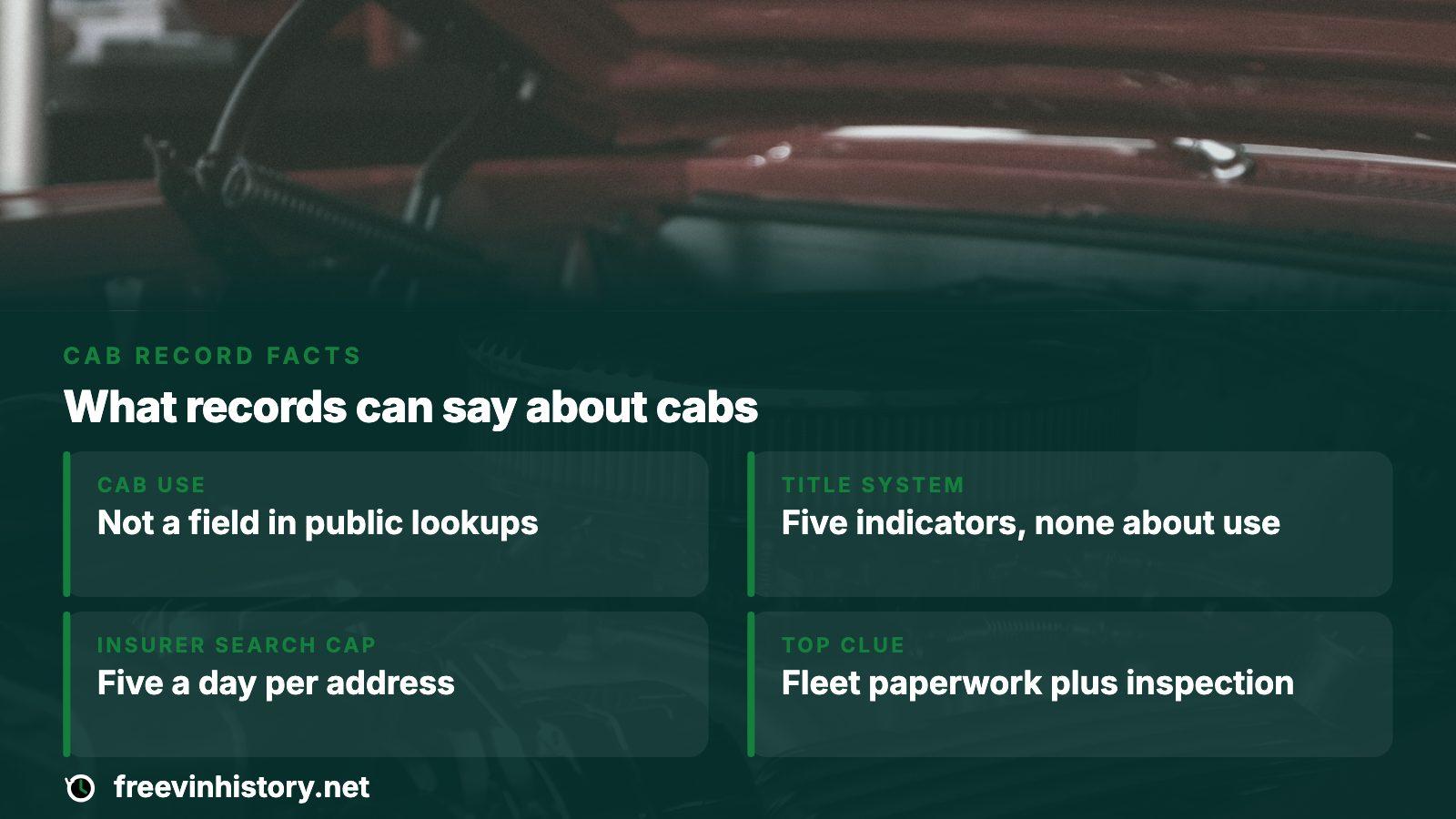
- Cab use in free data
- Not a field in any free federal or insurer lookup
- NMVTIS indicators
- Five: title state, brands, mileage, total loss, salvage
- NICB search cap
- Five lookups from one IP address per day
- Best clue
- Fleet paperwork plus an independent inspection
Why a retired cab hides so well
Once a fleet owner sells a cab, the next title is an ordinary one. A private buyer registers it, and the paper trail reads like any other used sedan or minivan. Nothing in the free lookups asks how the car earned its living.
That matters because a taxi can cover far more ground in a year than a commuter car, with many short stops, idling and different drivers behind the wheel. The wear is real even when the record is blank, so the free checks are a floor, not a verdict.
What the federal title record does cover
Justice Department pages describe the NMVTIS consumer report as built on five indicators. Cab, taxi or livery use is not on that list, yet the five it does carry are the ones a hard-driven car is most likely to trip.
| Indicator | Why it matters on a former cab |
|---|---|
| Current title state and date | Shows where the car was last titled and how recently it changed hands |
| Brand history | Junk, salvage or flood labels applied by any state stay on record |
| Odometer reading | Gives a number to compare with the dash and with the wear you see |
| Total loss history | Points to damage severe enough that an insurer wrote the car off |
| Salvage history | Signals a car that was sold as damaged goods at some point |
The Justice Department calls a clean report a good thing and says it is deliberately brief. That reassures you about brands and says nothing about use.
The free lookups worth running first
Three free tools each answer one narrow question. Run them in this order with the VIN copied from your car's registration card or the glass at the base of the driver-side windshield.
- NHTSA recall search: shows whether this exact car has a recall nobody fixed. It skips repaired recalls, very new campaigns, recalls older than 15 years and small-maker recalls.
- NICB VINCheck: shows whether member insurers logged the VIN as stolen and unrecovered, or as salvage or flood damaged. One IP address gets five lookups a day.
- NMVTIS through an approved provider: returns the five indicators from the table. The Justice Department's buying tips say a report costs up to $4.
NICB says plainly that VINCheck is no full history and carries no data on use, so a clear result there tells you little about a cab's past.
What a former cab can look like after the sale
NHTSA's public complaint database holds first-hand accounts from people who bought and drove these cars. The 2005 Ford Crown Victoria, a common fleet sedan, has 193 complaints on file.
From an NHTSA owner complaint
One owner bought a 2005 Crown Victoria from a private seller in December 2009. He wrote that it had been a police car, and that he then drove it as a taxi himself. He listed brake trouble that cost him $800, a transmission that gave out on a run to the airport and needed a tow, and a fence collision in December 2010. A friend, he said, only then told him to look up recalls online.
The takeaway is the order of operations: the recall and title lookups cost nothing and take minutes, so run them before the purchase, not after the second breakdown.
When a problem belongs to the whole fleet
Cab companies buy the same model in bulk, so a weak part tends to show up across many cars at once. A defect that looks like one bad vehicle can be a pattern, which is another reason to check the model's complaints and recalls, not just the single VIN.
From an NHTSA owner complaint
The owner of a 2014 Nissan NV200 taxi wrote that the van lost power in heavy traffic three times in three weeks, and roughly six times over two months. Mechanics at local garages and a dealership in Queens could not cure it, and he suspected every van in the fleet had the same fault. The complaint lists no crash, fire or injury.
Ask whether the car you are looking at had a repeat complaint like this, and what the shop did about it. Look at the maintenance record rather than relying on the seller's word.
Questions to put to the seller
With thin records, the seller becomes your best witness. The Justice Department's tips suggest asking the owner, dealer or repair shop for the maintenance history, and tracking down the previous owner if the current one never knew the car's past.
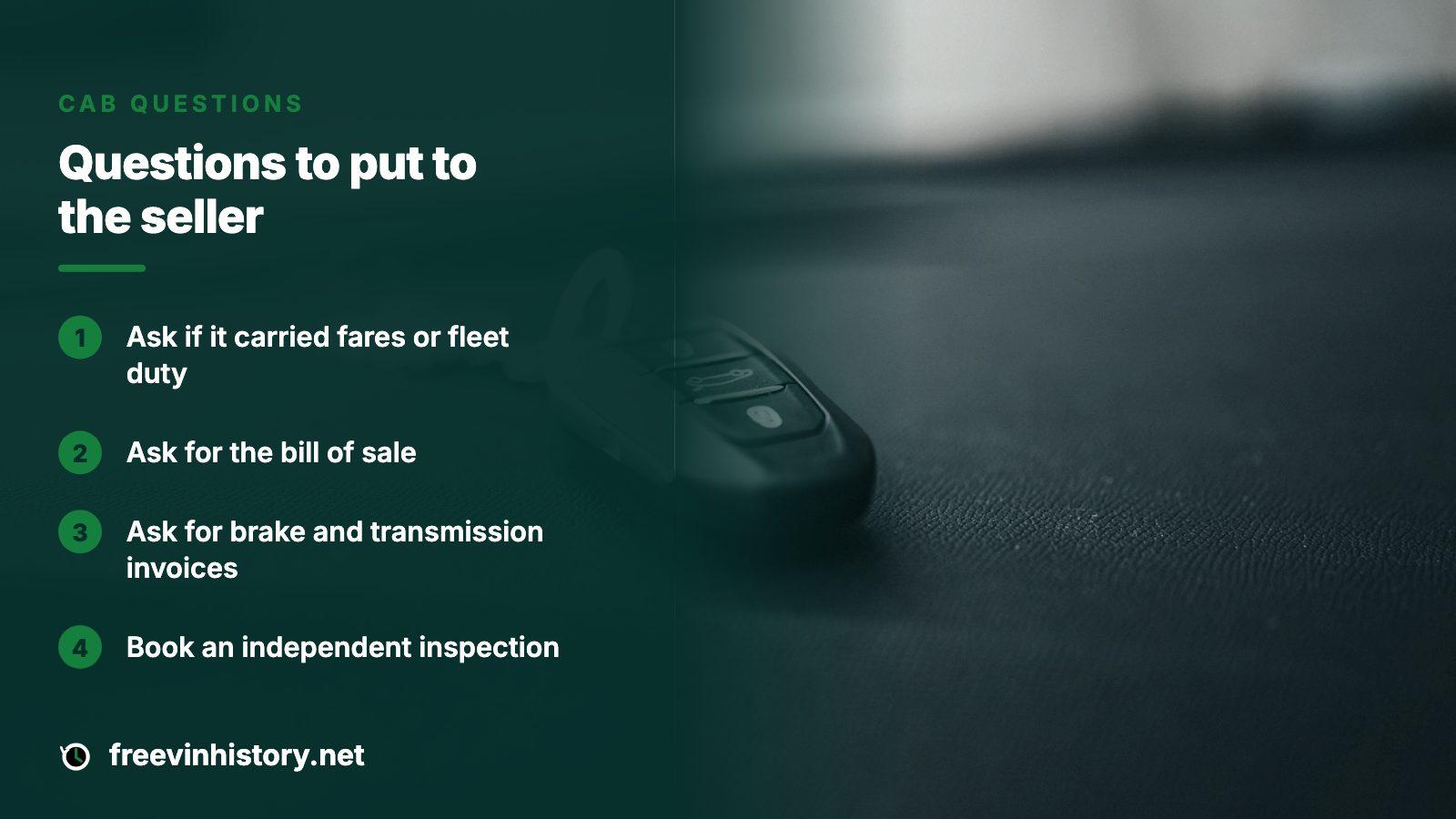
- Was the car ever used for fares, livery or a fleet, and for how long?
- Who sold it, and can you see the bill of sale or fleet release paperwork?
- Where are the service invoices, especially for brakes and the transmission?
- Was any body panel repaired or replaced, and did an insurer pay for it?
A seller who answers openly and produces paper is a better sign than a clean-looking interior.
Inspection and mileage, the parts the records skip
Pay an independent shop to look the car over before any money moves. On an ex-cab, point them at brake wear, how the transmission shifts under load, door latches, seat fabric and suspension bushings, the parts that suffer from constant stop and go and heavy passenger traffic.
Set the title record's mileage figure beside the dash reading. A mismatch is grounds to walk away, or to press the seller hard. A cabin that looks worn well past the stated mileage deserves the same suspicion.
When a full report is the next step
When the free lookups come back clean and the seller's story holds together, a full report makes sense for a car you mean to buy. It gathers ownership and use type, damage records and salvage or auction entries in one place, which the three free tools never combine.
Start with the preview, which costs nothing, then decide if the car justifies a one-time purchase. Pricing lives on its own page, and nothing renews.
Where this information comes from
- NMVTIS: understanding a vehicle history report — the five indicators and what a clean report means
- NMVTIS: used car buying tips — inspection, maintenance record and previous owner advice, plus report cost
- NHTSA: check for recalls — what the VIN recall search shows and leaves out
- NICB: VINCheck — theft, salvage and flood scope and the search limit
- NHTSA owner complaint 10371993 — owner experience, paraphrased
- NHTSA owner complaint 10721924 — owner experience, paraphrased
Sources and photos: Facts checked against the sources above in November 2026. Photos by Karwin Luo, Bence Balla-Schottner and Victor Hughes on Unsplash; diagrams by FreeVINHistory.
Keep reading
- Used rideshare car history: how to tell if a car drove for Uber or LyftAnother commercial-use history that free records do not label.
- Ex police car history: what to check before buying a retired cruiserRetired cruisers often become cabs and share the same record gaps.
- Fleet vehicle meaning: what it says about a used car's pastWhat fleet ownership means for a used car you are weighing.
- Commercial use vehicle history: what free sources show and missHow commercial use shows up, or fails to, in a vehicle record.
Frequently asked questions
Can I find out if a car was a taxi by VIN?
Not from the free official lookups. NMVTIS, NICB VINCheck and the NHTSA recall search do not carry a cab-use field. Seller paperwork, service invoices and a mechanic's eye give better clues. A full report may list use type, so check the preview for that entry before buying.
Does a clean NMVTIS report mean the taxi was fine?
It means no brand, total loss or salvage entry was found among its five indicators. The Justice Department calls that a good thing, but the report is short on purpose. It will not show worn brakes, a tired transmission or repairs paid out of pocket.
Is a former taxi a bad buy?
Not automatically. A well-maintained cab with service records can be a fair deal, and some run on durable fleet models. The risk is hard use with thin paperwork. Price it for the wear, and let an independent inspection decide.
What should I check first on a former cab?
Run the VIN through NHTSA recalls and NICB VINCheck, then pull the title record. Next, weigh brake, transmission and cabin wear against the odometer, and ask the owner or repair shop for service history.
Where do I find the VIN on the car?
Look at the driver's side base of the windshield from outside the car, or at the registration card. It runs 17 characters. Confirm the number on the glass matches your paperwork before typing it into any lookup.
Now check the car itself
The guide explains what to look for. The report shows what this VIN has on record.