THE SHORT ANSWER
The world manufacturer identifier is the first section of a VIN, normally positions 1 to 3. Federal rules say it names the manufacturer and vehicle type. Small makers add positions 12 to 14. NHTSA's free vPIC tool decodes it. It confirms the builder, but says nothing about accidents, titles or mileage.
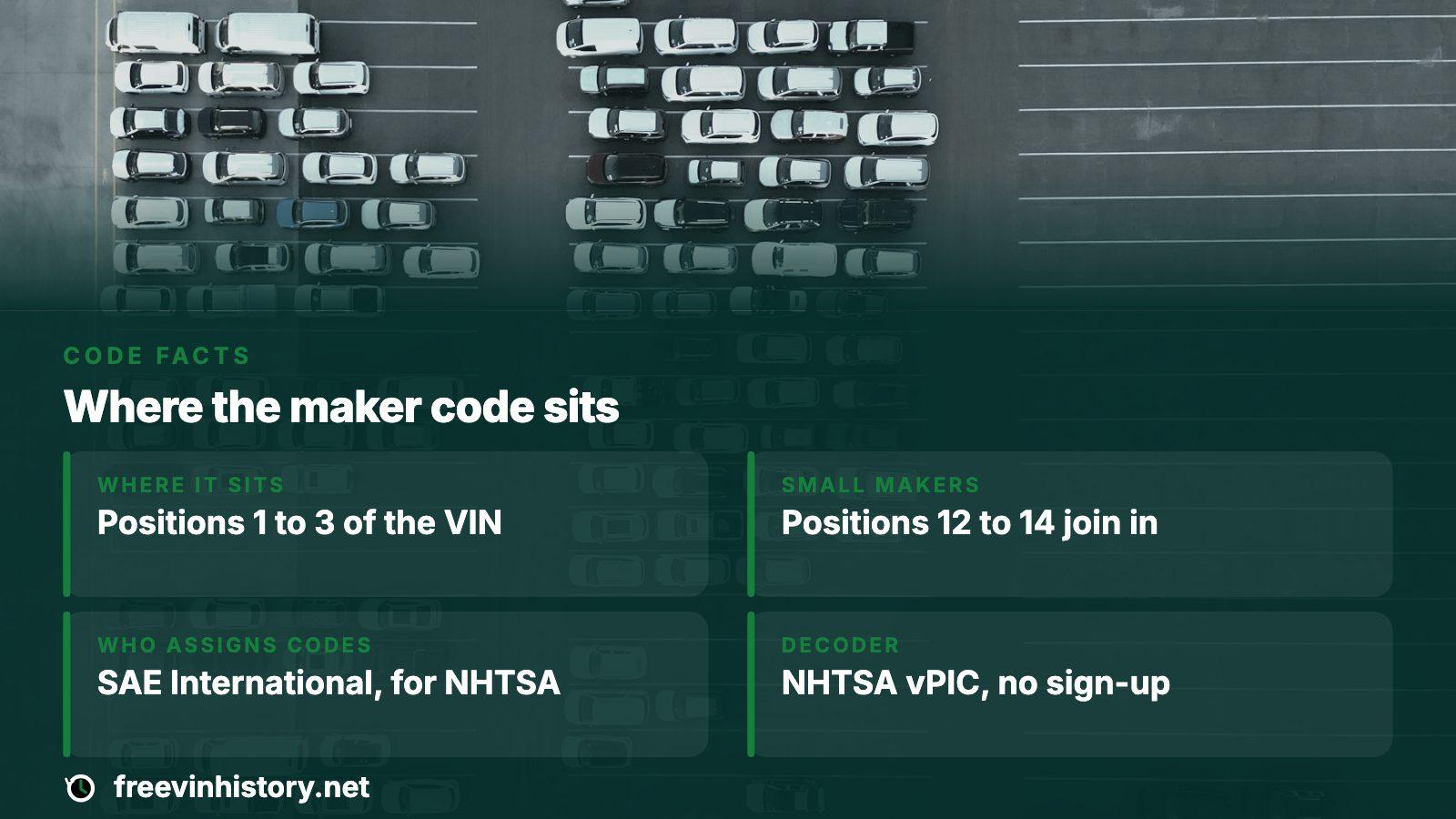
- Where it sits
- Positions 1 to 3 of the VIN
- Small makers
- Positions 12 to 14 join the first three
- Who hands them out
- SAE International, for NHTSA, at no charge
- Free decoder
- NHTSA vPIC, no sign-up
What the first block of a VIN actually names
Federal VIN rules split the number into sections. The first is three characters long and is meant to single out one manufacturer and one kind of vehicle. A Ford truck, a Tesla sedan and a Honda motorcycle each start with a different code, even when the same company sits behind them.
The block does not describe the particular car in your driveway or on a lot. It says who built the vehicle and what family it belongs to. Everything about trim, engine and body style lives in the next section, positions 4 to 8, which the maker decides and must be able to explain to NHTSA.
Free step, honest limit
Decoding the WMI shows the maker the number claims. It does not show whether that car was wrecked, branded or rolled back. That is what a history report is for.
Reading a few real codes
NHTSA's vPIC service answers a code lookup with the make, the legal name of the manufacturer and the vehicle type. The table below comes from lookups run for this page, so you can repeat them yourself and compare.
| First three characters | Make returned | Manufacturer on record | Type |
|---|---|---|---|
| 1FT | Ford | Ford Motor Company | Truck |
| 5YJ | Tesla | Tesla, Inc. | Passenger car |
| 1HG | Honda | American Honda Motor Co., Inc. | See vPIC |
| JTD | Toyota | Toyota Motor Corporation | See vPIC |
| WBA | BMW | BMW AG | See vPIC |
| 1G1 | Chevrolet | General Motors LLC | See vPIC |
Notice that the legal manufacturer name is not always the badge on the hood. A Chevrolet code resolves to General Motors, and a Volkswagen code can resolve to the company's Mexican entity. That is normal: the identifier follows the entity that built and certified the vehicle.
Why one brand owns many codes
A maker is not limited to a single WMI. vPIC lists 78 identifiers tied to Ford, 34 to Toyota and 45 to Honda. The Honda list alone spans Japan, the United States, Belgium, Mexico, Italy and Thailand, and it includes motorcycles along with cars.
The practical meaning for a buyer: the code can hint at the factory region and the vehicle class, so a mismatch is worth a question. If a listing says a truck was built by a company known for cars, and the code decodes to a passenger car maker with a motorcycle type, something in the paperwork or the number is off.
- A code can point to a plant country, not only a brand.
- A maker may hold separate codes for cars, trucks and motorcycles.
- A decoded type that disagrees with the vehicle in front of you is a flag, not a verdict.
The third-position 9 and small manufacturers
Rules in 49 CFR Part 565 give two special cases. When the third character is a 9, the maker's identifier is six characters long, not three. A low-volume builder, such as a boutique or kit maker, is named by the opening three characters combined with the three found at positions 12 to 14.
This matters when a free decoder returns a vague or generic answer on a niche vehicle. The first three characters alone may only say the builder is a small producer. The remaining identifier sits near the end of the number, so read the whole VIN into the tool rather than just the opening block.
For replicas, specialty trucks and trailers, the maker's own paperwork is the next place to look. The decoder tells you which company registered the code, and the company can say what it built.
Who hands out the codes
For U.S. makers, NHTSA hired SAE International as its coordinator for handing out these codes, and SAE charges nothing for them. A requested code is screened against codes already issued or held back, and SAE then writes to the requester to confirm.
Makers work to a deadline. Filing comes first: 60 days or more must pass between a code being submitted for a make and type and the first VIN carrying it. They must also give NHTSA the key to decipher their VIN characters, which is why a federal decoder can read positions the public could never guess.
The system is registration, not inspection. A code proves a maker registered it, not that the car in front of you has been checked by anyone.
How to decode it for free
Start with the free official tool and treat its answer as a first filter.
- Copy the number off the vehicle and compare it with the seller's paperwork. One wrong letter sends the decoder to a different answer.
- Enter it in NHTSA's vPIC decoder. Read the make, manufacturer name and vehicle type it returns.
- Compare those three answers to the listing. A truck sold as a coupe, or a brand that does not match the manufacturer, is a reason to pause.
- Run the same VIN through NHTSA's recall lookup and NICB's free theft and salvage check, both of which are free.
None of those steps costs anything, and they take a few minutes. They also leave gaps, so keep reading before you pay a seller.
What a matching WMI still leaves open
A clean decode is the start of the checking, not the end. vPIC itself carries a note that missing values must not be read as a feature being absent, and that the model year it guesses can be wrong when you do not supply one. If the tool is cautious, so should you be.
A matching manufacturer says nothing about what happened to the car afterward. A salvage brand, an insurance total loss, an odometer rollback and an unpaid lien all sit in other records. A cloned VIN can also carry a perfectly valid WMI, because a copied number copies the first three characters too.
| Question | WMI decode answers it? | Where the answer lives |
|---|---|---|
| Who built it | Yes | NHTSA vPIC |
| Open safety recalls | No | NHTSA recall lookup |
| Theft or salvage report | No | NICB check, title records |
| Accident and damage records | No | Full history report |
| Odometer readings over time | No | Title and service records |
When to run a full report
If the free decode matches the car, the next question is the car's past. This site's preview shows whether records exist for the VIN, and the single-purchase report opens the title brands, damage entries, mileage readings and liens behind it. No subscription is involved, and the prices are on the pricing page.
Run it before you hand over a deposit, not after. A decode that passes and a report that finds a brand beat a decode alone every time. When the seller refuses to share the full VIN, treat that as the answer to your question.
Where this information comes from
- eCFR: 49 CFR Part 565, VIN requirements — Supports the section layout, the third-position 9 rule and the SAE assignment process.
- NHTSA vPIC API documentation — Source of the code lookups and identifier counts shown in the tables.
- NHTSA vPIC VIN decoder — The free tool a buyer can use to decode a VIN.
- NHTSA: recalls lookup — Free open-recall check by VIN.
Sources and photos: Facts checked against the sources above in November 2026. Photos by Justin Cron, Miles Loewen and Iain on Unsplash; diagrams by FreeVINHistory.
Keep reading
- Free open recall check by VIN: GM, Polaris and every other makeThe next free official check after a matching decode.
- Free vehicle history report: what the free sources showShows what free sources cover and where they stop.
- VIN check no records found: reading a blank resultWhat it means when a valid VIN returns nothing.
- Grey market vehicle: what it means and how to check one before you buyImports often decode to unfamiliar manufacturers and countries.
Frequently asked questions
What does WMI stand for in a VIN?
WMI stands for world manufacturer identifier. It is the opening block of the VIN, usually the first three characters, and it names the builder and the type of vehicle. It is not a serial number for the individual car, and it is not a record of what has happened to it.
Is the world manufacturer identifier the same as the make?
Not always. The code points to the manufacturer on record, and that can be a parent or a regional entity. A Chevrolet code resolves to General Motors LLC, for example. One maker also holds many codes, so the same brand can start with different characters depending on the plant and vehicle class.
Why does a VIN sometimes have a 9 in the third spot?
Under federal rules a 9 as the third character tells you the maker's identifier is six characters, not three. This applies to low-volume builders, whose identity is split between the start of the number and its tail. If you see it, decode the whole VIN, not just the start.
Can a fake VIN pass a WMI check?
Yes. A copied or altered VIN can keep a valid first section, and the decoder will happily name the real maker. The decode confirms the structure of the number, not the identity of the car. Pair it with title records, a physical comparison of the plates and a full history report.
Is decoding the WMI free?
Yes. NHTSA's vPIC decoder is free and needs no account. It returns the make, manufacturer and vehicle type. To see accidents, title brands and odometer readings you need a history report, which is a separate paid step after this site's free preview.
Now check the car itself
The guide explains what to look for. The report shows what this VIN has on record.