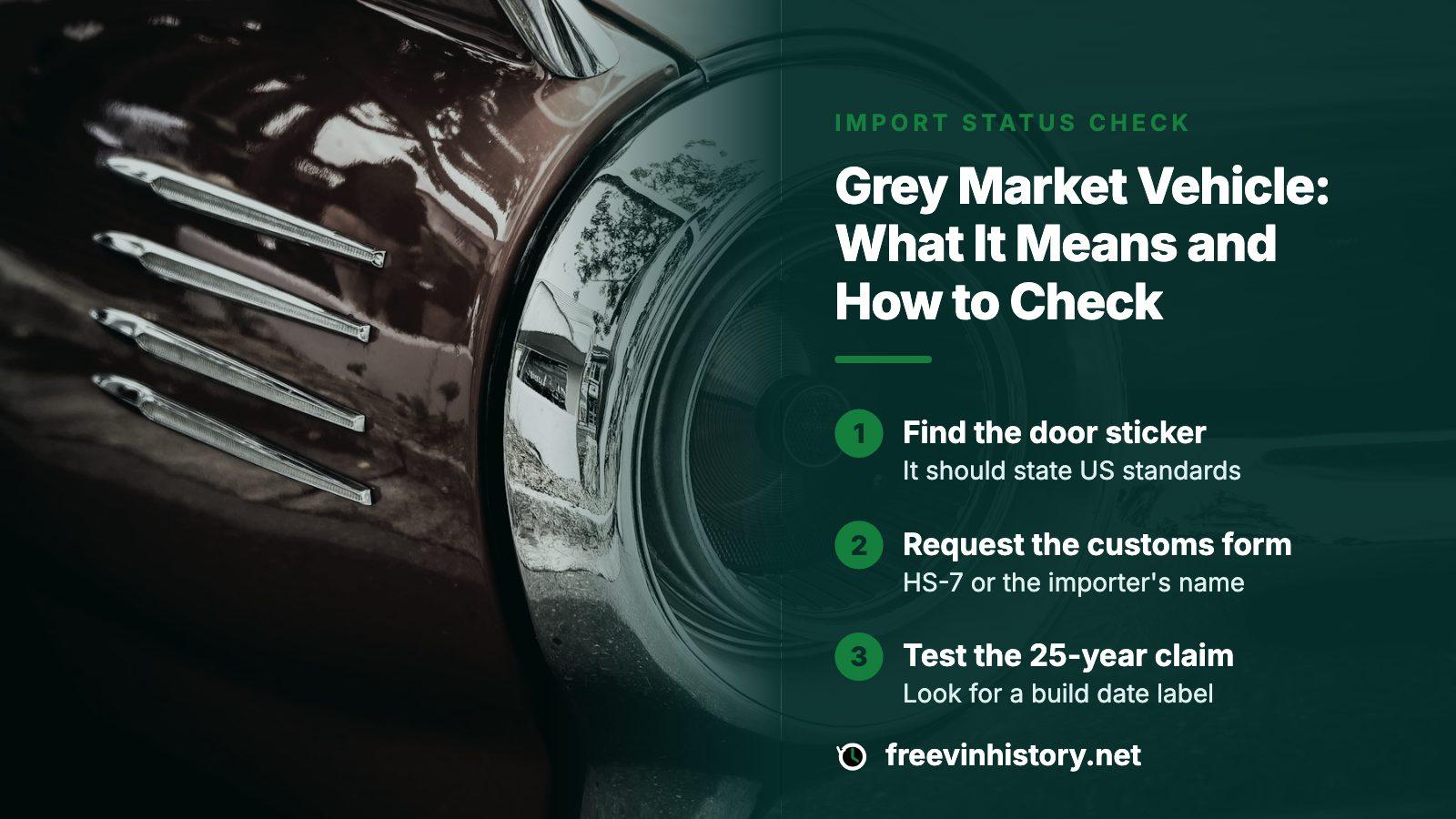
THE SHORT ANSWER
A grey market vehicle was made to another country's safety and emissions rules, not the US ones, and then imported. It can be legal: NHTSA allows cars 25 years or older, and newer ones through a registered importer. It can also be a problem. NHTSA's free decoder will often say the maker is not registered here, which is worth knowing before any money moves.
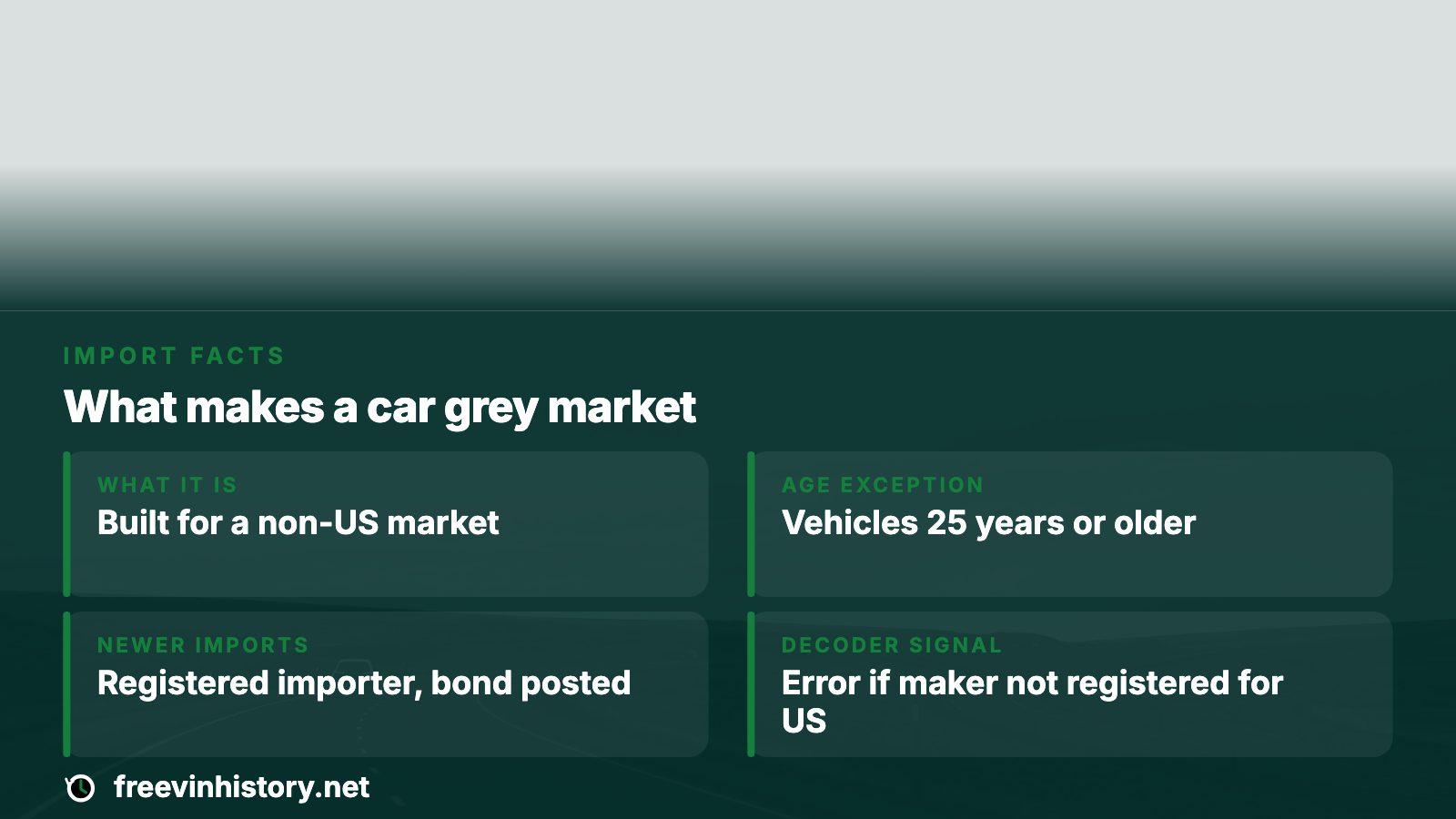
- What it is
- A vehicle built for a non-US market and imported outside the maker's US channel
- Age exception
- NHTSA lets a vehicle at least 25 years old in regardless of the safety standards
- Newer imports
- Must go through a registered importer, with a bond posted at entry
- Free first step
- NHTSA's VIN decoder returns an error when the maker is not registered for US sale
What the term covers
NHTSA uses the label gray market for a motor vehicle that was not certified for the US or Canada, with the examples it gives being cars first sold in Europe or the Far East. In plain terms, the car was engineered for different crash, lighting and emissions rules than the ones that apply on American roads.
That alone does not make it illegal or unsafe. Plenty of owners import a model the US never got, and some do it correctly. The point for a buyer is that the car arrived through a side door, so the paperwork trail matters more than usual. A clean-looking title from a US state tells you the state registered it. It does not tell you how the car crossed the border.
How a grey car gets in legally
Federal law gives an importer a few routes, and each leaves a different trail you can ask about.
- Built to US standards and labeled so by its maker, then brought back or sold across the border: no NHTSA approval needed.
- At least 25 years old, counted from the build date: allowed whatever its safety equipment, declared in Box 1 of the customs form known as HS-7.
- Under 25 years and not built for the US: only if NHTSA has found that make, model and year eligible, and only through a registered importer.
- Temporary entry, such as a visitor's own car for up to a year, or a race or demonstration vehicle: it must leave again, not be sold.
The temporary routes are the ones to be wary of. A car admitted on a promise to leave was never cleared for permanent use, so a later sale to a US buyer is a red flag in itself.
The registered importer route
For a newer car, the lawful path runs through a registered importer, a business NHTSA has approved to bring nonconforming vehicles in and modify them to meet the safety standards. NHTSA rules on eligibility one model year of one model at a time, then issues a number that the importer writes on the HS-7 form Customs receives.
At entry the importer posts a bond equal to 150 percent of the declared value, which is meant to guarantee the conversion work gets finished within 120 days. A buyer should be able to see that paperwork. If a seller says an import was converted but cannot name the importer, treat the claim as unproven.
Right-hand drive is not a shortcut
NHTSA says right-hand drive models may not count as similar to their left-hand US versions, because crash performance is not necessarily the same. A maker's own letter, on its letterhead rather than a dealer's, can change that. A seller's say-so cannot.
The emissions side is a separate test
Clearing NHTSA does not clear the EPA. Under the Clean Air Act, a vehicle that fails EPA's emission rules cannot be imported, new or used, and EPA says nonconforming vehicles enter either through an independent commercial importer that modifies, tests and certifies them, or temporarily under a Customs bond with prior EPA approval.
EPA also has a route for vehicles over 21 years old, but the engine must match the original in model and configuration, and EPA urges importers to call its imports hotline first. Customs and EPA can seize or export a vehicle that arrives without the right arrangements, and can fine the importer. A buyer who ends up holding a car with an unresolved entry problem has no easy remedy, so the question of who imported it and under which exemption is fair to ask.
What a free VIN decode tells you
Run the number through NHTSA's vPIC decoder before you drive to see the car. For a chassis number in a Japanese format, I tried one: the decoder came back with error codes 6, 7 and 400 and no make or model. Code 7 says the maker has no registration with NHTSA for sale or import into the US for use on US roads. A known US-market Honda Accord VIN decoded cleanly with error code 0.
That contrast is useful. A listing that claims a US-market model but decodes to an error deserves questions. Still, the decoder only reads the number. It will not say how the car was entered.
What NHTSA says about itself
NHTSA states that a VIN cannot reveal whether the vehicle was built to the US standards, since makers never report that to the agency. For an answer on a particular car, the maker is the contact, and the certification label on the door area is the evidence.
A short inspection routine
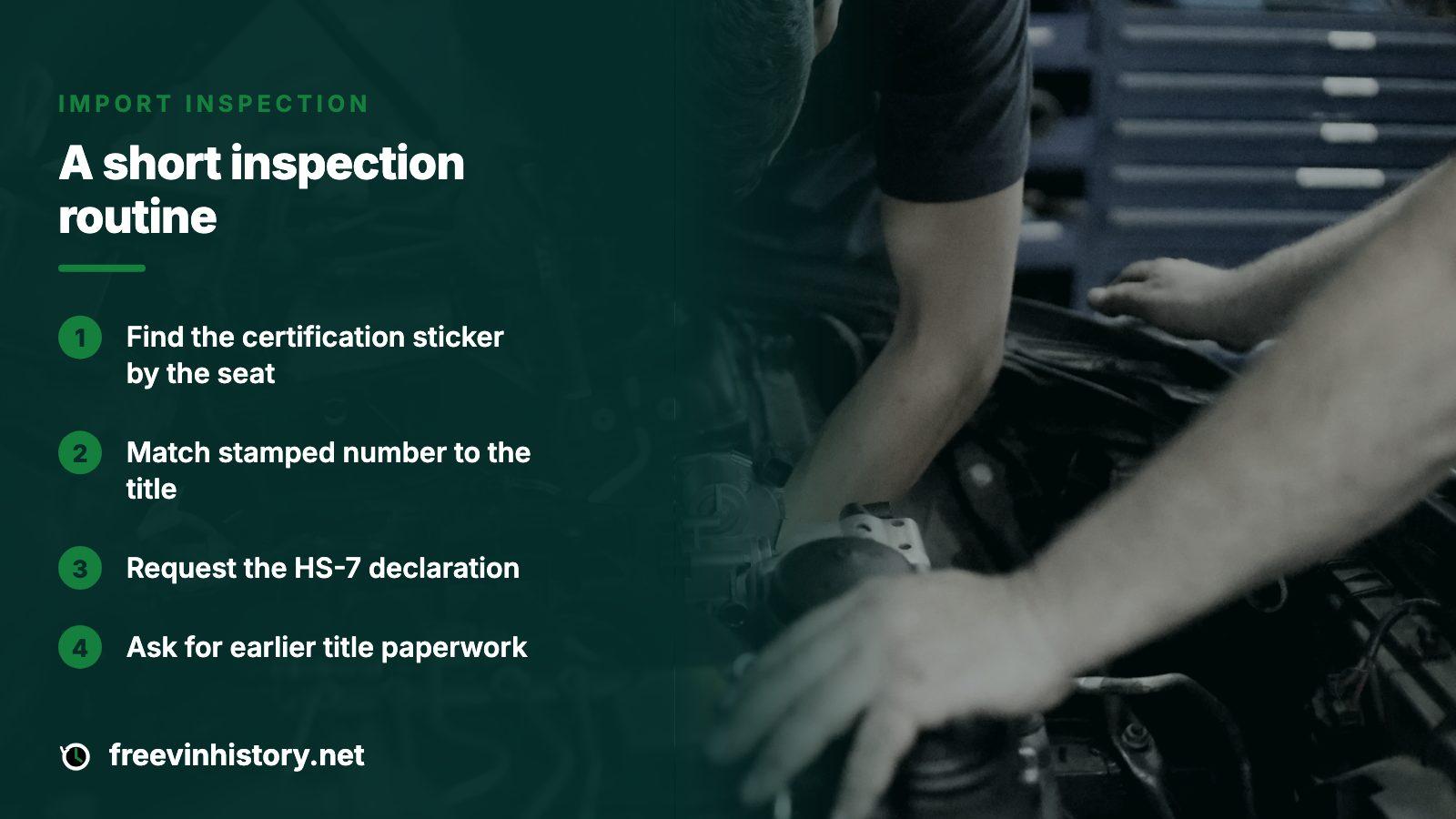
- Open the driver's door and find the maker's certification sticker beside the seat. A car certified for the US carries one that states it meets the federal standards.
- Match the number stamped on the vehicle against the number printed on the title, and try a second spot on the car as well.
- Request a copy of the HS-7 declaration, or at least the importer's name and the entry date.
- Where the seller cites the 25-year rule, look for a build date on the label, a first-sale invoice or an old registration.
- Find out where else the car was titled before, and ask to see that earlier paperwork.
A seller who answers these without hesitation is usually easy to deal with. One who gets vague about the entry paperwork has told you what you needed to know.
Where the free sources stop
NHTSA's decoder reads the number, and its recall search covers US-market vehicles. NMVTIS, the federal title database, exists to guard buyers against title fraud and stolen vehicles being resold. None of these is built to show how a given car entered the country, and a car that never had a US-market record may return little or nothing.
| Question | Free source | Reaches it? |
|---|---|---|
| Was the maker registered for US sales? | NHTSA VIN decoder | Yes, through its error text |
| Is the car eligible for import? | NHTSA eligibility list and a registered importer | Yes, by make, model and year |
| Did this car clear Customs and EPA? | The importer's entry papers | Only on paper from the seller |
| Has it been salvaged, stolen or rebranded since? | Free lookups cover pieces only | Partly |
When the full report is the natural next step
Once the entry paperwork looks sound, the question moves to what happened after the car landed. A grey car can be wrecked, branded or retitled like any other. Start with the preview on this site, which costs nothing and shows what records exist for the VIN. Where records turn up, the one-time report adds the title brands, odometer readings and any salvage or accident entries, which you can set against what the seller told you.
If the preview finds nothing at all on a number that decodes to a US-market maker, read the guide on empty results before treating silence as a good sign. The pricing page explains how the report is sold.
Where this information comes from
- NHTSA: Importation and Certification FAQs — The gray market label, the 25-year entry, registered importers, the bond and the right-hand drive position.
- NHTSA: Importing a Vehicle — Where the HS-7 form, the eligible vehicle list and registered importers are published.
- EPA: Learn About Importing Vehicles and Engines — The emissions requirement, importer routes, the over-21-year provision and seizure risk.
- NHTSA vPIC VIN decoder — The free decoder behind the error 7 wording.
- VehicleHistory.gov: NMVTIS — The federal title information system's stated purpose.
Sources and photos: Facts checked against the sources above in November 2026. Photos by Warren Griffiths, Mustafa Sheikhmouss and John Kakuk on Unsplash; diagrams by FreeVINHistory.
Keep reading
- VIN check no records found: reading a blank resultWhat an empty result can and cannot tell you about a car.
- World manufacturer identifier: what the first 3 VIN characters tell a buyerHow the first characters of a VIN point to the maker and country.
- Free classic car VIN lookup: what works on older carsOlder vehicles, where the 25-year import rule often applies.
- Car title search by VIN free: what you can see before you payWhat free tools reveal about a title, and what they skip.
Frequently asked questions
Is a grey market vehicle legal to own in the US?
It can be, when it entered lawfully: as a car at least 25 years old, or through a registered importer after NHTSA found the model eligible. EPA has its own rules as well. A car that skipped these steps may be seized, so ask for the entry documents before buying.
Can I register a grey market car?
Registration is handled by each state, and requirements differ, so check with your DMV before paying. A state registration alone does not prove the federal import steps were followed. Ask the seller for the HS-7 declaration or the registered importer's paperwork, and keep copies.
How do I tell if a car is grey market?
Start with the VIN in NHTSA's decoder: an error saying the maker is not registered for US sale is a strong hint. Then look for a certification label by the driver's seat. A missing label, right-hand drive or foreign-language plates all point toward a non-US build.
Does a VIN check show grey market status?
Not directly. NHTSA says it cannot determine from a VIN whether a car was built to US standards. A decode can flag an unregistered maker, and a history preview can show what records exist, but neither replaces the entry paperwork.
Are grey market cars harder to insure or repair?
NHTSA's FAQ does not cover insurance or parts, so I can only say to ask. Call your insurer with the VIN before purchase, and ask a shop about parts for that exact model. A model sold new in the US has a dealer, parts and recall network that a non-US model may lack.
Now check the car itself
The guide explains what to look for. The report shows what this VIN has on record.