THE SHORT ANSWER
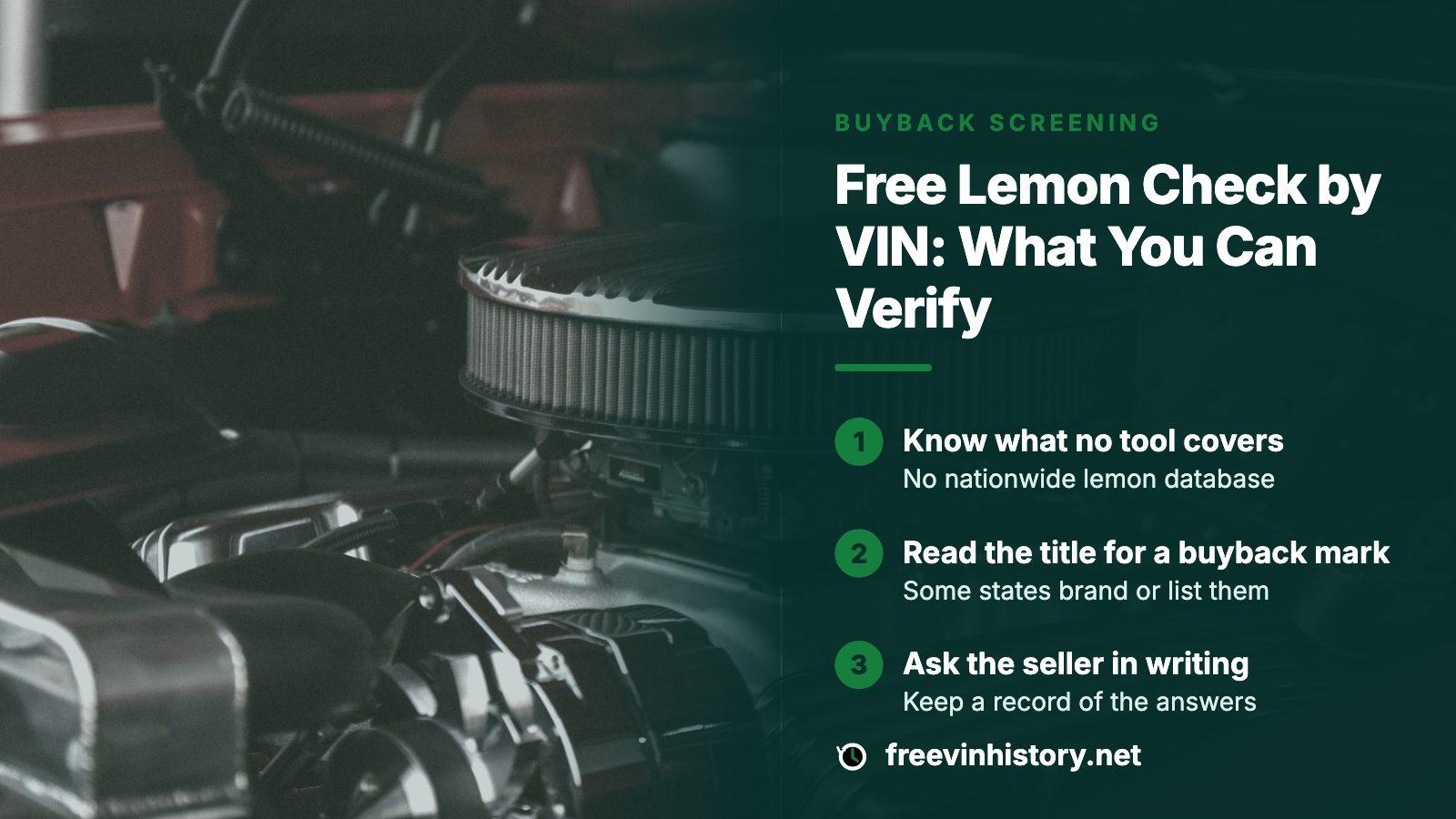
Nothing free covers lemon buybacks nationwide. NICB's VINCheck reads theft, salvage and flood claims only, NHTSA reads recalls, and some states, Florida for one, brand the title or post a buyback list. Use those, inspect the title itself for a buyback mark, and put your question to the seller in writing. Our preview costs nothing; the report is a paid step for cars still on your list.
- NICB VINCheck
- Theft, salvage and flood from member insurers; no lemon status
- Daily cap
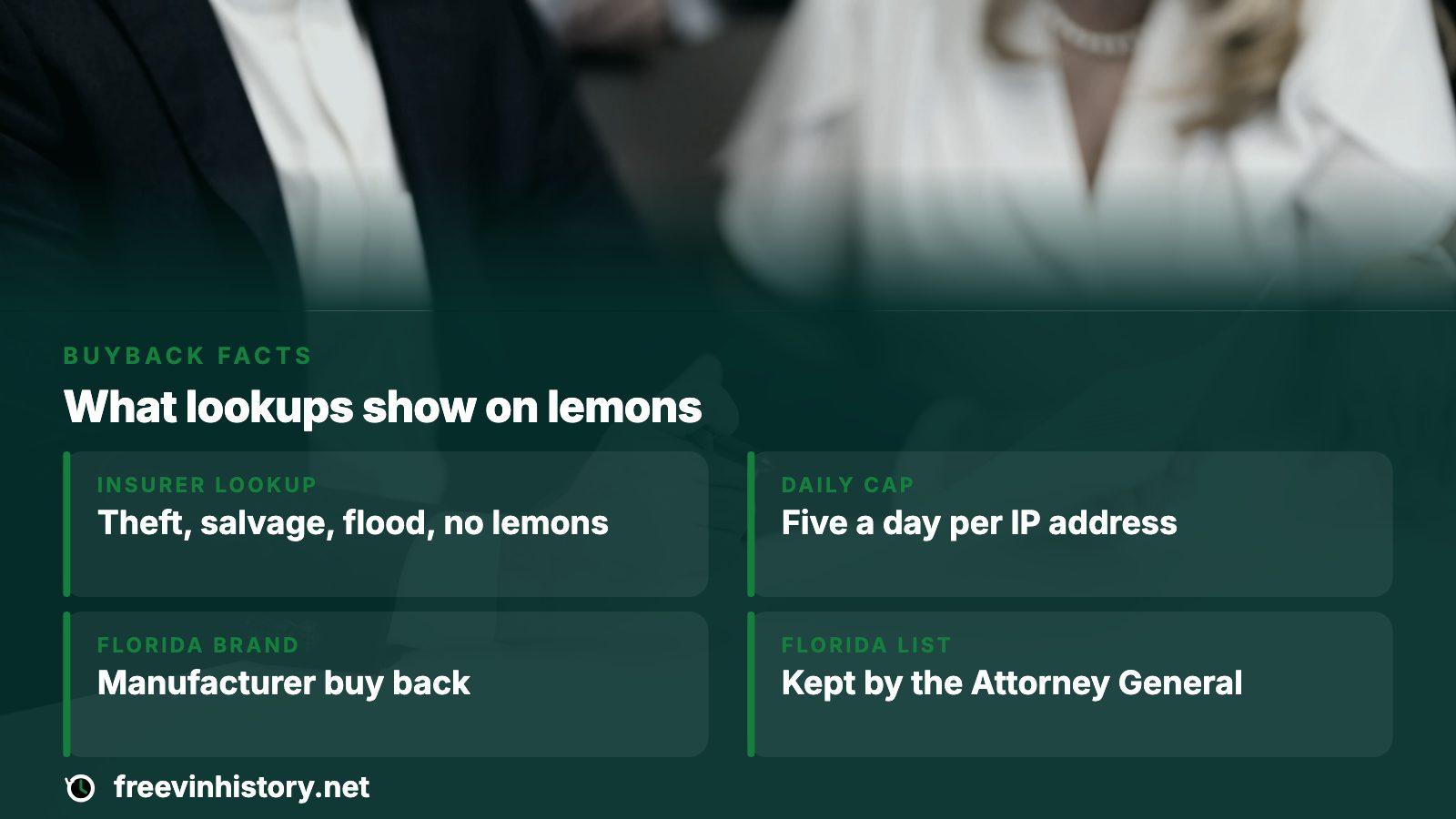
- Capped at five lookups a day per IP address
- Florida
- Buybacks are branded 'manufacturer buy back' and listed by the Attorney General
- Paid step
- Preview at no cost; full report bought once
What you are really trying to find
A lemon buyback describes a vehicle the maker reacquired once a customer's claim succeeded under a state lemon statute. The record you want is not a damage report. It is a title or registry entry saying the maker repurchased the vehicle, and it lives with the state that handled the claim.
That detail shapes everything below. Each state writes its own lemon statute, which means branding and disclosure rules vary by jurisdiction, so a tool that reads insurer files or federal safety data will not see most buybacks. Searching for a lemon is a title question first and a database question second.
The no-cost sources worth five minutes
Three sources cost nothing and each answers a different slice of the question. None of them is a lemon database, but together they rule out a lot.
| Source | What it can tell you | What it will not tell you |
|---|---|---|
| NICB VINCheck | Whether member insurers reported the VIN stolen and unrecovered, salvage or flood damaged | Buyback status, repairs, anything an insurer never reported |
| NHTSA recall search | Whether this exact car has an unrepaired recall | Repaired recalls, very old recalls, non-safety campaigns |
| A state buyback list, where one exists | Whether a manufacturer repurchased the VIN under that state's law | Buybacks handled in other states |
Treat a clean answer from any of them as one data point. A clean NICB result in particular says nothing about a repurchase, because lemon claims are settled between owner and maker, not filed with an insurer.
Where NICB's lookup helps and where it stops
NICB's VINCheck draws on member insurers that together represent 92.49% of U.S. earned premium, as of August 2026. Type the VIN in exactly, all 17 digits, or a match can slip past. Searches are rationed to five per IP address per day, so a shopper weighing several cars should choose the order carefully.
Its own page is blunt about limits: only participating insurers' records appear, law enforcement files are not searched, and it is not a complete history report. For a lemon question the practical value is indirect. A salvage or flood flag on the same VIN tells you the car has a harder story than a repurchase, which changes how you negotiate.
State buyback lists and brands: Florida as the example
Florida shows what a workable state system looks like. If a maker settles or loses a claim and takes back a new car, the law makes it report the repurchase to the state's top legal office and get the title stamped 'manufacturer buy back'. That office then publishes the vehicles in a list.
A disclaimer sits on top: the list is informational, built from submissions, and cannot be treated as every repurchase made under Florida's statute or comparable ones in other states. Each row separates the 'Name Plate' maker, who first sold the car, from the 'Liable' maker, who took it back. Ask about a particular car by sending the VIN, make and model.
Other states differ
Florida's rules are confirmed here only for Florida. Before you rely on a buyback list or brand in any other state, read that state's attorney general or motor vehicle agency page, because the wording, the list and the disclosure duties vary.
Read the title and paperwork like a skeptic
The most reliable free evidence is on paper. Before talking price, get the seller to hand over the title. Read the brand area for wording like the Florida phrase above, and compare its VIN against the number stamped on the vehicle, since a mismatch settles the matter.
- Ask in writing whether the maker ever repurchased or replaced this car, and keep the answer.
- Look for a brand, stamp or note on the title that mentions a buyback or manufacturer repurchase.
- Check whether the title came from a different state than the one where the car is for sale.
- Ask a dealer for any state disclosure form that applies and read it before signing.
A clean-looking title from a state that does not brand buybacks proves little. That is where a broader record search earns its place.
Run the VIN the right way
NHTSA lists the lower-left corner of the windshield, the registration card, and at times the insurance card. Take the number off the car itself and test it against the papers, not a listing someone typed.
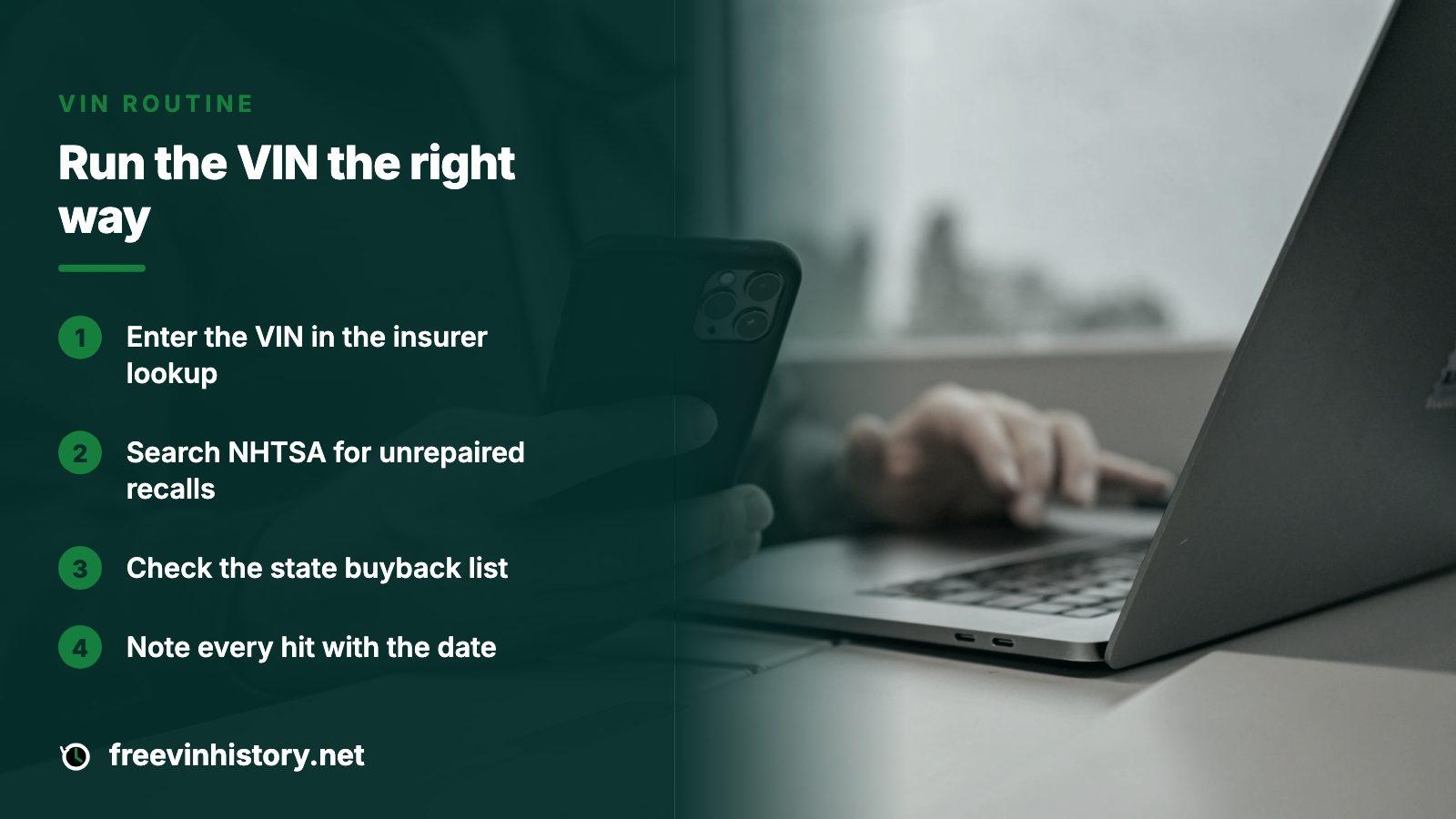
- Enter the VIN in NICB's lookup and jot down any theft, salvage or flood hit.
- Search NHTSA's recall tool for the same VIN and note any unrepaired campaign.
- Check the state buyback list if the car was first sold in a state that publishes one.
- Open the preview here to learn which record types exist for that VIN.
Write down each result with the date, since recall lists and insurer files change over time.
Recalls and repair patterns as a stand-in
Many lemons never carry a brand, so owners and buyers sometimes look for repeat repair patterns instead. NHTSA's recall search shows only unrepaired recalls on a specific VIN, and its complaint database is a public record of owner reports with personal details removed.
That makes complaints useful context for a model year, not proof about one car. When one failure repeats across many filings for your model year, request the invoices that show what the shop actually did.
From an NHTSA owner complaint
A 2012 Ford Focus owner's relative told NHTSA that the transmission slipped at highway-ish speed, was repaired, then failed again, and the clutch and transmission were later called for replacement without a fix. The manufacturer mentioned a buyback and sent the owner to NHTSA's hotline. The failure came near 110,000 miles.
Take from it that a repurchase offer can follow repeated failed repairs, and that the resulting car may not announce itself unless the title or a record does.
When the free checks run out
Free sources split the question into pieces, and the pieces rarely line up for a car that moved between states. NICB itself notes that complete history reports reach past insurers into motor vehicle title files, auction lots and shop records, and that most carry a charge.
In this case the preview is without charge and hints at whether title, damage or auction entries exist for the VIN. To read the full report means one purchase with nothing billed monthly; pricing lives on its own page. Save it for a car that has survived the earlier steps, then hold the title chain up against the seller's story.
Decide what the result means for your offer
If you find a buyback brand or a listing, you are not forced to walk away, but the price and the paperwork must change. Ask for the repair history, get an independent mechanic to inspect the failing system, and expect the discount to be real because the next buyer will apply it too.
If nothing turns up, do not read that as a guarantee. Keep the seller's written answer, the dated search results and the title photo together, and walk away from any seller who refuses to let you inspect the car or see the title.
Where this information comes from
- NICB: VINCheck lookup — what the insurer-based lookup covers, its search cap and its stated limits
- NHTSA: Check for Recalls — what the VIN recall search shows and omits, and where the VIN is printed
- NMVTIS: Vehicle history — the federal title system's purpose, and the fact that its pages do not mention lemon records
- Florida Attorney General: Vehicles bought back under Florida's Lemon Law — buyback title brand, notification duty and the published list with its caveats
- NHTSA owner complaint 11551631 — owner experience, paraphrased
Sources and photos: Facts checked against the sources above in November 2026. Photos by Victor Hughes, Anastasiia Nelen and Carrie Allen www.carrieallen.com on Unsplash; diagrams by FreeVINHistory.
Keep reading
- Rebuilt title check free: what you can learn before payingAnother title brand that hides in plain sight, and how to spot it before you pay.
- Free salvage title check by VIN: what the free lookups showWhat a salvage flag means, since a buyback car can carry one too.
- Car title search by VIN free: what you can see before you payHow to read the title record itself, where a buyback brand would appear.
- NMVTIS report: what the federal title record shows and missesHow the federal title database fits in, and what it leaves out.
Frequently asked questions
Is there a free lemon check that works in every state?
Not one I could confirm. Each state writes its own lemon law, so the brand and any list differ. Florida publishes a buyback list and brands the title, but that covers Florida cases only. Combine the title, NICB, NHTSA and a state page where available, then ask the seller in writing.
Does NICB VINCheck show lemon buybacks?
Its description lists theft, salvage and flood results from participating insurers, and nothing about lemon status. It also says clean results are no guarantee. Use it to catch other problems, not to clear a car of a manufacturer repurchase.
Can an NHTSA recall check tell me if a car is a lemon?
No. It shows unrepaired recalls for a VIN, not repurchases. Repaired recalls and non-safety campaigns are absent. It still matters, because an open safety recall should be fixed, and the repair is something to ask the seller about.
Which questions belong in a message to the seller?
Ask whether the manufacturer ever repurchased or replaced the car, who owned it first, and which state issued the first title. Ask for repair invoices and photograph the title. A seller who dodges a written question has told you something.
Is the full report free?
No. Only the preview comes at no cost. A lemon report is a single payment that does not renew, and the pricing page gives the amount. Begin with the preview, and pay only for a car that holds up through your other checks.
Now check the car itself
The guide explains what to look for. The report shows what this VIN has on record.