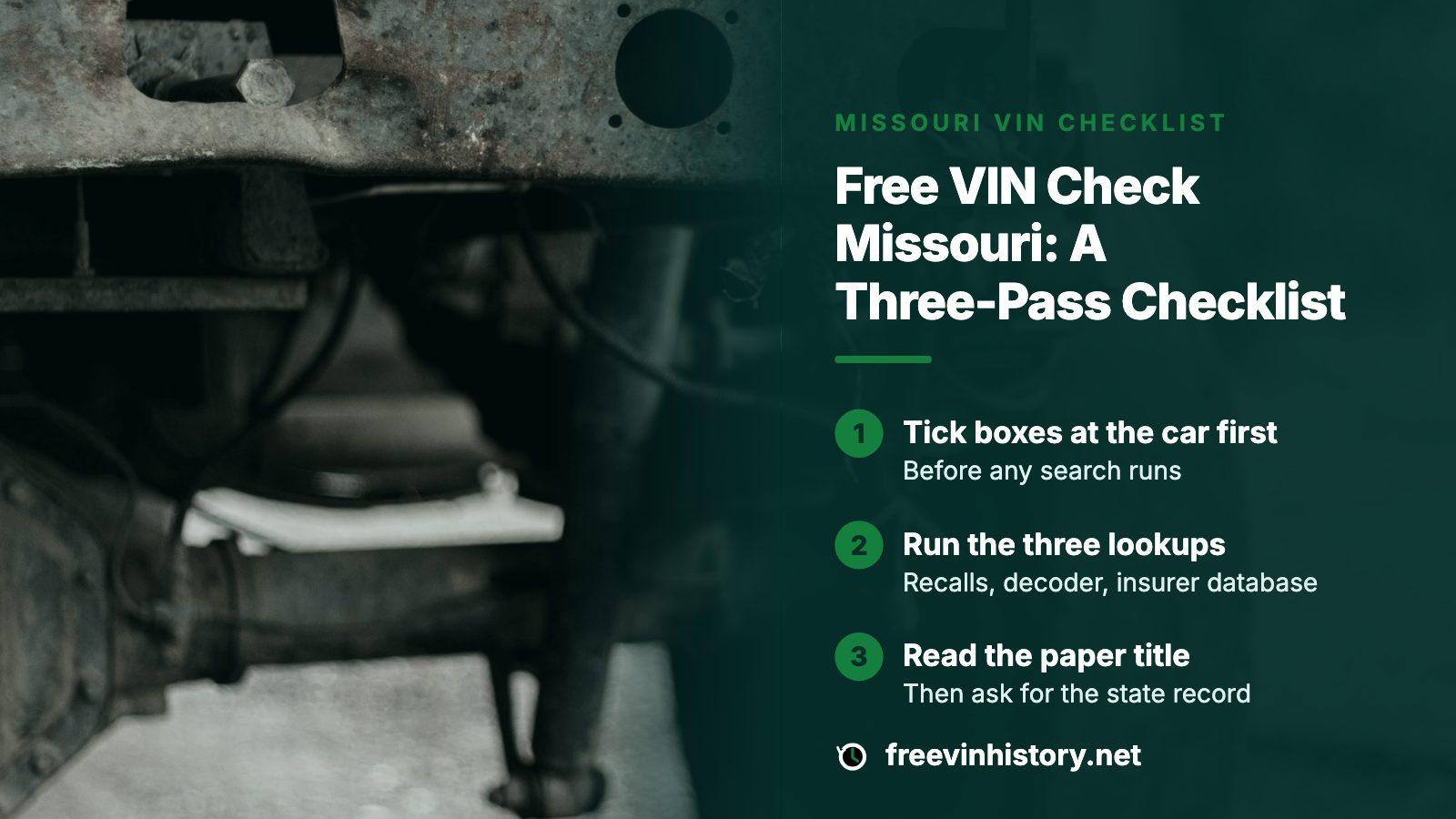
THE SHORT ANSWER
Partly. NHTSA's recall search, NHTSA's VIN decoder and NICB's insurer lookup cost nothing, and the paper title is yours to read. None of them shows repairs, mileage history or auction photos. Missouri's Revenue Department hands out a title and registration record on a request form, and an approved provider's national title report fills in brand history. The preview on this site shows which deeper records exist for a VIN before you pay anything.
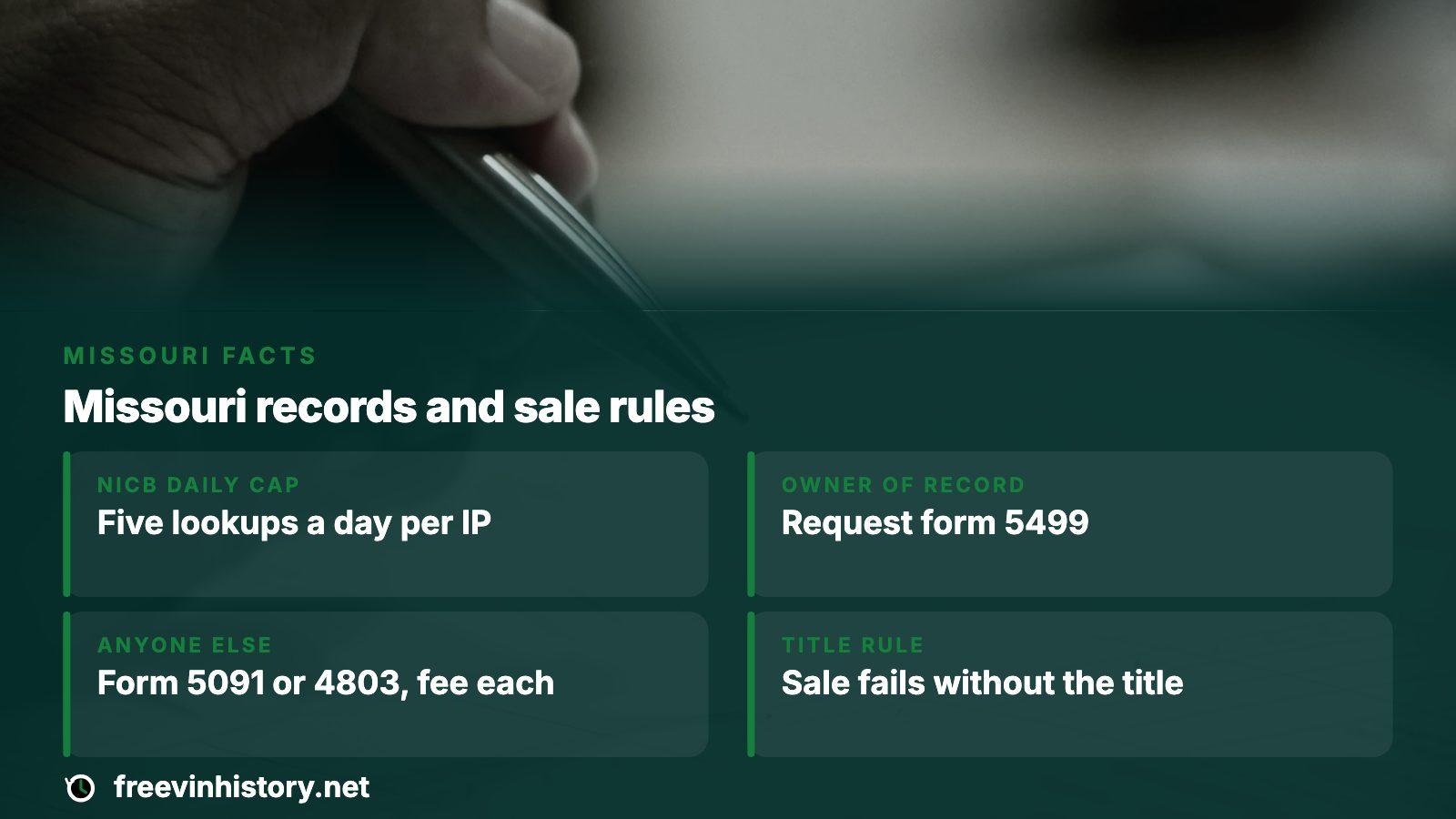
- NICB daily cap
- Five lookups a day from one IP address
- State record, owner of record
- Request form 5499
- State record, anyone else
- Form 5091 or 4803, with a fee for each record
- Missouri title rule
- Sales usually fail if the title is not handed over at purchase
The three passes, and what each one can settle
Take the passes in sequence. What you learn early shrinks the questions left for later, and any paid report comes last.
| Pass | Where it happens | Cost | Question it answers |
|---|---|---|---|
| 1. Car and paper | In person, title in hand | None | Does the paperwork belong to this car, and does the car match its story? |
| 2. No-charge lookups | Online, three tools | None, with a daily cap on one of them | Recalls waiting for repair, insurer theft and salvage flags, a VIN that decodes to the ad |
| 3. Title and state record | The title, Revenue Department forms, a national title provider | Fees for the record request and for a provider's report | Brands, owner and lien details, earlier states |
| Then: full report | Preview on this site first | Preview at no charge, then one payment | Accident, damage, mileage and auction records for one VIN |
Pass one: tick these at the car, before any search
Most Missouri problems show up in the driveway. The attorney general's consumer guide warns that under state law most car sales are void when the title does not change hands at the moment of purchase, so the paper matters as much as the metal.
- Take a photo of the 17-character VIN at the dashboard corner by the steering wheel, then compare that photo with the registration card.
- Compare every character of that VIN with the title and the listing, and confirm the seller is the person the title names.
- Insist on the title itself in the seller's hands, not a promise to find it.
- Flood tells: a musty or over-perfumed cabin, mud or water lines under carpets and mats, rust on upper door hinges, trunk latches or console screws.
- Arrange for a mechanic who owes the seller nothing to look the car over.
Pass two: the three lookups that cost nothing
Each tool answers one narrow question, and each has a blind spot to know about first.
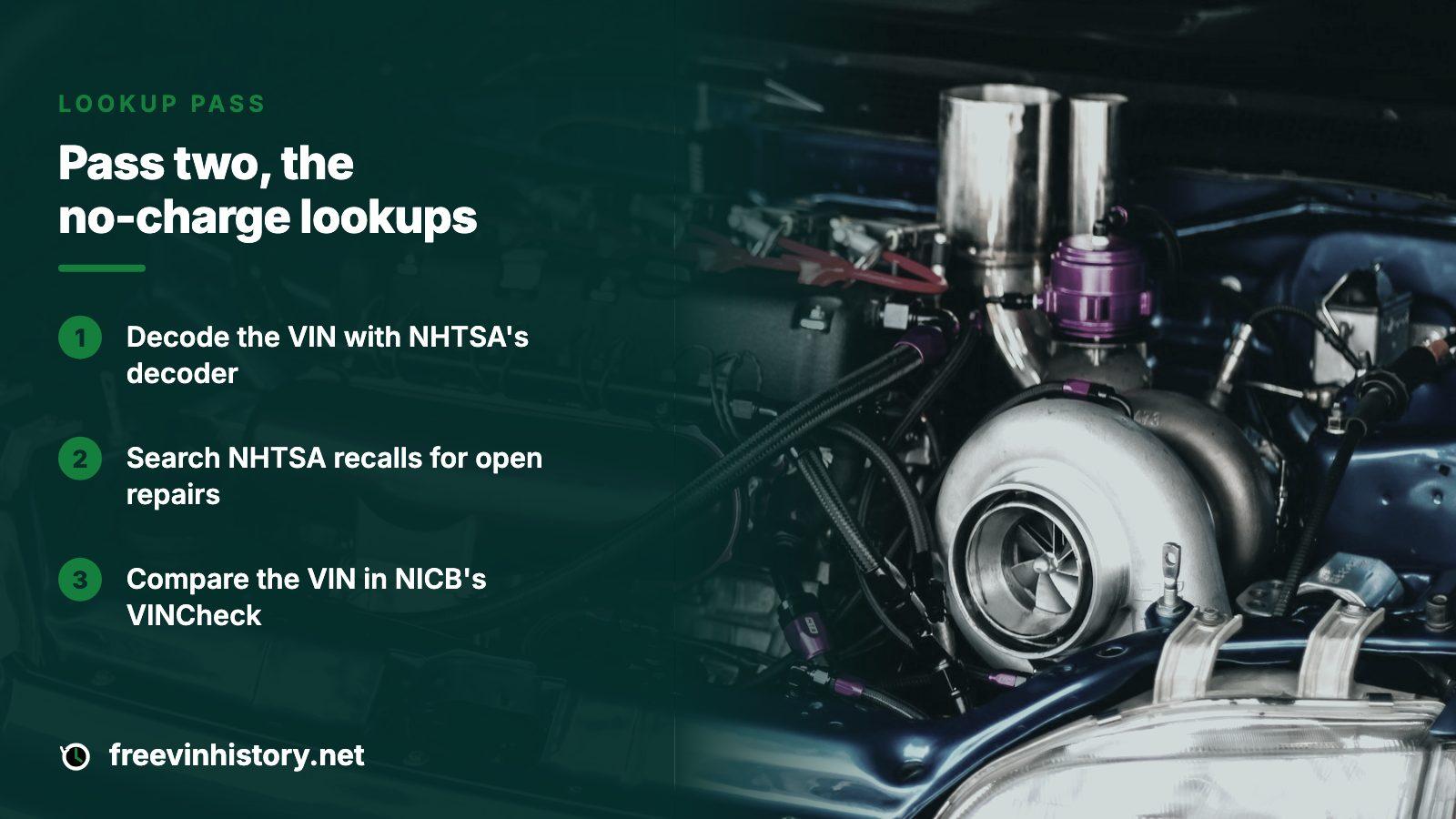
- NHTSA's VIN decoder unpacks what the number encodes, as reported by the maker, down to the plant that built the car. Match its make, model and year to the ad. A mistyped VIN can trip a warning about the ninth character, so read any error line.
- NHTSA's recall search names a safety recall still waiting for repair, or answers 0 unrepaired recalls. It leaves out recalls already fixed, very new ones not yet tied to every VIN, safety campaigns older than 15 years that the maker has stopped covering, and small manufacturers.
- NICB's VINCheck compares the VIN with entries from participating insurers: stolen and never recovered, or declared salvage or flood-damaged. NICB allows five lookups from one IP address within a day, and a wrong character in the VIN can hide a match.
What a clean answer from the free lookups still leaves open
A salvage entry from NICB means the insurer wrote the car off, deciding repairs would eat too large a share of its worth and paying out instead. Written-off cars can lawfully come back with a new title after repairs, so a hit calls for digging rather than an automatic no.
Clean is not the same as clear
NICB says VINCheck is not a complete history and a clean answer is no guarantee. Its data comes only from insurers that take part, and police files are outside its reach. A wreck nobody claimed on, or a loss recorded by a company outside the program, can pass every no-charge lookup. Missouri's attorney general adds that some databases run behind, so the mechanic's visit stays on the list.
Pass three: read the title, then ask for the state's own record
Look at the brand line on the paper title yourself. The attorney general names flood, junk, salvage and rebuilt as the words to watch for, and warns that a clean-looking title proves nothing about damage, since a title can be washed through another state or doctored to conceal a brand.
Missouri's Revenue Department also releases a motor vehicle record covering owner, vehicle, lien and registration details. The Justice Department's state-by-state list gives three routes:
- Owner of record: form 5499, handed in at a licensing office, mailed to the Motor Vehicle Bureau Record Center, or sent by e-mail.
- Anyone else who wants personal details: form 5091, with a fee for each record.
- Anyone else who does not need personal details: form 4803, again with a per-record fee.
The printout cannot stand in for the title at a transfer. Because the seller is normally the owner of record, asking the seller to order it is one option. Confirm the current fee and form on the department's own pages before sending anything.
The national title record, and the gaps in it
Entries in the national title system arrive from insurers, recyclers, junk and salvage yards, and each state's titling office. An approved provider sells a consumer search that can show the title's brand history, the newest odometer reading on file, any insurer write-off, and a sale to a salvage yard or recycler.
The Justice Department calls its own report brief by design, resting on five indicators, and admits a car can look cleaner than it is when a source never reported. Standards differ by state: a car one state brands salvage may escape the brand elsewhere because the damage sits under that state's threshold, and some states never issue a flood brand, so an out-of-state car deserves extra scrutiny. After 30 days without recovery, an insurer may record a stolen car as a total loss, and that record stays even when the car later turns up safe.
When the free passes are enough and when to add a report
A late-model car with the title in hand, clean results from all three tools and a mechanic's sign-off may need nothing more. Add a full report when any of these shows up:
- The title carries a brand, or came from another state.
- The seller's account of an accident does not match the car.
- The mileage looks low for the age.
- The price sits well under comparable cars.
Start with the preview on this site. Enter the VIN and it shows which accident, mileage, auction and lien records exist, with nothing paid up front. One payment buys one VIN's report. A shopper weighing several Missouri cars can buy a multi-report pack (3, 5 or 10 reports) instead, and nothing renews on its own. The pricing page lists current rates.
Missouri sale rules the checklist cannot settle
The attorney general's guide says state law gives a buyer no right to return a purchased car for any refund, and that a typical used car changes hands as is. Dealers must display a Buyers Guide on the window of every used car, with a box marking a warranty or as is, no warranty. Run the passes before you sign, not after.
If a sale goes wrong
The attorney general's consumer hotline is 800-392-8222, and the office takes complaints online as well. Keep the signed title, the receipt and your saved history results in one folder.
Where this information comes from
- NICB: VINCheck lookup — Supports the insurer-only scope, the daily search cap, the salvage meaning and the clean-result caution.
- NHTSA: Check for recalls — Supports what the VIN recall search shows and what it leaves out.
- NHTSA: VIN decoder — Supports the decoder's maker-reported data and plant details.
- U.S. Department of Justice: NMVTIS for consumers — Supports what the national title report holds, state differences and the reporting gaps.
- U.S. Department of Justice: State vehicle record request information — Supports the Missouri record request forms and who may use them.
- Missouri Attorney General: Tips to avoid flood damaged cars — Supports the paper-title check, flood signs, the independent inspection and the hotline.
- Missouri Attorney General: Student consumer guide — Supports the title-transfer rule, the no-return point and the Buyers Guide.
Sources and photos: Facts checked against the sources above in November 2026. Photos by Zoshua Colah, Willian Cittadin and Masjid MABA on Unsplash; diagrams by FreeVINHistory.
Keep reading
- Free VIN check through the DMV: what a state agency will and will not showHow state motor vehicle agencies answer a request for a free VIN check.
- Car title search by VIN free: what you can see before you payWhat a title check covers and where to run one.
- Free salvage title check by VIN: what the free lookups showSpotting a salvage history before you hand over money.
- Free flood check by VIN: what the free tools show and missFlood signs and records for a car from a storm-hit area.
Frequently asked questions
Is there a completely free VIN check for Missouri cars?
Not one that covers everything. NHTSA's decoder and recall search, plus NICB's insurer lookup, cost nothing, and the paper title is yours to read. The state record needs a form and a fee, and an approved provider charges for a national title report. The preview on this site shows which deeper records exist for a VIN.
Does Missouri's Revenue Department offer a VIN lookup of its own?
The Justice Department's state-by-state list points to request forms for Missouri, not to a public one-VIN search. The owner of record uses form 5499, and other requesters use form 5091 or 4803 with a fee for each record. The department's own pages carry the current forms and fees.
What if I hit NICB's search limit?
Come back the next day. The cap is five lookups a day per address, and nothing limits searches over time. Spend them on cars you are seriously weighing, and copy the VIN straight off the car so a typo does not burn one.
Does a salvage result mean I should walk away?
Not automatically. NICB explains that a salvage result means an insurer paid out on a total loss, and the car may still be repaired and titled again. Look for a rebuilt brand, ask for repair paperwork and let an independent mechanic examine the structure and wiring.
Can a clean title still hide flood damage?
Yes. Missouri's attorney general says a clean title does not prove a car is undamaged. A title can pass through another state or be doctored without showing it. States also define flood differently, so pair the records with a physical inspection.
Now check the car itself
The guide explains what to look for. The report shows what this VIN has on record.