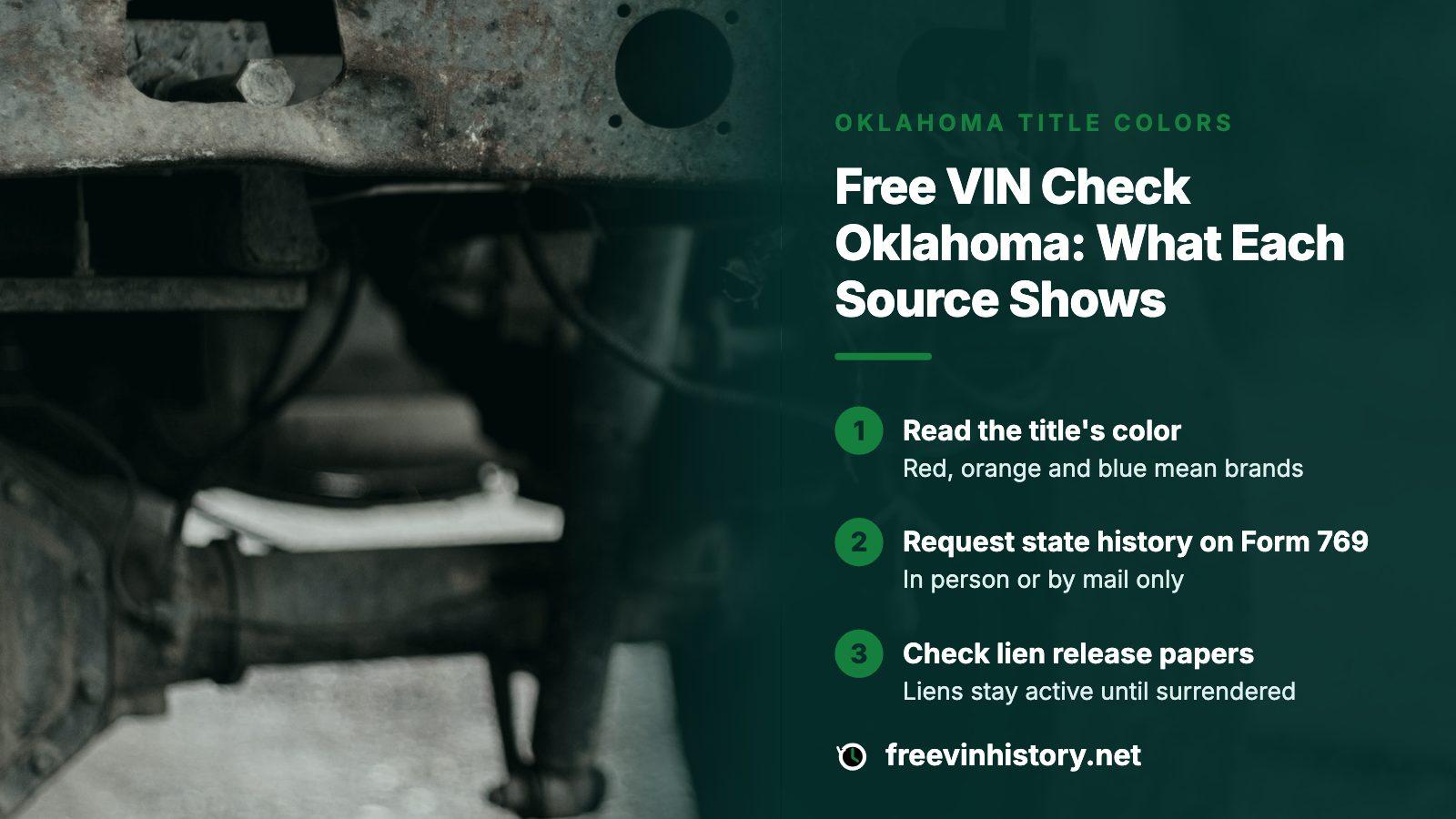
THE SHORT ANSWER
Start with NHTSA's recall search and NICB VINCheck, both at no cost, then look at the title's paper: orange marks a rebuilt car, red a salvage one, blue a junked one. Oklahoma's own title history needs a notarized Form 769 and a small fee. Accidents no insurer heard about, and brands from other states, stay out of reach.
- Title colors
- Green standard, red salvage, orange rebuilt, blue junked
- NICB limit
- 5 searches per IP address in 24 hours
- State title history
- Form 769, in person or by mail only
- Out-of-state cars
- Physical VIN inspection before an Oklahoma title
The free sources compared
Free vehicle history starts with what public agencies and one insurer-backed nonprofit publish. The table puts them next to each other so you can see which question each one can answer for an Oklahoma car, and which it cannot.
| Source | Cost to you | Answers | Silent on |
|---|---|---|---|
| NHTSA recall search | Free | Does this VIN still have an open safety recall | Repaired recalls, crashes, brands |
| NICB VINCheck | Free, 5 searches a day | Theft, salvage or flood reports from member insurers | Law enforcement files, insurers that opt out |
| Title color | Free, in hand | Standard, salvage, rebuilt or junked status in Oklahoma | What happened in another state |
| Form 769 request | Small state fee | Ownership, liens, title transactions | Damage, auctions, instant answers |
| Full report | One payment, see pricing | Records from many sources in one place | Anything never reported anywhere |
The two instant lookups
Paste the VIN into NHTSA's page and it tells you whether a safety recall is still waiting for a repair. A car with none gets a one-line message of zero. A batch box takes as many as 100 VINs together, useful when you are weighing a whole row of listings.
NICB VINCheck asks something else: has a member insurer reported this car as stolen and unrecovered, as salvage, or as flood damaged? The insurers taking part account for 92.49 percent of earned U.S. premium, which is a great deal of coverage but not every company. Each IP address is limited to five searches a day, and a single wrong character can leave you with no result.
Read both clean results carefully
NICB states that a clean answer guarantees nothing. NHTSA's search skips recalls already repaired, and anything beyond 15 years old, unless the maker still covers it. Two clean screens narrow the field. They do not clear the car.
Oklahoma's colored titles do some of the work
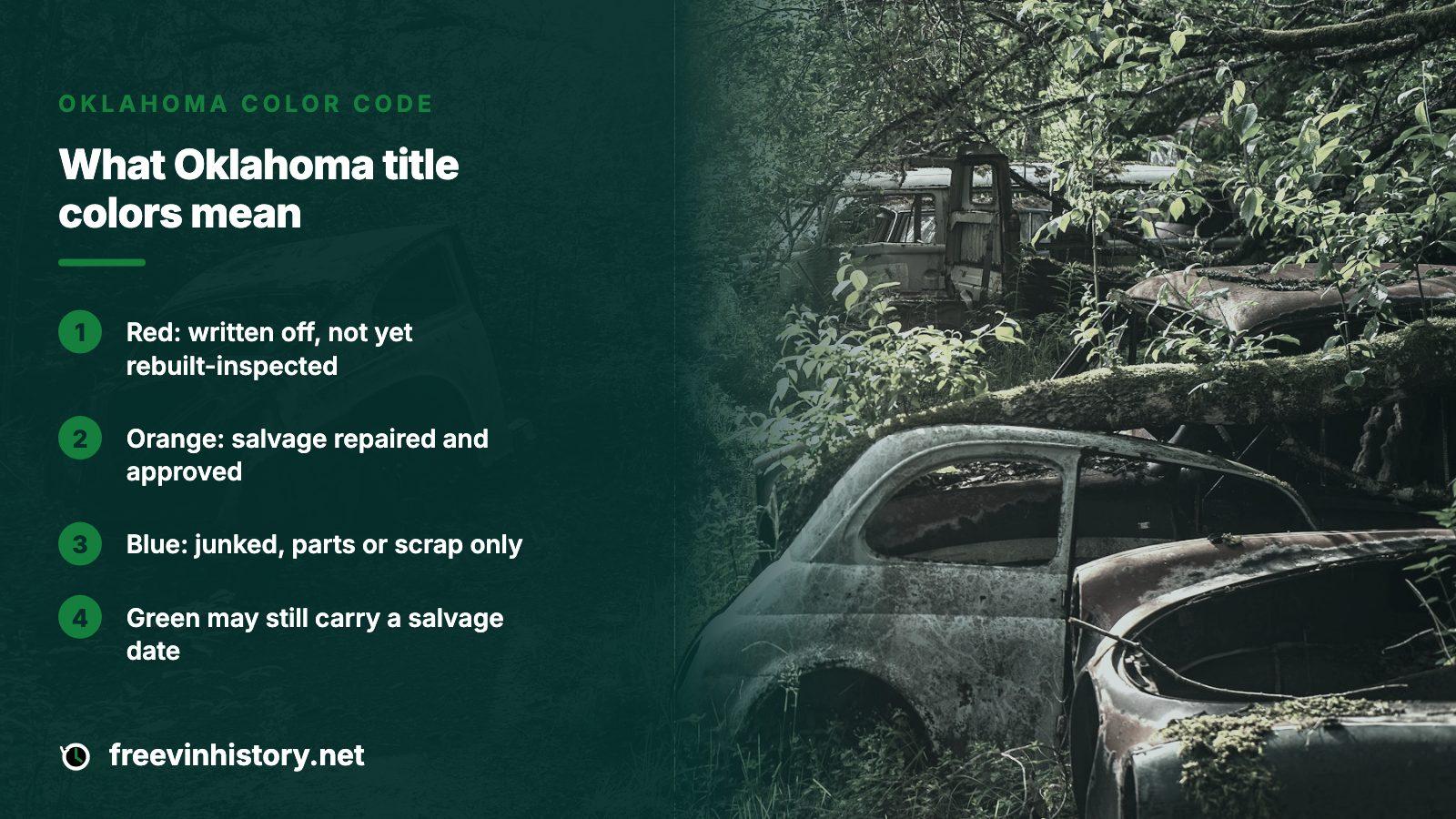
The Tax Commission's rules assign each type of Oklahoma title a paper color. Standard titles are green, salvage red, rebuilt orange and junked blue. Unrecovered theft prints purple. A seller who hands you anything but green has just told you something the free databases might not.
- Red: the car was written off or badly damaged and has not been through the rebuilt inspection.
- Orange: a former salvage car, repaired and approved at an agent's rebuilt inspection.
- Blue: junked, meaning no use beyond parts or scrap.
- Green with a salvage date: possible on older cars, since vehicles beyond 10 model years can move in and out of salvage freely.
Oklahoma also brands a car Flood Damaged when it was a salvage or rebuilt flood vehicle, or when it was submerged to or above the dashboard and the insurer paid a loss. Water below that line, or a flood nobody claimed, may leave no brand at all.
The state record: Form 769
Service Oklahoma's pages list no instant public title lookup. Title histories come from Form 769, the Vehicle Information Request, submitted in person or by mail. The signature must be notarized, and each vehicle needs its own form with at least one identifier such as the VIN, plate, decal or title number.
The fee schedule printed on the form, as I read it, starts at $1.00 for current ownership and lienholder details, rises to $7.50 for a microfilm search, and adds a $1.73 mail fee to each. Its middle option costs $5.00: a printout summarizing title transactions since 1992, with no copies of the paperwork itself. Check the form for current amounts.
Who may ask
Whoever signs has to tick one eligibility statement. The categories printed on the form include owners, people holding the owner's written authority, towing firms, businesses checking data they were given, court matters, insurers, licensed investigators and government agencies. A shopper with no deal yet fits none of them cleanly, so the practical route is asking the seller to send the request.
A car that arrived from another state
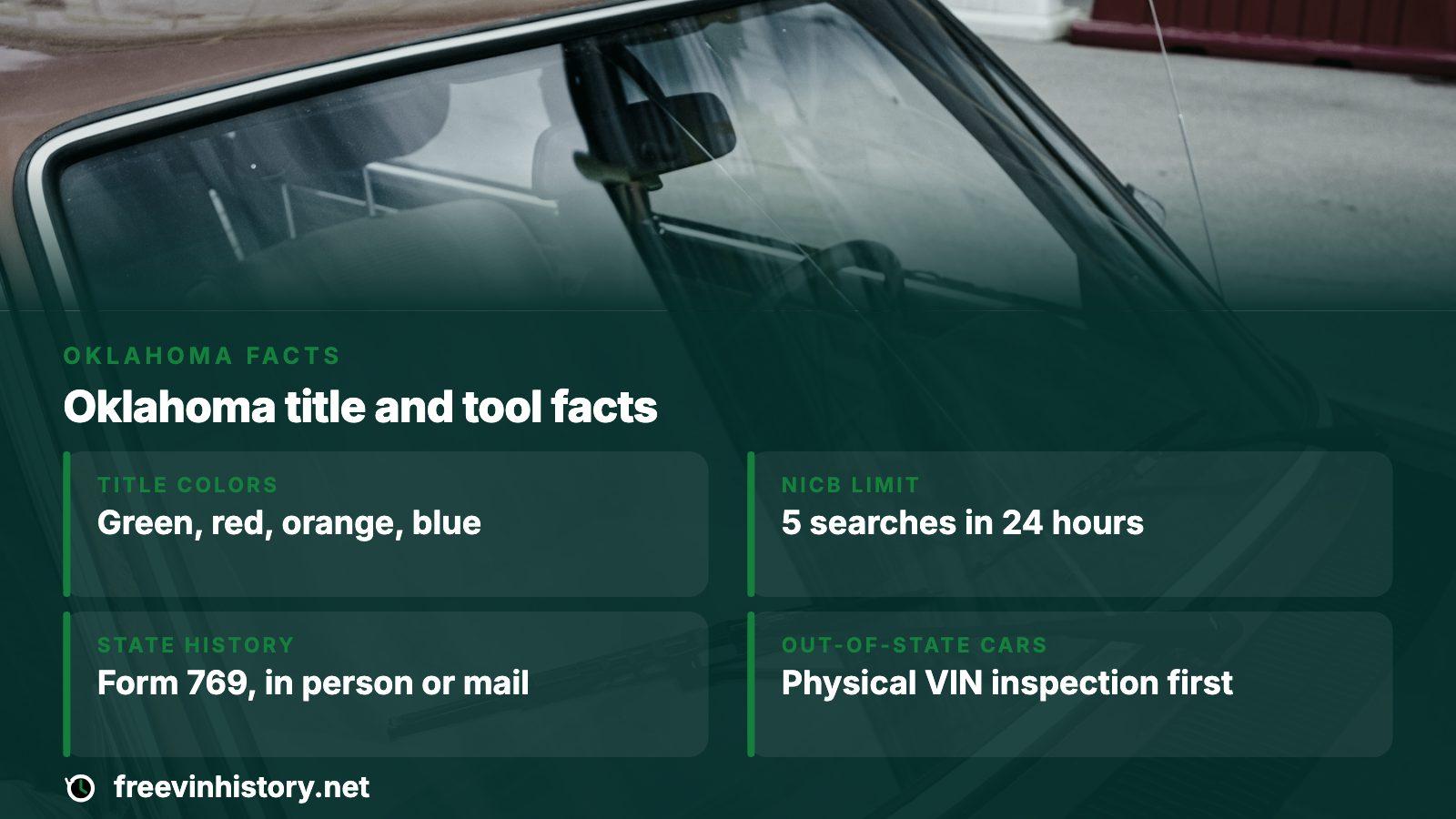
Oklahoma physically inspects most previously titled out-of-state cars before issuing its own title. The agent records the VIN and odometer reading from the car and compares the VIN to the old paperwork. That catches mismatched numbers. It is not a damage review, and it tells you nothing about what the car went through before.
The federal NMVTIS database fills some of that hole: once a state applies a brand, it remains in the national record permanently. Its own consumer page warns that only part of the country reports into it, so an empty search can still be a false negative. States define salvage and flood differently, which means a car branded elsewhere may look ordinary under Oklahoma's rules.
What the seller's paperwork should show
- A title in the seller's name, notarized when it changes hands, or Form 718 if the title is electronic.
- Proof any lien was released, since liens stay active in state records until a release is surrendered.
- An odometer disclosure on vehicles from 2011 or newer.
- The same VIN, character for character, at the dash, in the title and in the bill of sale paperwork.
Oklahoma now issues titles electronically. With a lien on the car, the lienholder holds the title, so a seller who cannot produce one may be telling the truth about a loan. Ask for the lender's name rather than walking away, and have the payoff handled before money changes hands.
When the preview and a full report make sense
For a cheap runabout, the recall search, NICB and a hard look at the title may be enough. Add this site's free preview when the price is meaningful or something above looked off. It tells you whether deeper records, like brands, damage entries, mileage readings or auction history, turn up for that VIN.
The full report comes as its own step and always costs something. It is one payment with no renewal, and the rates are posted on the pricing page. NICB itself points out that complete history reports pull from wider sources and mostly carry a charge, which is the gap this step fills.
Results that should slow the sale
- A salvage, flood or theft hit from NICB that the seller never mentioned.
- A red, orange or blue title presented as an ordinary clean one.
- A VIN that differs between the dash, the title and the paperwork.
- An open recall the seller says was handled, with no repair record to show.
- A seller who refuses to ask the state for the title history.
If you suspect a fraudulent sale, NICB takes reports online and at 800-TEL-NICB. Keep every message and document, and hold your deposit until the VIN checks out.
Where this information comes from
- NICB: VINCheck — what the insurer database covers, the daily search limit and its own warnings
- NHTSA: Check for Recalls — what a VIN recall search shows and leaves out
- Service Oklahoma: Vehicle Titles — electronic titles, transfer paperwork, out-of-state inspection and title history requests
- Service Oklahoma: Form 769 Vehicle Information Request — eligibility statements, record types and fee schedule
- Oklahoma Tax Commission: OAC 710:60 — title colors, flood brand definition and the out-of-state VIN inspection
- NMVTIS: Information for Consumers — what the national title database holds and where it can miss
Sources and photos: Facts checked against the sources above in November 2026. Photos by Zoshua Colah, Patrick von der Wehd and Max Tokarev on Unsplash; diagrams by FreeVINHistory.
Keep reading
- Free VIN check through the DMV: what a state agency will and will not showWhat a state motor vehicle agency can and cannot tell you from a VIN.
- Free salvage title check by VIN: what the free lookups showWhat to do when an insurer flag or a red title points to salvage.
- Free flood check by VIN: what the free tools show and missSpotting flood history that the title may not show.
- Car lien search free: what the free tools show and what they missHow to confirm a loan was released before you pay.
Frequently asked questions
Can I check an Oklahoma VIN for free?
Partly. The recall search at NHTSA and the insurer lookup at NICB cost nothing, and the title's paper color gives a quick brand clue. State title history costs a small fee through Form 769. Together they cover recalls, insurer-reported losses and Oklahoma brands, but not accidents that never reached an insurer.
Does Oklahoma have an online title search by VIN?
Service Oklahoma's titles page describes title histories as available through the agency, by mail or in person, using Form 769. It does not list a public instant search. Requesters confirm an eligibility reason on the form, and the signature has to be notarized.
What does an orange Oklahoma title mean?
Orange is the color Oklahoma assigns to rebuilt titles. A rebuilt car began as salvage, then was repaired and cleared an agent's inspection covering the VIN, the VIN plate and the odometer. It can be legal to drive, but the history lowers its value and deserves a close mechanical look.
Will NICB show a car that was in a crash?
Only if an insurer reported it as a salvage or flood loss, or as stolen and unrecovered. A collision that was repaired privately, or paid by a company outside the program, can leave no NICB record. A clean NICB answer therefore says little about ordinary accident history.
Do I pay for the report from this site?
Yes, the report costs money, though the preview in front of it does not. The preview hints at whether deeper records exist for your VIN. After that you pay one time, with no subscription, at the rates on the pricing page. The recall and insurer lookups above stay free at their own agencies.
Now check the car itself
The guide explains what to look for. The report shows what this VIN has on record.