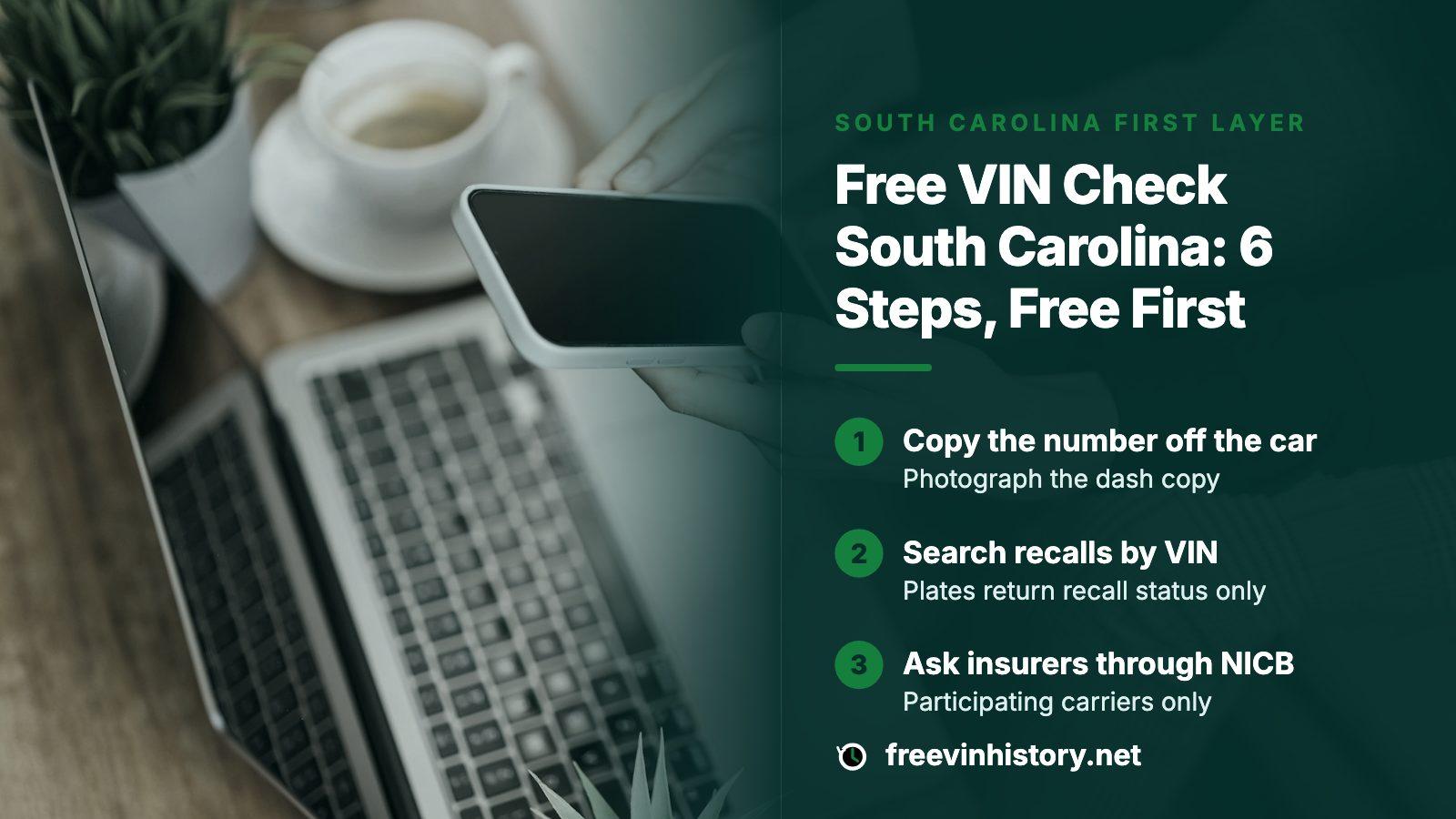
THE SHORT ANSWER
Yes, for the first layer. NHTSA's decoder and recall search, plus NICB's insurer database, cost nothing and need only the 17-character VIN. They show what the car is, whether a safety recall is unrepaired and whether a participating insurer logged theft, salvage or flood loss. They do not show repairs, owners or mileage over time. The preview on this site shows which records exist, and the report is a single payment.
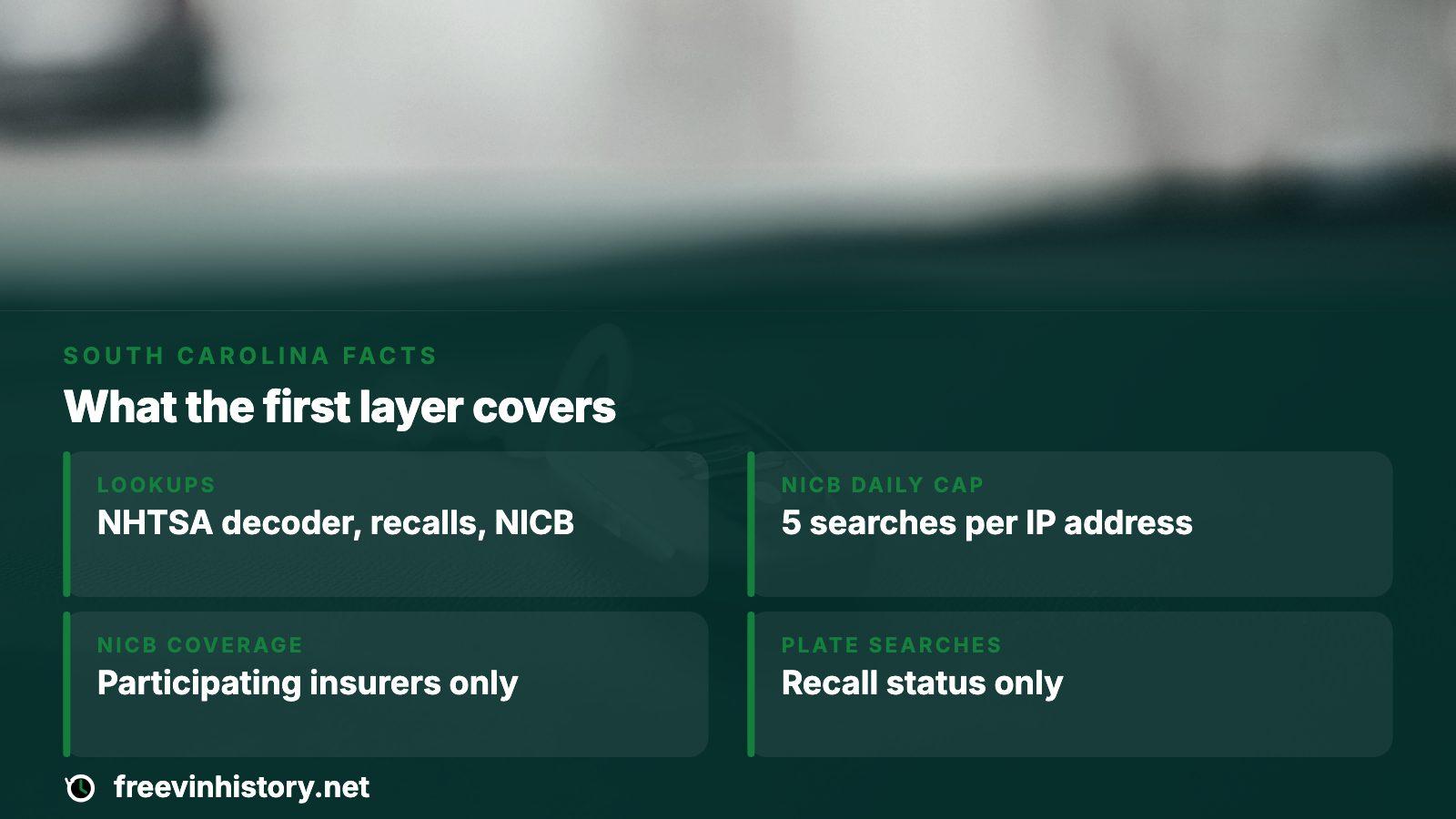
- Free lookups
- NHTSA decoder, NHTSA recall search, NICB VINCheck
- NICB daily cap
- 5 searches per IP address in 24 hours
- NICB coverage
- Participating insurers, 92.49 percent of earned premium
- Plate searches
- Recall status only; use the VIN for everything else
What the free layer covers on a South Carolina car
Think of the free tools as three filters, each catching a different kind of problem. None of them reads the state title file, which is why this page ends with a step up rather than a promise.
| Free step | What it answers | What it leaves open |
|---|---|---|
| NHTSA VIN decoder | Does the number describe the car in the listing? | Anything about the car's past |
| NHTSA recall search | Is a safety recall still unrepaired? | Repaired recalls, non-safety campaigns, very old recalls |
| NICB VINCheck | Did a member insurer report theft, salvage or flood loss? | Insurers outside the program, police files, uninsured damage |
| Full report, after a free preview | Title, mileage, auction and lien records together | Damage nobody ever recorded |
Step one: copy the number off the car itself
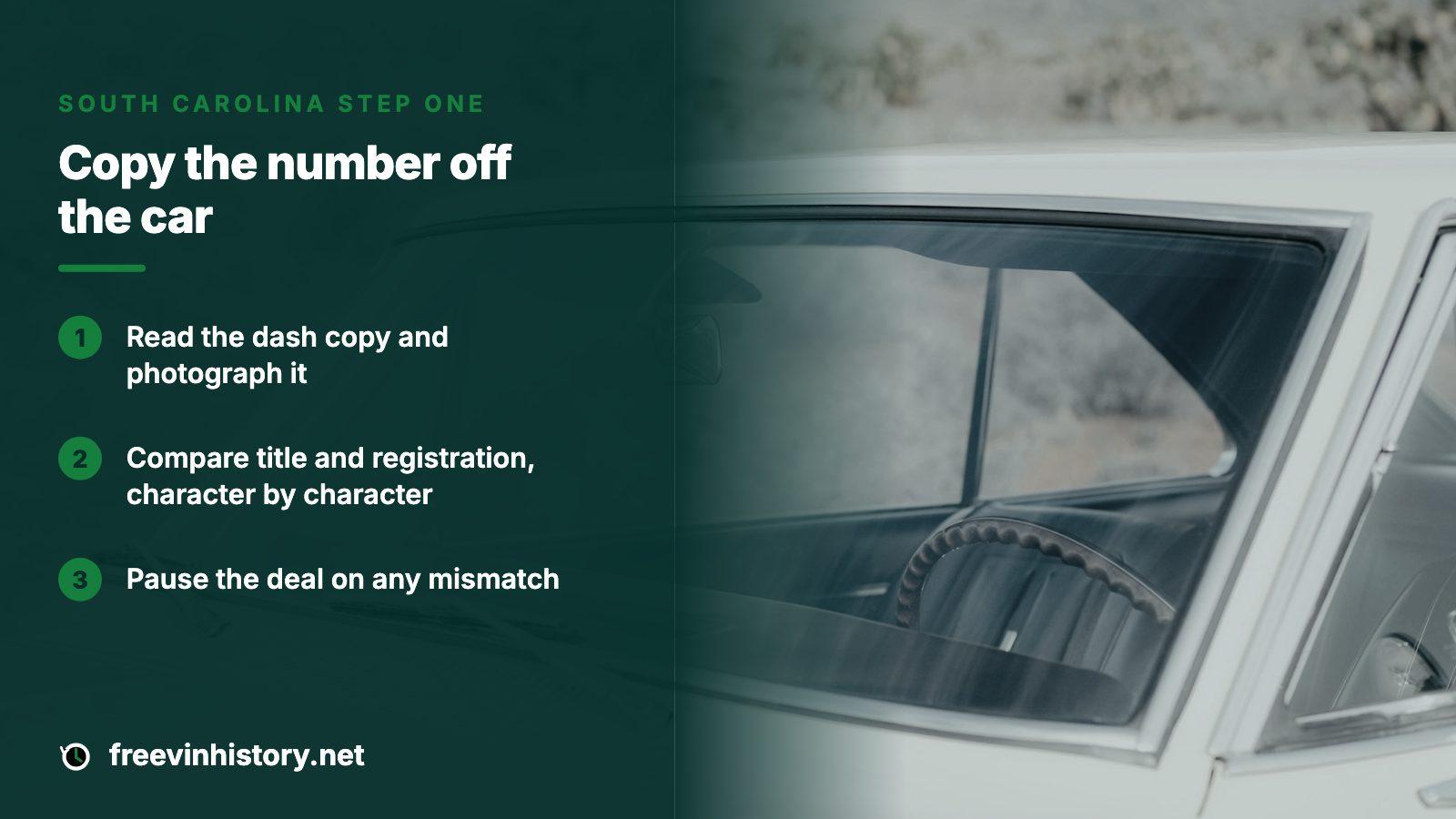
A seller's listing can carry a typo, and a swapped digit sends every lookup to the wrong car or to nothing. NHTSA describes it as a 17-character string sitting low on the left side of the windshield. The same number is printed on your registration card, and sometimes on the insurance card.
- Read the dash copy yourself and photograph it.
- Compare it with the number on the title and registration, character by character.
- Any mismatch between those copies is a reason to pause the deal and get an explanation.
Step two: decode it and compare with the listing
NHTSA's vPIC decoder takes the VIN, even a partial one, and returns what the number encodes, including the build plant and country. Because the maker supplies the data, an empty field only tells you NHTSA lacks an entry.
Use it as a sanity test. If the listing says one trim and engine and the decoder says another, the ad is wrong or the VIN belongs to a different vehicle. Either answer matters before you drive across the state to look at it.
Step three: search recalls by VIN, not by plate
On NHTSA's recall page you can type a VIN, or enter a plate and pick South Carolina from the state menu. A vehicle with nothing outstanding gets a message saying zero unrepaired recalls. The plate route only reflects what the state's motor vehicle records say, so if it returns a different vehicle, NHTSA tells you to contact the state DMV and search by VIN meanwhile.
What a clean recall result does not mean
The search skips repaired recalls, fresh announcements still waiting on VIN data, recalls older than 15 years, small manufacturers and non-safety service campaigns. A zero is good news about open safety recalls and silent about everything else.
Step four: ask the insurers through NICB
VINCheck answers one question: did a member insurer record this VIN as stolen and still missing, written off as salvage, or lost to flooding. NICB allows five lookups a day from one IP address, and a mistyped VIN can slip past a real record. The member insurers represent 92.49 percent of earned premium in the country.
If the answer is salvage, an insurer judged repair uneconomical and paid the owner instead. NICB notes it can legally be rebuilt and retitled, so the result is a reason to investigate, not an automatic no. On the other side, NICB warns that a blank result proves little.
Step five: the national title record, if the car is cheap or the story is thin
The federal NMVTIS system is built around five indicators: the title's current standing and last change date, brands any state applied, an odometer reading, and separate flags for total loss and salvage. Federal law obliges state titling offices, insurers and the scrap and salvage trades to feed it. South Carolina appears among the participating jurisdictions on the Justice Department's page for states.
Reports come from approved providers, not from the government directly. The department's buying-tips page mentions expecting to pay up to $4 per report. It also describes a clean NMVTIS report as intentionally short, since private providers add things NMVTIS leaves out, such as repair and maintenance data.
Where South Carolina's own title office fits
The state agency holds the title record and sets its own branding rules, fees and forms. This page does not quote those details, because the agency's website could not be read when we researched it, and a number printed from memory is worse than none.
- Ask the South Carolina DMV what title status and brand it shows for the VIN.
- Ask how it treats a car with a salvage or rebuilt history.
- Confirm any fee on the agency's own page before you pay it.
Reading the results together
One free result rarely settles a purchase. The combination does the work, so lay the answers side by side before you decide.
| What you saw | What it suggests | Next move |
|---|---|---|
| Decoder disagrees with the listing | Wrong ad or wrong VIN | Recheck the number on the car; walk away if it still differs |
| Open recall | Repair pending, usually at the dealer | Ask the seller to get it repaired first |
| Insurer salvage or flood flag | Severe damage or water loss on record | Get the full report and an independent inspection |
| Everything clean, but the price looks low | Gaps in free coverage, not proof of a clean car | Run the preview and weigh the report |
Step six: when to move up to the full report
Free tools stop where insurance and federal safety data stop. Accident records, mileage readings across owners, auction history with photos and lien records live elsewhere. Enter the VIN here and the preview, which costs nothing, reveals which kinds of record are on file for the car. Opening the full report takes one payment and no subscription; options sit on the pricing page.
Buy it when the free steps raised a question, or when you are close to handing over money. Add a mechanic's inspection, chosen by you, since both NICB and the NMVTIS pages recommend going beyond any one database.
Where this information comes from
- NICB: VINCheck lookup — Supports the insurer-only scope, the daily search cap, the coverage figure and the clean-result caution.
- NHTSA: Check for Recalls — Supports the VIN location, the plate option and what the recall search leaves out.
- NHTSA: VIN decoder (vPIC) — Supports what the decoder returns and its manufacturer-reported data.
- U.S. Department of Justice: Understanding an NMVTIS report — Supports the five indicators, the reporting sources and the short clean report.
- U.S. Department of Justice: NMVTIS used car buying tips — Supports the report cost mention and the advice to inspect and ask for records.
- U.S. Department of Justice: NMVTIS for states — Supports state participation in the national title system.
Sources and photos: Facts checked against the sources above in November 2026. Photos by Jakub Żerdzicki, Wesley Tingey and Bence Balla-Schottner on Unsplash; diagrams by FreeVINHistory.
Keep reading
- Free VIN check through the DMV: what a state agency will and will not showHow state motor vehicle agencies fit into a free VIN check.
- Free salvage title check by VIN: what the free lookups showWhat to do when the insurer lookup returns a salvage flag.
- Free flood check by VIN: what the free tools show and missSpotting water damage that never reached a database.
- Free VIN check in North Carolina: a six-step walk from decode to titleThe same check for a car coming from the neighboring state.
Frequently asked questions
Is there a free VIN lookup in South Carolina that shows accidents?
Not a complete one. NICB's lookup surfaces theft, salvage and flood entries that member insurers filed, which can expose a severe loss. Minor accidents, repairs paid in cash and damage on uninsured cars rarely appear anywhere free. A full report pulls more sources, and the preview here shows whether such records exist.
Can I check a South Carolina car by license plate?
NHTSA's recall page accepts a plate with South Carolina chosen, but it returns recall status only, and the answer can show a previous vehicle if records are stale. For title, salvage or theft questions, take the VIN from the car and use it instead.
What is the search limit on NICB's lookup?
The cap is five per IP address each day, with no ceiling over time. If you are comparing several cars, space the lookups across days or keep the shortlist small before you start.
Does a clean insurer result clear the car?
No. NICB itself cautions that a blank result is not proof, because only participating insurers are searched and police files are not queried. Treat it as one filter, then add the recall search, a title record and an inspection.
What does this site's report add over the free steps?
It brings title, accident, mileage, auction, lien and theft records into one document for the VIN, where the free steps each cover one slice. Only the preview is free; the report is a one-off payment, with options on the pricing page.
Now check the car itself
The guide explains what to look for. The report shows what this VIN has on record.