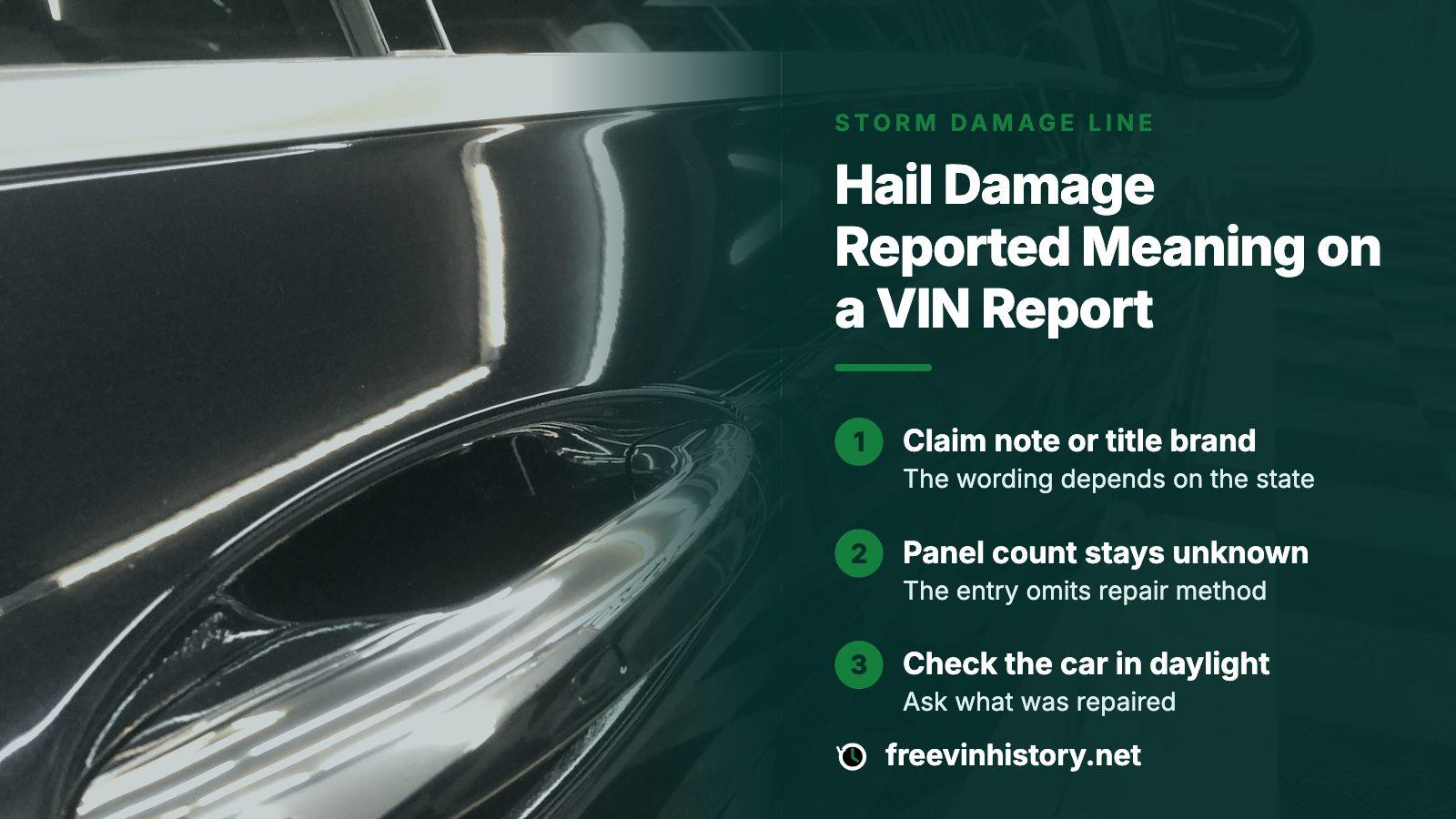
THE SHORT ANSWER
A hail damage reported line says some source logged storm damage against the VIN. Depending on the state and the repair bill, it can be a plain claim note or a formal title brand. It does not say how many panels were hit or how the repair was done. The free official tools mostly stay silent on it, so confirm with a title check, a paperwork request and a hands-on inspection.
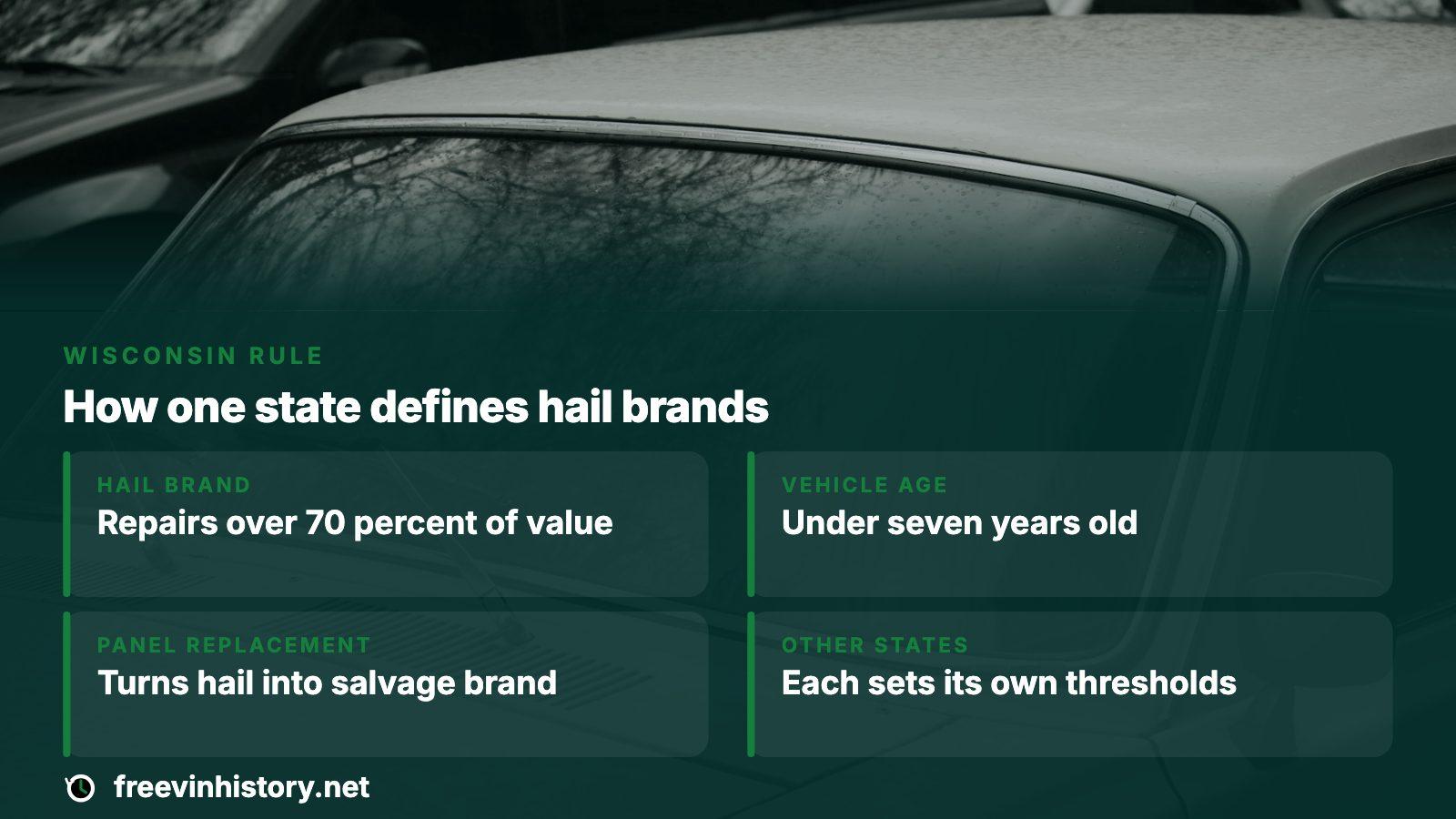
- Wisconsin hail brand
- Repair cost above 70 percent of fair market value, under seven years old
- Panel replacement
- In Wisconsin it turns a hail brand into a salvage brand
- Brand disclosure
- Wisconsin penalty for an undisclosed brand: up to 5,000 dollars
- Other states
- Each sets its own thresholds, so one state's numbers do not transfer
What the entry actually says
The line is short and the possible stories behind it are wide. A hailstorm may have left a handful of small dimples that an insurer paid out on, and the owner pocketed the money. Or it may have wrecked the roof, hood and glass, ended in a total loss, and produced a branded title. Both can read the same way on a screen.
Hail is also unlike a collision. Nothing bent the frame, and no airbag fired. The damage is mostly cosmetic and sits on the upward-facing panels, which is why some states give it a title brand of its own instead of lumping it in with crash salvage.
A title brand versus a claim note
A brand is a legal label printed on the title. A claim note is just a data point that someone recorded. You want to know which one you are looking at, because a brand follows the car permanently and changes what lenders, insurers and later buyers think of it. Wisconsin's transportation agency calls its brands a permanent record printed on each title issued for that vehicle.
- Title brand: a state-issued label on the certificate of title, visible to every future buyer.
- Claim or loss note: an insurer or repair record that never reached the title.
- Auction or damage listing: a sale entry that mentions hail, often with photos, but carries no legal status.
How one state defines it
Wisconsin spells its rule out, which makes it a handy example. The hail brand applies to newer vehicles, under seven years of age, whose only damage came from hail and whose bill for fixing it, taking the larger of the quote and the real invoice, passes 70 percent of what the car was worth on the market. The test also asks that the work needed or done leaves the original body panels in place instead of swapping the outer skin.
| Situation in Wisconsin | Brand outcome |
|---|---|
| Hail only, repair over 70 percent of value, no exterior part replaced | Hail damaged |
| Hail only, but exterior panels were replaced | Salvage |
| Collision or other cause, repair over 70 percent | Salvage (hail excluded from this test) |
| Damage paid by an insurer, repair over 30 percent, below the salvage line | Claim paid |
These are Wisconsin's numbers for Wisconsin titles. Another state may use a different percentage, a different age cutoff, or no hail brand at all, so read the issuing state's own page.
Why the panel rule matters to you
That Wisconsin split carries a hint about the car. A hail brand is meant for vehicles that took the beating but kept their original sheet metal. Once a shop swaps body panels, the brand gets stricter. So a hail-branded car is, in theory, one whose factory panels are still there, dents and all, or have been repaired in place.
In theory is the operative phrase. The brand tells you the category the car fell into at a point in time, not the quality of any work that followed. A cheap paintless-repair job and a careful one produce the same label.
What the free official sources show
NMVTIS, the federal title database that the Justice Department publishes through vehiclehistory.gov, is aimed at fraud, unsafe vehicles and resale of stolen cars. Its public page highlights flood notices in its news list; I found no hail-specific notice there. NHTSA's recall lookup covers open safety recalls, which is a different question from storm damage.
NICB's free VINCheck blocked my automated request, so I cannot tell you what it lists for hail. Treat the free tools as a first screen for theft, salvage and recalls, and expect a hail note to turn up, if at all, in a fuller report or on the title itself.
What owners say happened afterward
Two filings with NHTSA show how a hail history can complicate ownership later.
From an NHTSA owner complaint
Filing in August 2024 about a 2019 RAV4, a driver explained that an insurer wrote the SUV off after a hailstorm. The maker then refused to touch a drivetrain part that its own bulletin called faulty, pointing to the write-off. The driver's position: the weak part was built in long before the storm.
A write-off in the past may change how a maker responds to a known defect, so ask the dealer in advance what support the car still gets.
From an NHTSA owner complaint
One Outback owner, writing in September 2022, said the wagon spent roughly three months in a collision shop being fixed after hail. The power door locks quit the day it came home, the battery failed again afterward, and the Subaru dealer turned down warranty work, blaming the outside shop's involvement.
The narrower point: electrical work done during a body repair can muddy a later warranty claim, so ask the seller for the shop's invoice.
What to check before you pay
- Look at the title itself, front side first, and the area where brand data prints. Wisconsin titles issued after December 2004 print it under a heading called Additional Vehicle Detail, including brands from other states.
- Ask the seller whether any brand applies. Wisconsin advises buyers to ask this at transfer, and its sellers risk a fine of up to 5,000 dollars for staying quiet.
- Request the repair invoice and the insurer's claim paperwork if the seller has them.
- Walk the car in daylight, looking along the roof and hood at a low angle for dimples and uneven paint.
- Check glass, trim, sunroof seals and lights, which hail often cracks or chips.
Skipping all five and trusting listing photos leaves the seller to describe the car's worst day.

Where a VIN check fits
Start with the free preview here. It hints at whether damage or title records sit behind the VIN, at no charge. When it points to hail, a loss or a brand, you can buy the full report once, with no recurring billing, and the pricing page covers single and multi-report options.
Compare the report's dates, odometer readings and any insurance or auction entries with the seller's account. If the story changes between those documents and the conversation, that is your answer.
Where this information comes from
- Wisconsin DOT: title brands — state definition of hail damaged, salvage and claim paid brands, plus seller disclosure duty
- NMVTIS: vehiclehistory.gov — federal title data program and its purpose for buyers
- NHTSA owner complaint 11606143 — owner experience, paraphrased
- NHTSA owner complaint 11484811 — owner experience, paraphrased
Sources and photos: Facts checked against the sources above in November 2026. Photos by Clarence Tioh, Dimitri Karastelev and Tigran Shishmanyan on Unsplash; diagrams by FreeVINHistory.
Keep reading
- Free salvage title check by VIN: what the free lookups showHail with panel replacement can end up as a salvage brand.
- Free flood check by VIN: what the free tools show and missThe other weather-damage record buyers worry about.
- Structural damage reported: what the entry means on a history reportSeparates cosmetic storm damage from frame damage.
- Car title search by VIN free: what you can see before you payWhere a brand would show up on the title record.
Frequently asked questions
Is a hail entry the same as a salvage title?
No. In Wisconsin, hail has its own brand and is carved out of the salvage definition unless exterior panels were replaced. Other states differ. A report line can also be a claim note that never reached the title, so check the title itself.
Is a hail-damaged car safe to drive?
Hail mostly hits the roof, hood, trunk and glass, so structure is usually intact. Still, cracked glass, damaged sunroof seals and rushed repairs are possible. Only an independent mechanic looking at the specific car can settle it.
Will a hail history lower the price?
It often should, because the brand or claim record stays attached to the car. I did not find an official figure for the discount, so negotiate from the inspection findings and repair paperwork rather than a rule of thumb.
Can a seller hide hail damage?
Wisconsin requires owners to tell buyers about brands, and penalizes silence with a fine of up to 5,000 dollars. Rules vary by state, which is why you should check the title and run the VIN yourself.
Can I find hail damage on a free check?
Free official tools cover recalls, and some cover theft and salvage. I found no federal page that lists hail notes. A fuller history report or the title itself is the more likely place for it.
Now check the car itself
The guide explains what to look for. The report shows what this VIN has on record.