
THE SHORT ANSWER
A TMU title means someone in the car's paper trail declared or suspected that the odometer does not show the real distance. Causes range from tampering and a swapped instrument cluster to a gauge that simply could not count any higher. The brand does not say which cause applies, so ask for proof and read the dated odometer entries in a full report.
- Plain wording
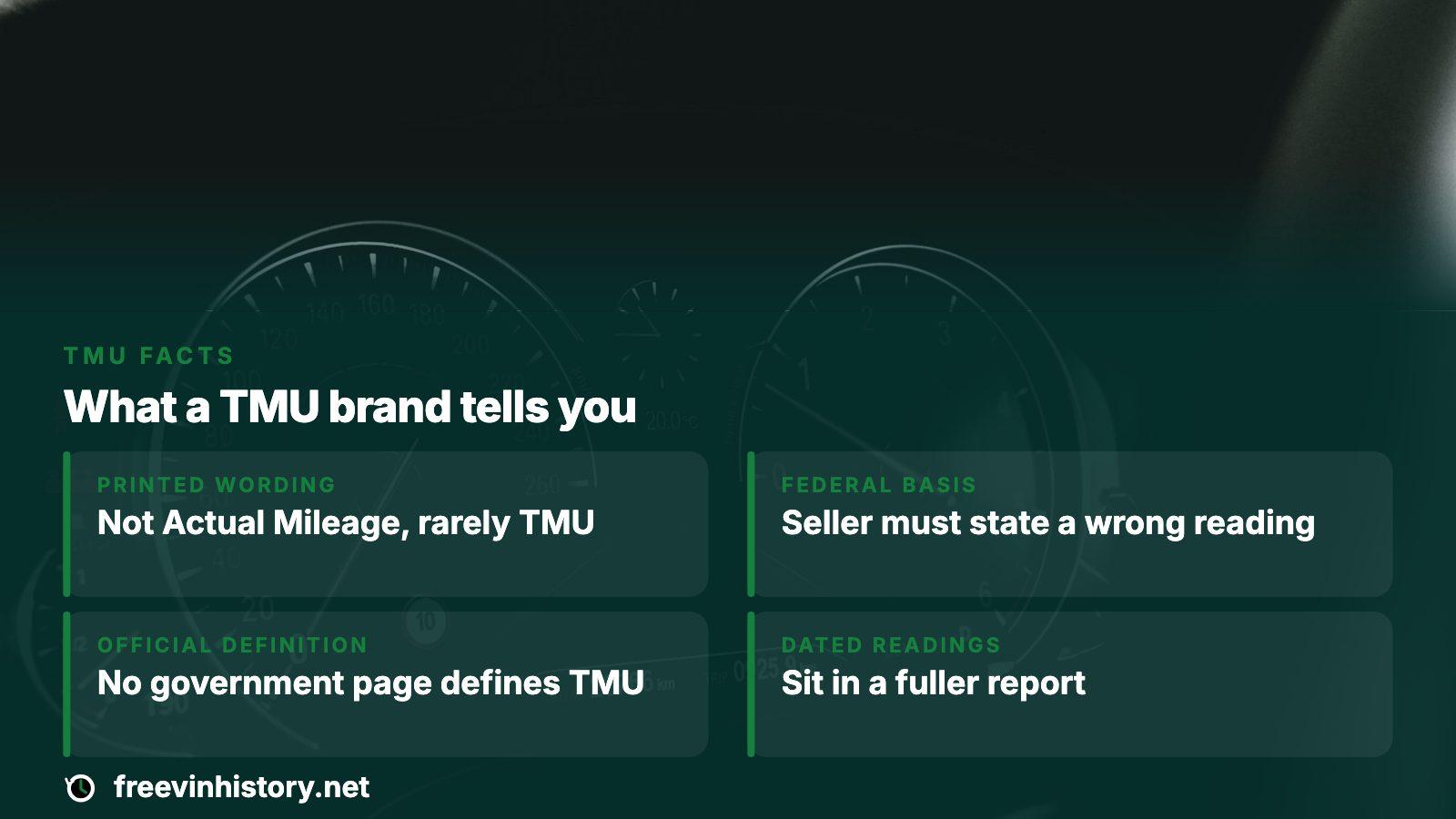
- Titles usually print Not Actual Mileage rather than the letters TMU
- Federal basis
- Where the seller knows the reading is wrong, the title must carry a written statement to that effect
- Official definition
- No government page I opened defines the abbreviation itself
- Free step
- Official pages explain the brands; the dated readings sit in a fuller report
What a TMU brand actually says
Think of it as a disclaimer stamped on the mileage. The title, or the records behind it, tells the next buyer that the figure shown may be lower or simply different from the distance driven. It does not give you the real figure, and it does not name a culprit.
The abbreviation is dealer and auction slang. I could not find any federal or state page that spells out the letters, so I will not pretend there is an official definition. What government pages do describe is the underlying idea: a reading that is known or believed to differ from true mileage.
What the title itself prints
Texas publishes a helpful table that pairs each national title-system odometer brand with the wording a Texas title carries. Several different situations collapse into one printed phrase, Not Actual Mileage, which is why the phrase alone is a blunt instrument.
| Brand behind the title | What the state says it means | Printed on a Texas title |
|---|---|---|
| Not Actual | Reading is known to be other than the true mileage | Not Actual Mileage |
| Tampering Verified | Known to be wrong because of tampering | Not Actual Mileage |
| May Be Altered | Titling office has reason to think the odometer was altered | Not Actual Mileage |
| Odometer Replaced | The unit is not the one installed at the factory | Not Actual Mileage |
| Discrepancy | Reading conflicts with earlier recorded values | Not Actual Mileage |
| Exceeds Mechanical Limits | Gauge cannot show every mile driven | Mileage Exceeds Mechanical Limits |
Other states word things differently, so check your own titling agency for its exact phrasing.
Causes, from harmless to alarming
The mildest case is a gauge that rolled past its maximum display. Federal rules treat that as its own statement, mileage exceeds mechanical limits, separate from the not-actual one. Next comes a replaced instrument cluster, common after a failure, where a record of the old reading may or may not exist.
At the far end sits deliberate tampering. NHTSA defines odometer fraud as disconnecting, resetting or altering the device to change the miles shown, and it estimates more than 450,000 vehicles are sold yearly with false readings. A digital display with no visible moving parts is, in the agency's words, even harder to catch than a mechanical one.
Same label, different stories
One car wears the brand after an honest cluster swap with paperwork in the glovebox. Another wears it because a prior reading was higher than a later one. You cannot tell them apart from the word on the title, which is exactly why the next sections matter.
What federal law requires the seller to put in writing
At transfer, the seller signs a mileage statement tied to the title. It carries the reading, the date, both parties' printed names and addresses, and the vehicle's identity including the VIN. Under the federal regulation the seller then either certifies the reading is accurate, flags that it exceeds mechanical limits, or declares that the figure is not the real mileage and carries a warning about the discrepancy.
That final option is the legal root of the Not Actual wording. A seller who knows the number is off and says nothing is breaking the law. Civil penalties can reach $10,000 per violation, and a deliberate violation can also bring criminal charges, with prison time capped at three years.
Exemptions exist. Older vehicles escape the written statement altogether: per NHTSA, that covers anything two decades old or more, and any model year through 2010. A vintage car with a blank mileage line is therefore not automatically suspect.
What you can learn for free, and where it stops
Free official pages teach you the vocabulary. Texas DMV lists the brands and how to spot a doctored odometer, NHTSA explains the fraud and who enforces it, and the federal title-information system describes the data states, insurers and salvage yards feed into it. None of those pages looks up your specific car and hands back its odometer history.
That gap is where a VIN report comes in. The free preview on this site shows whether a deeper record exists for a VIN. Bought once with no subscription, the full report sets each odometer reading next to its date, the title brands and any damage records, which shows whether a backward jump coincides with an accident or a sale. Prices are on the pricing page.
A checklist before you hand over money
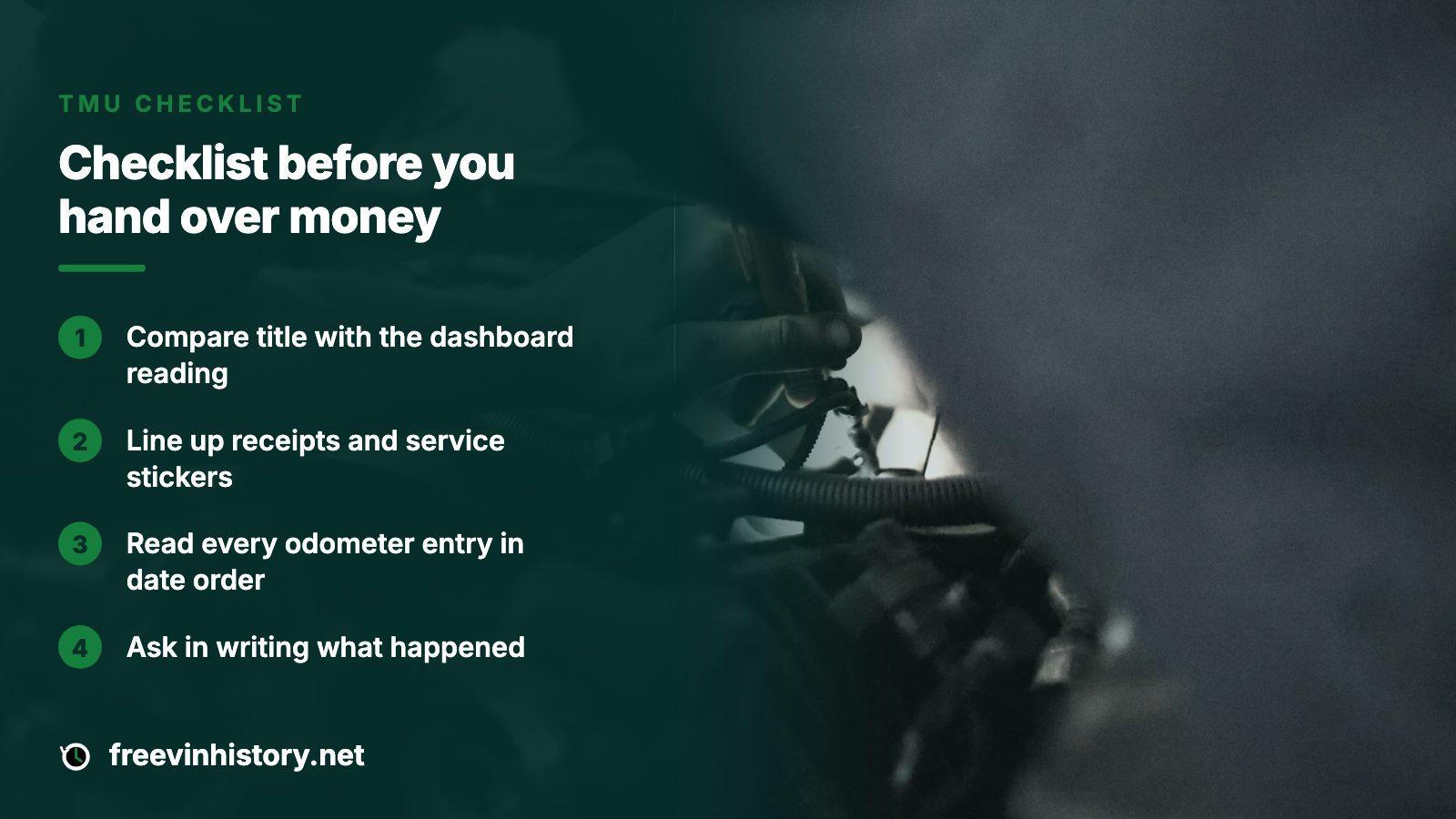
- Hold the title up against the dashboard reading, and slow down if the mileage box looks smudged or is hard to make out.
- Gather maintenance receipts, inspection paperwork and any service stickers stuck on the glass, door jamb or inside the engine bay, then set their dates and readings side by side.
- With a mechanical gauge, watch for misaligned wheels of numbers, blank gaps, or digits that rattle when you rap the dash.
- Compare tread depth and pedal rubber with the display. Low readings should come with factory tires still on the wheels.
- Run the VIN and read every odometer entry in date order, looking for a figure that drops.
- Ask in writing what happened to the odometer and request invoices for any cluster replacement.
Any one clue can be innocent. Several that disagree with each other deserve a walk-away or a steep discount.
Pricing the risk and choosing the next step
I did not find a government figure for how much a Not Actual brand lowers resale value, so any percentage you see quoted online is unsourced. The practical logic is simpler: you are buying a car whose wear cannot be judged from its display, so every wear part, from brakes to suspension, needs inspecting as if the miles were high.
If you suspect fraud, an individual case goes to your state enforcement agency. Tips about big multi-car schemes can go to the agency's Vehicle Safety Hotline. It cannot chase refunds on a single buyer's behalf, so for your own money a lawyer of your choosing is the route NHTSA points to.
Where this information comes from
- Texas DMV: Odometer Brands — Brand-by-brand table and the wording Texas prints, plus detection tips.
- NHTSA: Odometer Fraud — Fraud definition, estimate, disclosure exemptions and who to contact.
- 49 CFR 580.5: Disclosure of odometer information — What the seller's signed statement must contain and the three certification options.
- 49 USC 32709: Penalties and enforcement — Civil and criminal penalty ranges for violating the odometer chapter.
- NMVTIS: Consumer information — What the federal title system reports and which entities supply its data.
Sources and photos: Facts checked against the sources above in November 2026. Photos by Carrie Allen www.carrieallen.com, Mustafa Sheikhmouss and Viktor Theo on Unsplash; diagrams by FreeVINHistory.
Keep reading
- Not actual mileage meaning: what the title brand tells a buyerThe title's own wording for the same warning, explained line by line.
- Exceeds mechanical limits meaning: what the odometer box tells a buyerThe milder odometer statement, for gauges that ran out of digits.
- Free odometer check by VIN: what you can verify before you payWhat free sources can show about mileage before you pay for a report.
- Title issue reported on a car's history: what it can meanAnother title entry that calls for questions before a purchase.
Frequently asked questions
Does a TMU brand mean the car also has a salvage brand?
No. A salvage brand describes damage or a total loss, while TMU concerns the odometer reading only. A car can carry both, or neither. Check the brand history separately, because a mileage warning says nothing about crash or flood damage.
Can a TMU brand be removed from a title?
I found no official page that promises removal. Some states offer a correction process when a mileage entry was a clerk's error, and that needs proof, such as records showing the true figure. Ask your titling agency, not a seller or a blog, whether your case qualifies.
Does TMU mean the odometer was rolled back?
Not necessarily. The brand can come from a replaced cluster, a gauge that hit its display limit, or an earlier reading that conflicts with a later one. Tampering is one possible cause, so ask the seller to document what happened rather than assuming the worst.
Can I still get a loan or insurance on a TMU car?
I could not confirm lender or insurer rules from an official source. Policies vary, so call your lender and insurer with the VIN before you sign. A seller telling you it will be fine is not evidence.
Will a free VIN check show TMU?
Free official pages explain odometer brands but do not return one car's odometer history. A fuller VIN report lists dated readings, which is where a drop or a gap becomes visible. The preview here is free; the report is a single paid purchase.
Now check the car itself
The guide explains what to look for. The report shows what this VIN has on record.